 wedding
- How it works
- Pricing
- Reviews
- FAQ
- QR Code TemplatesBuilt-in QR code templates you can customize and download right from your dashboard, no design tool needed.Unlimited Photos & VideosNo limit on the number of photos & videos, up to 30MB per photo and 100MB per videoLong-term Album StorageYour shared album stays stored for 6 months to 2 years depending on plan, with a ZIP download of all your memoriesUnlimited GuestsNo need to worry about guest count. Unlimited uploadsNo App Download NeededNo need to download an app. As long as you are connected to the internet, you can use Pix WeddingNo Guest Login RequiredGuests don't have to log in to upload. They can simply Scan and UploadPrivate QR Code for WeddingUnique and private QR Code for Wedding. Privacy settings to disallow guest view/downloadFilm Roll ModeA digital disposable camera: photos stay hidden until the reveal moment you set, with an optional shot limit per guestAudio GuestbookGuests record voice messages with their photos, with guest name tracking so you know who sent whatPhoto MissionsPhoto challenges or a personal photo bingo card for every guest, with a live leaderboard on the venue slideshowAI Selfie SearchGuests take one selfie and instantly see every photo they appear in. Face data stays private to your eventLive SlideshowGuest uploads appear on a TV or projector at the venue in real time, right from the browserPhotographer Upload LinkA private link for your pro photographer, their shots land in a separate album inside the same gallerySub-AlbumsSplit your gallery into up to 6 sub-albums like ceremony and reception, all under one QR code
 Wedding Photo Sharing, Built for Ireland
Wedding Photo Sharing for Irish Weddings
An Irish wedding day does not end when the band packs up. One QR code keeps collecting guest photos from the church steps to the residents' bar sing-song, no app, no faff, no one left holding forty phones full of photos nobody ever sees.
Start Your Free AlbumThe short answer
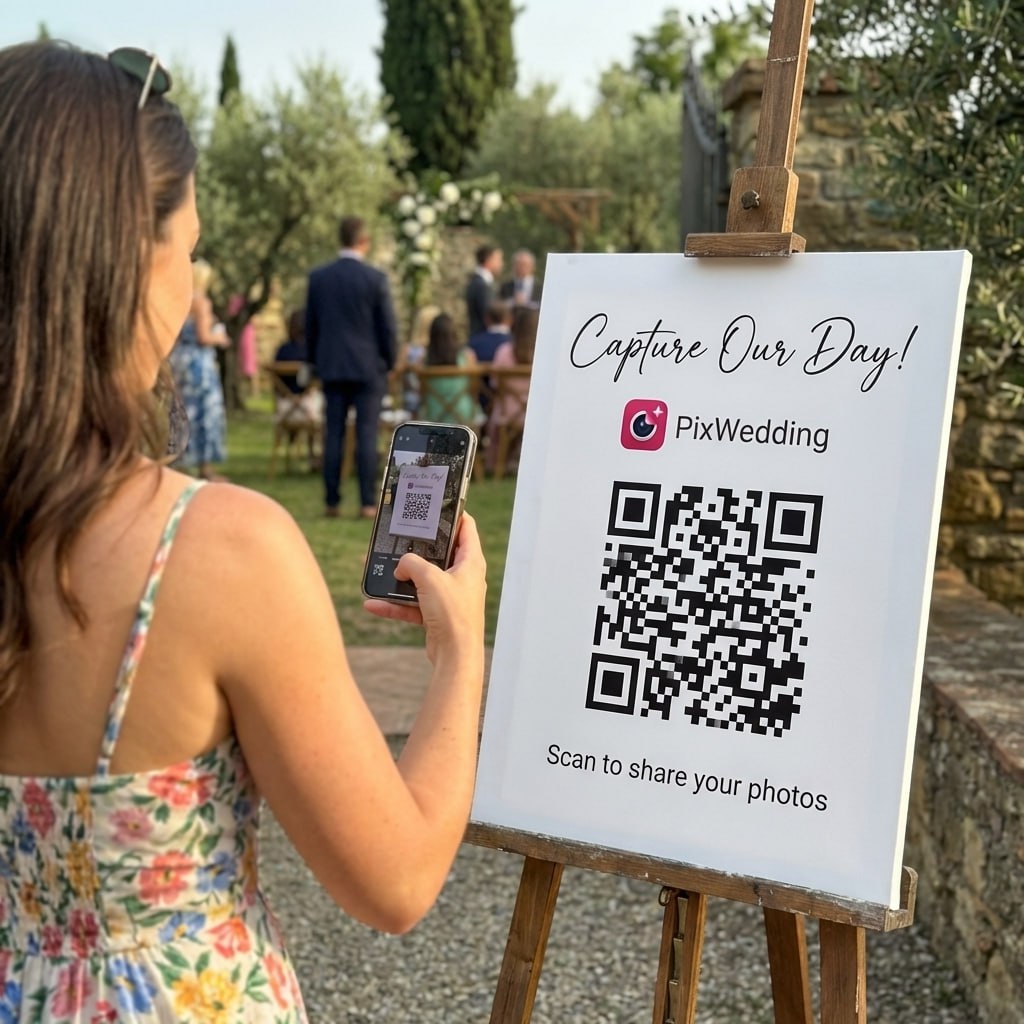
Put a QR code on your tables, your welcome sign, and your order of service. Guests scan it with their phone camera, upload straight through their browser, and every photo lands in one shared album, from the ceremony through to whoever is still standing at the residents' bar at 4am. Pix Wedding is free to start with 20 guest uploads, then a single one-time payment from €35 removes the cap. No app, no account, no subscription.
The Shape of an Irish Wedding Day
An Irish wedding is a long day by any international standard, and that length is exactly why photos scattered across dozens of phones are such a waste. Guest photo sharing works best when it maps onto the day's actual timeline, not a generic checklist.
1. Church or civil ceremony, early afternoon
Most Irish ceremonies start around 2pm, with a civil ceremony typically wrapping by 3pm and a church ceremony running to roughly 3:15pm. Guests arrive at the reception venue by around 4pm. Getting-ready shots, the ceremony itself, and confetti outside the church or registry office happen before your photographer's clock has even hit the halfway mark.
2. Drinks reception, the longest stretch of the day
This is where most of your photographer's formal group shots happen, and it is also where guests scatter across a hotel garden, a courtyard, or a marquee lawn in small groups. None of those candid conversations make it into the official album unless a guest's own phone catches them.
3. The meal and the speeches
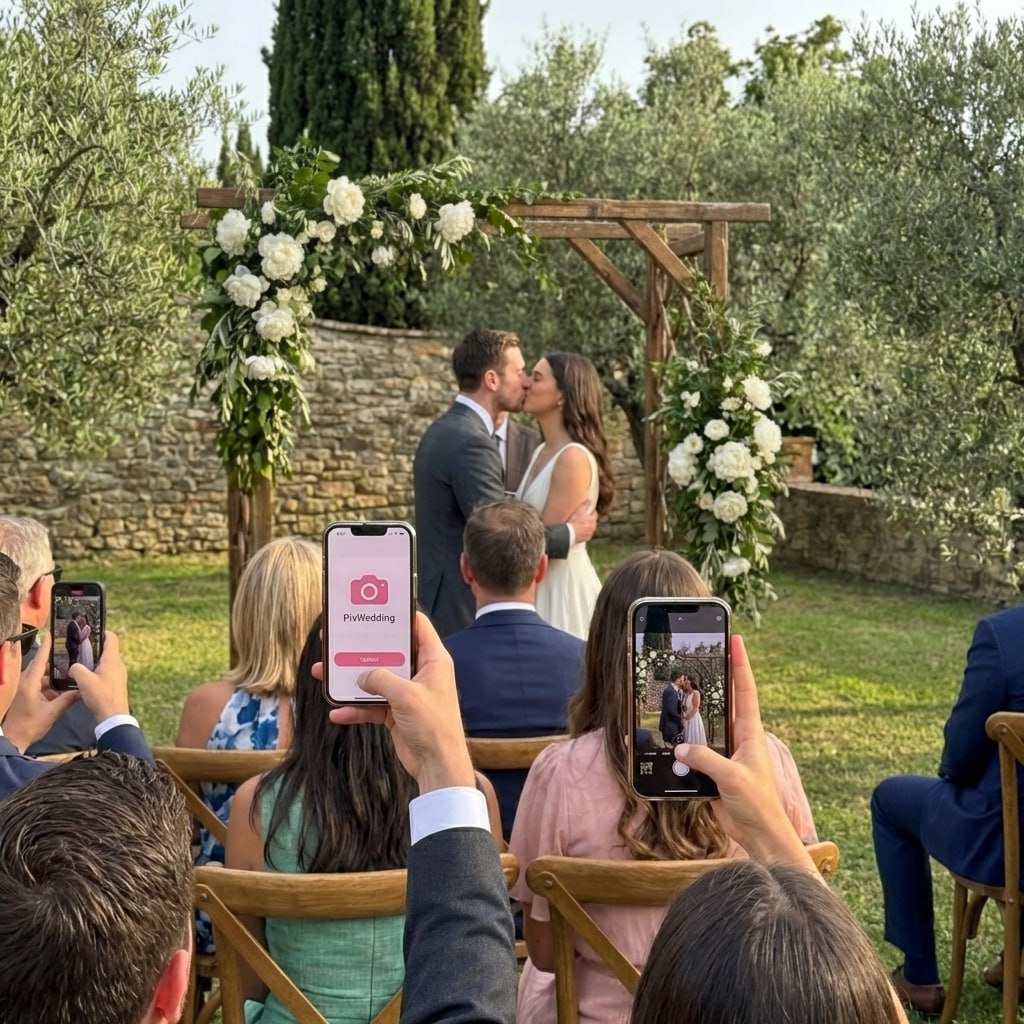
Phones come back out for the top table, the speeches, and the first dance. A QR code on the table centrepieces means every guest at every table can upload their view of the speeches, not just the one your photographer is standing in front of.
4. The band, then the DJ
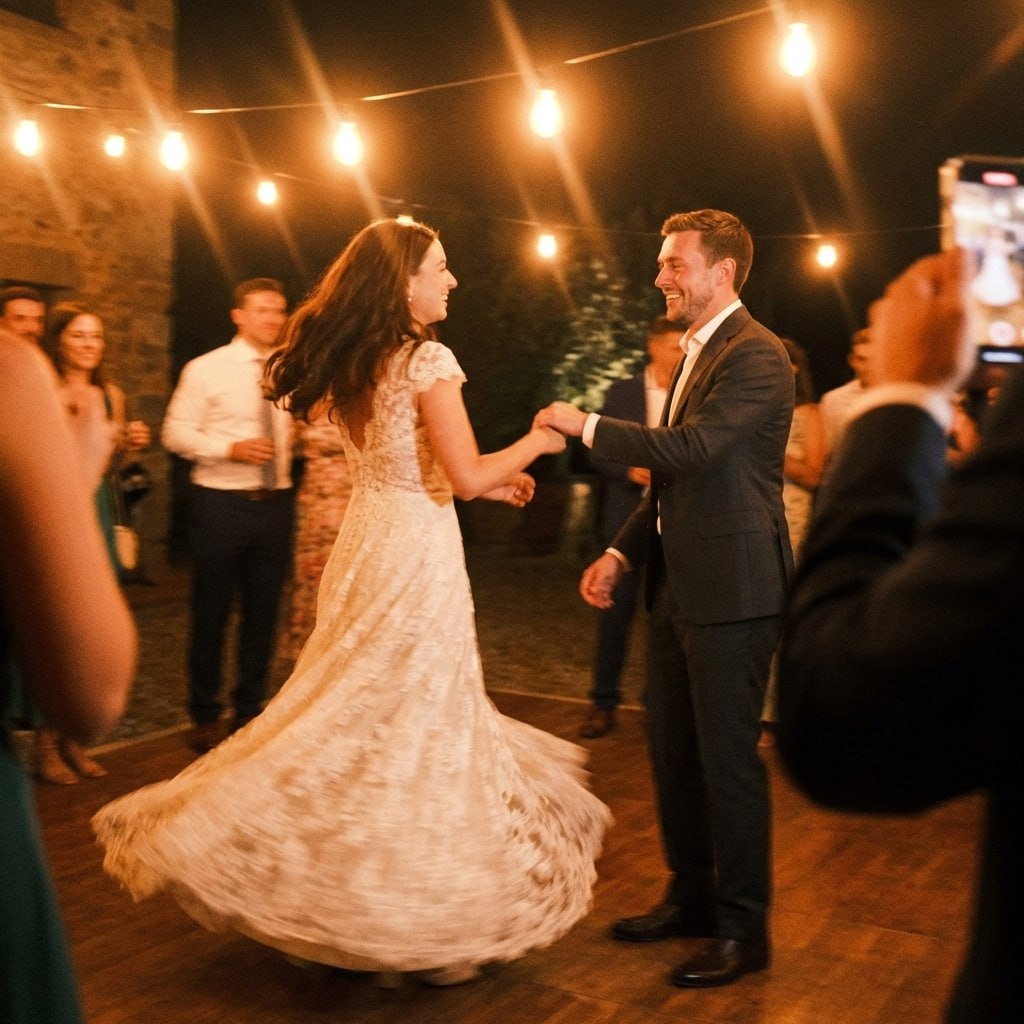
A wedding band typically plays a set of around two and a half hours from roughly 9:30 or 10pm, and a DJ takes over for another two hours or so after that, running the dance floor into the small hours. Your photographer is usually booked to leave well before the DJ finishes, which is exactly when the dance floor photos get wildest.
5. The afters and the residents' bar
When the DJ finishes, a hotel wedding often has one more act left. Guests staying overnight can keep drinking in the hotel's residents' bar, which is not bound by normal pub closing time, and it is not unusual for an impromptu sing-song with a guitar, a banjo, or a tin whistle to carry the night on until 4 or 5am. Nobody is professionally photographing this part of the night, and it is often the part people talk about for years.
6. The next morning, breakfast, and comparing photos
Hotel weddings usually mean a shared breakfast the next morning where the wedding party and out-of-town guests compare notes on the night before. This is the natural moment guests most want to see everyone else's photos, and it only works if those photos already landed in one place overnight instead of sitting on forty separate phones that are already scattering to airports and train stations.

First dance
You guys!!
One QR code, every hour of the day
Set it up before the ceremony and it keeps collecting through the band, the DJ, and the residents' bar, right up until breakfast.
From Mom
Scan to join the album
No app, no account
UPLOADING
Saving your moment
THE ALBUM
Emma & Jack
June 21, 2026
647 photos · 95 guests



SCAN TO TRY
pix.wedding/
your-wedding
Who Is Going to Upload These at 2am?
This is the honest question every couple should ask before picking a photo collection method. Nobody wants to be the guest fumbling with a login screen at 2am after three pints and a round of shots. The whole point of a QR code that opens straight into a browser is that it asks nothing of a tired guest beyond a scan and a tap.
Works late at night
- Scan with the phone camera, no app store detour
- No password to remember or type with cold fingers
- Upload queues automatically if signal drops mid-song
- Works for a 70-year-old aunt and a 12-year-old cousin alike
What tends to fail instead
- A shared WhatsApp group nobody remembers to post to
- An app guests were meant to download beforehand and did not
- Disposable cameras left on tables that get forgotten in a car
- "Just email me your photos" asked at the bar and never followed up on
See It Working, Not Just Described
This is the real Pix Wedding album, not a mockup. A guest scans the QR code, uploads a photo from their camera roll or takes one on the spot, and it appears in the shared gallery within seconds, whether that guest is in a Dublin hotel ballroom or a marquee outside Galway.
Try It With Your Own PhotoVenue by Venue: What Changes
Irish weddings happen across a wide spread of venue types, and each one changes how and where you place your QR codes.
Castle hotels in the west
Thick stone walls and rural locations can weaken mobile signal in bedrooms and function rooms even where outdoor coverage is fine. Place a QR code near the bar and in the main reception room, where hotel WiFi tends to be strongest, rather than only out on the grounds.
Country house and estate venues
Outdoor ceremonies and marquee receptions on estate grounds often sit further from the nearest mast than a hotel in town. A browser upload handles this gracefully: it queues the photo and sends it the moment the guest wanders back within range of signal or the marquee's WiFi point.
City centre hotels
Weddings in Dublin, Cork, Galway, and Limerick city centres generally sit on the strongest coverage in the country, so the only real job is getting the QR code in front of guests early, on the table plan and the welcome sign, before the room gets loud and phones get put away.
Rural Signal, and What Happens When It Drops
Ireland's countryside is genuinely patchy for mobile coverage in places, and a wedding out past a small town or up a coastal road is no exception. According to network comparison guides from smartsaver.ie and suss.ie, Eir generally has the strongest rural coverage in Ireland, inherited from the old Telecom Éireann network built to reach even remote farms, with Vodafone a step behind and Three sometimes weaker in the most remote spots. All three networks now support WiFi calling as a backup when the mobile signal itself is weak.
What this means for a browser upload
A guest does not need a strong signal at the exact moment they take a photo. They only need enough signal at some point before the upload window closes. A modern phone browser holds the photo locally and retries the upload once it finds a connection, whether that is a bar of Eir coming back on the drive home or the venue's guest WiFi picked up at the bar. This matters far more at a rural Irish wedding than it does in a city centre hotel, and it is exactly the failure mode a QR-and-app combination handles worse: an app that requires a login at the moment of upload is far more likely to be abandoned by a guest with two bars of signal than a browser tab that quietly retries in the background.
Privacy and GDPR for Irish Weddings
A private wedding album, set up by the couple and shared only with their own guest list, generally sits under the GDPR's "purely personal or household activity" exemption (Article 2(2)(c)), which is the same principle Ireland's Data Protection Commission points to when explaining that taking photographs in public is not itself a data protection issue. What can turn it into one is what happens next: publishing a guest's photo publicly on social media, or using it commercially, moves you outside that personal exemption.
In practice, that means a Pix Wedding album kept private and shared only with your guest list stays firmly in the personal-use category couples are used to. If you plan to repost highlights publicly afterwards, it is good manners, and good practice, to let guests know in advance or check with anyone whose face is clearly the focus of a shot.
What an Irish Wedding Costs
According to weddingsonline's 2025 Irish Wedding Survey, based on responses from over 1,000 couples collected in December 2025, the average Irish wedding now costs €36,641 excluding the honeymoon, up 6.5 percent on the previous year.
| Metric | 2025 figure |
|---|---|
| Average total wedding cost | €36,641 (excluding honeymoon) |
| Average number of guests invited | 141 |
| Average venue spend (excluding accommodation) | €15,087 |
| Average meal price per guest | €107 |
| Couples who booked suppliers on reviews and recommendations | 54% |
Source: weddingsonline.ie, "The 2025 Irish Wedding Survey Report", based on a December 2025 survey of 1,014 couples.
With the venue alone averaging over €15,000, professional photography is one line item couples are careful not to overspend on. Guest photo sharing does not compete with that budget line, it adds to it. A 141-guest wedding with even a fraction of guests uploading photos can easily produce several times what a photographer delivers, at no extra cost per guest.
How Irish Couples Currently Collect Guest Photos
A handful of QR-based photo apps circulate at Irish weddings. One worth naming is takeNplace, a wedding photo-sharing platform built in Cork by Valda and Brad Binding, which won weddingsonline's Newcomer of the Year award in 2023. It uses the same no-app, scan-and-upload model and adds a moderated live slideshow feature, with packages starting from €59. Beyond that, global QR photo-sharing apps such as GuestPix, GuestCam, Kululu, Wedibox, and WedUploader also turn up at weddings worldwide, including in Ireland, each with its own take on the same basic idea: scan a code, upload a photo, skip the app store.
What most of these apps share
- No app download required for guests
- A scan-to-upload flow through the phone's browser
- A private gallery the couple can share and download after
Where Pix Wedding differs
- A genuine free tier, 20 guest uploads, before any card is asked for
- One flat one-time price from €35, unaffected by guest count
- No subscription, nothing renews once the wedding is over
- Full-resolution downloads with no watermark on any plan
takeNplace details sourced from the Irish Times (April 2024), echolive.ie, and takeNplace's own weddingsonline supplier listing. Always confirm current pricing directly with each provider.
Free to start, one flat price after that
Start with 20 free guest uploads and your QR code, no card required. When you are ready for unlimited guests and full-resolution downloads, plans start from €35 as a single one-time payment, not a subscription.
See Plans and Start FreeCommon Mistakes That Lose Photos at Irish Weddings
- Only placing the QR code at the ceremony. Most photos happen at the reception, not the church steps. Print the code again for every table and the dance floor area.
- Setting up the album the week of the wedding. Printing takes time, and a QR code that only appears on the day itself gets far less use than one seen on the invitation or wedding website beforehand.
- Relying on a WhatsApp group. Group chats bury photos under replies within hours and nobody goes back to download the full-resolution originals afterwards.
- Forgetting the residents' bar entirely. If your upload window quietly closes when the DJ finishes, you miss the sing-song, and that is often the part of the night people remember most fondly.
- Assuming an older relative will not bother. A camera-only scan with no login has no real age barrier. The friction is usually in the setup, not in the guest.
When QR Code Photo Sharing Makes Sense
Makes sense if
- Your day runs long, church or civil ceremony through to the afters
- You have guests staying overnight for a residents' bar night
- Your photographer is booked for a set number of hours, not the whole night
- You want one organised album instead of chasing photos from forty phones
Less useful if
- You are having a very small, intimate elopement with no reception
- Every single guest is already in one tight group chat you trust
- You are happy relying entirely on your photographer's coverage
Why an Irish Wedding Needs a Photo Plan, Not Just a Photographer
Most Irish couples book a photographer for six to eight hours, and a rough eight-hour block rarely covers a day that starts with getting ready photos at 11am and does not properly finish until the residents' bar empties out at 4 or 5am. Everything the photographer misses, from the drinks reception chats to the last sing-song, only exists because a guest happened to have their phone out.
A QR code photo album does not replace your photographer. It catches the hours they are not booked for and the angles they cannot be in at once, then puts every guest's photos into one place instead of forty separate camera rolls that never get shared.
- •Works at church ceremonies, civil ceremonies, hotels, castles, and marquees alike
- •No app download, guests scan and upload straight from their phone's browser
- •Photos land in one private album you and your photographer can both draw on
- •Keeps collecting all the way through the band, the DJ, and the afters
- •A free tier means you can test it before committing to anything
Setting It Up Before the Day
Create the album and QR code as soon as your venue is booked, not the week before. Print it on the order of service, the table plan, a welcome sign at the ceremony, and a card on every table at the reception. The more places guests see the code, the earlier they start using it, and the more they upload before the drink starts flowing and phones go into pockets for the meal.
Ask your MC, best man, or bridesmaid to mention the code once during the speeches and again as the band comes on. A single spoken reminder at the right moment does more than any amount of printed signage on its own.
Explore more free wedding tools
Everything you need to make your wedding day stress-free and unforgettable.
QR Sticker Designer
Design custom print-ready stickers.
Hashtag Generator
Create unique wedding hashtags.
How to Collect Guest Photos
5 methods ranked by participation rate and ease.
Share Wedding Photos with Guests
Compare every sharing platform by ease and participation.
Best Way to Get Guest Photos
The single method with the highest participation rate.
How to Make a Shared Wedding Album
Step-by-step setup for every platform.
Alternative to Disposable Cameras
Better, cheaper options than disposable cameras.
Alternative to Wedding Photo Booth
5 cheaper alternatives to a $1,000+ photo booth rental.
Wedding Photo Sharing in Ireland FAQ
Straight answers to the questions people ask most about this topic.
It works wherever a guest has any signal or a WiFi connection, which covers the great majority of Irish wedding venues. Coverage in Ireland is generally strongest with Eir, followed by Vodafone, with Three sometimes weaker in remote rural spots (per smartsaver.ie and suss.ie's 2026 network comparisons). If a guest has no signal at all, the upload simply queues in their browser and sends the moment they pick up a bar of signal or the venue's guest WiFi, so nothing is lost, it just arrives a little later.
Weddingsonline's 2025 Irish Wedding Survey, based on over 1,000 couples surveyed in December 2025, put the average Irish wedding at €36,641 excluding the honeymoon, with couples inviting an average of 141 guests and spending around €107 per head on the meal. Guest photo sharing adds hundreds of extra candid shots from every angle at zero extra cost, which matters most on a budget where the venue alone averages over €15,000.
No. Guests scan the QR code with their phone's own camera, which opens a page in their browser where they can upload straight away. There is no app store visit, no account, and no password, which matters at a wedding where guests range from a ten-year-old cousin to a granny who has never used a QR code before.
Yes. The album and QR code stay live for as long as you set the upload window, and there is no cut-off at midnight or when the band finishes. Whoever is left standing for the residents' bar sing-song can still scan and upload from their phone at 3 or 4am, and those photos land in the same album as the ceremony shots.
A private wedding album, set up by the couple and shared only with their own guests, generally falls under the GDPR's personal or household activity exemption (Article 2(2)(c)), as confirmed in the Irish Data Protection Commission's own guidance on photography. That exemption applies to how you, the couple, collect and share the photos privately. It stops applying the moment photos are posted publicly or used commercially, which is worth keeping in mind if you plan to share album photos on social media afterwards.
Pix Wedding is free to start, with 20 guest uploads and no card required, so you can test the QR code before committing to anything. If you need more, a single one-time payment from €35 removes the guest upload cap entirely, with no subscription and nothing that renews after the wedding.
Wedding Photo Sharing in Other Countries
Compare Pix Wedding to other apps
Still researching? Here is how Pix Wedding stacks up against the other major wedding photo sharing platforms.
First dance
You guys!!
Every phone in the room becomes a photographer
From the church steps to the residents' bar at 4am, one QR code catches what your photographer's contract hours never could.
From Mom
Scan to join the album
No app, no account
UPLOADING
Saving your moment
THE ALBUM
Emma & Jack
June 21, 2026
647 photos · 95 guests
SCAN TO TRY
pix.wedding/
your-wedding