QR Codes for Weddings: 16 Ideas and Where Each One Goes
Discover 16 QR codes for weddings, from RSVP and programs to the wishing well and live slideshow, with where each code goes and what it links to.
11 min readUpdated Sep 22, 2026Pix Wedding Team
The short version
QR codes for weddings work best when each one does a single job at the moment guests need it: the wedding website and RSVP before the day, a digital program and livestream at the ceremony, photo uploads and menus at the tables, song requests and a live slideshow on the dance floor, and the shared album on the thank-you card. Keep gift codes off the invitation, and keep the total number of distinct codes small.
A QR code is only a link your guests can open with a phone camera. That sounds modest, but it removes the one thing that makes weddings clunky for guests: typing. Nobody types a 40-character RSVP address from a paper card, and nobody asks the planner where the shuttle leaves if the answer is on the back of their place card. The ideas below are grouped in the order guests meet them, from the envelope to the thank-you note, with a line on where each code goes and what it should open.
If you only need one code for guest photos and want the technical side (size, printing, testing), our wedding QR code for photos guide covers that step by step. This page is the wider menu.
1Before the Wedding: Save-the-Dates, RSVP and Travel
Paper goods sent months ahead have one weakness: plans change after they are printed. A code that opens your wedding website solves this, because you can update the website while the card stays the same.
1. Save-the-date that opens your wedding website
Where it goes: the back of the save-the-date, small and tidy. What it opens: the home page of your wedding website, where the date, city and hotel information live. This is the code that saves you the most follow-up texts, since every later question has one place to point to. Guests keep save-the-dates on the fridge for months, so the address must stay live until after the wedding.
2. RSVP form on the invitation
Where it goes: the invitation or a small details card, with the reply-by date printed next to it. What it opens: your RSVP page, either on the wedding website or a form that collects names, meal choices and dietary needs in one go. Keep a printed option or a phone number for relatives who prefer it. Our free wedding RSVP tracker keeps the answers in one list, and the invitation wording generator has lines that introduce the code politely.
Turning the RSVP card into a QR code
A walkthrough from a form-builder company showing how wedding QR codes work and three steps to move RSVPs online with free tools. It is a useful model for idea 2, whatever form tool you pick in the end.
Where it goes: a travel insert or the back of the details card, useful for destination weddings and out-of-town guests. What it opens: the booking link for your room block, airport notes and a map. Hotel booking links are long and full of codes, so this is where a QR earns its place over a printed address.
4. Registry, through the website and not the invitation
This is the idea couples most often get wrong. Emily Post's wedding registry etiquette says registry details do not belong on the invitation, and suggests sharing them by word of mouth and on the wedding website. The polite QR version is indirect: the invitation code opens your website, and the registry sits one tap away in the menu. Shower invitations are the traditional exception, where the host can include registry details.
2At the Ceremony: Programs, Livestream and a Quiet Photo Note
Ceremony codes should be glanced at before the processional and then forgotten. Put them where guests wait, not where they should be watching.
5. Digital ceremony program
Where it goes: a sign at the ceremony entrance or on each chair. What it opens: the order of service, the wedding party, readings, song lyrics and a line about anyone you are remembering. A digital program cuts printing and lets you fix a typo the night before. Keep a handful of printed copies for guests who want a keepsake or do not carry a phone.
Building a digital program and its QR sign
A stationery designer walks through making a digital wedding program, the matching QR code sign and the code itself, pitched as a budget-friendly option. Watch it for the layout ideas, then check the code on two phones before printing the sign.
Where it goes: this one is for the people who are not there, so put it in the email or card you send to remote guests, and on the website. A code on a sign at the venue helps guests share the link with a grandparent at home. If you plan to stream from a phone on YouTube, check the rules early: YouTube's help page lists at least 50 subscribers, a verified channel and a possible 24-hour wait before the first mobile live stream. A video call link or a streaming service your videographer already uses avoids that hurdle.
7. A photo note that waits until after the vows
If you are asking for an unplugged ceremony, the ceremony sign can do double duty: phones away now, and a code for sharing photos later at the reception. It turns a rule into an invitation. For the wording and the tradeoffs, see unplugged wedding vs photo sharing.
3At the Tables: Photo Uploads, Menus and Seating
Dinner is the longest stretch of the day when guests sit still with their phones nearby, which makes the tables the best real estate for any code you want scanned. Give the photo code the most space.
8. Guest photo and video upload
Where it goes: a table card on every table, plus the bar and the photo booth. What it opens: an upload page where guests add photos and videos straight from the browser. This is the idea most couples come for, and the one where the choice of service matters most. A good photo code opens without an app or an account, accepts video, and points to an address that will not stop working after a trial. Our app comparison checks upload caps, storage and price, and the guide on where to put the QR code covers placement in detail. If you only need the code itself, the free wedding QR code for photos generator makes one for your album in a minute.
What to expect in numbers: across 203 real weddings on Pix Wedding, the median album collected 149 guest photos from 8 uploaders (upload statistics). Most photos come from a small group of keen guests, so a code at every table matters more than one big sign by the door. To see the guest side, open the demo upload page on your phone.
Before you pick a photo QR service, check that
First dance
You guys!!
One code for the tables, every photo in one album
Create a Pix Wedding album and put its QR on every table card. Guests upload from the browser, no app or account. Free for 20 guest uploads with no card, one-time plans from $49 for unlimited photos and videos.
Where it goes: the back of the table number, or a small card by the bar. What it opens: the dinner menu with allergens marked and the signature cocktails with their ingredients. Guests with allergies can check quietly without flagging down staff. Print one paper menu per table anyway, since this code is a courtesy, not a replacement for telling your caterer about allergies. Build the page with the free wedding menu builder.
10. Seating chart finder
Where it goes: next to the printed seating chart at the entrance, for large weddings where guests crowd the board. What it opens: an alphabetical list of names and table numbers. Keep the printed board as the main display, the code only relieves the queue. Plan the chart itself with the free seating chart planner.
4On the Dance Floor: Song Requests, Slideshow and Photo Games
Evening codes are about joining in. They work when the result is visible: a song comes on, a photo appears on the screen, a team climbs a leaderboard.
11. Song request form
Where it goes: a sign by the DJ booth or on the bar. What it opens: a short form that sends requests to your DJ or band. Ask your DJ first, many have their own request system and a view on how much guest input the set can take. Add a line about the songs you have vetoed so nobody is disappointed. Start the must-play list with the free wedding playlist builder.
12. Live photo slideshow
Where it goes: the same code as your table cards, with a sign by the screen that says what happens when you upload. What it opens: your upload page, while the photos play on a screen or projector at the reception. A QR code slideshow gives guests an instant reason to share, because they see their picture on the wall within moments. On Pix Wedding the live slideshow comes with the Standard plan and runs from the album guests already upload to, so there is no second code to explain.
13. Photo missions, bingo and scavenger hunts
Where it goes: a mission card on each table. What it opens: a list of photo prompts, such as the oldest guests on the dance floor or the best toast face. Games give quieter guests a reason to pick up the phone. The Pix Wedding Standard plan includes photo missions with a leaderboard, and the free wedding photo bingo generator prints a paper version.
5The Wishing Well and Cash Gifts: Handle With Care
The QR code wedding wishing well is a popular search for a reason. Fewer guests carry cash or checks, and couples saving for a house or a honeymoon want an easy way to receive gifts. It is also the code that can feel pushy if it shows up in the wrong place.
14. Wishing well or honeymoon fund code
Where it goes: a small, framed sign beside the card box or wishing well, and the registry page of your website. What it opens: your cash fund page, or a payment profile. With Venmo, each account has a personal QR code found on the Me tab, which guests scan from inside their Venmo app. Keep in mind that only guests who use that same app can pay through it, so a fund page that accepts cards reaches more people.
Feels gracious
A small sign next to the card box, matching your stationery
Wording that thanks guests for coming first and mentions gifts second
A cash fund listed on the website's registry page
A card box still available for guests who bring envelopes
Feels pushy
A payment code printed on the invitation
A payment code on every dinner table
The DJ announcing the payment code
A sign that names an amount or a target
Your Presence Is Our Present
If you would like to add to our honeymoon fund,
scan the code or leave a card in the box.
Thank you for celebrating with us.
Helping Us Build Our First Home
Having you here means the most.
For anyone who asked, this code opens our home fund.
With love, [Names]
6Logistics Codes Guests Quietly Thank You For
These codes will never appear on Pinterest, and they save more small headaches than any of the pretty ones.
15. Guest wifi, maps, shuttle and the morning after
Guest wifi
A wifi QR joins guests to the network without typing a password. Android phones can create one from the Wi-Fi settings with the Share option. It also helps photo uploads in venues with weak mobile signal.
Map and parking
For estates and resorts with several spaces, a map link on the welcome sign shows where the ceremony, cocktails and reception are, plus where to park.
Shuttle times
A code on the hotel welcome bag with the shuttle schedule and the last pickup time answers the question guests ask most at 11 pm.
Next-morning brunch
Print the brunch or after-party details behind the escort card so guests find them later, without announcing it to everyone.
Build the day's schedule once in the free wedding day timeline builder, then share that single page from the website and the welcome sign.
7After the Wedding: Thank-You Cards and the Album
16. The shared album on your thank-you card
Where it goes: inside the thank-you card, under your note. What it opens: the finished album, so guests can see the day and download the pictures they are in. It is also a second chance to collect photos from guests who forgot on the night, since many people only sort their camera roll days later. The live demo album shows what guests see. Check how long your album stays open: on Pix Wedding, uploads stay open for 3, 6 or 12 months and storage runs 6, 12 or 24 months, depending on the plan. The free thank-you note generator helps with the words above the code.
8How Many QR Codes Is Too Many?
Sixteen ideas does not mean sixteen codes. Guests stop scanning when every surface carries a code and none of them says why. A few rules keep things clear.
One code per surface
Two codes side by side on a card force guests to guess which one to scan. If a surface needs two links, point to a page that holds both.
Label every code
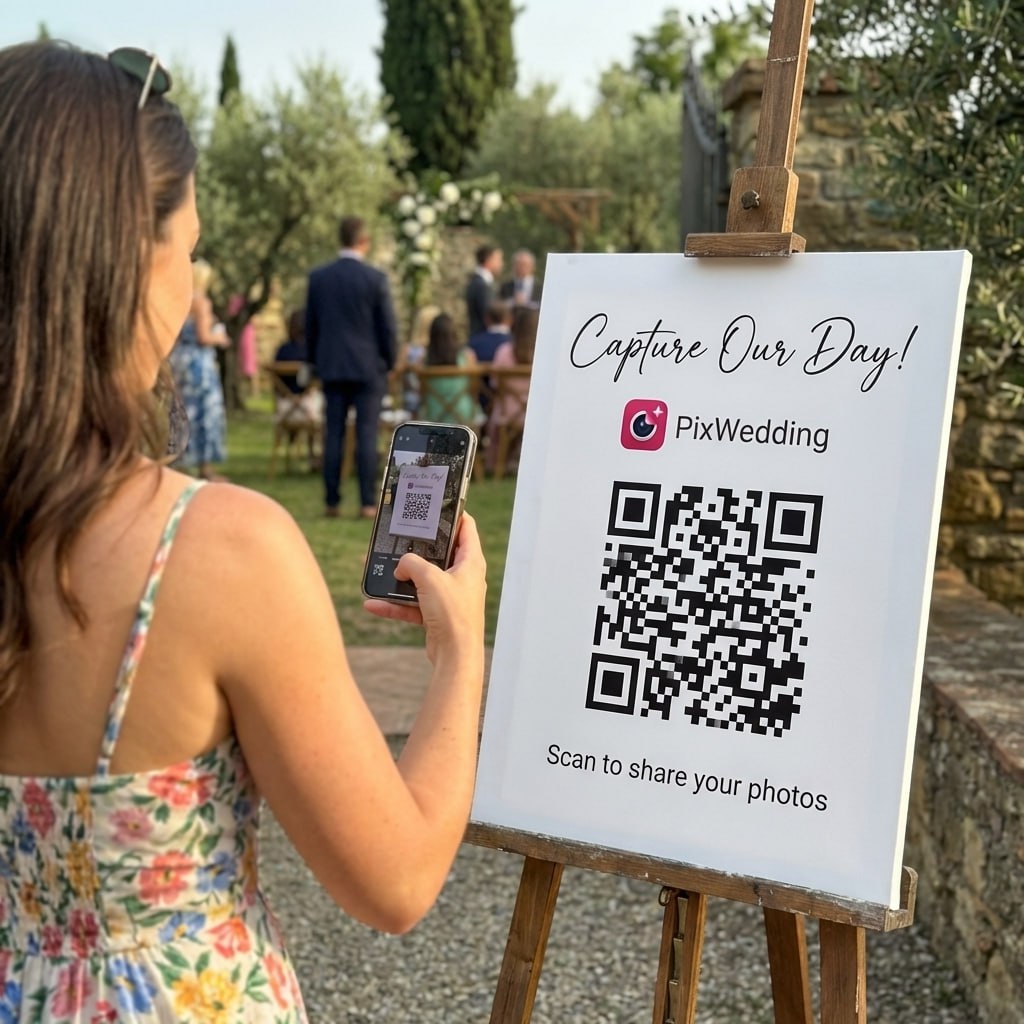
A code without a line like 'Scan to share your photos' is a gamble. The label is what gets the scan.
Keep one photo code
Use the same upload code on every table, the bar and the booth, so all photos land in one album.
Let the website carry the rest
RSVP, travel, registry and schedule can all live on the site behind one invitation code.
One master code to the website
Simple
Best for: Invitations and save-the-dates.
One link to update when plans change
Nothing to explain
Guests need an extra tap to find a detail
Works best if the website menu is short and clear on a phone.
A few codes with one job each
Focused
Best for: The reception, where speed matters.
Each code opens exactly what the sign promises
Higher scan rates for the photo code
More printing and testing
Most weddings need three or four distinct codes at most: website, program, photos and gifts.
Before printing any of them, run each code through the same test: scan from the real distance, on two different phones, on mobile data. The full routine, including sizes for each card and sign, is in the wedding QR code for photos guide. If you are still deciding whether codes suit your crowd at all, read are wedding QR codes worth it.
9Which Free Tool Builds Each Destination?
A code is only as good as the page it opens. These free tools build the destinations for the ideas above, and none needs a sign-up to try.
Pick the three or four ideas that solve a real problem at your wedding, give each one a clear label and a good spot, and let the rest go. Guests remember a wedding that ran smoothly, not how many codes it had.
FAQ
Frequently Asked Questions
What can you use QR codes for at a wedding?
The most useful wedding QR codes link to the wedding website and RSVP form, a digital ceremony program, a livestream for guests who cannot travel, a guest photo upload album, the menu and allergen list, a seating chart finder, a song request form, a live photo slideshow, a cash gift or honeymoon fund page, the guest wifi, maps and shuttle times, and the shared album on your thank-you cards.
How many QR codes should a wedding have?
Fewer than you think. Give each printed surface one code with one job, and point the invitation code at your wedding website so that one link covers RSVP, travel, registry and schedule. At the reception, the photo upload code is the one to repeat on every table. Three or four distinct codes across the whole day is plenty for most weddings.
Is it OK to put a registry or wishing well QR code on the invitation?
Traditional etiquette says no. Emily Post advises never putting registry information on the invitation itself and sharing it by word of mouth and on your wedding website instead. A cash gift or wishing well code fits better on a small sign beside the card box at the reception, or on the registry page of your website.
Can I use a QR code for a wedding slideshow?
Yes. Guests scan a code on the tables, upload photos from their phones, and the pictures appear on a screen or projector during the reception. On Pix Wedding the live slideshow is part of the Standard plan, and it uses the same code guests already scan to upload photos.
Which wedding QR code do guests scan the most?
The photo upload code at the tables, because dinner is when guests sit with their phones out. Give it the largest card and repeat it on every table, at the bar and by the photo booth. It should open in the browser with no app or account, accept videos, and keep working after any trial. To generate one, use the free [wedding QR code for photos generator](/qr-code-for-wedding-pictures).
Do QR codes on a wedding program need wifi?
Scanning the code itself works offline because the phone camera reads the pattern without a connection. Opening the linked page needs mobile data or wifi. If your ceremony site has poor signal, print the key information on the card too and use the code for extras like readings or a thank-you note.
How early should I make wedding QR codes?
Make the invitation and save-the-date codes first, three to four months before the wedding, and point them at addresses that will still work on the day. Reception signs, table cards and programs can be designed six weeks out and printed three to four weeks before, which leaves time to scan-test a proof.
 wedding