
Unplugged Wedding vs Photo Sharing: The Hybrid Approach That Wins
You do not have to pick. The 2026 best practice is a hybrid: phones down during the ceremony so your guests are present and your photographer has clear sightlines, then QR codes out for the reception so you collect every candid moment the rest of the night. The couples who try to force a single rule for the entire day end up with either blurry aisle shots or a gap in their photo archive.
Set Up Your Hybrid Photo SharingWhy Pure-Unplugged Weddings Fall Short
The fully unplugged approach - no phones at any point during the day - is well-intentioned but creates real gaps in your photo archive.
You lose the reception entirely
A single photographer cannot be everywhere across a four-hour reception. The dancing, the table conversations, the moment your college friends finally meet your work friends - none of that gets documented unless guests are capturing it. Asking guests to keep phones away all night means those moments disappear.
Guests feel policed, not celebrated
When the no-phone rule extends through dinner and dancing, some guests feel like they are being monitored rather than hosted. The rule that was meant to create intimacy starts to create awkwardness. Guests who want to remember a funny moment with a friend feel like they are doing something wrong.
You are dependent on one hard drive
If you go fully unplugged, your entire visual record of the day lives on your photographer's memory cards and backup drive. Drives fail. Cameras get stolen. Hard drives get corrupted. Guest photos are an irreplaceable backup that no professional backup strategy can fully replicate.
Why Encouraging Phones All Day Also Falls Short
Guest phones ruin ceremony photos
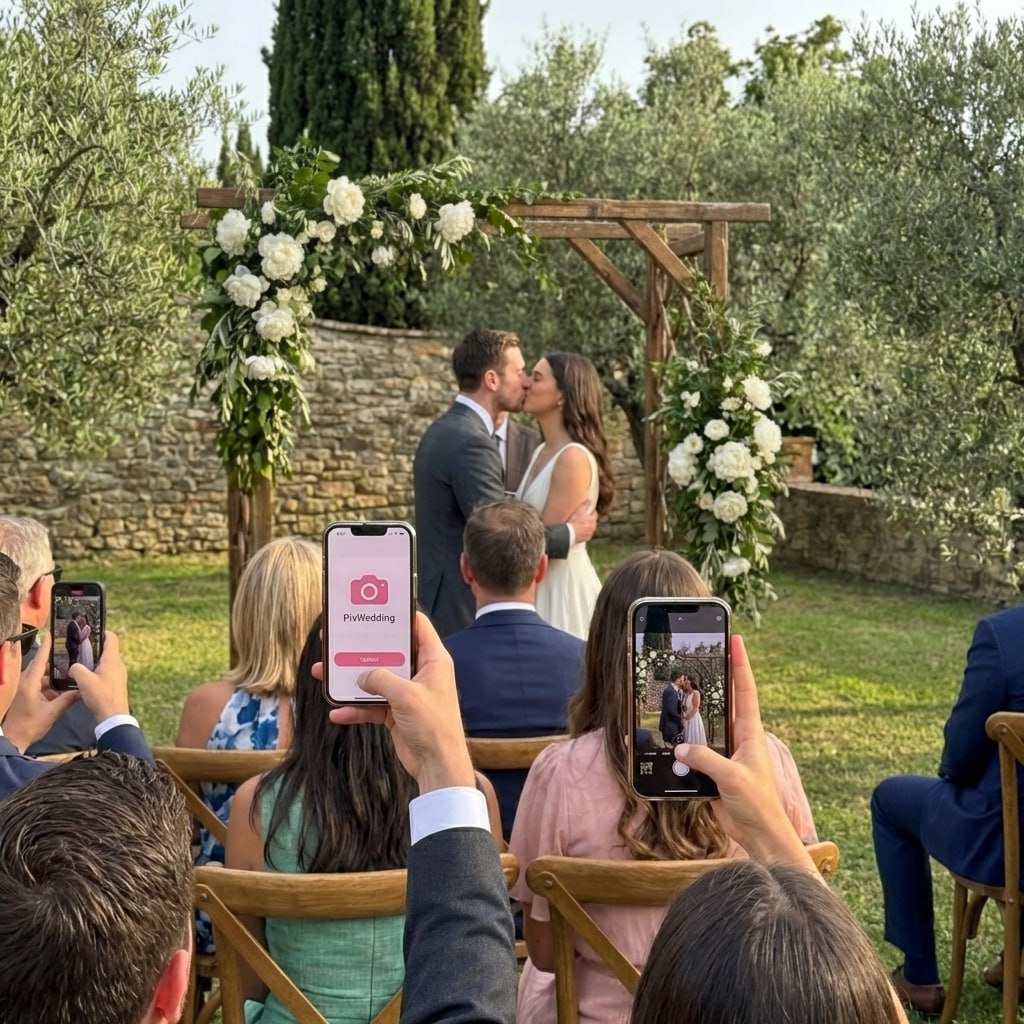
Photographers consistently cite this as their top frustration. A guest leans into the aisle to capture the first look and appears in the foreground of the shot your photographer spent 20 minutes positioning for. Some couples look back at their ceremony gallery and see more phones than faces. The ceremony is the one segment where guest phones genuinely compete with professional coverage.
Phones during vows reduce emotional presence
Psychology researcher Linda Henkel's widely cited 2014 museum-tour study, published in Psychological Science, found that people who photographed objects rather than simply observing them remembered fewer details about what they saw, a pattern researchers call the photo-taking-impairment effect. The same logic applies at a ceremony: guests who put their phones down are more likely to actually retain the moment. The pure photo-sharing approach inadvertently turns your most important guests into content creators during your most intimate moment.
The Hybrid Framework: Phase by Phase
The key is treating different moments of the day differently rather than applying one blanket rule.
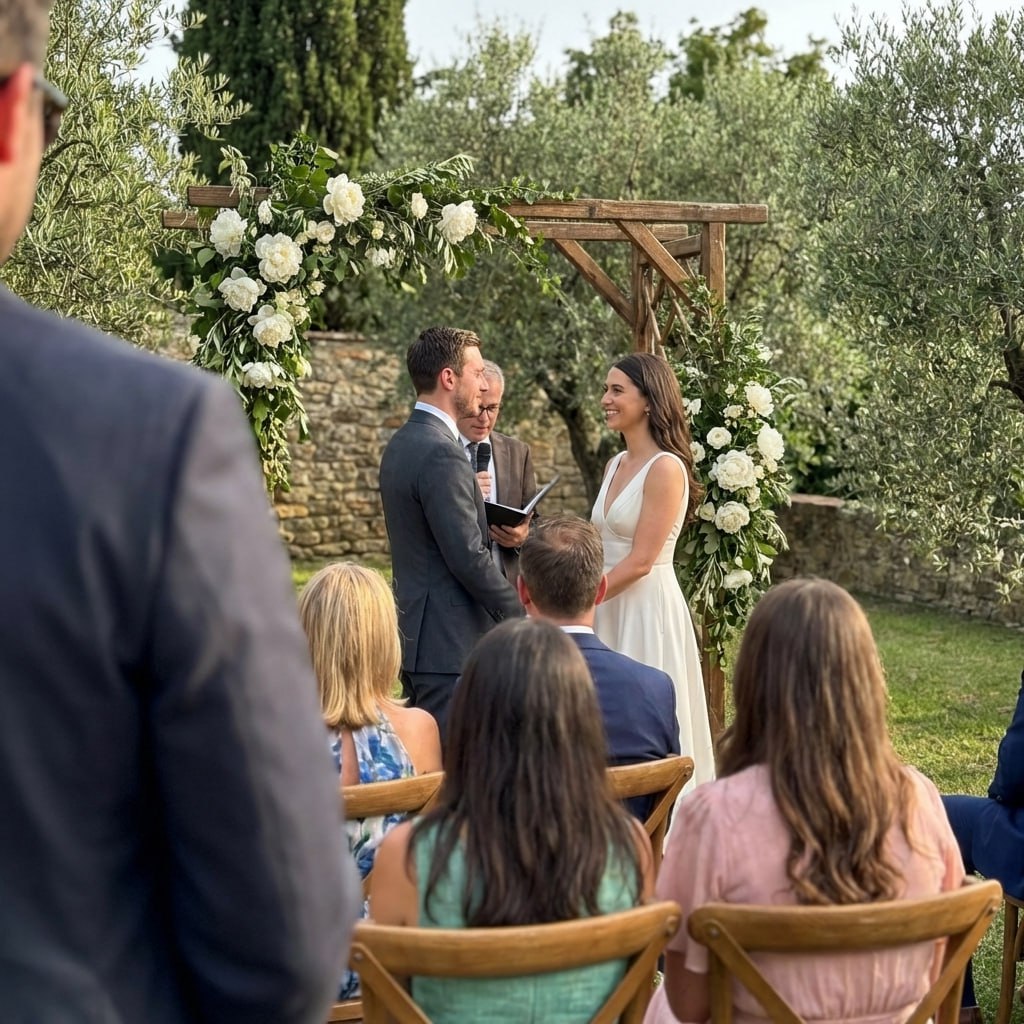
20 to 45 minutes. This is the protected window. Officiant script + signage enforce the ask. Photographer has full aisle access with no guest phones blocking their angles.
45 to 75 minutes. Guests are mingling, greeting, exploring. This is prime candid territory. Have a QR code at the welcome table and encourage guests to start uploading.
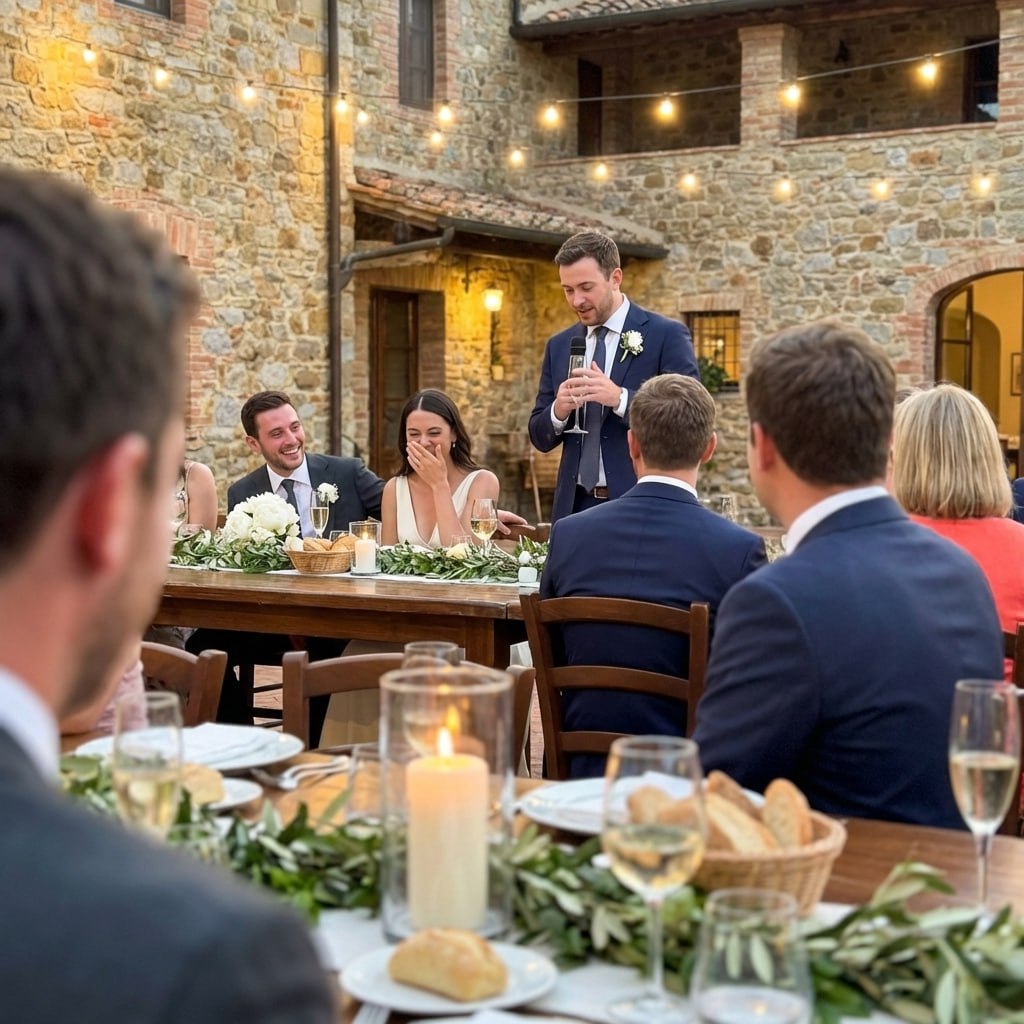
60 to 90 minutes. Toasts and speeches benefit from fewer phones - consider a soft ask. Table QR codes are visible and available for guests who want to upload between courses.
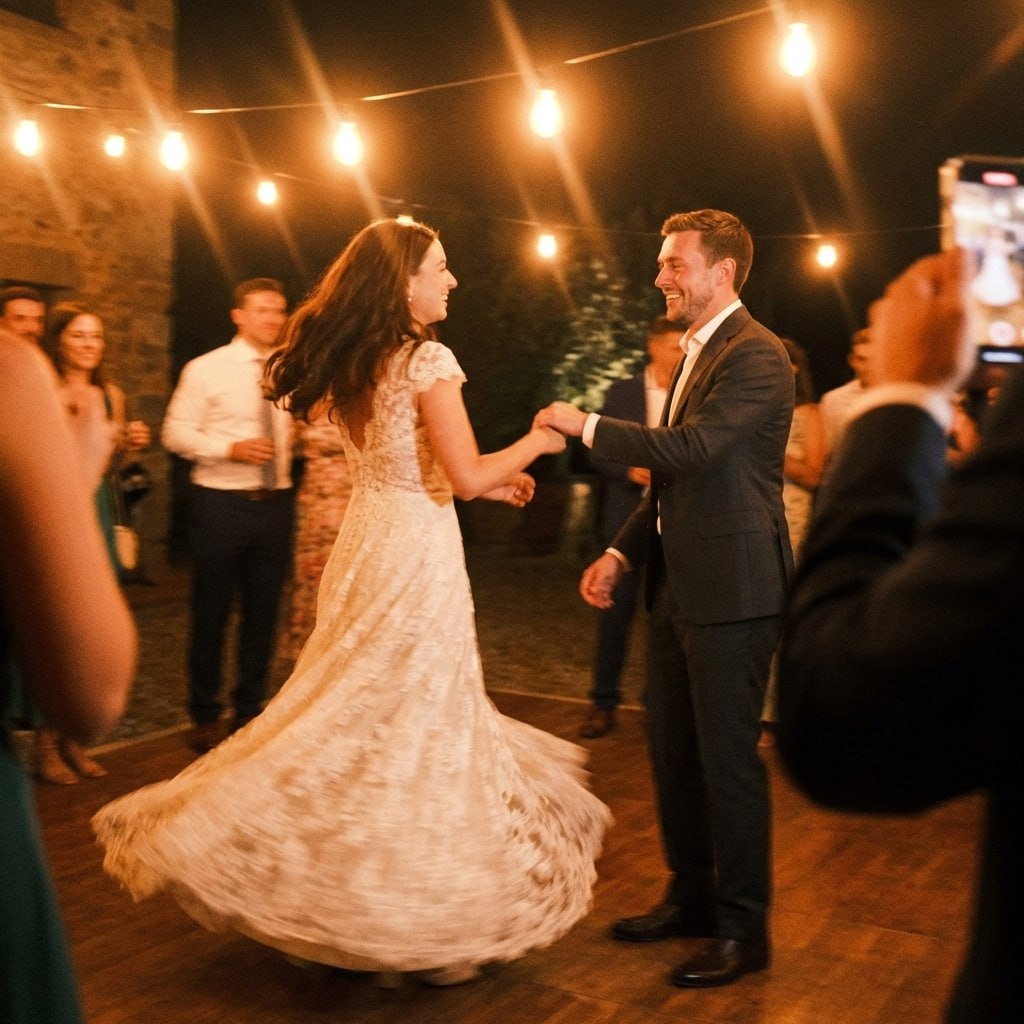
2 to 3 hours. This is the highest-energy segment. Guest phone videos of dancing moments are irreplaceable. Remind guests the QR is available. Ask MC to shout it out once.
Sample Officiant Scripts
Give your officiant one of these scripts verbatim or adapt it to their voice. A spoken announcement is more effective than signage alone because it is harder to ignore and adds a moment of shared intention before the ceremony begins.
"Before we begin this beautiful celebration, [Name] and [Name] have one request. They would love for you to be completely present with them during this ceremony - not as photographers, but as their most beloved people. Their photographer is here to capture every moment, and we promise you will not miss a single thing. Please silence your phones and simply enjoy being here. Thank you so much."
"On behalf of [Name] and [Name], I ask that all guests refrain from photography and videography during the ceremony. Their professional photographer and videographer are positioned to capture this occasion in full. Please silence your devices and give the couple the gift of your undivided presence. Thank you."
"Quick housekeeping before we get to the good stuff: please silence your phones. [Name] and [Name] specifically said, and I quote, 'We hired a real photographer so our wedding photos do not look like a Yelp review.' So phones away, eyes up, and let's be actual humans together for the next 20 minutes. The QR code at your dinner table is for sharing YOUR photos later - and those we absolutely want."
Tip: email the script to your officiant at least two weeks before the wedding. Ask them to rehearse it at the rehearsal so it does not feel like an announcement being read cold.
Signage and Insert Wording for the QR Portion
The best signage does two jobs at once: explains the ceremony ask AND introduces the photo-sharing invitation for the reception. Place the sign at the ceremony entrance. Place the QR version on dinner tables and at the bar.
"Unplugged Ceremony Please silence your phone and enjoy this moment with us. Our photographer is capturing everything. Scan the QR code at your dinner table to share your own photos."
"We want to see your faces, not your screens. Please put your phone away and be here with us for these few minutes. We promise you will remember more. (And yes, there's a QR code at dinner for sharing your pictures later.)"
"Unplugged Zone Ceremony in progress. Our photographer has this covered. Please silence phones and enjoy the show. Want to share your own photos? Scan the QR at your table after dinner. We cannot wait to see them."
How to Enforce the Unplugged Ceremony Without Being a Buzzkill
Enforcement is mostly about framing. Guests respond to requests that feel caring rather than controlling.
Lead with a reason, not a rule
"We want to see your faces" is a reason. "No phones" is a rule. Reasons create buy-in. Rules create resentment. Every version of your signage and script should explain why - even a single line.
Make the payoff visible
Tell guests upfront that there IS a photo-sharing option coming. "Please put phones away for the ceremony - your QR code for sharing your own photos is at your dinner table." Guests who know the restriction is temporary and that their photos are wanted are far more compliant.
Position an usher near the aisle
One groomsman or family member standing near the aisle entrance has a gentle deterrent effect. They do not need to say anything - presence is enough. If someone starts to lean in with a phone, a quiet word before the ceremony begins is far less disruptive than one during.
Brief your photographer in advance
Tell your photographer about your hybrid plan. Many will appreciate the heads-up and will photograph any notable violations as part of their documentary instinct. More practically, they will be ready to step in front of any guest phone that gets raised at a critical moment.
4 Moments That Need Quiet. 4 That Need Guest Phones.
Moments that need quiet
Moments that benefit from guest phones
What to Do About the Guest Who Ignores the Rule
During the ceremony
Do not engage publicly. A scene is worse than the offense. If the guest is in the aisle, a quiet usher nudge or a gentle look from the officiant is enough. Your photographer is trained to work around it.
After the ceremony
If the guest took photos you genuinely want, ask them to upload to your sharing link during the reception. This reframes the situation: you are not policing them, you are inviting them to contribute. Most guests respond warmly to this.
The bigger picture
One guest with a phone raised rarely ruins a ceremony. What ruins a ceremony is 40 guests with phones raised because no one asked them not to. Signage plus a spoken officiant announcement is far more effective than either one alone, since guests who miss the sign on their way in still hear the ask before the processional starts. Perfection is not the goal - a mostly screen-free ceremony is a win.
Tell Your Photographer the Plan
Your photographer needs to know three things before the wedding day:
The ceremony will be unplugged - they will have clear aisle access and should position for wide shots without worrying about guest phones in the frame.
The reception will have an active QR photo-sharing setup - they may want to photograph guests scanning the code as a candid moment in itself.
You will share all guest photos with them after the wedding if they want reference shots for portfolio work - many photographers love seeing the candid angles they could not get.
Most photographers will be relieved. The hybrid approach removes the friction between an unplugged request and the practical reality of guest behavior. Everyone is set up for success.
Your Hybrid Wedding Checklist
Use this checklist in the 2 to 4 weeks before your wedding. Everything you need to execute the hybrid approach correctly.
4 Weeks Before
1 Week Before
Wedding Day

First dance
You guys!!
Get the best of both: presence and photos.
Pix Wedding lets guests be in the moment during the ceremony, then contribute their photos during cocktail hour and dinner when it feels natural.
From Mom
Scan to join the album
No app, no account
UPLOADING
Saving your moment
THE ALBUM
Emma & Jack
June 21, 2026
647 photos · 95 guests


SCAN TO TRY
pix.wedding/
your-wedding
Why the Unplugged vs. Sharing Debate Is the Wrong Frame
The internet has framed this as a binary choice for years: you either go fully unplugged (no phones, pure intimacy) or you lean into photo sharing (QR codes everywhere, encourage guests to snap). Couples spend real time agonizing over which camp they are in.
The debate is a false one. Unplugged and photo-sharing are not opposites - they apply to different parts of the day and serve different goals. An unplugged ceremony is about presence and protecting your photographer's angles. A photo-sharing reception is about capturing the candid energy of 150 people celebrating, which no single photographer can fully document.
The most photographically rich weddings of 2026 use both tools deliberately. Phones off for the 20 to 30 minutes that are sacred. Phones on for the 4 to 6 hours that are celebratory.
Setting Up Your Wedding Photo Sharing
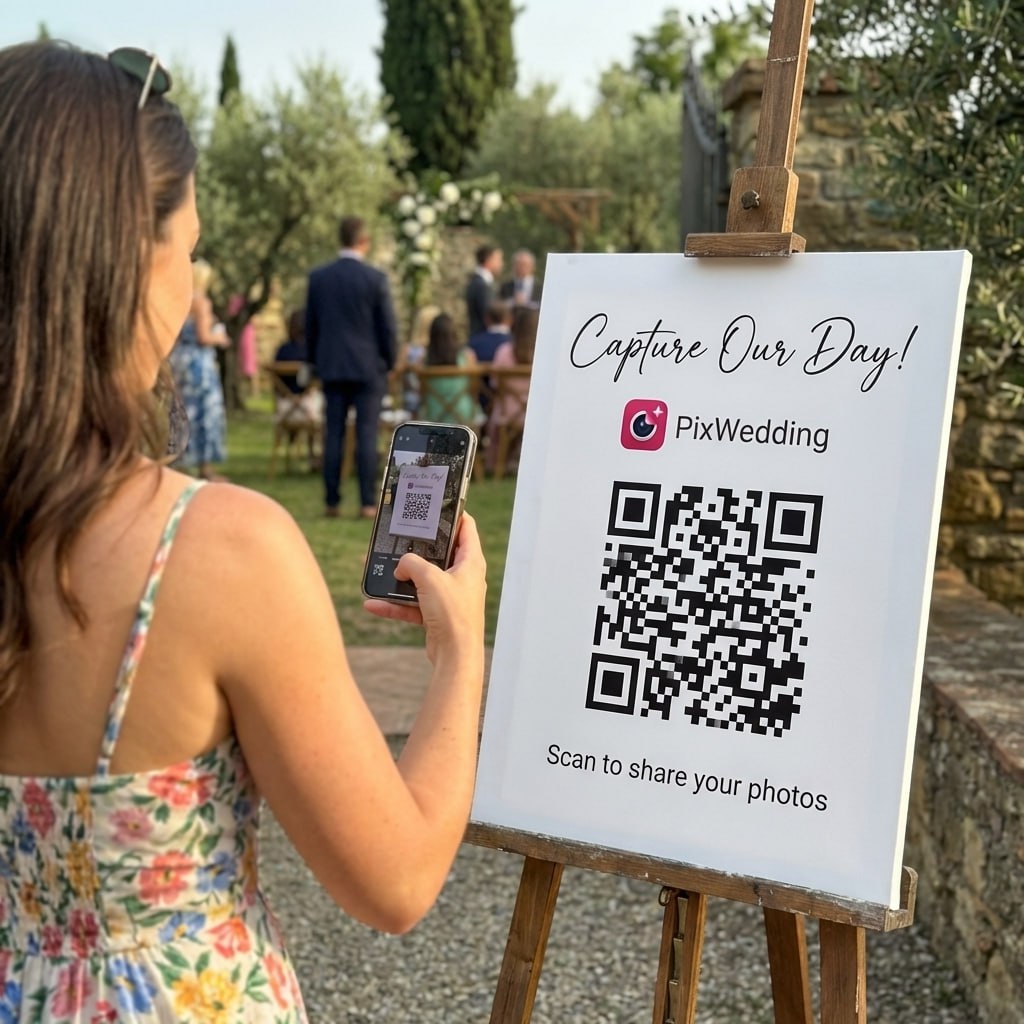
Once the ceremony is over and guests move to cocktails, activate your photo-sharing link. A service like Pix Wedding gives you a branded upload page and a QR code you can print on table cards, stickers, or the back of your menu.
The logistics are straightforward: one QR code per table, a brief mention by the MC, and a clear instruction on what to do. Guests scan, upload from their camera roll, and your album grows in real time. You can check it on your phone during the reception if you like - many couples find it one of the most joyful parts of the day.
- •Print QR stickers for every place setting or table number card
- •Frame a larger QR code near the dance floor and bar area
- •Add the link to your wedding website as a post-ceremony reminder
- •Ask your DJ or MC to mention it twice during the reception
- •Send a text or email follow-up the next morning with the link for anyone who missed it
Explore more free wedding tools
Everything you need to make your wedding day stress-free and unforgettable.
QR Sticker Designer
Design custom print-ready stickers.
Hashtag Generator
Create unique wedding hashtags.
How to Collect Guest Photos
5 methods ranked by participation rate and ease.
Share Wedding Photos with Guests
Compare every sharing platform by ease and participation.
Best Way to Get Guest Photos
The single method with the highest participation rate.
How to Make a Shared Wedding Album
Step-by-step setup for every platform.
Alternative to Disposable Cameras
Better, cheaper options than disposable cameras.
Alternative to Wedding Photo Booth
5 cheaper alternatives to a $1,000+ photo booth rental.
Unplugged Wedding FAQs
Straight answers to the questions people ask most about this topic.
A hybrid unplugged wedding asks guests to put phones away during the ceremony but actively encourages photo sharing during the cocktail hour and reception. You get the intimate, screen-free ceremony you wanted plus hundreds of candid guest photos from the rest of the day. Unplugged ceremonies have been one of the fastest-growing requests couples make of their guests over the past decade, per The Knot, and pairing that request with a reception photo-sharing link is the natural next step.
The key is giving a reason and a payoff. Instead of "no phones," frame it as "please be fully present with us for this moment - we have a photographer who will capture everything, and we will share a link so you can upload your own photos during the reception." Warmth and a clear explanation remove the feeling of being scolded.
A short, warm script works best. Something like: "Before we begin, the couple asks that you silence your phones and enjoy this ceremony as their guest rather than their photographer. Their photographer is capturing every moment, and we promise you will not miss a thing. They would love for you to be fully present." Keep it under 30 seconds.
Clear and kind beats clever. "Unplugged ceremony - please silence your phone and enjoy this moment with us. Our photographer is capturing everything. A QR code to share your reception photos is on your table." That gives guests the full picture: put it down now, you can share later.
It happens at nearly every wedding despite clear signage. The best approach is to let your officiant or a groomsman make brief, gentle eye contact rather than making a scene. Post-ceremony, you can ask the guest privately if they would upload any photos to your sharing link - which often softens the situation. Publicly calling someone out ruins the mood for everyone.
Activate photo sharing from the moment cocktail hour begins. Have the QR code at the cocktail welcome table, then again at every reception table. Ask your MC to mention it when they open the reception - something like "Before we get started, the couple has set up a photo-sharing link at your table. Scan the QR code and upload any photos you take tonight." The cocktail hour is often the most photo-rich segment of the whole day.