























pixPix Weddingwedding
Complete 2026 Guide

QR Code for Wedding Pictures: The Complete 2026 Guide

Learn exactly what a QR code for wedding pictures is, why it works better than any alternative, where to place them for maximum participation, and how to design beautiful printable cards.

The Basics

What Is a QR Code for Wedding Pictures?

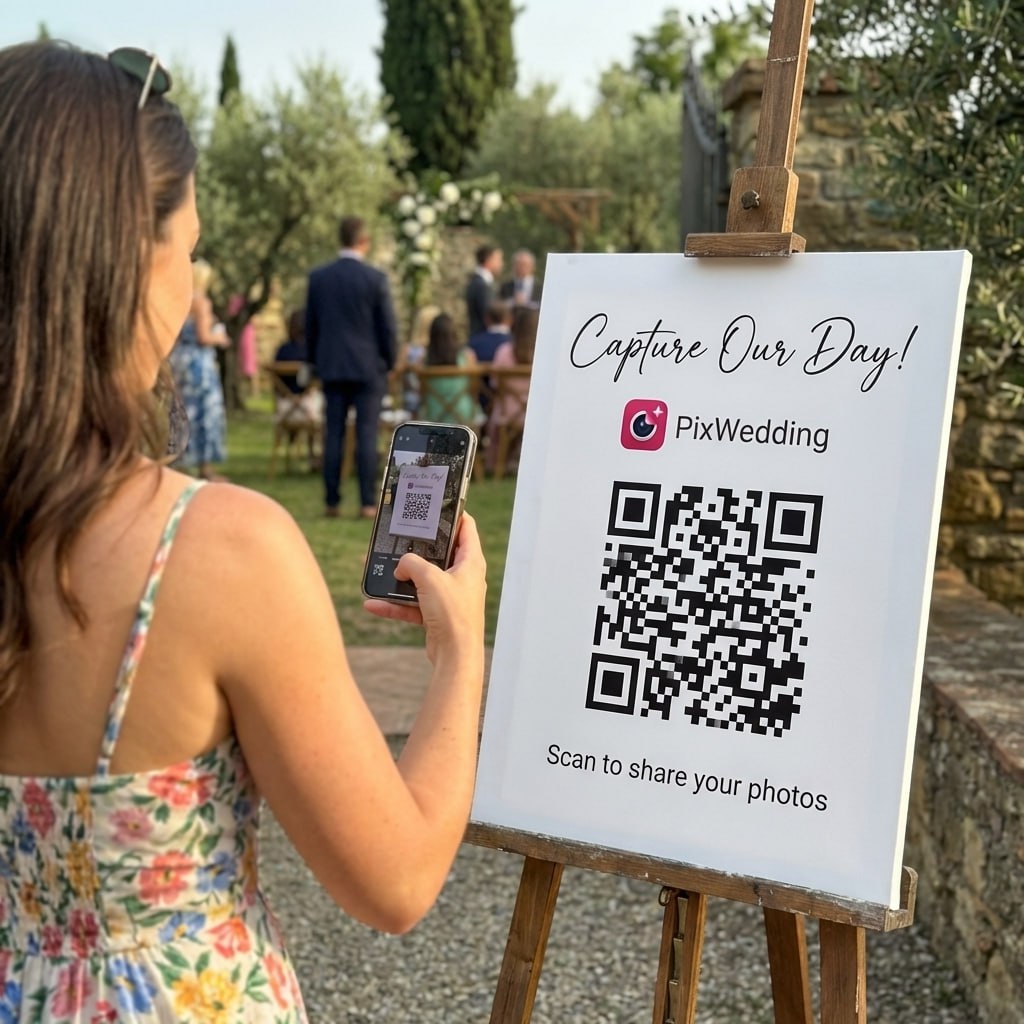
A QR code for wedding pictures is a scannable square printed on your table cards, welcome sign, or ceremony programs. Guests point their phone camera at it during your reception. The camera recognizes the code and opens a photo upload page directly in the browser, with no app to download and no account to create.

Guests then select photos from their camera roll or take new ones, tap upload, and the photos appear in your private wedding album within seconds. You and your partner can watch photos arrive in real time throughout the evening. By the end of the night, you might have 500 to 1,500 candid photos from dozens of guest perspectives, all in one private gallery.

The QR code itself is just a shortcut. What matters is where the code sends guests: a well-designed, frictionless upload experience. Pix Wedding generates this automatically when you create your album.

Quick Stats
Guest participation rate80-95%
Average setup time2 minutes
Photos per 100-guest wedding500-1,500
App download requiredNo
Cost to set upFree
Placement Strategy

Where to Place QR Codes at Your Wedding

More placements means more reminders. Each additional location increases the number of guests who upload their photos.

Reception Tables

Reach: 100% of guests

Print on table cards or menu cards. Guests see it every time they look at the table. Aim for at least one code per table, ideally placed at eye level when seated.

Welcome Sign or Entrance

Reach: 95% of guests

A large printed QR code on the welcome sign or entrance display catches guests as they arrive. It sets expectations early: "we want your photos."

Bar and Cocktail Area

Reach: 85% of guests

Guests spend significant time at the bar. A QR code here captures cocktail hour photos. Print it on a small tent card next to the drinks menu.

Ceremony Programs

Reach: 80% of guests

Include the QR code on the back of ceremony programs so guests know about it from the very start. By dinner, they already know how it works.

Bathroom Mirror or Door

Reach: 70% of guests

Guests often check their phones in the bathroom. A QR code near the mirror is a low-friction reminder to upload photos they have already taken.

Photo Booth Backdrop

Reach: 60% of active photographers

If you have a photo area or backdrop, post the QR code right beside it. Guests taking photos there are already in photo-taking mode and more likely to upload.

Setup Guide

How to Set Up a QR Code for Wedding Pictures (6 Steps)

1

Create your Pix Wedding album

Sign up at pix.wedding. Create your album and customize it with your names, wedding date, and a welcome message. Takes about 2 minutes.

2

Get your unique QR code

Pix Wedding generates a unique QR code linked to your album. Every scan opens your album upload page directly in the browser. No app required.

3

Design your printed QR cards

Use the free QR Sticker Designer at pix.wedding/qr-sticker-designer to create beautiful printable cards that match your wedding theme and colors.

4

Print and distribute

Print your QR codes at home or through a print shop. For outdoor weddings, use laminated cards or weatherproof vinyl stickers to prevent moisture damage.

5

Brief your MC and wedding party

Give your MC a 20-second announcement script to share during dinner. Ask 2-3 wedding party members to show guests how to scan if needed.

6

Watch photos arrive live

Every photo guests upload appears in your album in real time. You can check your phone throughout the evening and see candid moments as they happen.

Design Tips

6 Rules for Designing QR Codes That Always Scan

Use high contrast: dark QR code on a white background always scans better than colored codes on colored backgrounds.

Minimum print size is 2.5 cm x 2.5 cm (1 inch square) for reliable scanning from a table distance.

Add a short instruction line below the code, such as "Scan to share your photos, no app needed."

For outdoor weddings, laminate paper cards or use weatherproof sticker vinyl to prevent water damage.

Test every printed code with at least two different phones before the wedding day.

QR codes remain scannable even if up to 30% of the code is covered, so overlaying a small logo or heart is acceptable.

Related Guides and Tools

Your wedding pictures, gathered in seconds.

Print the QR code, place it on the tables, and guests upload every picture as the night unfolds. You get one album with shots from every corner of the room.

From Mom

From Mom

9:41

ALBUM

Emma & Jack

June 14, 2026

634 photos · 94 guests

AllMomentsMine
Wedding guest photo 1 from album preview
Wedding guest photo 2 from album preview
Wedding guest photo 4 from album preview
Wedding guest photo 5 from album preview
Wedding guest photo 6 from album preview
Wedding guest photo 7 from album preview
Wedding guest photo 8 from album preview
Wedding guest photo 9 from album preview
Wedding guest photo 10 from album preview
Add photosShare your moments
Table 4 just uploadedSarah B. · +12 new photos

The History of QR Codes at Weddings

QR codes were invented in 1994 by Denso Wave for tracking automotive parts in Japan. For two decades, they required a separate scanning app and remained mostly a novelty outside of Asia. The turning point came in 2017, when Apple integrated a QR scanner directly into the iPhone camera in iOS 11. No app required, just point and scan.

For weddings specifically, the COVID-19 pandemic of 2020-2021 was the catalyst that moved QR codes from "interesting idea" to "standard feature." Couples began using QR codes for contactless menus, seating charts, and RSVP links. In this environment, photo sharing via QR code felt natural. By 2022, multiple dedicated wedding photo sharing platforms had launched, and QR-based sharing had replaced disposable cameras as the default way to collect guest photos.

By 2026, a QR code on the table card is as expected at a modern wedding as a DJ or a cake. The technology has matured to the point where even less tech-savvy guests know how to use it.

  • 1994: QR codes invented for automotive supply chain tracking
  • 2010-2016: Mainstream awareness, but required a separate scanning app
  • 2017: Apple adds native QR scanning to iPhone camera (iOS 11)
  • 2019: Android adds native QR scanning to Google Lens
  • 2020-2021: COVID pandemic normalizes contactless QR code experiences
  • 2022: Dedicated QR-based wedding photo sharing platforms launch
  • 2024-2026: QR codes become the standard method for collecting wedding guest photos

Design Principles for Printable Wedding QR Codes

A QR code that does not scan reliably defeats its purpose. The most common printing mistake is using low contrast: a light-colored QR code on a similarly light background. Always use a dark code (ideally black) on a white or very light background for maximum scan reliability.

Size matters more than most people expect. A QR code printed too small on a dinner table card may not scan reliably from the seated position of a guest holding their phone above the table. The minimum reliable size is 2.5 cm x 2.5 cm (about 1 inch square). For welcome signs, go larger: 10-15 cm for signage that guests approach from a few feet away.

  • High contrast is critical: dark code on white or cream background
  • Minimum size: 2.5 cm x 2.5 cm for table cards
  • Add "Scan to share photos, no app needed" as instructional text
  • Test every code with iPhone and Android before printing in bulk
  • QR codes tolerate up to 30% coverage, safe to overlay a small graphic
  • Laminate outdoor copies or use weatherproof vinyl for alfresco receptions

Explore more free wedding tools

Everything you need to make your wedding day stress-free and unforgettable.

Common Questions Answered

QR Code for Wedding Pictures FAQ

Everything you need to know about our free tools and how they help your wedding day.

A QR code for wedding pictures is a scannable code printed on cards, signs, or stickers at your venue. Guests scan it with their phone camera and are taken directly to a photo upload page in their browser. They can then upload photos and videos directly to your private wedding album, no app download or account needed. Platforms like Pix Wedding generate this QR code for free.

QR codes existed for decades but became mainstream at weddings around 2020-2021. Two forces drove this: the COVID-19 pandemic accelerated contactless technology adoption, and Apple added native QR code scanning to the iPhone camera in iOS 11 (2017), which finally made scanning effortless for the average user. By 2022-2023, QR codes on wedding table cards had become common, and by 2025 they had replaced disposable cameras at most modern weddings.

Print at least one QR code per table, plus additional codes for your welcome sign, bar area, and ceremony programs. For a wedding of 100 guests across 12 tables, a practical print run is 20-25 codes: 12 for tables, 2 for the bar, 2 for the welcome display, and the rest as backups or for programs. More codes in more locations directly increases the number of guests who upload photos.

Guests need a working mobile data connection or WiFi to upload photos after scanning the QR code. Most modern venues have good cell coverage, but for remote or basement venues, you may want to provide guest WiFi. Pix Wedding handles uploads gracefully: if a guest's connection is slow, the app queues the upload and retries automatically.

Yes. Pix Wedding includes a free QR Sticker Designer tool at pix.wedding/qr-sticker-designer. You can choose from multiple card templates, adjust colors to match your wedding palette, add your names, wedding date, and a custom message. The designer outputs print-ready files you can take to any print shop or print at home.

Yes, creating a Pix Wedding album and getting your QR code is free. The free plan supports hundreds of photo uploads from unlimited guests. Premium plans starting at $49 add features like video uploads, slideshow mode, and extended album lifetime. There is no per-photo fee on any plan.