
Wedding Reception Entrance Order
Just the grand entrance: who gets announced, in what order, the MC script for each pair, and how long to give each name.
The short answer
The standard grand entrance order is grandparents first (if included), then parents of the groom, then parents of the bride, then the flower girl and ring bearer (if there was a junior wedding party), then the bridesmaid-and-groomsman pairs, then the maid of honor and best man, and finally the newlyweds, who always enter last.
This entrance is only one segment of the reception, the part where the MC announces everyone as they walk in from cocktail hour. It is separate from the full run of the night: toasts, dinner, cake, and the first dance all happen afterward. If you need the complete run of show for the whole reception, our full order of wedding reception guide covers every segment start to finish. This page goes deep on the entrance only: the exact lineup, what the MC actually says for each pair, and how long each introduction should take.
The Grand Entrance Lineup
This is the order used at most receptions with a full wedding party. Every position is adjustable; treat it as a default to edit down, not a script to follow exactly.
- 1
Grandparents of the couple
If both sets of grandparents are attending and able to walk in, they typically go first, entering to a calm, respectful song. Some couples skip this position entirely if grandparents prefer to be seated ahead of time.
- 2
Parents of the groom
Enters next, together as a pair. If the groom has divorced or remarried parents, decide ahead of time whether they walk in together, separately, or with a new spouse included.
- 3
Parents of the bride
Mirrors the groom's parents in pacing and song choice so the two introductions feel consistent rather than lopsided.
- 4
Flower girl and ring bearer
Optional position. If they are very young, a parent or usher waits at the entrance to walk with them. Skip this slot entirely if there was no junior wedding party.
- 5
Bridesmaids and groomsmen, paired
The core of the grand entrance. Each bridesmaid and groomsman pair gets its own announcement and its own short walk before the next pair starts.
- 6
Maid of honor and best man
Enter after the paired wedding party, either together as a pair or as two separate introductions right in a row. Both are common; pick whichever matches how your other pairs entered.
- 7
The newlyweds
Always last. This is the loudest, longest, most energetic introduction of the entrance, and the moment guests are asked to stand and cheer.
Do grandparents have to be announced?
No. It is a nice touch when grandparents are present and able to walk in, but plenty of receptions skip this position and start directly with the parents. Treat it as optional, not a rule.
Should the maid of honor and best man enter together or separately?
Either works. Entering together mirrors how the rest of the wedding party was paired. Entering separately gives each of them an individual moment right before the couple. Pick whichever matches the pacing you used for the bridesmaid and groomsman pairs.
What if a wedding party member is running late?
Give the MC a quick backup plan: skip that position and slot them in later, or hold for 30 seconds while a groomsman or usher checks the entrance. Agreeing on this ahead of time means one late arrival does not stall the whole entrance.
MC Announcement Scripts for Each Pair
The lines below are illustrative examples, not fixed wording. Swap in real names, adjust the order to match your lineup, and send the final version to your MC or DJ ahead of time.
"Please help us welcome the grandparents of the groom, [Names], and the grandparents of the bride, [Names]!"
"Now entering, the parents of the groom, [Father Name] and [Mother Name]!"
"And the parents of the bride, [Father Name] and [Mother Name]!"
"Let's welcome our flower girl and ring bearer, [Names]!"
"Bridesmaid [Name], escorted by groomsman [Name]!"
"Your maid of honor, [Name], and best man, [Name]!"
"For the first time as a married couple, please welcome Mr. and Mrs. [Last Name]!"
Example scripts shown for illustration. Write out phonetic spellings for any name your MC has not heard before.
Keep the tone consistent across all seven lines. A script that is playful for the wedding party but stiff and formal for the couple's own introduction feels disjointed once guests hear it live.

First dance
You guys!!
The entrance is the most photographed 8 minutes of the night
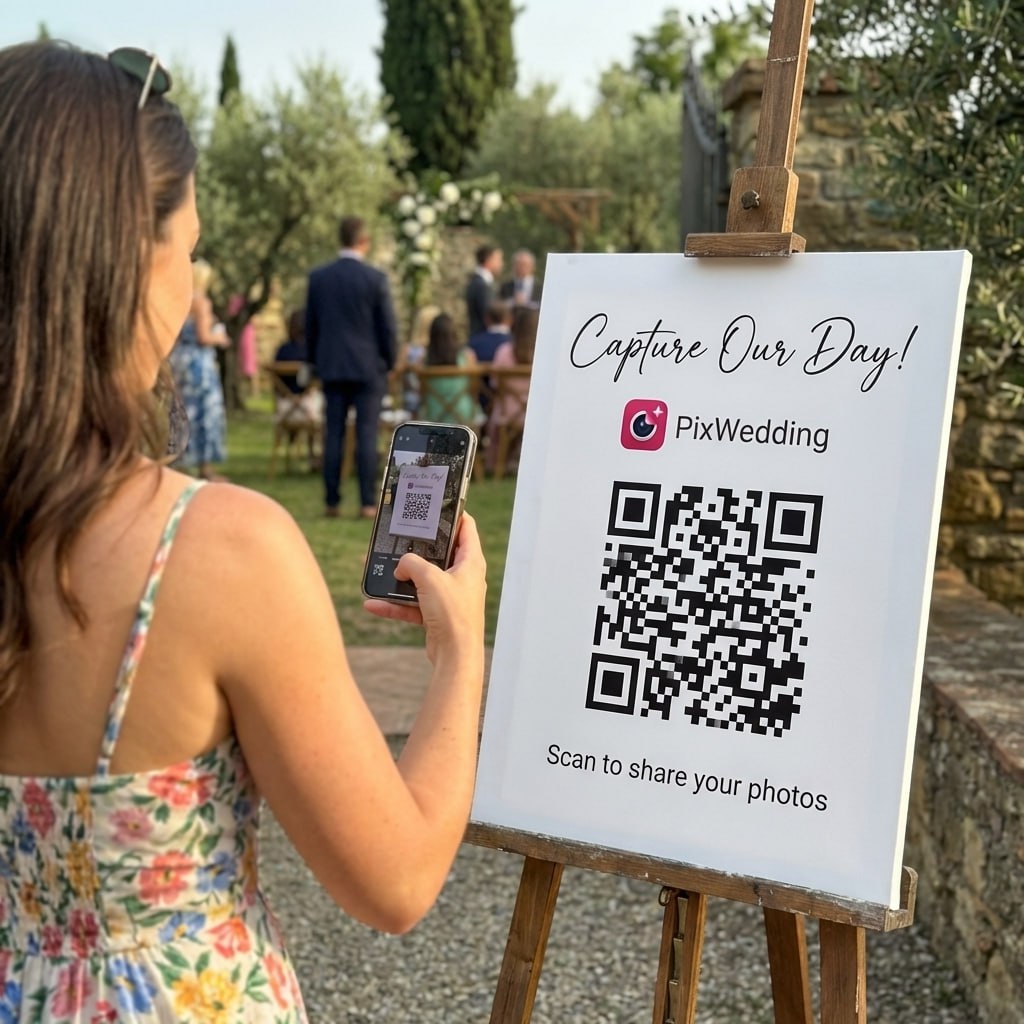
Every guest has their phone out for the grand entrance anyway. Give them a QR code so those shots land in one shared album instead of scattered camera rolls.
From Mom
Scan to join the album
No app, no account
UPLOADING
Saving your moment
THE ALBUM
Emma & Jack
June 21, 2026
647 photos · 95 guests
SCAN TO TRY
pix.wedding/
your-wedding
Entrance Song Timing, Pair by Pair
The music does not need to play in full for each entrance, just long enough to set the mood and cover the walk. Fade or cut the track once a pair reaches their spot so the next introduction is not fighting the previous song.
| Entering Group | Suggested Time | Notes |
|---|---|---|
| Grandparents | 10 to 15 seconds | Slower pace is fine here; no need to rush. |
| Parents (groom, then bride) | 10 to 15 seconds each | Keep the two introductions the same length for balance. |
| Flower girl / ring bearer | 10 to 20 seconds | Build in extra time since young kids move at their own pace. |
| Bridesmaid and groomsman pairs | 10 to 15 seconds per pair | Leave 5 to 10 seconds between pairs for applause and photos. |
| Maid of honor and best man | 15 to 20 seconds | Give this pair a slightly bigger musical moment than the rest of the party. |
| The newlyweds | 30 to 45 seconds | The longest, loudest slot. Let the cheering run its course before the MC moves on. |
Total entrance length
A full wedding party with six or more pairs plus parents typically runs 5 to 8 minutes start to finish. Smaller parties finish faster.
When the couple lands
The newlyweds should always be the last announcement, timed to the biggest musical moment of the entrance, not shared with any other pair.
Adjusting the Lineup for Your Wedding
The seven-position lineup above assumes a full-size wedding party. Most weddings need to adjust it somewhere. Use these as starting frameworks, not rules.
Small wedding party
With one or two attendant pairs, combine the maid of honor and best man announcement with the paired wedding party section instead of giving it a separate slot. The whole entrance can wrap in 2 to 4 minutes.
Blended families
If a parent has remarried, decide ahead of time whether stepparents are announced alongside them ("parents and stepparents of the groom") or given their own line. Talk it through with both families before the day, not at the reception.
Honoring a parent who has passed
Some couples reserve a chair or place a photo at the table instead of a spoken mention. Others simply skip any reference in the MC script. This is a private family decision; there is no expected way to handle it.
Skipping the party entrance
Some couples skip individual introductions for the wedding party altogether and only announce themselves. This is common at smaller or more casual receptions and cuts the entrance down to a single 30 to 45 second moment.
A full lineup makes sense when
- Your wedding party has four or more pairs and you want each one recognized.
- Family members specifically asked to be announced.
- Your reception has a formal, sit-down structure with a clear cocktail-hour-to-reception transition.
- You want the photographer to get a clean shot of every pair entering.
Skipping ahead is the better call when
- Your wedding party is very small or you did not have one.
- You are running short on time before dinner service.
- Your reception style is casual and a long formal entrance would feel out of place.
- Your wedding party would rather skip individual attention altogether.
Example Timeline for a Four-Pair Wedding Party
The timestamps below are an illustrative example only, not a fixed schedule. Your actual times will vary with your DJ, your MC's pacing, and the size of your venue.
Total example runtime: roughly 3 minutes for a four-pair wedding party. A larger party with six or more pairs, plus grandparents, stretches this closer to the 5 to 8 minute range covered above.
Common Grand Entrance Mistakes
- Rushing the pairs: announcing names back-to-back with no gap gives the photographer nothing to work with and makes the room feel chaotic rather than exciting.
- Flat, same-energy music throughout: if every segment plays at the same tempo, the couple's entrance has nowhere left to climb to.
- No pronunciation guide for the MC: an MC guessing at an unfamiliar name live is the single most avoidable awkward moment in the entrance.
- Blended-family wording decided on the spot: figure out how stepparents are announced with both families before the wedding, not while everyone is lined up at the door.
- An entrance too long for the room: an eight-minute entrance for a 40-guest backyard wedding drags. Match the length of the entrance to the size and formality of the reception.
- Skipping the walkthrough: a five-minute rehearsal run saves everyone from bunching up at the entrance or missing their cue on the day.
- No cue for guests to stand: the MC should explicitly invite guests to their feet for the couple's entrance rather than assuming they will pick up on it.
- MC reading the lineup cold: even a great MC needs the final order and names in hand before doors open, not scribbled last minute from a text message.
- No plan for a missing wedding party member: agree ahead of time on what happens if someone is not at the staging area when their name is called.
Full Lineup vs. Couple-Only Entrance
Both formats are common. Neither is more correct than the other. The right call depends on your wedding party size, your reception style, and how much of the night you want to spend on introductions.
Pros of the full lineup
- Every attendant gets recognized individually in front of the whole room.
- Builds anticipation in stages so the couple's entrance lands as the clear peak.
- Gives the photographer a clean, posed shot of each pair as they enter.
- Matches a formal, sit-down reception where guests expect a structured start.
Pros of a couple-only entrance
- Faster, wrapping in under a minute instead of several.
- Lower pressure for a small or informal wedding party that would rather skip the spotlight.
- Fits casual venues like backyard or brewery receptions where a long formal segment feels mismatched.
- Keeps focus entirely on the couple with no split attention.
Getting the Entrance Right on the Day
Send the final lineup two weeks out
Give your DJ or MC the order, name spellings, and song choices well before the wedding, not the morning of.
Write out pronunciation
Phonetic spelling on a printed card removes the single most common source of an awkward introduction.
Walk it once at the venue
A five-minute walkthrough during rehearsal is enough for everyone to know where to enter and where to stand.
Loop in your photographer
They need the exact order and entry point to get in position for each introduction, especially the couple's entrance.
Stage the wedding party early
Line everyone up in order a few minutes before doors open so the first announcement is not held up by a search for a missing groomsman.
Confirm the couple's exit cue
Agree with the MC on what happens right after the couple's entrance, whether that is moving straight into a welcome toast or the first dance.
Grand Entrance Glossary
Grand entrance
The formal introduction of the wedding party and the couple as guests transition from cocktail hour into the reception.
MC (emcee)
The person, often the DJ, who reads the announcements and keeps the entrance moving on cue.
Walk-up song
A short, personal song clip played for one pair as they cross the floor, similar to a sports player intro.
Paired entrance
A bridesmaid and groomsman announced and walking in together as a matched pair, rather than individually.
Run of show
The full minute-by-minute schedule for the entire reception, of which the grand entrance is one segment.
Cocktail hour transition
The window where guests move from cocktail hour into the reception space, right before the entrance begins.
Staging area
The hallway, tent entrance, or side room where the wedding party lines up in order right before the first announcement.
Planning the Entrance, Step by Step
- Decide who is in the lineup. Confirm which family members and wedding party positions you actually want announced.
- Set the pairing order. Match bridesmaids with groomsmen, commonly by height or by how the ceremony processional was ordered.
- Pick a song for each segment. Calmer for family, more upbeat for the wedding party, biggest for the couple.
- Draft the MC script. Write out exactly what gets said for each position using the templates above as a starting point.
- Confirm pronunciations. Ask anyone with a name your MC has not said before to write out a phonetic spelling.
- Send the final order to your DJ or MC and photographer. Do this at least two weeks out so it is locked in, not improvised.
- Walk through it at rehearsal. A five-minute run at the venue is enough for everyone to know their cue and their entry point.
- Line everyone up before doors open. Have the wedding party staged in entrance order a few minutes before the first announcement so there is no scramble.
Quick Recap: The Seven Positions
Trim, combine, or reorder any of these to fit your own wedding party. The one position that should not move is the last one: the newlyweds always close out the entrance.
For the segments before and after this one, from cocktail hour through the last dance, see the full order of wedding reception.
Why the Grand Entrance Order Matters
The grand entrance is the hinge between cocktail hour and the reception proper. Guests are seated, the room is quiet, and every introduction from that point forward builds toward the couple's own entrance. Getting the order right means the energy climbs steadily instead of peaking too early or falling flat right before the biggest moment.
The lineup on this page is a default built from how most MCs and DJs structure the entrance: family first, then the wedding party in pairs, then the two closest attendants, then the couple. Every wedding adjusts it somewhere. What should not change is the last position: the newlyweds always enter last.
- •Share the final lineup with your DJ or MC at least two weeks ahead
- •Keep parent introductions consistent in length and tone between the two families
- •Reserve the loudest, longest musical moment for the couple's entrance
- •Decide blended-family wording together before the wedding, not during it
Common Grand Entrance Mistakes
The most frequent mistake is rushing the pairs. Each pair needs roughly 10 to 15 seconds to cross the floor; rapid-fire announcements with no gap feel chaotic and give the photographer nothing usable to work with.
The second is mismatched energy. If the wedding party enters to the same tempo as the parents, the couple's entrance has nowhere left to go. Build the music gradually: calm for family, upbeat for the wedding party, and the biggest song of the night for the couple.
Who Should MC the Entrance
Most receptions use the DJ as MC since they already control the music cues and can time the announcements to the song. It is also common for a friend, family member, or a separate hired emcee to read the introductions while the DJ handles sound, as long as the two are coordinated on timing.
Whoever is speaking needs the final written order in hand, not a verbal summary. Include the exact wording for each introduction, the correct pronunciation of every name, and a note on which song plays for which segment so nothing depends on memory in the moment.
Explore more free wedding tools
Everything you need to make your wedding day stress-free and unforgettable.
Seating Chart Planner
Plan your reception seating visually.
Guest List Manager
Track RSVPs and dietary needs.
Budget Allocator
Turn your total into a category-by-category plan.
Venues by State
Explore venues across all 50 states.
Countdown Timer
Count down the days to your big day.
Wedding Checklist
Month-by-month planning checklist.
Bachelorette Party Games
15+ games with rules, supplies, and timing.
Alternative to Wedding Guest Book
15 creative alternatives guests actually enjoy.
Reception Entrance Order FAQ
Everything you need to know about our free tools and how they help your wedding day.
The common order is grandparents (if included), parents of the groom, parents of the bride, flower girl and ring bearer (if there was a junior wedding party), bridesmaid-and-groomsman pairs, maid of honor and best man, then the newlyweds. The couple always enters last.
No. It is traditional and adds a respectful tone before the energy builds, but many modern receptions skip family introductions and start directly with the wedding party or even go straight to the couple.
A full wedding party with parents typically runs 5 to 8 minutes. Each pair gets about 10 to 15 seconds, with a short gap for applause between introductions, and the couple gets the longest slot at 30 to 45 seconds.
Either is common. Grouping them with the other bridesmaid-and-groomsman pairs keeps the pacing even. Giving them a separate line right before the couple gives them an individual moment. Match whichever style you used for the rest of the wedding party.
Combine or drop positions freely. A small party can skip straight from parents to the couple, or combine the maid of honor and best man announcement with the paired wedding party section. There is no wrong version as long as the couple enters last.
A simple, energetic line works best, for example: 'For the first time as a married couple, please welcome Mr. and Mrs. [Last Name]!' Cue guests to stand and time it to the biggest song of the entrance.