
Order of Dances at a
Wedding Reception
Just the dances, in order, with timing and a DJ coordination checklist. Looking for the whole reception run of show instead? See the full reception timeline.
The Short Answer
The traditional order of dances at a wedding reception is: first dance (the couple), father-daughter dance, mother-son dance, wedding party dance, then open floor for all guests. The whole formal segment usually runs about 10 to 15 minutes before the DJ opens the floor to everyone. Optional extras like an anniversary dance or a money dance are slotted into open dancing later in the night, not before the formal sequence.
That order is a convention, not a rule. Plenty of couples reorder it, combine the parent dances, skip a dance entirely, or drop straight into open dancing after the first dance. What matters is that your DJ or MC knows the sequence you want before the reception starts, since this is one of the few moments in the night that cannot be re-run once it has happened.
The Order of Dances, Step by Step
Here is the sequence most receptions follow, in order, with what happens at each stage and roughly when it lands relative to the rest of the dances.
- 1
First Dance (The Couple)
When: Right after the couple is announced into the reception, or right after the first course is cleared if you are dancing after dinner
Typical length: About 2 to 3 minutes
The couple dances alone while guests watch from their tables. This is the opening moment of the formal dance segment and sets the tone for everything that follows.
- 2
Father-Daughter Dance
When: Immediately after the first dance, or whenever the couple invites the father to the floor
Typical length: About 1.5 to 2.5 minutes
The bride and her father (or a stand-in such as a brother, uncle, or grandfather) dance alone. In the final moments the groom, or the mother of the groom, may cut in to bridge into the next dance.
- 3
Mother-Son Dance
When: Directly after the father-daughter dance
Typical length: About 1.5 to 2.5 minutes
The groom and his mother (or a stand-in) take the floor using the same format. Some couples run both parent dances at the same time on the same song to keep the segment moving.
- 4
Wedding Party Dance
When: After the parent dances, as a bridge into open dancing
Typical length: About 1 to 2 minutes before the floor opens further
The DJ or MC invites the bridal party to join the couple. Many DJs then layer in additional invitations, married couples first, then all couples, then everyone, so the floor fills gradually.
- 5
Open Floor / General Dancing
When: Once the wedding party dance transitions into general dancing
Typical length: The remainder of the reception, with breaks for toasts, cake, and any additional traditions
The DJ or band takes over with a full set. Optional add-ons like the anniversary dance or a money dance are typically slotted somewhere in this open segment, not before it.
Building your own dance segment and reception playlist? Line up every song in the right order first.
Build Your Wedding Playlist Free
First dance
You guys!!
Every dance looks different from every seat
The father-daughter dance from your seat, the hora from theirs. Guests scan one QR code and upload their photos and videos straight to your shared wedding album.
From Mom
Scan to join the album
No app, no account
UPLOADING
Saving your moment
THE ALBUM
Emma & Jack
June 21, 2026
647 photos · 95 guests
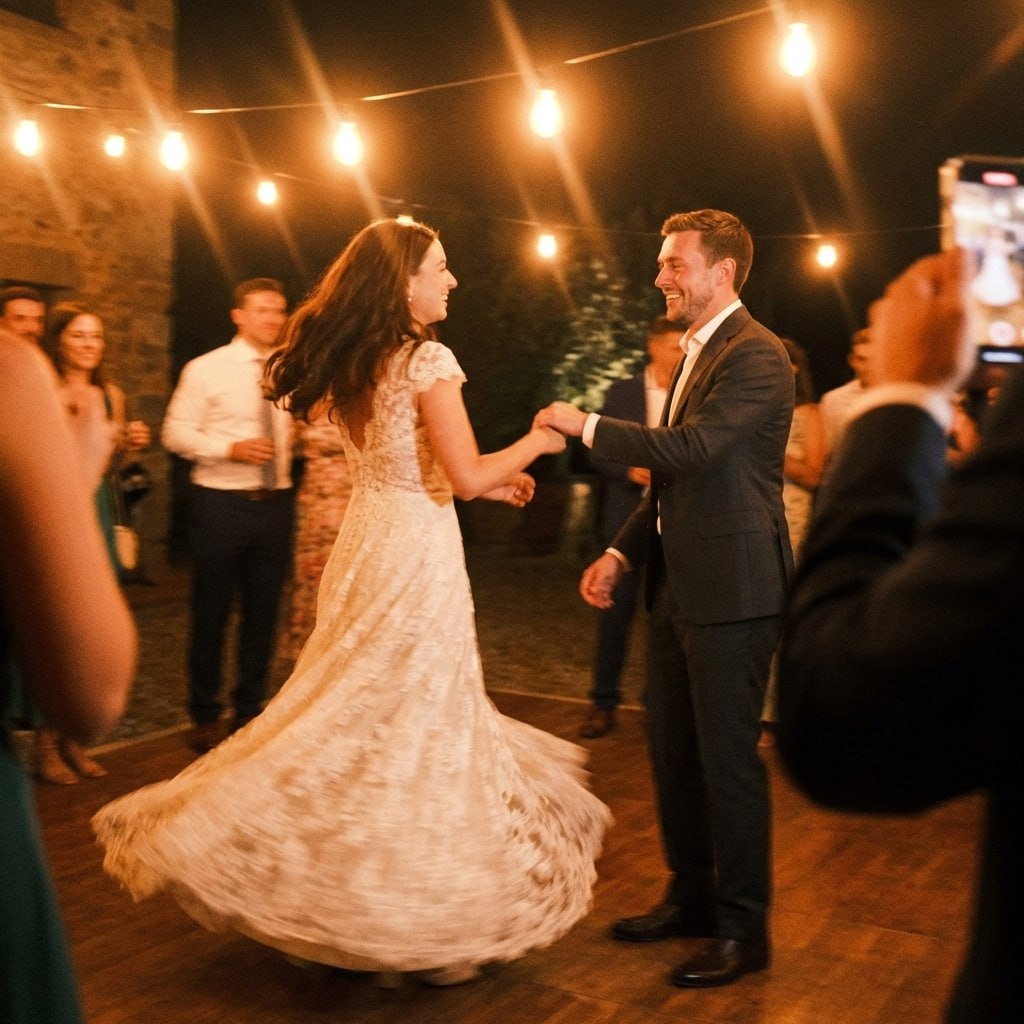

SCAN TO TRY
pix.wedding/
your-wedding
Song Timing for Each Dance
Use this as a starting point when you talk to your DJ or band about edits and fade points. These are typical ranges, not fixed rules, adjust to fit the songs you actually pick.
| Dance | Typical Placement | Length | Song-Length Tip |
|---|---|---|---|
| First dance | Opens the formal segment, right after entrance or after dinner | 2:00 to 3:00 | Ask the DJ to fade after the first chorus rather than let a full song play out. |
| Father-daughter dance | Right after the first dance | 1:30 to 2:30 | A shorter edit keeps energy from dipping before the mother-son dance. |
| Mother-son dance | Right after the father-daughter dance | 1:30 to 2:30 | If combining both parent dances into one song, budget closer to 2:30 to 3:00 total. |
| Wedding party dance | Bridge into open floor | 1:00 to 2:00 | Pick something upbeat, this is where the room should start to feel like a party. |
| Anniversary or money dance (if included) | Sometime during open dancing, not before it | Varies by guest count and format | Give the DJ a rough time window rather than an exact minute, these run at their own pace. |
| Last dance | End of the night, closing the reception | 2:30 to 3:30 | This is the one formal dance where a full-length song works well. |
DJ and MC Coordination Checklist
The dance segment is one of the most choreographed parts of the reception, but it only runs smoothly if your DJ or MC has the details ahead of time. Walk through this list at your final planning meeting.
Confirm final song choices and any specific edit points (fade, cut, or full length) at least two weeks out.
Give the DJ or MC correct pronunciation for every name that will be announced, including parents and wedding party members.
Flag any family sensitivities in advance, such as divorced parents, a deceased parent, or a stepparent who should be included, so the MC can phrase the introduction with care.
Decide who cuts in and when, for example whether the groom joins the father-daughter dance in its final seconds.
Tell the DJ the order you want if you are adding a money dance, anniversary dance, or other extra, and roughly when in the night it should happen.
Confirm the cue for the photographer and videographer so they are in position before the first dance starts, not scrambling once the music begins.
Ask the DJ to hold a wireless mic or handheld mic ready in case a parent or MC needs to say a few words before their dance.
Walk through the floor layout with the venue and DJ so the dance floor is clear and lit before the first dance begins.
Cultural and Family Dance Variations
The five-dance sequence above is the common baseline in the United States, but many families layer in additional dance traditions later in the night. These typically happen during open dancing, not as part of the formal opening sequence.
Money Dance (Dollar Dance)
Guests line up to pin or hand cash to the couple in exchange for a short dance, a tradition with roots that trace back to Polish immigrant communities and that has since been adopted across many cultures. It is an optional add-on scheduled during open dancing rather than part of the core sequence. See The Knot's guide to the dollar dance tradition for etiquette and how couples typically run it.
The Hora and Chair Lift
A circle dance common at Jewish weddings where guests dance around the couple and then lift them into the air on chairs. Bands and DJs usually place it early in open dancing while energy is highest. Read The Knot's explainer on the hora dance for its background and how the chair lift works.
Anniversary Dance
The DJ invites every married couple to the floor, then eliminates couples by years married until the longest-married pair remains. It is a distinct tradition from the money dance and works best mid-way through open dancing, once most guests are already on the floor.
None of these are required. If a tradition does not fit your family or your venue's timeline, it is common to skip it entirely and stay with just the core five-dance sequence.
When the Standard Order Does Not Fit
This order works well when
- Both parents (or clear stand-ins) are present and comfortable dancing in front of guests
- You want a formal, recognizable structure that guests and the DJ can anticipate
- Your reception has a sit-down dinner where a clear transition into dancing helps re-energize the room
Consider a different order when
- A parent has passed away or is estranged, in which case a sibling, grandparent, or close family friend can stand in, or the dance can be skipped with a quiet moment of acknowledgment instead
- You or your partner are uncomfortable being watched, in which case a short 60 to 90 second sway is a common substitute for a choreographed routine
- Blended families want both parents included, which some couples handle by splitting the dance in half between two parents
- Your venue has a tight turnover window and you would rather move straight into open dancing after one combined dance
Common Mistakes That Throw Off the Sequence
- Choosing a song without checking the length. A 4-minute first dance song with no edit plan feels much longer live than it does when you are listening at home.
- Not telling the DJ who dances with whom. Blended families and remarriages need the parent dances mapped out in advance so nobody is left standing awkwardly on the floor.
- Scheduling extras like the money dance too early. Doing it before open dancing has built momentum tends to feel forced, since most guests are not yet warmed up.
- No signal for the photographer. If your photographer or videographer is not cued before the first dance starts, the first few seconds, often the best ones, get missed.
- Letting the wedding party dance run too long. If it drags past two minutes before inviting other guests, the energy that built during the first dances starts to fade.
- Skipping the walkthrough with the venue. A dance floor that is not cleared, lit, or positioned correctly before the first dance starts creates a visible scramble on video.
Illustrative Example: A Sample Dance Segment
The walkthrough below is an illustrative example only, not a real couple's timeline, to show how the five-dance sequence plays out back to back once the reception is underway.
Couple is announced into the reception and moves straight onto the dance floor.
First dance begins, DJ fades the track around the 2:30 mark.
Father-daughter dance starts, groom cuts in during the last 20 seconds.
Mother-son dance follows immediately using the same transition.
DJ invites the wedding party, then married couples, then all guests to the floor.
Open dancing begins, formal segment is complete in about 11 minutes.
Example only. Your own timing will shift based on song choices, family size, and whether you add extras like a money dance or anniversary dance later in the night.
Quick Answers to Common Dance-Order Questions
Does the couple's first dance always come before the parent dances?
In the traditional order, yes. Some couples reverse this and have the parent dances happen first, then close the formal segment with the couple's first dance. Either order works as long as the DJ knows which one you want.
Can the wedding party dance be skipped?
Yes. Many couples skip a dedicated wedding party dance and move directly from the parent dances into open floor, with the DJ simply inviting everyone up at once.
Do we need a choreographed routine for the first dance?
No. A slow sway is the most common approach. Choreographed routines are optional and typically reserved for couples who enjoy performing or want a surprise moment for guests.
Dance Order Glossary
Formal dance segment
The block of scheduled dances from the first dance through the wedding party dance, before general open dancing begins.
Open floor
The point in the night when the DJ or band opens the dance floor to all guests with no more scheduled formal dances.
Cut in
When a second person joins a dance already in progress, such as the groom joining the father-daughter dance near its end.
Last dance
The final song of the night, danced by the couple alone, that signals the reception is ending.
Anniversary dance
A tradition where married guests are eliminated by years married until the longest-married couple remains on the floor.
Money dance
Also called a dollar dance, guests pay for a short dance with the couple as a gesture of financial support.
Make Sure Every Dance Gets Captured
A professional photographer usually gets one great angle of the first dance and the parent dances. Guests sitting at other tables see a completely different view, the father wiping his eyes, the groom's reaction during the mother-son dance, the moment the whole family gets pulled onto the floor for the hora. Those angles disappear unless guests have an easy way to share what they capture on their phones. A shared QR-code photo album lets everyone's shots land in one place without anyone needing to download an app or remember to text photos later.
Related Reception Planning Guides
Capture the Whole Dance Floor, Not Just One Angle
From the first dance to the last, guests see moments your photographer misses. Give them one QR code and collect it all in a shared wedding album.
Start Your Free AlbumWhen Do the Dances Happen at a Wedding Reception?
The formal dances usually happen right after the couple's grand entrance into the reception. Some couples prefer to eat first and dance once the main course is cleared. Neither approach is wrong, but dancing before dinner keeps energy high and gives photographers better light at evening weddings.
If you are hosting a cocktail hour before the reception, the dances typically start once guests have moved from the cocktail space into the main reception room. Your DJ or band leader coordinates the announcements once the room is ready.
- •Before dinner keeps energy high and gives photographers strong natural light
- •After dinner lets the couple eat without rushing and gives guests time to settle in
- •Between courses is a compromise some formal sit-down receptions use
- •Whichever you choose, confirm the timing with your DJ and caterer in advance so cues line up
How to Handle Special Family Circumstances
Not every family structure fits the traditional father-daughter, mother-son mold. If a parent has passed away, consider dancing with a sibling, grandparent, or close family friend instead. Some couples honor an absent parent with a moment of silence or a reserved seat before the dance begins.
Blended families may want to include stepparents. One common approach is splitting the dance in half, dancing part of the song with one parent and the rest with another. Whatever you decide, tell the DJ or MC the plan in advance so the transition on the floor is smooth rather than improvised in the moment.
If You or Your Partner Do Not Like Dancing
If dancing in front of a crowd makes you uncomfortable, you are far from alone. Many couples choose a simple slow sway instead of a choreographed routine. Stand together, hold each other close, and move gently. Nobody expects a performance.
Another option is to keep the first dance short, under 90 seconds, and invite the wedding party or all guests onto the floor right away. This shifts the spotlight off the couple quickly and gets the party moving faster.
Explore more free wedding tools
Everything you need to make your wedding day stress-free and unforgettable.
QR Sticker Designer
Design custom print-ready stickers.
Photo Sharing QR
The best way to collect guest photos.
Hashtag Generator
Create unique wedding hashtags.
How to Collect Guest Photos
5 methods ranked by participation rate and ease.
Share Wedding Photos with Guests
Compare every sharing platform by ease and participation.
Best Way to Get Guest Photos
The single method with the highest participation rate.
How to Make a Shared Wedding Album
Step-by-step setup for every platform.
Alternative to Disposable Cameras
Better, cheaper options than disposable cameras.
Order of Dances at Wedding Reception FAQ
Straight answers to the questions people ask most about this topic.
The traditional order is: first dance (the couple), father-daughter dance, mother-son dance, wedding party dance, then open floor for all guests. The full formal segment usually takes about 10 to 15 minutes before the floor opens to everyone.
In the traditional sequence, yes, the parent dances lead directly into the wedding party dance, which then bridges into open dancing. Some couples reorder this or combine both parent dances into a single song to shorten the segment.
The money dance is an optional add-on, not part of the core formal sequence. It is typically scheduled sometime during open dancing, after the room has already warmed up, rather than before the first dance or parent dances.
Aim for 1.5 to 3 minutes per dance. The first dance can run slightly longer at 2 to 3 minutes, while parent dances and the wedding party dance usually work better shorter, around 1.5 to 2.5 minutes, to keep momentum moving toward open dancing.
Yes. There is no rule requiring parent dances. Some couples go straight from the first dance into the wedding party dance and open floor, especially when a parent is not present or the couple prefers a shorter formal segment.
The anniversary dance, where married couples are eliminated by years married, typically happens mid-way through open dancing once most guests are already on the floor. It is a separate tradition from the money dance and is not part of the initial five-dance sequence.