
Will My Wedding Guests Bother to Use a Photo Sharing App?
Short answer: yes, if you remove the two things that kill participation before it starts. Here is the funnel that explains the drop-off, guest by guest.
See the No-App SetupThe short answer
Yes, guests use photo sharing at weddings, but only when the ask is genuinely small. The two things that kill participation are an app download and an account signup. Remove both, so a guest can scan a code, land straight on a browser upload page, and tap once, and most of the "nobody used it" fear disappears. This is not a guest enthusiasm problem. It is a friction problem, and friction is entirely within the couple's control at the planning stage.
The friction funnel: where guests drop off
Every photo-sharing setup, app or QR code, asks a guest to move through the same four stages. Guests do not drop off randomly. They drop off at specific, predictable points depending on what the flow asks of them.
See
Low drop-offA sign at the table, a mention from the DJ, a line on the invitation. This stage has near-universal reach if repeated more than once. Almost nobody drops off here; the failure mode is simply not saying it enough times or in enough places.
Scan
Low drop-offGuest opens their camera app and points it at the code. Modern iPhones and Androids both recognize QR codes natively through the camera, no separate scanner app needed since iOS 11 and Android 9. This stage loses very few people today; QR scanning itself stopped being unfamiliar years ago.
Open
High drop-off (app-store path only)This is the fork in the road. If the code opens a webpage directly in the browser, almost everyone who scanned continues. If the code routes to an app store listing, a large share stop here: they see 'Install' and decide it is not worth it for one event. This single fork explains most of the participation gap people blame on 'guests just don't bother.'
Upload
Moderate drop-off (if account required)If the page also demands an account, an email, or a password before the upload button appears, a second wave leaves here. If the upload button is right there with no signup, this stage keeps almost everyone who made it past Open.
Read the funnel again: three of the four stages barely lose anyone. Only the stages that add an app-store install or an account signup create real drop-off. That is the entire behavioral case for a browser-based flow over an app-based one.
Four guest types, four different reasons to drop off
"Guests" is not one group. Each type at a typical wedding has a different reason it might not participate, and a different fix.
Grandparents and older relatives
What they need
Comfortable with their phone's camera, uneasy about app stores and new logins. They will scan a code and tap an upload button. They will not sit through an install-and-signup flow at a reception.
College friends and younger guests
What they need
Technically capable of anything, but their attention span for a one-time app is close to zero. They already have Instagram and their camera roll; asking for a new app for one night competes with apps they open every day.
Coworkers and plus-ones
What they need
The least emotionally invested group and the most likely to skip anything that feels like effort. They need the lowest possible bar: no download, no account, a scan and a tap, or they simply will not bother.
The kids' table
What they need
Kids and teens will happily photograph everything, but usually on a parent's phone or their own without adult supervision of an app install. A browser link a parent can hand over for thirty seconds works; an account they need help creating does not.

Grandma's shot
No app needed
No install screen. No signup form. Just a scan.
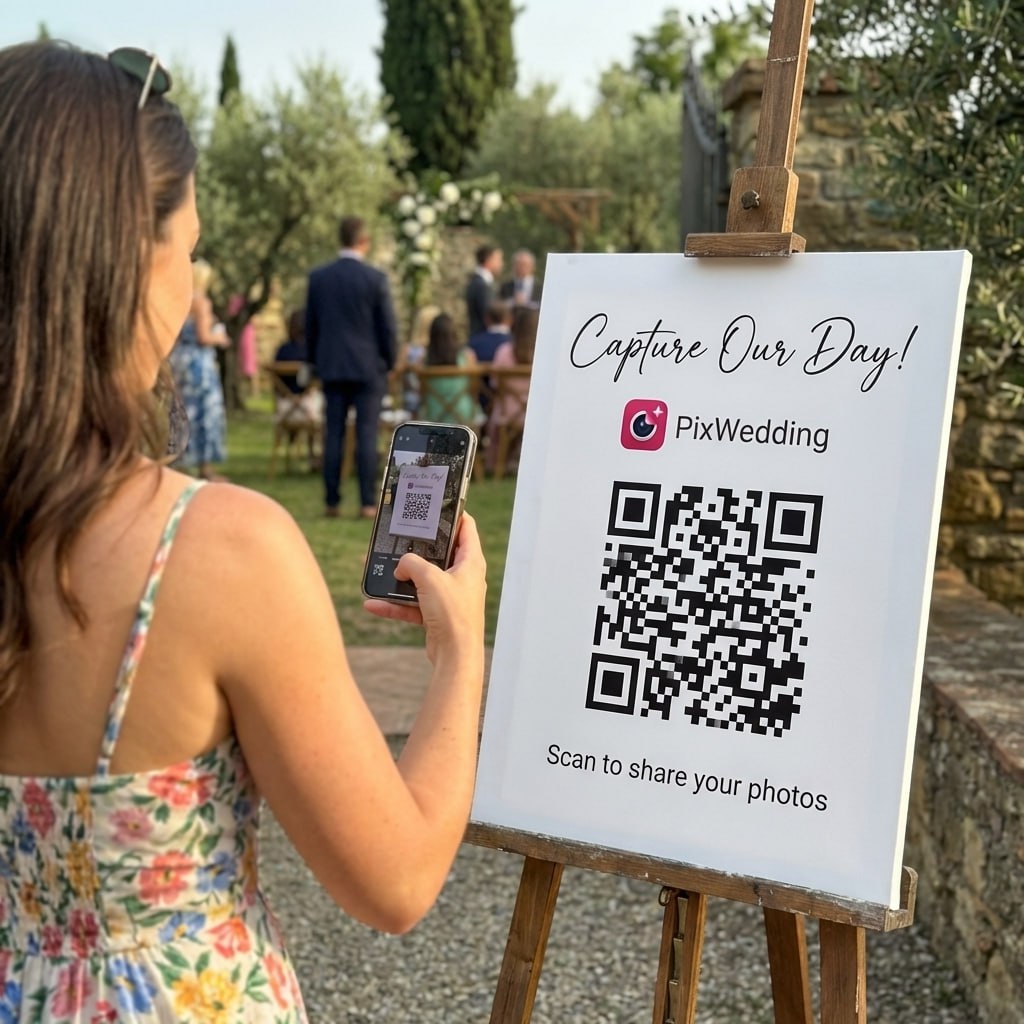
Pix Wedding opens straight in the guest's browser. Scan, upload, done, whether they're 8 or 80.

From Mom
Scan to join the album
No app, no account
UPLOADING
Saving your moment
THE ALBUM
Emma & Jack
June 21, 2026
647 photos · 95 guests






SCAN TO TRY
pix.wedding/
your-wedding
App-install flow vs browser-based flow
Not every app-based system is bad and not every QR code is good. The dividing line is whether the code leads to an app store or a webpage. Here is the honest comparison of each path.
App-install flow (QR code leads to an app store)
Pros
- Can offer richer features once installed: filters, live slideshows, guest chat.
- Guests who do install tend to open it repeatedly through the event.
Cons
- Loses guests at the install screen before they ever see the app.
- Needs storage space and a wait for the download to finish mid-event.
- Some guests will not install anything for a one-time use case, regardless of age.
- Support burden: "it's stuck on installing" becomes the couple's problem on the day.
Browser-based flow (QR code opens a webpage)
Pros
- No install step, no wait, no storage space needed on the guest's phone.
- Works the same on iPhone and Android with no separate app to maintain.
- Guest is uploading within seconds of scanning, while the moment is still fresh.
- No account required means no forgotten password mid-reception.
Cons
- Fewer in-app social features like live commenting compared to a full native app.
- Guests will not return to a browser tab the way they might reopen a home-screen app icon.
When guests engage, and what to say at each moment
Participation is not evenly spread across the day. It clusters at a few specific windows. Hitting those windows with the right prompt matters more than any amount of signage.
Cocktail hour
Guests are relaxed, phones are already out for candid shots, and there is unstructured downtime. First mention here plants the idea before anyone forgets.
Reception seating / dinner lull
There is a natural pause between courses or toasts. A second mention here catches guests who missed the first one and reminds uploaders to keep going.
Dancing / open floor
The highest volume of genuinely fun candid photos happens here, but phones are also least likely to be checked mid-dance. A table sign matters more than an announcement at this point.
Right before the last dance or send-off
A final reminder from the DJ catches guests who have photos saved up from the whole night and are about to leave without uploading them.
The next morning
Some of the best candid shots get taken and forgotten. A short thank-you text or group message the next day with the link again recovers a real slice of late uploads, especially from guests who traveled and only reviewed their camera roll once home.
Fill-in-the-blank scripts for the DJ, MC, and officiant
An unscripted "oh yeah, and there's a QR code somewhere" mention gets ignored. A short, specific line said with energy gets acted on. Send these to your DJ or MC in advance, filled in with your details.
DJ/MC script, cocktail hour
"Hey everyone, grab a drink and find your seats in a bit, but first: see the QR code on your table? Point your camera at it, no app to download, and every photo you take tonight lands straight in [Couple names]'s album. We want the shots we'll never see, so scan it now while you remember."
DJ/MC script, dinner lull
"Quick reminder while dessert comes out: that QR code on the table works all night, no login, no app. If you've got photos from the ceremony sitting on your phone, now's a good time to upload them before you forget."
Officiant or toast-giver script, ceremony close
"Before we head to cocktail hour, [Couple names] wanted me to mention: there's a photo code on your programs. Scan it anytime today, it just opens in your browser, and share what you see through your own eyes. They'd love to see the wedding from your side of the room."
Final send-off script
"Last call before the send-off: if you've still got photos on your phone from tonight, the QR code is still live, no rush, no app, just scan and upload whenever you get a second. Thank you all for celebrating with [Couple names] tonight."
Signage placement: what works and what gets ignored
Do
- Put a small code on every table, not just one large sign at the entrance.
- Repeat the code on the printed program or ceremony seating card, where guests are already looking.
- Print it large enough to scan from arm's length, roughly 1.5 inches square minimum.
- Add one plain-language line under the code: "Scan with your camera, no app needed."
- Place a copy near the guest book or gift table, a spot guests naturally pause at.
Don't
- Rely on a single sign at the entrance that nobody sees again after cocktail hour.
- Print the code so small it needs a guest to walk up and lean in to scan it.
- Place it only in dim areas like the dance floor where phone cameras struggle to focus.
- Assume the sign alone replaces a verbal mention. Signage and announcements work together, not as substitutes.
- Use jargon like "scan to access our gallery portal." Say what happens in plain words.
Signs your guests genuinely will not use it, and the fix for each
Some setups really do fail. If any of these describe your plan, it is worth changing before the wedding, not after.
The QR code links to an app store listing, not a webpage.
Fix: Switch to a service where the code opens directly in the browser. This single change removes the biggest drop-off point in the whole funnel.
Guests need to create an account or password before uploading.
Fix: Use a tool that allows anonymous upload. Nobody wants to invent a password at a reception. Collect names optionally, after the photo is already in.
The only signage is one sign near the guest book, mentioned zero times out loud.
Fix: Add table signage and get a verbal mention from the DJ or MC at two or three points in the timeline, per the script section above.
The venue has known dead zones for cell signal, like a converted barn or basement reception hall.
Fix: Check whether the tool works offline and syncs later, or confirm venue WiFi is available and the password is posted next to the code.
You are relying on guests to remember a URL or hashtag instead of scanning something.
Fix: A code guests scan beats a hashtag or URL they have to type correctly. Typing an unfamiliar handle is its own friction point.
Nobody has tested the scan-to-upload flow on a real phone before the wedding.
Fix: Scan it yourself on both an iPhone and an Android phone a week before the wedding. If it takes more than two taps to reach an upload button, simplify it.
What the data on app friction says
None of this is wedding-specific research; there is no independently audited study of wedding QR code participation rates. What does exist is general research on app-install behavior, which explains the same pattern.
21%
of users abandon a newly installed app after just one use, according to app-engagement research from Itransition. A one-night wedding app is exactly the kind of single-use case this describes.
~50%
of downloaded apps get deleted within the first 30 days, per data compiled by TekRevol. Wedding photo apps rarely get a second use, which puts them squarely in this pattern.
Treat with caution
Photo-sharing vendor Snapeen publishes an 85% vs 23% QR-vs-app participation claim drawn from its own platform data. It is not an independently audited study, has no published methodology, and should be read as marketing rather than fact. It points in the same direction as the general app-friction research above, but the specific numbers are unverified.
A thread on The Knot's community forum shows couples actively asking each other whether a QR code photo app is worth setting up, and other couples answering with their own experience. It is anecdotal, not data, but it confirms the demand and the doubt both exist among real couples planning real weddings, which is the honest starting point for this question.
Disposable-camera vendor Posable published a full article arguing guests will not use QR code apps. It cites zero statistics and two testimonials for its own product. The underlying complaints it raises, forgetting the code and poor venue signal, are real, but the piece exists to sell disposable cameras, not to inform the decision.
Glossary: the terms couples mix up in this decision
App-install flow:
A QR code or link that sends the guest to an app store page, where they must tap Install, wait for the download, then open the app before they can do anything.
Browser-based flow:
A QR code or link that opens a normal webpage in the guest's existing browser (Safari, Chrome). No install, no app store, no separate icon added to the home screen.
Native camera QR scanning:
The built-in ability of a phone's default camera app to recognize a QR code without a separate scanner app. Standard on iPhone since iOS 11 and on most Android phones since Android 9.
Account wall:
Any requirement to create a username, password, or email login before a guest can upload a photo. The second-largest source of drop-off after the app-store fork.
Guest-origin visit:
A page view or upload that came from a QR scan or a shared link, as opposed to someone finding the page through search. This is the number that reflects real wedding-day participation.
Keep reading
This page answers the behavioral doubt: will people bother. If you have already decided the behavior works and want the cost and ROI case, or you already ran a QR code and it underperformed, these cover the adjacent questions.
When a photo sharing setup is worth doing, and when to skip it
It makes sense when
- You have 50 or more guests and cannot personally text everyone for their photos afterward.
- Your guest list spans multiple generations and phone types.
- You are willing to have the DJ or MC mention it more than once.
- You pick a browser-based tool, not one that routes through an app store.
It is probably not worth it when
- You have a very small, intimate wedding of under 20 people where everyone is already in one group chat.
- Nobody is willing to announce it or place signage, and you plan to rely on the sign alone.
- You are set on an app that requires a download, and you accept a smaller participation rate as a tradeoff for its extra features.
Why the fear feels bigger than the reality
Couples researching wedding photo sharing tend to find the same worry repeated across forums and comment sections: what if we set this up and nobody uses it. That fear is reasonable. It comes from real memories of apps sitting unused on a phone, or a QR code sign nobody scanned at a previous event. The mistake is treating it as a fact about weddings instead of a fact about a specific kind of app.
The apps people remember failing were usually ones that asked for a download and a signup before showing any value. Guests who are mid-celebration, holding a drink, dressed up, and only mildly curious will not clear that bar. They will clear a much lower bar: point the camera app at a code, tap once, upload. The fear is real. The fix is not more enthusiasm, it is removing the two steps that kill enthusiasm before it can act.
What predicts whether a wedding sees strong guest participation
Across the pattern that shows up in forums, vendor case notes, and general app-adoption research, three variables predict participation far more than the guest list's age or tech comfort: whether an app install is required, whether an account or login is required, and whether someone verbally reminds the room at the right moments. Venues with weak signal also matter, but it is a distant fourth compared to those three.
None of those three variables are about the guests. They are about the setup choice the couple makes months before the wedding. That is the useful reframe: guest participation is mostly decided at the planning stage, not on the dance floor.
Explore more free wedding tools
Everything you need to make your wedding day stress-free and unforgettable.
QR Sticker Designer
Design custom print-ready stickers.
Hashtag Generator
Create unique wedding hashtags.
How to Collect Guest Photos
5 methods ranked by participation rate and ease.
Share Wedding Photos with Guests
Compare every sharing platform by ease and participation.
Best Way to Get Guest Photos
The single method with the highest participation rate.
How to Make a Shared Wedding Album
Step-by-step setup for every platform.
Alternative to Disposable Cameras
Better, cheaper options than disposable cameras.
Alternative to Wedding Photo Booth
5 cheaper alternatives to a $1,000+ photo booth rental.
Guest participation, answered
Straight answers to the questions people ask most about this topic.
Most will, if the ask is small. The data on app downloads shows people abandon apps constantly, not because they dislike the idea, but because installing something new for a one-time event is a real barrier. A browser-based QR flow removes that barrier entirely: guests scan, a page opens, they upload. No install, no account, no password to invent at a reception.
There is no independently audited industry-wide number, and you should be skeptical of any site that states one as fact. Vendors sometimes cite specific participation percentages from their own platform data, which is marketing, not third-party research. What is well established is the mechanism: every extra step (app store, install, account creation) loses a meaningful slice of guests, and removing those steps recovers most of that group.
Yes, more reliably than most couples expect, as long as the flow ends at a normal camera-app scan and a webpage, not an app store listing. Older guests are usually comfortable with their phone's built-in camera and a simple upload button. Where they drop off is app store friction: choosing to install, waiting for a download, creating a login. Skip those steps and the age gap mostly disappears.
Timing and repetition beat signage alone. The DJ or MC announcing it once during cocktail hour, once during a dinner lull, and once before the last dance covers the three moments guests are most likely to act. A single sign at the entrance that nobody mentions again gets scanned by a fraction of the room.
Functionally these are the same decision if the QR code leads to an app store. The distinction that matters is app-install vs browser-based. A QR code that opens a webpage in the guest's existing browser removes the install step; a QR code that leads to an app store re-introduces it. Pick the flow, not the label.
That article is the cost and ROI question: is the price and setup effort worth it compared to a photographer or disposable cameras. This page is the behavioral question underneath the purchase decision: will people you already invited use it once it exists. They are meant to be read together if you are still deciding.