


pixPix Weddingwedding
2026 Comparison

Disposable Cameras vs QR Code at Weddings: The 2026 Comparison

The direct verdict: QR code photo sharing is cheaper, faster, and produces more photos at the average 2026 wedding. Disposable cameras cost $575-960 for a 150-guest event (including developing and scanning), take 3-14 days to see results, and produce 570-680 usable shots. A free QR code setup produces 800-1,800 photos, available live during the reception, at zero cost. Disposables still win for couples who deliberately want the film aesthetic - but only under good lighting conditions.

Cost Comparison by Wedding Size

All-in cost including developing, scanning, and QR setup

Wedding Size
Disposable Cameras(cameras + developing + scan)
QR Code Sharing(including QR sticker printing)
Savings with QR
100 guests
$345 - $640
$0 - $15
$330 - $625
150 guests
$575 - $960
$0 - $15
$560 - $945
200 guests
$750 - $1,280
$0 - $39
$711 - $1,241

Disposable costs: 1 camera per 4-5 guests + developing at $12-18/roll + $20-40 scan fee. QR costs: Pix Wedding free to $39 premium.

5 Dimensions of Comparison

Head-to-head across the factors that matter most to couples

Cost (150 guests)

Winner: QR Code
Disposable Cameras

$575 - $960 total

QR Code Sharing

$0 - $39 total

Photo Quality

Winner: QR Code
Disposable Cameras

Grainy, soft, low-light issues

QR Code Sharing

12-50MP, night mode, instant

Immediacy

Winner: QR Code
Disposable Cameras

3-14 days after wedding (developing)

QR Code Sharing

Live during reception

Guest Effort

Winner: Tie (both easy)
Disposable Cameras

Pick up camera, point, click

QR Code Sharing

Scan QR, select photos, upload

Environmental Impact

Winner: QR Code
Disposable Cameras

Plastic + batteries + chemicals

QR Code Sharing

Near zero physical waste

When Disposable Cameras Still Win

3 specific scenarios where film makes sense in 2026

Intentional analog aesthetic weddings

Couples who want a curated film look for their wedding gallery and are willing to pay for it. Works best for outdoor daytime ceremonies with good natural light.

Tech-averse older guest demographics

If a large portion of your guests are 70+ and unfamiliar with smartphones, disposable cameras are more intuitive. Physical cameras need no instruction beyond "point and click."

Venue with poor or blocked WiFi and cellular

Some venues (basements, rural barns, thick-walled historic buildings) have dead zones where QR upload fails. Disposables are network-independent.

When QR Code Wins

5 scenarios where QR code sharing is the clear choice

  • Budget is a concern: QR code sharing costs 15-25x less than a full disposable camera setup

  • You want photos in real time during the reception, not 2 weeks later

  • Your wedding has 120+ guests - disposables simply cannot cover the whole event

  • Indoor or evening reception where disposable flash range and film grain create unusable shots

  • You care about environmental impact - each disposable camera adds plastic and chemical waste

Hidden Costs of Disposable Cameras

The costs couples forget when budgeting

Cost Item
Typical Cost
Note
One-hour lab developing
$12-18/roll
Most labs charge per-roll; one camera = one roll
Mail-order developing
$8-12/roll + $8-15 shipping
Cheaper per roll but adds 5-10 days wait time
Digital scan fee
$20-40 per order
Required to get digital files; often not included in developing price
Camera loss (avg 2-4 cameras)
$20-56 wasted
Cameras left at bar, taken by wrong guest, or simply missing at end of night
Table distribution labor
$0-50
Someone must place and collect cameras across all tables, often a coordinator task
Unused exposures
Embedded in developing cost
Half-used cameras still cost full developing price

Photo Quantity: What to Expect

Realistic yield at a 150-guest wedding

30 disposable cameras (27 exposures each)

Raw Shots / Uploaders

810 exposures

Usable Photos

570-680 usable (70-84%)

QR code sharing (150 guests, 38% participation)

Raw Shots / Uploaders

57 uploading guests

Usable Photos

570-1,140 photos (avg 10-20 per guest)

QR code sharing (150 guests, 45% participation)

Raw Shots / Uploaders

67 uploading guests

Usable Photos

670-1,340 photos

Disposable usable rate is based on typical indoor/mixed-light reception conditions. Outdoor daytime usable rate may reach 85-90%.

Quality Realism: Film vs Smartphone in 2026

What the photos actually look like

Disposable Camera Photos

  • Warm grain and soft focus: distinctive film look
  • Max effective resolution: ~3-4MP equivalent after scanning
  • Flash range: 8-10 feet (beyond this = dark/underexposed)
  • Outdoor daytime: generally good
  • Indoor evening: 20-30% unusable rate
  • Color accuracy: warm cast, vintage palette
  • Print quality: excellent for 4x6, soft at 8x10+

Guest Smartphone Photos via QR

  • Resolution: 12-50MP depending on device (2020+ smartphones)
  • Night mode: automatic low-light enhancement on iPhone 13+ and equivalent Android
  • Flash: phone flash effective at 15-25 feet
  • Outdoor and indoor: consistently usable
  • Color accuracy: true-to-life or AI-enhanced
  • Print quality: excellent at 12x18 and beyond
  • Video: supported on all major QR sharing platforms

Guest Experience Comparison

Effort to use, fun factor, and drunk-friendliness (a real factor)

Ease of use

5/5 - point and click
4/5 - scan and upload (2 steps)

Fun factor

5/5 - physical, tactile, nostalgic
3/5 - familiar but not novel

Drunk-friendliness

5/5 - no login, no phone needed
4/5 - requires working phone and camera access

Photo coverage

3/5 - limited to cameras at each table
5/5 - every guest with a phone can contribute

Instant gratification

1/5 - wait 3-14 days to see results
5/5 - photos appear live on gallery and slideshow

Guest keeps something

5/5 - no (cameras are collected)
5/5 - can download their own photos after

The Hybrid Approach: Using Both

When and why to combine disposables with QR code sharing

Many couples find the best outcome by using a reduced number of disposable cameras alongside a QR code sharing system. Instead of 25-30 cameras, place 8-12 cameras at selected tables and in the photo booth area. Use QR code sharing as the primary collection method. This strategy cuts disposable camera costs by 55-65% while preserving the film aesthetic for a curated subset of shots.

1

Place 8-12 disposable cameras

Head table, parents tables, photo booth corner. Label each with the table number.

2

Set up QR code at every table and entrance

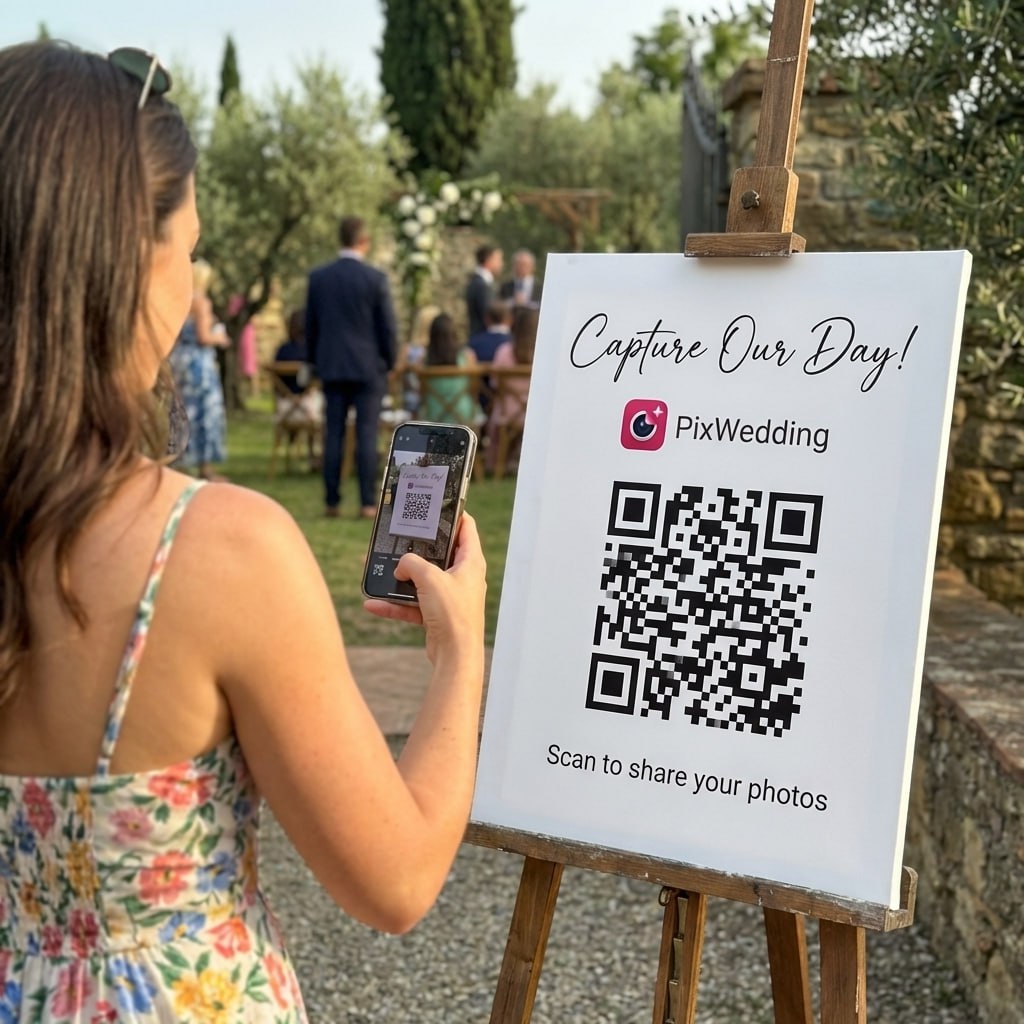
Use Pix Wedding's free QR code. Print on table cards or a welcome sign for maximum visibility.

3

Announce both options at the start of reception

DJ or MC mentions both: "Grab a camera at your table OR scan the QR code to upload from your phone."

4

Collect cameras at end of night

Assign one person (coordinator, family member) to collect all cameras before guests leave.

Hybrid cost estimate for 150 guests: $115-$190 (10 cameras + developing + $0 QR) vs $575-960 for disposables-only.

Related Wedding Photo Resources

The QR side wins on every metric.

Better photos, lower cost, instant access, and no post-wedding developing runs. Pix Wedding gets you started for free with one printable QR code.

From Mom

From Mom

9:41

ALBUM

Emma & Jack

June 14, 2026

634 photos · 94 guests

AllMomentsMine
Wedding guest photo 1 from album preview
Wedding guest photo 2 from album preview
Wedding guest photo 4 from album preview
Wedding guest photo 5 from album preview
Wedding guest photo 6 from album preview
Wedding guest photo 7 from album preview
Wedding guest photo 8 from album preview
Wedding guest photo 9 from album preview
Wedding guest photo 10 from album preview
Add photosShare your moments
Table 4 just uploadedSarah B. · +12 new photos

The Real Cost Breakdown: Disposable Cameras vs QR Code

The sticker price on a disposable camera is $10-14. The actual cost is 3-4 times higher once you factor in developing, digital scanning, shipping, and the cameras that go unused or missing. A 150-guest wedding budget for disposable cameras realistically lands between $575 and $960.

QR code photo sharing costs vary from $0 (Pix Wedding free plan) to $39-59 for premium apps. Even at the highest end, QR code sharing is 15-25x cheaper than a full disposable camera setup.

  • Disposable camera purchase (25-30 cameras): $250-$420
  • Film developing per roll: $12-18 at 1-hour labs, $8-12 mail-order
  • Digital scanning (if not included): $20-40 extra per order
  • Shipping for mail-order developing: $8-15
  • Expected camera loss at average wedding: 2-4 cameras ($20-56 wasted)
  • QR code sharing (Pix Wedding free): $0
  • QR code sticker printing for table cards: $5-15 total

What the Photos Actually Look Like: A Realistic Quality Assessment

Disposable camera photos have a distinctive look: slightly overexposed highlights, warm color casts, soft grain, and a flatness to shadows. Many couples love this aesthetic intentionally. It reads as nostalgic and analog. On a sunny outdoor wedding, results can be genuinely beautiful.

The problem is that wedding receptions happen indoors at night. Disposable cameras flash up to 10 feet. Tables at 12 feet get underexposed shots. Candid dance floor moments in low light are frequently unusable. The grain that looks charming in sunlight looks muddy in low-light.

Guest smartphone cameras in 2026 have night mode, computational photography, and sensors that outperform dedicated point-and-shoot cameras from 2010. A guest photo uploaded via QR code from an iPhone or Samsung flagship can be printed at 12x18 inches. A disposable camera photo scanned at standard lab resolution maxes out at roughly 4x6 print quality from the file size alone.

Environmental Impact: The Facts

Each disposable camera contains a lithium battery, plastic casing, chemical film, and requires chemical developing with developer and fixer solutions that are regulated hazardous waste in most US states. A 30-camera wedding generates roughly 30 lithium batteries and 30 plastic camera bodies.

QR code photo sharing has essentially zero physical waste. The environmental case for digital sharing is clear-cut. For eco-conscious couples, the hybrid approach (5-10 cameras instead of 25-30) is a reasonable middle ground that preserves the aesthetic while reducing waste by 60-70%.

Explore more free wedding tools

Everything you need to make your wedding day stress-free and unforgettable.

Common questions from couples choosing between film and digital

Disposable Cameras vs QR Code: FAQs

Everything you need to know about our free tools and how they help your wedding day.

For a 150-guest wedding you typically need 25-30 disposable cameras (one per table plus spares). At $10-14 per camera plus $12-18 per roll for developing plus $20-40 for digital scanning, the total cost ranges from $575 to $960 - and that is before factoring in lost or unused cameras.

With a well-promoted QR code, the average 150-guest wedding receives 800 to 1,800 photo uploads. Each guest uploads an average of 6-12 photos when the process is frictionless (browser-based, no app download). Disposable cameras at the same wedding typically yield 600-900 usable shots total, with 15-25% too blurry or too dark to use.

Disposable camera photos in 2026 produce grain, soft focus, and color casts that many couples find charming - but only in good light. Indoor reception shots are frequently underexposed, flash range is limited to 8-10 feet, and 20-30% of shots at the average wedding are technically unusable. Guest smartphone photos via QR code average 12-50 megapixels with night mode and AI processing.

Yes, and many couples do. The hybrid approach works well: place 10-15 disposable cameras (not 25-30) at selected tables for the analog aesthetic, and use QR code sharing for the bulk of guest photos. This cuts disposable camera costs by 50-60% while preserving the film look for a curated set of shots.

Lost cameras mean lost photos with no recovery option. At the average wedding, 2-4 cameras go missing. That is 54-108 potential shots permanently lost. QR code uploads are stored in the cloud immediately after upload, so a lost or broken phone does not affect the photos already submitted.

When the QR code is prominently placed (table cards, welcome sign, wedding program) and the upload process is browser-based (no app download), participation rates average 35-45% of guests. That means 52-67 guests uploading at a 150-person wedding. With disposable cameras, participation is limited to whoever picks up a camera at their table.

Disposable Cameras vs QR Code at Weddings: The 2026 Comparison | Pix Wedding