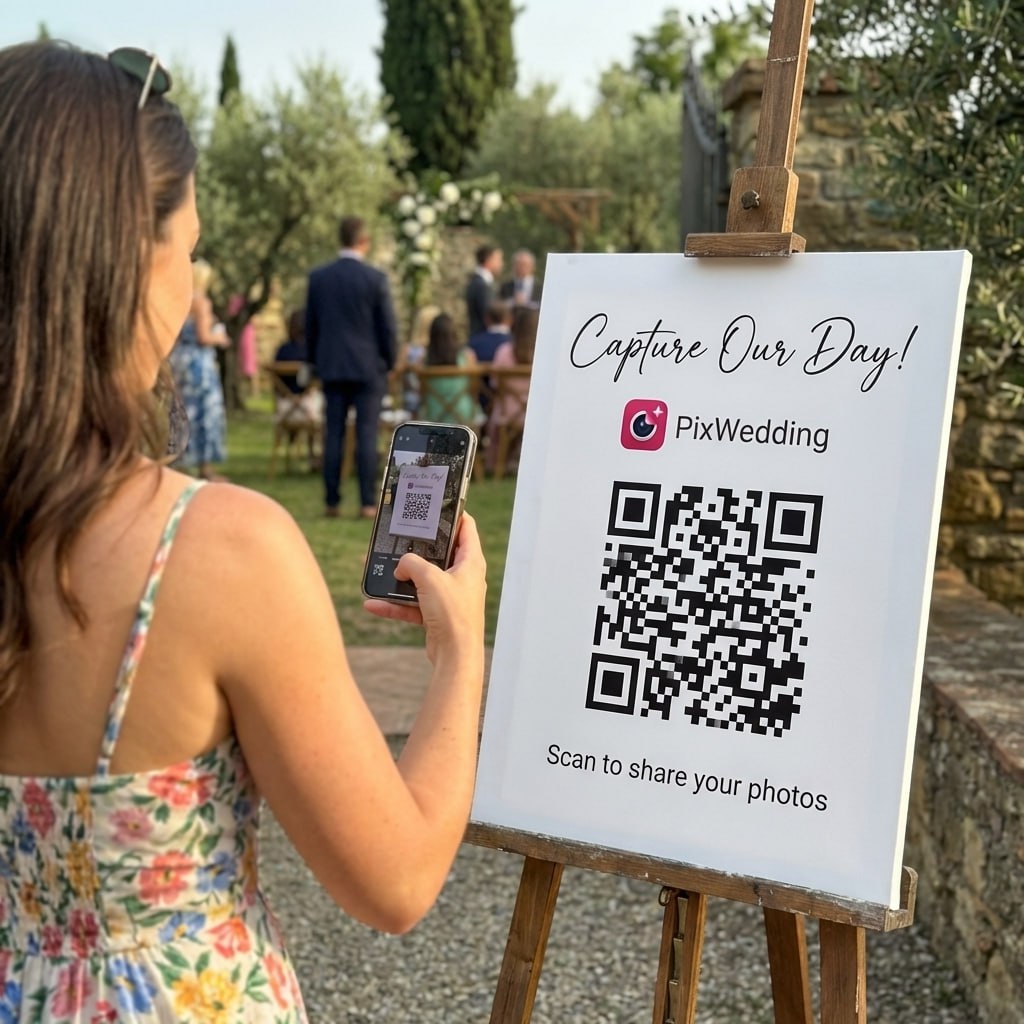
Are wedding photo sharing apps private? Who can see your photos
Most wedding photo sharing apps are private from strangers but not from forwarding: the album sits at an unlisted address anyone with the link or QR code can open. Below is private wedding photo sharing laid out plainly: who can see what, whether Google can list the album, what a phone photo gives away about where it was taken, other people's children, GDPR, and what delete removes. Checked against Google, Apple and each app's own pages on 27 September 2026, plus a 10-question audit you can run on any app, this one included.
Most wedding photo sharing apps are private in one specific way: the album lives at an unlisted address that only people holding the link or the QR code can open, and nothing is posted to a public feed. That is enough to keep strangers and search engines out when the app blocks them. It is not end-to-end encryption, and it does not stop a guest from forwarding the link.
So the real questions are practical ones. How does a guest get in, can Google list the page, can you hide the album from guests, does a photo carry its GPS location, who owns the files, and what does delete remove. The sections below answer each one with the source, and the audit near the end turns them into ten questions you can put to any app.
Private means unlisted, not encrypted end to end Anyone holding the link or QR can open it Search engines only stay out if the app blocks them Photos can carry the place they were taken Deletion rules differ app to app
4.29 billion
possible Pix album codes8 random hexadecimal characters, 16 to the power of 8
0
guest accounts neededthe trade that makes QR albums easy and forwardable
3
separate locks to checkwho gets in, who can list it, who can see inside
02Can guests see all the photos?
Private wedding photo sharing: who can see what
Four groups can end up near a wedding album. This map shows what each one can do on a Pix Wedding album, straight from how the product works. Most QR albums follow the same shape; the switches are what differ from app to app.
Your albumpix.wedding/upload/event-3f9a1c7e
The couple
Signed in to the dashboard
Upload
See every photoAlways, also during a film roll
DownloadSingle files, plus the ZIP on paid plans
Delete from storageOnly the couple can delete
Guests with the QR
Scanned the sign at the wedding
UploadNo app, no account
See the photosOnly while Guests can view is on
DownloadOnly while Guests can download is on
Delete from storage
Anyone they forward it to
Got the link in a group chat
UploadA forwarded link works like the QR
See the photosSame switch as guests
DownloadSame switch as guests
Delete from storage
Search engines
Googlebot, Bingbot, AI crawlers
Crawl the albumBlocked in robots.txt
List it in resultsPages carry noindex
Index the photosGooglebot-Image blocked too
Show a bare addressOnly if someone posts the link publicly
Always Depends on a switch or on a leak NeverStrangers without the link: nothing to open, there is no public list of albums.
03Access models
Three ways an album lets people in
Every photo sharing option at a wedding uses one of three access models. Knowing which one you are using answers most privacy questions before you read a single policy.
Model 1
Invite-only with accounts
Most closed
Who sees it: Only people you invite by email or phone, each signed in to an account.
Example: A Google Photos album shared with named Google Account contacts.
The catch: Closest to locked. Also the model most guests abandon, because older relatives and guests without that account cannot join in 20 seconds at a reception table.
Model 2
Unlisted link or QR code
Open to link holders
Who sees it: Anyone who holds the link or scans the code. No account, no password.
Example: Most wedding QR albums, a Google Photos link share, the new iCloud invite links.
The catch: Private from strangers, not from forwarding. If a guest drops the link in a public post, whoever reads the post can open the album.
Model 3
Public feed or hashtag
Open to everyone
Who sees it: Anyone on the platform, and often anyone on the web.
Example: An Instagram wedding hashtag or a public Facebook post.
The catch: Not private at all. Tagged faces, children and the venue are all out there, and a hashtag cannot be taken back once guests use it.
04Name link vs random code vs QR
Are QR code photo albums secure? It depends on the link inside
A QR code is only as private as the address it opens. On Pix Wedding there are three ways to hand out the same album, and they are not equally quiet. Guessing a random code is not the realistic risk; forwarding it is.
Guessing risk
Easier to guess
The short name link
pix.wedding/u/emma-daniel
Built from your names, so anyone who knows them can try it. If two events share the same names, the link lists the matching albums (up to 10) instead of opening one. It is the link on the card you can download while creating the event.
Fine for a relaxed album. Skip it if you want the album quiet.
Guessing risk
Hard to guess
The random album link
pix.wedding/upload/event-3f9a1c7e
Eight random hexadecimal characters, 16 to the power of 8, which is over 4.29 billion possible codes. Nobody finds it by trying names or dates. Copy it from the dashboard.
The private address. Share it by message to the guest list.
Guessing risk
Hard to guess, easy to photograph
The QR code on your sign
Same random address, printed
The QR on your dashboard and on the QR poster templates points to the random address, so guests never type it. The realistic leak is a guest posting a photo of the sign where the code is readable.
Best for the tables. Add a line asking guests not to post the sign.
A private link protects against
Strangers finding the album by searching your names
Someone browsing a public list of albums (there is none)
Guessing: a random 8-character code has over 4.29 billion combinations
Accidental discovery through a social feed
It does not stop
A guest forwarding the link to a group chat you are not in
A screenshot of the QR sign posted to a public story
The app company itself, which can open files to make thumbnails
Anyone who gets a direct file address copied out of the album
Unlisted is not encrypted: the three layers
Pix: yes
In transit
HTTPS scrambles uploads on the way, so people on the venue Wi-Fi cannot read them.
Pix: yes
At rest
Files are scrambled on the provider's disks. The provider still holds the keys.
Pix: no
End to end
Only the people sharing hold the keys. Almost no photo app offers it, because it has to open a photo to make a thumbnail.
Only what each company states on its own help or FAQ pages, word for word where possible. Where a page is silent, the table says so. For features and prices rather than privacy, see our comparison of the best wedding photo sharing apps.
Most privacy switchesPix Wedding
QR or link access to a random album address, search engines blocked, an upload-only switch and a hidden-until-reveal film roll. Not end-to-end encrypted, like every service in this table.
Service
Who can open it
Search engines
Keep guests out of the album
What the company says
Pix WeddingMost privacy switches
Anyone with the QR code or link to a random 8-character album address. No guest account.
Album and upload pages blocked in robots.txt and marked noindex
Guests can view off makes it upload only. Film roll hides every photo until the reveal date.
You keep ownership; license only to run the service; personal information not sold
Google Photos (link share)
Anyone with the link can view the photos and add to the album
Not stated in the sharing help page
You can share with named Google Account contacts instead of a link
New shares leave out photo locations by default; location data never shared with advertisers
iCloud Shared Albums (iOS 27)
People you invite, plus anyone you send an invite link to; they can contribute on the web without an Apple Account
Not stated in the upgrade page
You can allow participants to manage the album and invite others with a link
Full resolution sharing; old albums kept 6 months after an upgrade, then permanently deleted
GuestPix
Only people you share your QR code or private link with
Not indexed by search engines, per its FAQ
Restrict uploads, hide photos from other guests or close the gallery
Gallery completely private and not publicly discoverable
Kululu
Only you and those you share them with
Not stated
Moderation and photo deletion mentioned; hiding the album from guests not stated
We do not use, own, or interact with your photos in any way
Swipe to compare
Most privacy switchesPix Wedding
Who can open it
Anyone with the QR code or link to a random 8-character album address. No guest account.
Search engines
Album and upload pages blocked in robots.txt and marked noindex
Keep guests out of the album
Guests can view off makes it upload only. Film roll hides every photo until the reveal date.
What the company says
You keep ownership; license only to run the service; personal information not sold
Google Photos (link share)
Who can open it
Anyone with the link can view the photos and add to the album
Search engines
Not stated in the sharing help page
Keep guests out of the album
You can share with named Google Account contacts instead of a link
What the company says
New shares leave out photo locations by default; location data never shared with advertisers
iCloud Shared Albums (iOS 27)
Who can open it
People you invite, plus anyone you send an invite link to; they can contribute on the web without an Apple Account
Search engines
Not stated in the upgrade page
Keep guests out of the album
You can allow participants to manage the album and invite others with a link
What the company says
Full resolution sharing; old albums kept 6 months after an upgrade, then permanently deleted
GuestPix
Who can open it
Only people you share your QR code or private link with
Search engines
Not indexed by search engines, per its FAQ
Keep guests out of the album
Restrict uploads, hide photos from other guests or close the gallery
What the company says
Gallery completely private and not publicly discoverable
Kululu
Who can open it
Only you and those you share them with
Search engines
Not stated
Keep guests out of the album
Moderation and photo deletion mentioned; hiding the album from guests not stated
What the company says
We do not use, own, or interact with your photos in any way
Checked 27 September 2026 on each company's own pages: Google Photos Help (sharing and location), Apple Support (Upgrade your shared albums), the GuestPix FAQ and the Kululu homepage FAQ. Pix Wedding facts come from our own product and published terms.
Plenty of apps say the album is not indexed. There are three different ways a site can keep a page out of search, and they are not equally strong.
Weak
robots.txt says: do not crawl
A file on the site that asks crawlers to stay out of certain paths. Google says plainly that a page disallowed in robots.txt can still be indexed if linked to from other sites. The address can show up in results with no description.
Strong
noindex says: do not list
A tag on the page itself that tells search engines to keep it out of results. Google points site owners to noindex or password protection, not robots.txt, for hiding a page. The crawler has to be able to load the page to see the tag.
Strongest
Password or account says: prove it
A gate a crawler cannot pass at all. The strongest option, and the one guests trip over most at a reception, which is why most QR wedding albums skip it.
“A page that's disallowed in robots.txt can still be indexed if linked to from other sites.”
pix.wedding/upload/event-3f9a1c7eNo information is available for this page.Illustration. The bare address, no photos, no names, no text. It only happens if someone posts the link on a public site.
What this means for a wedding: the danger is a public link. Pix Wedding blocks album and upload pages for every crawler in robots.txt and also marks them noindex, so nothing on those pages is read or shown. But a crawler that is told not to load a page cannot see its noindex tag either, so if someone posts the album address on a public site, the bare address could still turn up in results without any photos or text. The fix is the same on every app: keep the link to the guest list.
07Location metadata
Do wedding photos show where they were taken? Often, yes
Phone cameras often write the GPS position into the photo file. For a hotel ballroom that hardly matters. For a wedding in your own garden, the full-size files can point to your home. None of the wedding app pages we checked talk about this.
IMG_4821.JPG
Before: sent as is
CameraPhone, rear camera
TakenSaturday, 16:42
Location51.50•• N, 0.12•• W
On a mapYour back garden
After: Location turned off
CameraPhone, rear camera
TakenSaturday, 16:42
LocationLocation Not Included
On a mapNothing to show
Illustrative example of the hidden data in a phone photo. Coordinates masked, not taken from a real guest file.
iPhone and iPad
Turn off Location in Options
In the share sheet, tap Options and turn off Location. Apple's personal safety guide says the sheet then shows Location Not Included above the Options button. The switch applies to what you send in that share.
Google says new albums, links and conversations you share do not include location details by default, and you can switch Share photo locations on per album. Its own warning: people may still guess the place from landmarks in the photo.
Pix stores each guest's original file untouched so quality is not lost. If a guest's camera saved a location in a JPEG, the full-size download still has it. iPhone HEIC photos are converted to JPEG for browsers and lose their metadata in that step, and the gallery thumbnails carry no metadata.
Max Dalton shows how to take the location off one photo on an iPhone or iPad in 75 seconds. Useful for the handful of shots from a home or private venue you want to send on without the address.
Or turn Location off in the share sheet Options before sending
A wedding album is full of people who never signed up for anything: flower girls, your cousin's toddler, the friend who hates being photographed. A private album shared with the guest list is the easy case. The hard part is what leaves it.
Ask the parents first
The shots guests love most are often the ones with other people's kids in them.
Decide the rule before the day
Private album only, or fine to post? Put it on the wedding website and the welcome sign so parents are not guessing.
Ask parents, not children
If a friend's child is in a lot of shots, ask the parent before any of them leave the private album. Many parents keep their kids off public feeds on purpose.
Keep the album for the guest list
A link shared with the people who were there is a very different thing from a post any stranger can open.
Prune before you share wider
When you pick favourites for a public post or a printed book, drop the ones with other people's children unless you have asked.
Does GDPR apply to your wedding album?
Album for the guest list
Usually inside the household exemption for the couple.
Public post
Outside it, per the EU Court of Justice in Lindqvist.
The app company
Never covered by the exemption.
GDPR Article 2(2)(c) says the regulation does not apply to processing by a natural person in the course of a purely personal or household activity. Recital 18 adds that this means activity with no connection to a professional or commercial activity, and that it can include social networking and online activity in that context. A couple collecting guests' photos into an album for the people who were there generally sits inside that.
Publishing is different. In the Lindqvist case (C-101/01, 2003) the EU Court of Justice held that the exemption does not cover publication on the internet so that the data are made accessible to an indefinite number of people. The app company is never covered by the household exemption either, which is why its privacy policy and processors matter. General information only, not legal advice for your wedding.
Who owns the photos? Six clauses to find in the terms
You do not need to read every word. Search the terms and the privacy policy for these six things. If a promise is only on the homepage and not in the documents, treat it as marketing.
ClauseRed flag wordingSafer wording
Content licensePerpetual, irrevocable, sublicensable rights to use your content for any purposeA license limited to storing and showing your content to run the service
OwnershipSilence, or wording that transfers rights to the companyAn explicit line that you keep ownership of what you upload
Selling dataSharing personal data with partners for their own marketingA plain statement that personal information is not sold
RetentionNo time limit, or kept until you close your accountA stated storage window and a warning before deletion
Model trainingUploads may be used to develop or train products or modelsUse limited to providing the service you paid for
ProcessorsNo list of who stores or processes the filesNamed storage and service providers in the privacy policy
What our own documents say: the Pix Wedding terms state that users retain full ownership of the content they upload and grant a license solely for the purpose of providing the service. The privacy policy says we do not sell your personal information and names the providers involved, with Cloudflare storing the photos and videos. It also lists the advertising and analytics tools on our marketing site, so you can see the whole picture.
10Deleted the app vs deleted the data
What delete removes, and when
Removing an app from your phone does nothing to the copies on the company's servers. Ask two questions: how long are files kept if you do nothing, and what exactly goes when you press delete. Apple is a useful example of a clear answer: after you upgrade an old shared album, a copy stays in Shared Albums settings for six months and is then permanently deleted.
Pix Wedding Starter, $39
6months of storage
3 months of uploads
Storage counted from the day the event is created
Pix Wedding Standard, $49
12months of storage
6 months of uploads
Storage counted from the day the event is created
Pix Wedding Pro, $79
24months of storage
1 year of uploads
Storage counted from the day the event is created
01
Any time
Delete a photo
The couple can delete single photos or many at once from the dashboard. The original and its thumbnail are removed from storage.
02
Any time
Revoke the photographer link
The private photographer upload link (Standard and Pro) can be switched off, so the old link stops working.
03
14 days before
Warning email
Before the storage window ends, Pix emails the owner so there is time to download the ZIP of everything.
04
At least 7 days after
Permanent deletion
Originals, thumbnails, audio guestbook messages, the cover and the logo are deleted from storage, along with the photo records.
Is a wedding photo sharing app safe? Ten questions to ask any app
Put these to the app's help pages, terms and support chat before the invitations go out. A good app answers all ten in writing.
01
How does a guest get in?
Account, link, QR or password. This single answer tells you which of the three access models you are buying.
02
Can a stranger guess the link?
A long random code is fine. A link built from your names or date is easy to guess.
03
Can Google or Bing list the album?
Look for a noindex tag or a login wall, not just a promise.
04
Can you stop guests seeing each other's photos?
An upload-only mode matters if you expect a few photos you would rather see first.
05
Can you take the album offline fast?
If a link leaks to a public post, you want one switch, not a support ticket.
06
What happens to photo location data?
Ask whether originals keep their metadata and whether any location is shown to other guests.
07
Who owns the photos and what license do they take?
You should keep ownership; the license should stop at running the service.
08
Is personal data sold or used to train models?
Find the sentence in the privacy policy. If it is not written down, it is not promised.
09
How long is it kept, and do they warn you?
A stated window with a reminder email beats indefinite storage you forget about.
10
What does delete remove?
Hiding an album and wiping the files from storage are two different things.
12Our own answers
How Pix Wedding answers the same audit
Straight from how the product works today, weak spots included. First, what a guest's phone shows in the three states that matter for privacy. Example names, real screens redrawn.
SATURDAY, 12 JUNEEmma & Daniel
48Memories
Jun 12Date
9People
Upload photosView albumHIDDENMade with on Pix.wedding
DASHBOARDShow album link on upload page
The upload pageShow album link off: the View album button disappears. Cosmetic on its own, the next switch is the real lock.
SATURDAY, 12 JUNEEmma & Daniel
No memories yetPhotos and videos uploaded by guests will appear here. Be the first to share a memory!
DASHBOARDGuests can view
The album, Guests can view offA guest who opens the album link sees it empty. The server refuses the photo list; you still see everything.
SATURDAY, 12 JUNEEmma & Daniel
Photos reveal on 13 June
212Memories
Jun 12Date
31People
The film is still developingAll photos will be revealed on 13 June. Keep shooting until then!
DASHBOARDFilm roll modeReveal on 13 June
Film roll, before the revealPaid plans. Guests keep uploading, nobody browses until the date you set.
How guests get in
The QR code points to pix.wedding/upload/ followed by a random 8-character code, over 4.29 billion possibilities. No guest account, no password.
The short name link
The card you can download while creating the event carries a short link built from your names. Two couples with the same names share it and it lists both albums, so it is easier to guess. For a quiet album, print the QR from the dashboard or a QR poster template, which use the random address.
Search engines
Album and upload pages are blocked for Googlebot, Googlebot-Image, Bingbot and every other crawler in robots.txt, and the pages carry a noindex tag. The short link page is noindex too.
Guest visibility
Guests can view is on by default. Switch it off and guests can only upload; a guest who opens the album sees an empty page that says No memories yet. Film roll mode (paid plans) hides every photo from guests until your reveal date.
Downloads
Guests can download is a separate switch. Off means no guest downloads, while you still get the full ZIP on a paid plan.
Encryption
The site runs on HTTPS and files sit on Cloudflare R2, which encrypts all objects at rest. There is no end-to-end encryption: the service opens files to build thumbnails and slideshows.
Direct file addresses
Each photo file sits at a long address with a 16-character random part. Anyone handed that exact file address can open that one file, the same as a shared link.
Face search
Off unless the couple turns it on (Pro). A guest's selfie is processed in memory and not stored, face data stays in a collection for that one event, and it is deleted when the feature is turned off or the event is deleted.
Ownership and selling
The terms say you keep full ownership and grant a license only to provide the service. The privacy policy says personal information is not sold.
Deleting the event
Only the event creator can delete it. That takes the album offline for guests and removes face data, but it does not wipe the files on its own. Delete the photos first, or email [email protected] for full deletion.
Want to see the guest side before you decide? The Pix Wedding photo sharing page walks through the QR album from scan to download.
13Settings checklist
How to share wedding photos privately, in seven steps
Whatever app you pick, these steps cover the realistic leaks. The phone shows the Pix Wedding switches set for the tightest version: upload only, no guest downloads, hidden until the reveal.
01
Print the random-address QR, not the name link
Use the QR from the dashboard or a QR poster template; both point to the random 8-character address. The card offered while you create the event carries the short name link instead.
02
Decide who sees what
Leave Guests can view on for a shared album, or switch it off so guests only upload and you see everything first.
03
Consider a film roll reveal
On a paid plan, film roll hides the whole album until a date you choose, so nothing circulates on the night.
04
Say the posting rule out loud
One line on the sign: photos stay in the album, please ask before posting. It is the forwarding, not the hacking, that leaks albums.
05
Ask about location
If the wedding is at your home, ask guests to share with Location turned off, or plan to strip location before any photo leaves the album.
06
Download the ZIP early
Keep your own copy on a drive you control, well before the storage window closes.
07
Delete what you do not want kept
Delete stray or unflattering shots from the dashboard; that removes them from storage, not just from view.
SETTINGSGuest Permissions
Guests can viewAllow guests to view photos and videos
Guests can downloadAllow guests to download photos and videos
Show album link on upload pageLet guests open the album from the upload link
Enable film roll modePhotos stay hidden until the reveal date
Photos stay hidden in the album until the reveal date.
WHAT GUESTS SEE
Scan. Upload. Only your guest list gets in.
Watch a guest scan the QR code and add photos from the browser in under 30 seconds. No app and no account, and the album stays off search engines. You choose whether guests can browse it or only upload.
Emma & DanielScan to share your photos
9:41
PRIVATE ALBUM
Emma & Daniel
Example album
AllCeremonyMine
Add your photosNo app needed
Just us
Guest list only
A wedding album only your guests can open.
One QR code to a random album address, blocked from search engines. Keep it shared, make it upload only, or hide it until a reveal date. Start with 20 uploads free, no card required.
Guests get in with a QR code or a long random link, not a guessable name link
Album pages carry noindex or sit behind a login
You can make the album upload only or hide it until a reveal
The terms leave ownership with you and limit the license to running the service
There is a stated storage window, a warning before deletion, and a real delete
Why private means different things on different apps
The word gets used for an unlisted link, an account-only album, encrypted storage and a promise not to sell data, often all at once. Those are four separate protections. A wedding album can have the first and the last without the others, and that is fine as long as you know it.
The biggest real-world leak is still a guest reposting the link or a screenshot. A clear line on the QR sign and an upload-only album do more for privacy than any setting a guest never sees.
Explore more free wedding tools
Everything you need to make your wedding day stress-free and unforgettable.
One payment per wedding, no subscription. The privacy switches (guest view, guest download) are on every plan, including the free tier with 20 uploads. What changes is film roll, the photographer link, face search and how long the files are kept.
Starter
$39one-time
For collecting every original
Unlimited photos, videos & guests
Original quality (no compression)
Film roll mode: photos stay hidden until the big revealNEW
3 months upload from event date
6 months storage + ZIP download
QR code template designs
A & T
A & T
A & T
A & T
Standard
$49one-time
For the photographer link and slideshow
Everything in Starter
Private upload link for your photographerNEW
Live slideshow at the venue
Up to 6 sub-albums (ceremony, reception)
Audio guestbook & guest name tracking
6 months upload, 1 year storage + ZIP download
One-time payment, no subscription
Pro
$79one-time
For big guest lists
Everything in Standard
AI selfie search: face data stays private to your event and is deleted with itNEW
Multiple admins
Custom domain for your album
Priority support
1 year upload, 2 years storage + ZIP download
One payment. Yours to keep.No subscription. No renewals. No surprise charges.
Secure checkout. Polar, Apple Pay, Google Pay.
Money-back guarantee:if your guests never upload a single photo, you get 100% back.See how it works
Wedding photo privacy FAQ
Questions about wedding photo app privacy
Short answers with the source behind each one.
Most are private in one specific sense: the album sits at an unlisted address that only people with the link or QR code can open, and it is not posted to a public feed. That keeps strangers out, but it is not end-to-end encryption, and anyone a guest forwards the link to can open it too. Check how guests get in, whether search engines are blocked, and what the terms say about your photos.
A good one is safe for a wedding if it passes a few checks: guests get in with a long random link or QR code rather than a guessable name link, album pages are kept out of search engines with noindex or a login, you can make the album upload only or hide it until a reveal, the terms leave ownership with you, and there is a stated storage window with a real delete. The biggest real risk on any app is a guest reposting the link, so pair the settings with a clear line on the sign.
On most QR albums, yes, unless you change it. On Pix Wedding, Guests can view is on by default, so every guest with the link can browse the album. Switch it off and guests can only upload, and a guest who opens the album sees it empty. Film roll mode on paid plans hides every photo from guests until your reveal date, while the couple always sees everything.
Only if the app lets it. Google says a page blocked in robots.txt can still be indexed if other sites link to it, and it recommends noindex or password protection for keeping a page out of results. Pix Wedding blocks album and upload pages in robots.txt and marks them noindex. Whatever app you use, never post the album link publicly.
A QR code is only as private as the address inside it. A QR that points to a long random address cannot be found by guessing; a QR that points to a link built from your names can. The realistic leak is a guest posting a photo of the sign with the code readable. On Pix Wedding, the dashboard QR and the QR poster templates use the random 8-character address, while the card offered during event creation uses the short name link.
They can. Phone cameras often save GPS location inside the photo file. On iPhone you can tap Options in the share sheet and turn off Location before sending. Google Photos leaves location out of new shares by default. Pix Wedding keeps originals as uploaded, so a JPEG with location keeps it in the full-size download; converted iPhone HEIC photos and all thumbnails do not carry metadata.
No. A private or unlisted link controls who can find the album. Encryption controls who can read the data. Pix Wedding uses HTTPS in transit, and its storage provider Cloudflare R2 encrypts all objects at rest, but like most photo sharing apps it is not end-to-end encrypted, because the service has to open files to make thumbnails and slideshows.
For the couple, usually not. GDPR Article 2(2)(c) excludes processing by a person in the course of a purely personal or household activity, and Recital 18 includes online activity in that context. The EU Court of Justice held in the Lindqvist case that publishing personal data on the internet to an indefinite number of people falls outside that exemption, so a private album for your guest list and a public post are treated very differently. The app company itself is still covered. This is general information, not legal advice.
Pix Wedding albums open only with the couple's QR code or link to a random 8-character address, need no guest account, and are blocked from search engines with robots.txt and noindex. The couple can make the album upload only, hide it until a reveal date with film roll mode, turn off guest downloads, and delete photos from storage. You keep ownership of your photos and the privacy policy says personal information is not sold. Storage lasts 6, 12 or 24 months from event creation depending on the plan, with a warning email before deletion.
Deleting an app from your phone does nothing to the files on the company's servers. On Pix Wedding, deleting a photo removes the original and thumbnail from storage; deleting the event takes the album offline but does not wipe the files by itself, so delete the photos first or email [email protected]. At the end of the storage window Pix warns you by email 14 days ahead, then deletes originals, thumbnails, audio and cover images.
Are Wedding Photo Sharing Apps Private? | Pix Wedding