
Wedding Photo Sharing Without an App
This page is about skipping the app store entirely: the QR code plus web gallery method that lets every guest upload photos straight from their phone browser. If you want to know which specific app to hand your guests, see our scan-to-upload walkthrough. If you want the full before-during-after collection plan, see how to collect photos from wedding guests. Here, we go deep on the no-app method itself.
The Short Answer
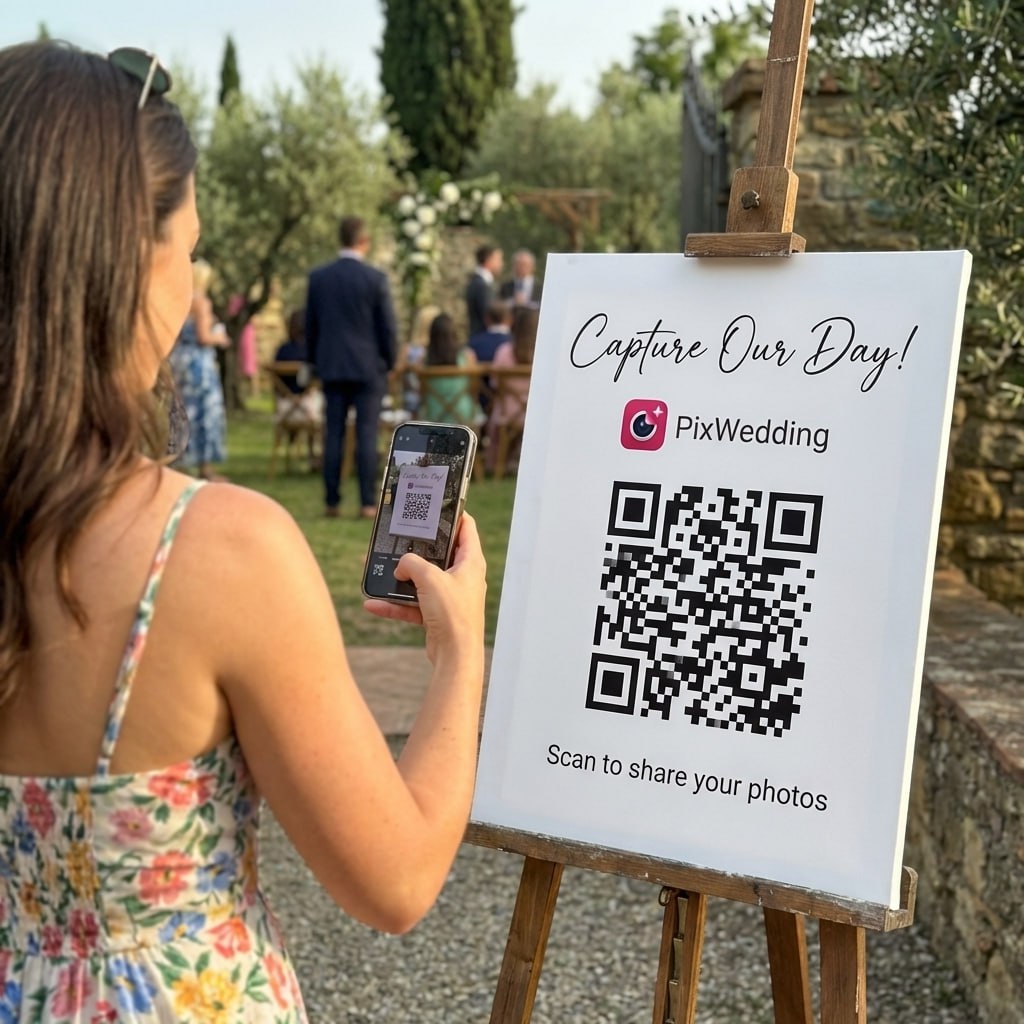
No-app wedding photo sharing works by giving guests a QR code that opens a web upload page directly in their phone's browser. There is nothing to install, no App Store visit, and no account to create. A guest scans the code with their regular camera app, taps the link, selects photos from their camera roll, and the photo appears in the shared album within seconds.
How the QR + web gallery method works
From creating the gallery to downloading the final ZIP, here is the entire journey, in order.
- 1
Create the gallery
Set up the event with the wedding date and couple names. On Pix Wedding this takes about three minutes and the free tier includes 20 guest uploads with no card required.
- 2
Get the QR code instantly
A unique QR code and upload link are generated the moment the gallery exists. Nothing to install, nothing to configure on the guest side.
- 3
Design and print QR stickers
Use a free QR sticker designer to turn the code into table cards, a welcome sign, or drink coasters that match the wedding colors.
- 4
Place the code where guests will actually see it
Ceremony programs, the welcome sign, every table, and near the bar are the highest-traffic spots. One placement is never enough.
- 5
Have the MC or officiant say it out loud once
A ten-second mention during the toast or right after the ceremony drives more uploads than any amount of signage alone.
- 6
Guest scans with the native camera app
No App Store visit, no search, no install screen. Every modern iPhone and Android camera reads a QR code automatically.
- 7
The browser opens straight to the upload page
Tapping the banner hands off to Safari or Chrome, whichever is already the default browser on that phone.
- 8
Guest taps Choose Photos and selects one or many
The native photo picker opens. Guests can select a single shot or multi-select a whole batch from the reception at once. No account, no password, no email.
- 9
Photos land in the live album within seconds
Uploads appear in the shared album (and on a TV slideshow if one is running) in near real time, so guests see their photo show up before they walk away.
- 10
After the wedding, the couple reviews and organizes
The couple looks through everything guests uploaded and can manually sort it into sub-albums by moment, like ceremony, first dance, or reception (a real feature on tools like Pix Wedding's Standard and Pro tiers, up to 6 sub-albums). Any stragglers from a photographer or a guest's laptop can simply be uploaded into the same album afterward.
- 11
Everything downloads as one ZIP
When it is time to make a photo book or hand a copy to the in-laws, the whole album exports as a single ZIP file instead of forwarding hundreds of individual texts.

No app needed
Scanned & uploaded!
Skip the app store. Start the gallery.
Guests scan a QR code and upload straight from their phone browser. No app, no account, 20 free uploads to try it.

From the maid of honor
Scan to join the album
No app, no account
UPLOADING
Saving your moment
THE ALBUM
Emma & Jack
June 21, 2026
647 photos · 95 guests







SCAN TO TRY
pix.wedding/
your-wedding
App-based sharing vs no-app QR sharing
A side by side of the two approaches across the dimensions that actually change the wedding-day experience.
| Dimension | App-based sharing | No-app QR + web gallery |
|---|---|---|
| Setup for the couple | Create the app listing, submit event details, sometimes wait on approval or a branded build | Create a web gallery and get a QR code in minutes, no app store submission involved |
| Guest friction | App Store or Play Store visit, install, open, sometimes an account before the camera even opens | Scan with the native camera, tap once, browser opens straight to the upload page |
| Older or less tech-comfortable guests | Unfamiliar app icons and install prompts are a common point where people give up | The scan-a-code motion already feels familiar from restaurant menus and event check-ins |
| Typical participation | Multiple platforms report meaningfully lower completion once an install step is added, though exact figures vary by source | Multiple platforms report higher completion when the flow stays inside the browser, though exact figures vary by source |
| Cost to the couple | Ranges from free to per-event or subscription pricing depending on the app | Free tiers are common; Pix Wedding is free to start with 20 uploads, then $49 to $89 one-time for unlimited |
Participation figures cited by photo-sharing platforms vary by source and are self-reported, so treat directional trends as more reliable than any single exact percentage.
Which platforms actually need an app
Verified against each platform's own app store listings and published guidance as of August 2026. Requirements can change, so double check before you commit.
| Platform | Guest needs an app? | What we verified |
|---|---|---|
| Pix Wedding | No | Web-based for the couple and every guest. No app, no account to upload. |
| GuestPix | No | Guests scan a QR code or tap a link and land in the gallery through their browser. |
| Wedibox | No | One QR code on invitations and table cards; the platform states no app to download and no account to create. |
| POV Camera | Guests: no. Organizer: yes. | The couple installs the POV app to run the event. Guests join through an App Clip on iPhone or a web page on Android, so they are not required to download the full app themselves. |
| Joy | No, for shared albums | Joy's current shared photo albums let guests scan a QR code and upload from the browser with no app and no account, with up to 1,000 photos included free per event. Some older Moments features still lean on the Joy app. |
| WedShoots | Yes | Listed on both the Apple App Store and Google Play as a photo-sharing app guests install to contribute. |
| Wedbox | Yes | Distributed as a native app on the Apple App Store and Google Play; there is no documented browser-only upload path for guests. |
No-app photo sharing, demonstrated live
This is exactly what no-app sharing means in practice: a guest scans the QR code, uploads from the browser, and the album updates in real time.
The real Pix Wedding demo album, exactly what your guests see after scanning the QR code.
Watch: building a QR code for wedding photo sharing
A short walkthrough of building the QR code itself, the same basic building block behind the entire no-app method.
When an app-based approach is actually better
We are not going to pretend no-app sharing is right for every wedding. A few honest situations where installing an app is the smarter call:
- You want deep offline capture during a multi-day, low-signal event: A native app can sometimes queue photos locally and sync later more gracefully than a browser tab that gets closed by accident. If the venue is a remote ranch with almost no signal for two days, an app built for offline-first capture may hold up better.
- The app is bundled with a wedding website and RSVP system you already use: If the couple is already running their entire wedding website, registry links, and RSVP tracking through one all-in-one app, adding photo sharing inside that same app avoids asking guests to juggle two different tools.
- You specifically want push notifications for the whole planning season: A dedicated app can nudge guests with reminders (RSVP due, hotel block closing, photo challenge live) in a way a one-time QR scan cannot. If ongoing engagement matters more than the wedding-day photo count, that push channel has real value.
- Your guest list skews heavily toward a demographic already comfortable installing apps: A friend-group wedding where most guests already run three social apps and treat installs as routine will see less of the drop-off that older or less tech-comfortable crowds experience.
Pros and cons of no-app wedding photo sharing
Pros
- No install step to abandon: There is nothing to download, so the single biggest drop-off point in the guest journey simply does not exist.
- Works the same on iPhone and Android: No separate app store, no version mismatch, no "why does this look different on my phone" confusion.
- No account means no forgotten password: Guests do not need to remember credentials weeks later if they want to check back on the album.
- Faster from scan to upload: A browser tab opens in a second or two; an app install with an app-store detour takes noticeably longer.
- Easier for older or less tech-comfortable relatives: A scan-and-tap flow maps onto habits people already have from restaurants and events.
Cons
- Needs a live internet connection at the moment of upload: A dead wifi zone with no cellular signal can stall an upload until the guest moves somewhere with service.
- No offline queueing the way some native apps offer: A dedicated app built for offline-first capture can sometimes hold photos locally and sync later more gracefully.
- No push notifications between now and the wedding: A QR code cannot remind guests about RSVP deadlines the way an all-in-one wedding app can.
- Relies on guests seeing a printed code: If signage is thin or poorly placed, the no-app method loses its main advantage: visibility.
Glossary: no-app sharing in plain terms
QR code
A square barcode that a phone camera reads automatically, without a separate scanner app, and turns into a tappable link.
Browser upload
Uploading a photo through a normal web page in Safari or Chrome instead of through an installed app.
App Clip
A small, lightweight slice of an iOS app that can launch instantly from a link or code without a full App Store install. Not every no-app platform uses this, and it is still a mini download, not a browser page.
Album storage window
How long an album stays hosted and viewable after the wedding before it comes down, which varies by platform and plan rather than being permanent.
Live album
A gallery view that updates in near real time as guests upload, often displayed on a TV during the reception as a running slideshow.
Common mistakes with no-app photo sharing
- Printing only one QR code for the whole venue: A single sign at the entrance gets seen once. Table cards, the welcome sign, and the bar area each catch a different set of eyes at a different point in the night.
- Never announcing it out loud: A code on a card is easy to miss during a reception. A ten-second MC mention drives more uploads than any amount of signage.
- Choosing a "no-app" platform that still gates uploads behind a signup form: Some tools call themselves app-free but still ask guests to create an account or enter an email before the first photo. That defeats the entire point of removing friction.
- Printing the QR code too small to scan from a normal arm's length: A code the size of a business card on a dim table often fails to scan on the first try. Bigger, high-contrast codes scan faster in low reception lighting.
- Skipping a test scan the morning of the wedding: Links expire, typos happen, and printers sometimes crop a QR code just enough to break it. A thirty-second test scan the morning of catches this before 150 guests try it at once.
- Assuming every venue has strong wifi: Historic venues, barns, and basements are notorious dead zones. Check coverage in advance and have a cellular-data fallback plan, since browser uploads still need some kind of internet connection at the moment of upload.
- Not exporting the album before a time-limited plan expires: Some free tiers cap the album at a set number of days. Download the full ZIP as soon as the wedding is over so nothing is at risk if a plan lapses.
- Forgetting guests who do not want to be tech-forward at all: A QR code should be one option, not the only option. Keep a disposable camera on a table or ask a relative to collect a handful of prints for the guests who would rather not use a phone at all.
Older guests and accessibility
No-app sharing tends to be the easier path for grandparents and less tech-comfortable relatives, but only if a few small things are handled with care.
The scan-a-code motion is already familiar to most adults from restaurant menus, parking meters, and event check-ins, which lowers the learning curve compared to hunting for an unfamiliar app icon.
There is no app store search to get lost in, no "which app was it again" confusion, and no login screen asking for a password nobody remembers.
A printed card next to the QR code with three short words ("Scan. Tap. Upload.") gives a visual anchor for guests who want to double check before they try.
Font size and button size on the upload page matter more than people expect. A single oversized "Choose Photos" button is easier for anyone with vision or dexterity challenges than a cluttered app interface with multiple menus.
Assign one relative or the day-of coordinator to quietly help anyone who is stuck. Ninety seconds of hands-on help turns a guest who would have given up into a guest who uploads for the rest of the night.
Offer a non-digital fallback (a disposable camera or a physical guest book) alongside the QR code so participation never depends entirely on comfort with a smartphone.
Printable QR placement ideas
The code only works if guests actually see it. Spread it across a few high-traffic spots instead of relying on a single sign.
Table cards
One small card per table, printed with the QR code and a one-line instruction. The highest-traffic placement because every seated guest sees it at eye level.
Welcome or seating chart sign
A larger version near the entrance catches guests before they even sit down, ideal for cocktail-hour photos.
Ceremony program insert
A small QR code printed on the program means guests can start uploading the moment the ceremony ends, before the reception crowd forms.
Bar and cocktail napkins
Guests linger at the bar. A code printed on napkins or a small tent card catches a captive audience with a drink in hand.
Photo booth backdrop corner
A code stitched into the corner of a photo booth backdrop nudges guests to also upload the phone photos they took nearby, not just the booth strip.
Favor tags or exit table
One last reminder as guests grab a favor or sign the guest book catches any late uploads before people head home.
More on QR codes and guest photo collection
If this page answered "how do I skip the app entirely," these go deeper on the pieces around it.
Why "no app" became the default recommendation
The wedding photo sharing category started with native apps because that was the obvious way to build a private photo feed a decade ago. As mobile browsers got faster and camera-roll access from a web page became reliable on both iOS and Android, the app requirement stopped being necessary. What used to be a technical limitation is now mostly a product decision, and several platforms have kept the app requirement anyway because it fits an existing all-in-one wedding-website business model, not because guests need it.
The trade-off is worth naming honestly. An app can do things a browser tab cannot, like queueing photos while fully offline or sending push reminders in the weeks before the wedding. For the specific job of getting a guest from "I took a nice photo" to "that photo is in the couple's album," though, the browser-based QR method removes the one step guests are most likely to abandon: the install.
What "web-based" actually means for guests
Web-based does not mean a worse experience, it means the upload page lives at a normal web address instead of inside an installed app. On a modern iPhone or Android phone, that upload page can still access the full camera roll, support multi-select, upload video, and show a live progress bar, all inside Safari or Chrome. Nothing about the guest-facing quality drops by skipping the app store.
What guests gain is speed and familiarity. They already know how to scan a code and tap a link. They do not know, and should not have to learn, which specific wedding app this particular couple picked out of a dozen similar options.
Explore more free wedding tools
Everything you need to make your wedding day stress-free and unforgettable.
QR Sticker Designer
Design custom print-ready stickers.
Hashtag Generator
Create unique wedding hashtags.
How to Collect Guest Photos
5 methods ranked by participation rate and ease.
Get Photos After the Wedding
Message templates to gather guest photos post-wedding.
Share Wedding Photos with Guests
Compare every sharing platform by ease and participation.
Best Way to Get Guest Photos
The single method with the highest participation rate.
How to Make a Shared Wedding Album
Step-by-step setup for every platform.
Alternative to Disposable Cameras
Better, cheaper options than disposable cameras.
Wedding Photo Sharing Without an App FAQ
Everything you need to know about our free tools and how they help your wedding day.
The upload itself needs some kind of internet connection, either venue wifi or the guest's own cellular data, since the photo has to travel from the phone to the album. Guests can still take photos with zero signal and upload them later once they have a connection. For venues with weak coverage, it helps to check signal in advance and let guests know they can upload after the reception if the venue itself has dead zones.
No, not with a genuine no-app platform like Pix Wedding. Guests scan the QR code, land on the upload page, select their photos, and upload. There is no account creation, no password, and no email requirement standing between the scan and the upload.
Yes. Both platforms have a native camera app that reads QR codes automatically, and both open the link in their default browser, Safari on iPhone and Chrome (or another default) on Android. The upload page itself looks and behaves the same regardless of which phone a guest is holding.
Yes, on Pix Wedding guests can upload both photos and videos through the same no-app browser flow. Video file sizes are larger, so an upload may take a few extra seconds on a slower connection, but the process itself is identical to uploading a photo.
Print it in multiple places rather than relying on a single sign: table cards at each seat, a larger version on the welcome or seating chart sign, a small insert in the ceremony program, and a copy near the bar. A free QR sticker designer makes it easy to match the code to the wedding colors and print it at the right size to scan reliably.
Pix Wedding's free tier includes 20 guest uploads with no credit card required, which is enough to try the entire scan-to-album flow before committing. Removing the upload cap for the full wedding is a one-time payment of $49, $59, or $89 depending on the plan, not a recurring subscription. Each paid plan includes a full-quality ZIP download of every photo and video, which is the couple's to keep. Album hosting itself is time-limited by plan (6 months, 1 year, or 2 years), so the ZIP is what makes the photos theirs for good.