









pixPix Weddingwedding
Legal Reference Guide

Wedding Officiant Requirements by State (2026)

The definitive legal reference: state-by-state rules on ordination, ULC and AMM acceptance, county registration, age requirements, paperwork deadlines, and who can legally marry a couple in the US.

Share Your Wedding Photos Free

Legal disclaimer: Marriage law changes frequently and enforcement occurs at the county level, not just the state level. This guide reflects publicly available information current as of April 2026. Always verify requirements directly with the county clerk\'s office where your marriage license was issued before the ceremony.

Universal Requirements: What Every State Has in Common

While states vary significantly in who they accept as an officiant, six requirements are essentially universal across all 50 states. These are the legal non-negotiables regardless of where you are getting married.

Be at least 18 years old

All states require officiants to be adults. Some states specify 18; others simply require legal adulthood.

Be legally authorized under state law

This means being an ordained minister of a recognized religion, a civil official (judge, magistrate, justice of the peace), or a person specifically authorized under state statute.

Ordination must be from a recognized body

Most states accept any bona fide religious organization. The contested area is non-denominational online organizations like ULC. Check state and county-specific rules.

Sign the marriage license correctly

The officiant must complete their section of the marriage license including their name, title/credentials, and signature. Errors on the license can create complications.

Ensure the license is valid on the ceremony date

Marriage licenses expire. Most are valid for 30 to 90 days after issuance. Confirm the expiration date; a ceremony performed with an expired license may not be legally valid.

Return the signed license within the required timeframe

Filing deadlines vary by state from a few days to 30 days. This is legally the most critical step after the ceremony.

ULC vs AMM: Which Ordination Is Accepted Where?

The two most widely used online ordination organizations are the Universal Life Church (ULC) and American Marriage Ministries (AMM). They are similar in practice but differ meaningfully in legal standing across specific states.

Universal Life Church (ULC)

Accepted in ~45+ states

Restricted or contested in Virginia, Tennessee, Pennsylvania (historically)

Free online ordination

Oldest and most well-known online ordaining body. Has faced more court challenges than AMM due to its longer history. Some counties within generally-accepting states still flag ULC ordinations.

American Marriage Ministries (AMM)

Accepted in all 50 states including Virginia

No documented restrictions as of 2026

Free online ordination

Founded specifically to address the legal gaps ULC encountered. AMM is accepted even in Virginia, where ULC is not. Generally considered the safer choice for couples in states with known ULC restrictions.

States With Known ULC Complications

Virginia

High Risk

Virginia Code Section 20-23 specifies that ministers must be "authorized" by their denomination. Courts have ruled that ULC's lack of a traditional denominational structure makes its ordinations legally insufficient. AMM ordinations are accepted in Virginia. This is the most consistently enforced restriction in the US.

Tennessee

Moderate Risk

Tennessee courts have challenged ULC ordinations at various points. The legal status has varied by county and over time. AMM is the safer choice. Couples getting married in Tennessee should verify with their county clerk and consider using AMM or an established religious officiant.

Pennsylvania

Historical Risk

Pennsylvania had court cases challenging ULC ordinations in the early 2000s. Current enforcement is less consistent, and many counties accept ULC. However, the historical uncertainty makes AMM the prudent alternative. Philadelphia and Allegheny counties have generally accepted online ordinations in recent years.

Delaware

Process Difference

Delaware requires officiants to register with the Orphans Court in the county where the ceremony takes place. This applies to all non-standard officiants, including online-ordained ministers. Registration must happen before the ceremony. Both ULC and AMM are accepted once registered.

North Carolina

Process Difference

North Carolina requires officiants to register with the Register of Deeds in the county where the ceremony takes place. Online-ordained officiants must complete this registration. The state generally accepts both ULC and AMM upon registration.

Every Type of Legally Authorized Officiant

All 50 States

Ordained Religious Clergy

Priests, pastors, rabbis, imams, ministers, and deacons of established religious organizations. Universally accepted in all 50 states without additional paperwork. Their ordination credentials from recognized denominations are legally sufficient.

All 50 States

Judges and Justices

Federal judges, state court judges, and justices of the peace are authorized in all states. Supreme Court justices, circuit judges, district judges, and magistrate judges all qualify. Their civil authority to solemnize marriages derives directly from their office.

Most States

Justices of the Peace / Magistrates

Civil officials with authority to perform marriages as part of their official duties. Availability for private ceremonies varies. Contact the local courthouse to inquire about private ceremonies outside official settings.

Select States

Notaries Public

Notaries can perform marriages in Florida, South Carolina, Maine, Nevada, and a few other states. This is not universal. In states that do allow it, the notary must be currently commissioned and in good standing. Check your state law before relying on this option.

45+ States

Online-Ordained Ministers

ULC and AMM ordained ministers are the most common choice for friend/family officiants. Acceptance is near-universal but with important state and county-level exceptions. Always verify with the issuing county clerk before the ceremony.

Select States

Self-Solemnization

A handful of states allow couples to legally marry without any officiant. Colorado, Pennsylvania, Wisconsin, and a few others permit self-solemnization. The couple signs the marriage license themselves with witnesses. This option is popular for intimate elopements.

State-by-State Reference Table (20 Key States)

This table covers 20 of the most populated and most commonly asked-about states. For the remaining 30 states, the general rule is that both ULC and AMM are accepted without county pre-registration.

StateULC OKAMM OKCounty Reg.Notary OKNotes
AlabamaNoNoStraightforward; no special requirements
AlaskaNoNoNo advance registration required
ArizonaNoYesNotaries can officiate
CaliforniaNoNoMust return license within 10 days
ColoradoNoNoSelf-solemnization permitted (no officiant needed)
DelawareVariesYes (Orphans Court)NoOfficiant must be registered with Orphans Court
FloridaNoYesNotaries can officiate; 10-day return
GeorgiaNoNoNo advance registration needed
IllinoisNoNo10-day return requirement
KansasNoNoNo special requirements
MichiganNoNoCourts have been generally accepting
NevadaNoNoHigh volume; very permissive rules
New YorkNYC onlyNoNYC requires filing with city clerk; 5-day return
North CarolinaVariesYesNoOfficiant must register with register of deeds
OhioNoNoNo advance filing required
PennsylvaniaVariesNoNoHistorical PA court challenges; AMM preferred
TennesseeVariesNoNoTN courts have challenged ULC; use AMM or clergy
TexasNoNo30-day return requirement; also self-solemnization
VirginiaNoNoVA Code restricts ULC; AMM and ordained clergy accepted
WashingtonNoNoOne of the most permissive states

Table reflects publicly available state and county law as of April 2026. Always verify with your county clerk.

Officiant Paperwork Checklist

Confirm ordination or civil authority is valid in your state

Verify acceptance with the county clerk's office specifically

Complete any required county registration before the ceremony

Obtain a copy of the signed marriage license

Confirm the license expiration date is after the ceremony date

Know the signing requirements (your name, title, address)

Confirm witness requirements (most states: 1 to 2 witnesses)

Know the filing deadline for your state

Know who is responsible for returning the license to the clerk

Order certified marriage certificates when filing (get 3 to 5 copies)

6 Legal Mistakes That Make a Ceremony Legally Invalid

A ceremony can be emotionally perfect and legally void. These are the most common mistakes that couples and officiants discover after the fact, sometimes not until they try to use the marriage certificate for a name change or benefits claim.

Using an expired marriage license

Marriage licenses have expiration dates, typically 30 to 90 days after issuance. A ceremony performed after the expiration date creates no legal marriage. The couple must obtain a new license and either repeat the ceremony legally or sign a new license with the same officiant.

Officiant not registered where required

In Delaware, North Carolina, and New York City, officiants must register before the ceremony. If an unregistered friend officiates and the couple later tries to file the license, the clerk may reject it. Verify county requirements well in advance, not the day before.

Missing witnesses when the state requires them

Most states require one or two witnesses to sign the marriage license during the ceremony. If the ceremony ends without witnesses signing, the license is incomplete. This is rarely noticed until someone tries to file or use the certificate.

Officiant signs with wrong title or credentials

The officiant must fill in their section accurately: full legal name, ordination status or official title, and in some states their address and ordaining organization. Sloppy or incorrect entries can cause the clerk to reject the filing.

Nobody files the license after the ceremony

The most common oversight. Everyone assumes someone else is handling it. Designate one person, usually the officiant or a detail-oriented attendant, to be responsible for mailing or delivering the signed license to the county clerk within the required timeframe.

Using a ULC officiant in Virginia without verification

Virginia is the most well-documented state where ULC ordinations have been ruled legally insufficient by courts. Couples who had ULC-ordained friends officiate have later discovered their marriage was not legally recognized. Use AMM or an established religious officiant in Virginia.

Unique Rules in Specific States Worth Knowing

Most states follow the same basic framework, but several have provisions that surprise couples and officiants. These are the most commonly asked-about state-specific rules.

Colorado

Self-solemnization permitted

Colorado is one of a handful of states that allows couples to marry themselves without any officiant. The couple signs the marriage license in front of witnesses and files it. This is popular for intimate elopements and ceremonies in remote locations.

Pennsylvania

Quaker self-solemnization + ULC history

Pennsylvania recognizes Quaker self-uniting marriages as a religious tradition. It also has a history of ULC legal challenges from the early 2000s. Pennsylvania courts have been more accepting of online ordinations in recent years, but AMM remains the more cautious choice.

New York (NYC)

City Clerk registration for online ordinations

Outside of New York City, online-ordained officiants can simply sign the license. Within the five boroughs, officiants may need to register their credentials with the City Clerk in advance. This is particularly relevant for destination weddings in Manhattan.

Nevada

Most permissive registration environment

Nevada, with its high volume of weddings in Las Vegas, has the most streamlined process. Both ordaining organizations and civil officiants work smoothly with Clark County. Wedding chapels typically handle all the paperwork as part of their service package.

Texas

Self-solemnization + 30-day filing window

Texas permits self-solemnization in addition to standard officiant ceremonies. The state also provides a 30-day window after the ceremony to return the signed license, the longest in the country. Friends-as-officiants are widely accepted.

Florida

Notaries can officiate

Florida is one of the states that authorizes notaries public to perform marriages. This creates a wider pool of potential officiants, since anyone who is a commissioned notary can legally marry a couple. Useful when a couple wants a professional but non-clergy ceremony with minimal advance planning.

Related Legal Guides

The ceremony is legal. Now capture it all.

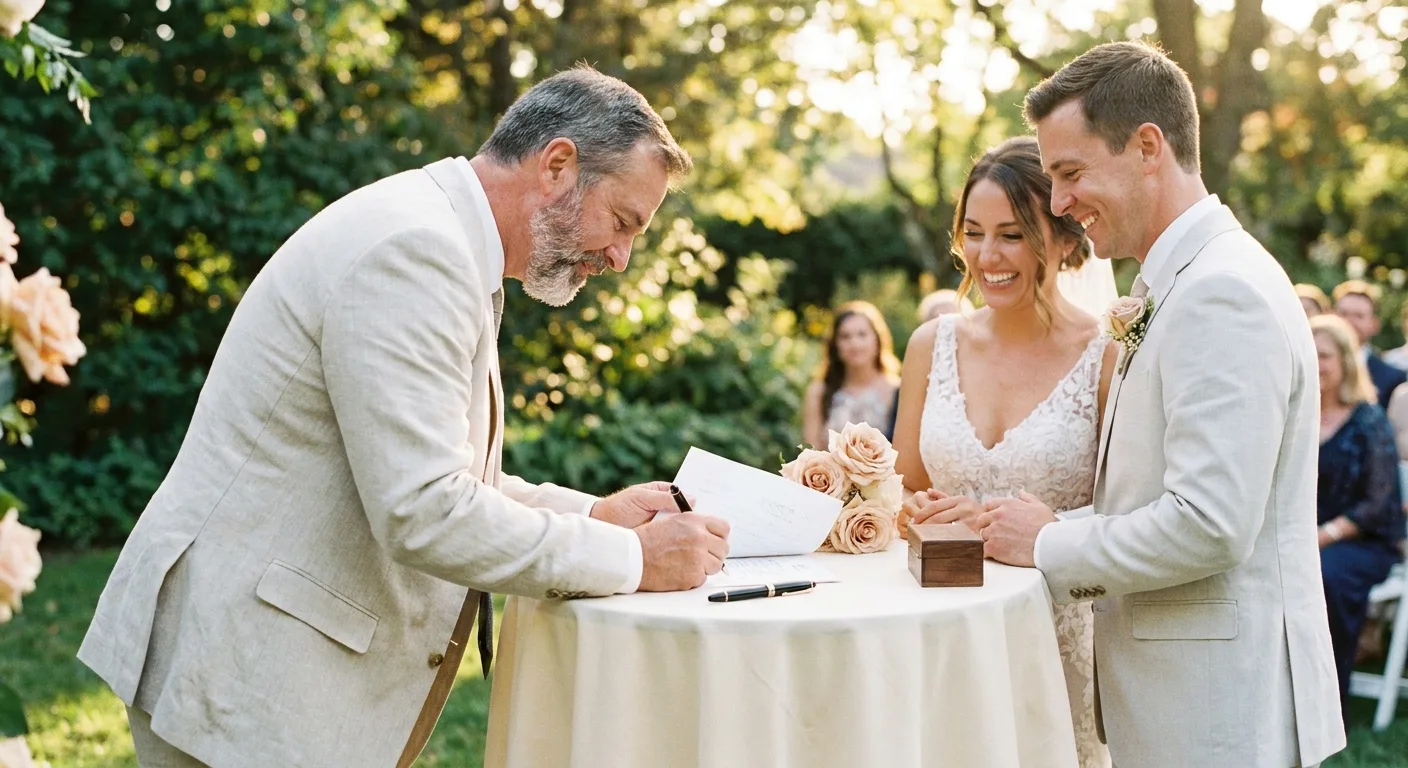
While your officiant signs the license, guests are already uploading photos. One QR code at the venue and every moment lands in one shared album.

From Mom

From Mom

9:41

ALBUM

Emma & Jack

June 14, 2026

634 photos · 94 guests

AllMomentsMine
Wedding guest photo 1 from album preview
Wedding guest photo 2 from album preview
Wedding guest photo 4 from album preview
Wedding guest photo 5 from album preview
Wedding guest photo 6 from album preview
Wedding guest photo 7 from album preview
Wedding guest photo 8 from album preview
Wedding guest photo 9 from album preview
Wedding guest photo 10 from album preview
Add photosShare your moments
Table 4 just uploadedSarah B. · +12 new photos

The Federal Framework: How Officiant Authority Actually Works

Marriage law in the United States is entirely a state matter. There is no federal marriage law and no federal database of authorized officiants. Each of the 50 states defines who may perform a legally recognized marriage ceremony, and each county within a state may impose additional administrative requirements.

The general categories of authorized officiants under state law are: ordained or licensed ministers of any religion, judges and justices of federal and state courts, justices of the peace and magistrates, and in some states, notaries public. Most states also accept online-ordained ministers, though the acceptance of specific ordaining organizations varies.

The critical legal moment in any ceremony is the signing of the marriage license. A beautiful ceremony performed by a beloved friend is legally irrelevant without a properly signed and filed marriage license. The officiant's signature on that document is the act that creates the legal marriage.

After the Ceremony: Filing Requirements and Deadlines

The marriage license must be signed by the couple, the officiant, and in most states one or two witnesses during or immediately after the ceremony. The signed license must then be returned to the issuing county clerk's office within a legally specified timeframe.

Filing deadlines range from 3 days in some states to 30 days in others. California requires the signed license to be returned within 10 days of the ceremony date. Texas requires return within 30 days. New York has a 5-day requirement. Missing the deadline does not void the marriage in most states, but it creates a bureaucratic problem that requires paperwork to correct.

Once filed, the clerk issues a certified marriage certificate, which is the official proof of marriage used for name changes, benefits, insurance, and legal matters. The couple should order at least 3 to 5 certified copies at the time of filing.

  • California: return within 10 days of ceremony
  • Texas: return within 30 days
  • New York: return within 5 days to the town/city clerk
  • Florida: return within 10 days
  • Illinois: return within 10 days
  • Pennsylvania: return promptly (no strict statutory deadline, but within days recommended)

Explore more free wedding tools

Everything you need to make your wedding day stress-free and unforgettable.

Common Legal Questions Answered

Officiant Requirements: Legal FAQs

Everything you need to know about our free tools and how they help your wedding day.

ULC ordinations are accepted in most US states, but several have historically challenged or restricted them. Virginia has the most well-documented history of courts refusing to recognize ULC-ordained officiants in certain jurisdictions. Tennessee and Pennsylvania have also had legal challenges. Always verify current acceptance with the specific county clerk where your marriage license is issued, since enforcement is at the county level, not just the state level.

It depends on the state. Most states do not require advance registration; the officiant simply signs the marriage license. However, some states including Virginia (for ULC specifically), Delaware, and parts of North Carolina require the officiant to register with a county office or provide credentials in advance. Check the clerk's office in the specific county where the wedding takes place.

The Universal Life Church (ULC) and American Marriage Ministries (AMM) are both non-denominational online ordination organizations. AMM was specifically designed to address the legal gaps that ULC faced in certain states and positions itself as a more legally defensible alternative. AMM is generally accepted in states where ULC has faced challenges, including Virginia. Both are free and take just minutes online.

After the ceremony, the officiant must sign the marriage license, along with the couple and typically one or two witnesses. The signed license must then be returned to the county clerk's office within the timeframe specified by state law, which ranges from a few days to 30 days depending on the state. Missing this filing deadline means the couple is not legally married, even if the ceremony took place.

Yes, judges and magistrates are authorized to perform weddings in most states as part of their official duties. Some are willing to perform private ceremonies outside the courthouse; others officiate only at their office. There may be a fee, and availability varies. Contact the local courthouse directly to inquire about private ceremony availability.

Most states require officiants to be at least 18 years old. There is no upper age limit. The officiant must also be legally competent (not under guardianship or declared legally incapacitated). Specific requirements vary by state, and ordained clergy of major religions are almost universally accepted without additional verification.