
6 Alternatives to Disposable Cameras at Weddings (2026)
A full roundup of every category of modern substitute, what each one costs in 2026, the honest tradeoffs, and which couples each one actually fits.
The short answer
Disposable cameras used to do two jobs: collect candid guest photos and give people something fun to do at the table. Six categories now split that job better than film ever did. For candid coverage at any guest count, a QR code shared album (free to $99) or a film-look phone app ($0-99) are the cheapest and most scalable. For a physical keepsake, an instant camera ($80-140 + per-print film cost) or a photo booth rental ($500-1,500) win instead. For professional-quality candids with zero guest effort, a second or roaming shooter ($300-1,500 added to a package) is the option. A reusable digicam ($50-150) sits in between as a physical, non-disposable pass-around camera. Most couples land on a combination of two, not one.
Why Couples Are Looking Beyond Disposable Cameras
The math rarely works out
A stack of 25-30 disposables for a mid-size wedding runs $250-420 before a single roll is developed. Add $10-18 per camera for processing and scanning and the real total lands closer to $600-900 for photos that might not even come out.
Indoor receptions are where film struggles
Built-in flash on a disposable reaches roughly 8-10 feet. Reception halls, tents, and dimly lit venues routinely exceed that range, so a meaningful share of indoor shots come back dark, blurry, or unusable.
One camera, one use, then landfill
Each disposable is a sealed unit of plastic, a lithium battery, and chemical film that cannot be reused. For couples trying to keep their wedding low-waste, that conflicts directly with the goal.

Guest candid
Caught it!
The substitute most couples land on first.
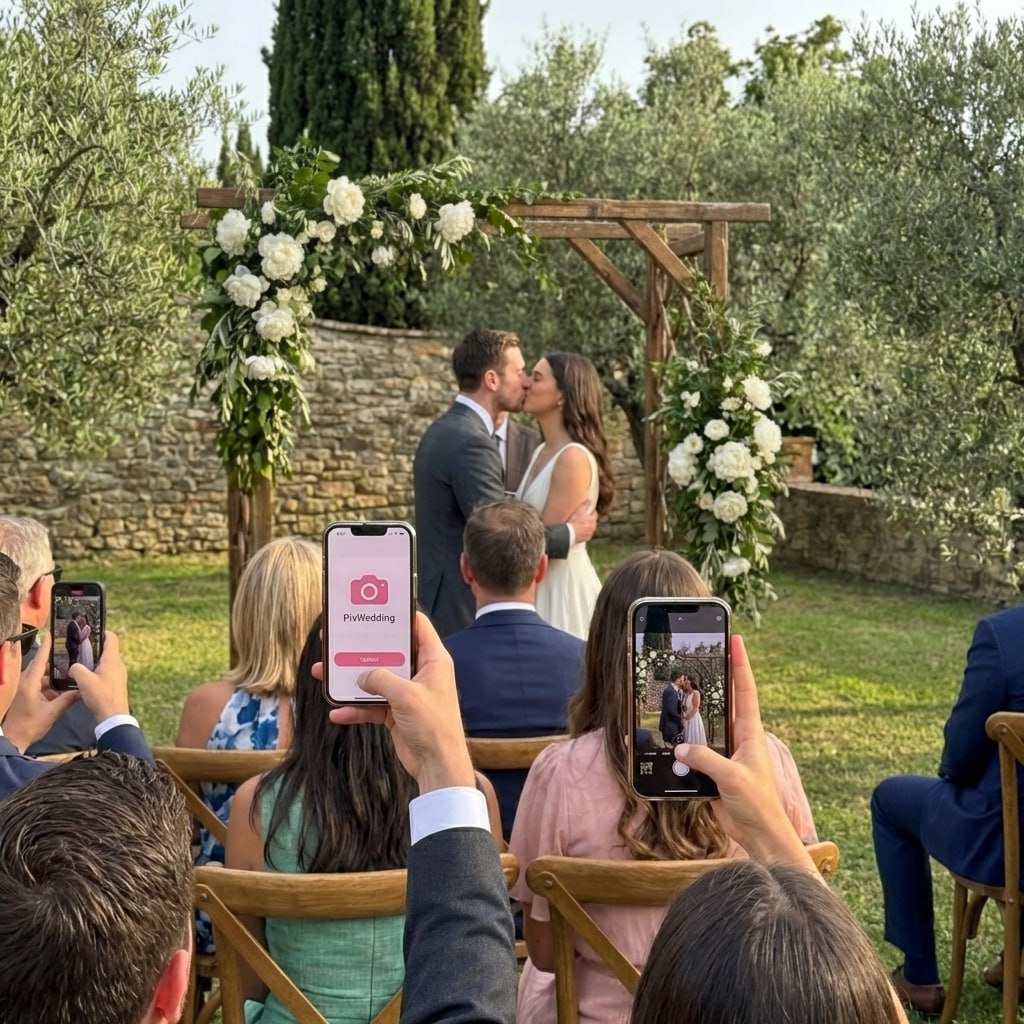
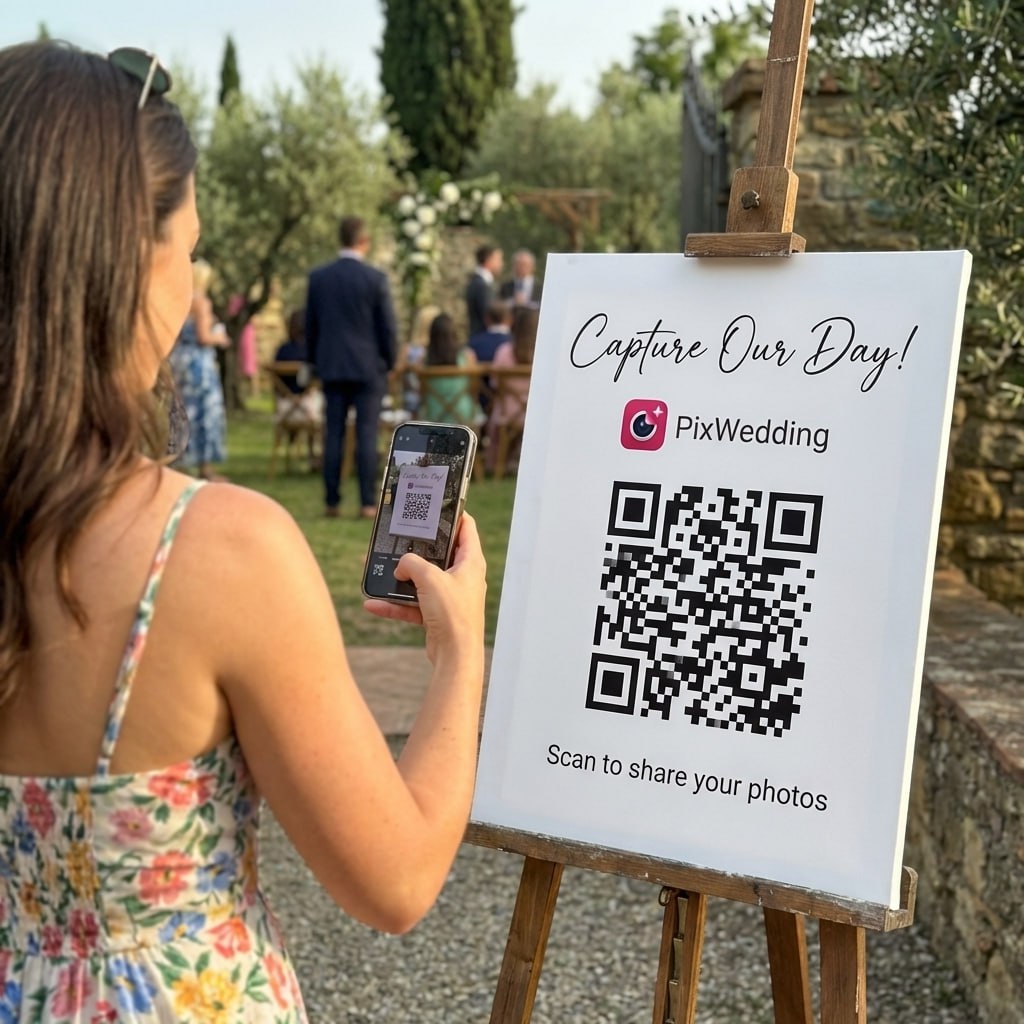
Guests scan one QR code and every photo from every phone lands in a single shared album. No developing, no wait, no cameras to collect.
From a guest
Scan to join the album
No app, no account
UPLOADING
Saving your moment
THE ALBUM
Emma & Jack
June 21, 2026
647 photos · 95 guests


SCAN TO TRY
pix.wedding/
your-wedding
The 6 Categories, At a Glance
Before the deep dive, here is the full field. Every genuine disposable camera substitute falls into one of these six buckets.
QR Code Photo-Sharing Apps
Every guest phone becomes a camera that uploads to one shared album.
Digital Point-and-Shoot (Digicam)
A reusable pocket camera passed table to table instead of a single-use one.
Instant / Polaroid-Style Cameras
A physical print guests can hold within seconds of the shot.
Film-Look Phone Apps
A browser or app that replicates disposable grain and the delayed reveal.
Second or Roaming Shooter
A trained photographer dedicated to catching candid guest moments.
Photo Booth Rental
A self-contained station with an attendant, props, and instant prints.
Each Alternative, In Detail
QR Code Photo-Sharing Apps
Pros
- No app download for guests, just scan and upload
- Full smartphone resolution, photos and video both supported
- Uploads appear live throughout the reception
- Scales to any guest count for the same flat cost
Cons
- Needs a guest smartphone and a working connection
- Nothing physical to hand a guest at the table
- Participation depends on the QR code being visible and explained
Digital Point-and-Shoot Cameras (Digicams)
Pros
- Reusable indefinitely instead of single-use
- No recurring film or developing cost after the initial purchase
- Noticeably better low-light performance than 35mm film disposables
Cons
- No built-in way to share photos, someone has to collect the memory card
- Multiple cameras mean multiple cards to track down after the event
- Just as easy to lose or leave behind as a disposable
Instant / Polaroid-Style Cameras
Pros
- A print develops in the guest's hand within minutes
- Doubles as reception decor or a guest-book page
- No phone or app required, the most intuitive option for older guests
Cons
- Film cost adds up fast once you calculate 100+ prints across a wedding
- Prints are small and exposure is inconsistent indoors
- No searchable digital archive unless someone scans every print afterward
Film-Look Phone Apps
Pros
- Replicates film grain and color casts without buying actual film
- A delayed reveal mimics the surprise of getting disposables developed
- Most platforms work from a phone browser with no app install
Cons
- Photo quality is capped by the filter, not the phone's real sensor
- Some apps need an active connection while guests are shooting
- Pricing tiers can scale with guest count on certain platforms
Hiring a Second or Roaming Shooter
Pros
- A trained eye catches candid moments a guest with a phone would miss entirely
- Images are shot on real gear and professionally edited
- Covers the reception, cocktail hour, or a second angle during the ceremony
Cons
- The most expensive category here by a meaningful margin
- Needs to be booked months ahead through your photographer or venue
- It is a service, not a device, so guests are not directly participating
Photo Booth Rental
Pros
- A self-contained guest activity, not just a photo tool
- An attendant runs it, so there is nothing to distribute or collect
- Most packages include a digital copy alongside the physical print
Cons
- Fixed to one location, so it only captures guests who walk over to it
- Higher upfront cost than any of the digital options
- Requires its own setup space and, often, a separate vendor contract
Digicam and app pricing referenced from Camp Snap and Scene's published pricing. Photo booth pricing referenced from WeddingWire's cost guide. Second shooter pricing referenced from OurVows' second shooter guide. All figures as of 2026 and subject to change by market.
Side-by-Side Comparison
| Option | Typical Cost | Physical Keepsake | Effort | Reach |
|---|---|---|---|---|
| Disposable camera (baseline) | $600-900 for 25-30 cameras | Yes, after 1-3 week wait | High (distribute, collect, mail, wait) | Whoever picks up a camera |
| QR code photo-sharing appMost scalable | $0-99 for the full event | No | Very low (print one QR code) | Every guest with a phone |
| Digital point-and-shoot | $50-150 per camera | No (digital file only) | Medium (collect memory cards) | Whoever picks up a camera |
| Instant / Polaroid camera | $80-140 + $0.65-$2 per print | Yes, instantly | Medium (manage film supply) | Guests near that camera |
| Film-look phone app | $0-99 depending on guest count | No | Low (share a link or code) | Every guest with a phone |
| Second or roaming shooter | $300-1,500 added to a package | Yes, professional digital files | Low for guests, booked in advance | Whatever the shooter can cover |
| Photo booth rental | $500-1,500 for 3-4 hours | Yes, instant prints | Very low (attendant runs it) | Guests who visit the booth |
Pick by What You Actually Want
Match your top priority to a category below. If two priorities conflict, combining two categories usually solves it.
Budget under $50
A free-tier QR code album or a free-tier film-look app covers most guest counts without spending anything.
QR code photo-sharing app
Want a physical keepsake
Nothing replaces the feeling of a print in hand within seconds. Put one at a dedicated corner rather than every table.
Instant / Polaroid camera
Want the disposable "surprise reveal"
Film-look apps replicate the grain and the wait without ever mailing a roll anywhere.
Film-look phone app
Want zero guest effort, professional quality
A dedicated shooter roaming the reception catches candids no guest with a phone would think to take.
Second or roaming shooter
Want a built-in party activity
A photo booth doubles as entertainment and a keepsake station, run entirely by its own attendant.
Photo booth rental
Large guest count, want it all in one place
A shared QR album is the only option here that scales to 100-300+ guests without extra cost per person.
QR code photo-sharing app
Quick Answers Along the Way
Do these alternatives replace my wedding photographer?
No. Every category on this page substitutes for the guest-candid layer disposable cameras used to provide, not for formal ceremony or portrait coverage. A hired second shooter adds professional images alongside your main photographer, it does not replace them.
Is it normal to combine two categories?
Yes, it is one of the most common approaches. A QR code album for guest-wide digital coverage paired with an instant camera at one table, or paired with a photo booth for the entertainment factor, covers both the candid-collection job and the tactile-keepsake job a disposable camera used to handle alone.
Which category is easiest to set up the week of the wedding?
A QR code shared album or a film-look phone app, both of which typically take minutes to set up and just need a printed code on the tables. A second shooter or a photo booth vendor should be booked months in advance, not the week of.
Common Mistakes When Switching Away From Disposables
1. Picking only one substitute and expecting it to do every job
A disposable camera used to cover two jobs at once: a fun tactile activity and a way to collect candid photos. Most single substitutes only do one of those well. Layering two categories (a QR album plus a photo booth, for example) usually covers both.
2. Not budgeting for how each category actually scales
A QR album and a film-look app stay roughly flat as guest count rises. A photo booth and a second shooter are flat rental or service fees. An instant camera scales per print, which is the one category where a bigger guest list directly means a bigger bill.
3. Booking a second shooter or photo booth too late
Unlike a digital album you can set up the week of the wedding, a second shooter or a photo booth vendor needs to be booked months ahead, especially during peak wedding season.
4. Not testing a digital option before the day
Whether it is a QR album or a film-look app, do a test run at the venue beforehand. Check the WiFi, the upload flow, and whether the QR code is legible in the actual reception lighting.
5. Assuming guests know what to do without a prompt
A QR code sitting on a table with no explanation gets ignored. Whatever category you pick, have the MC mention it once and put a short instruction line on the table card.
How This Roundup Fits With Our Other Camera Guides
This page is the full-field roundup, not a head-to-head
This page surveys all six categories of substitute side by side, including service-based options like hiring a second shooter or renting a photo booth, so you can see the whole field before narrowing down. That is different from our head-to-head comparisons, which take disposable cameras and pit them against exactly one replacement in much greater depth: disposable cameras vs QR code sharing and disposable cameras vs digital photo galleries both walk through full cost math and guest-return-rate data for a single matchup. It is also different from our device-and-app focused roundup, disposable camera alternative: 7 better options, which goes deep on individual products like GoPros and point-and-shoot cameras but does not cover hired-service substitutes. And if you have already decided to use disposables and just want to do it well, our buying and using guide covers that instead of the switch-away decision.
Related Guides
More on disposable cameras, digital sharing, and wedding photo collection.
Why 'alternative to disposable cameras' actually means six different things
A disposable camera at a wedding table did two jobs at once. It was a way to collect candid photos from guests who were not the professional photographer, and it was a small, tactile activity that gave people something to do between courses. Almost every complaint about disposables (the cost, the wait, the blurry indoor shots) is really a complaint about how badly a single-use film camera performs at the first job. But swapping it out means picking a replacement for each job separately, because no single substitute does both equally well.
That is the reason this page is organized around six categories rather than one 'best pick.' A QR code shared album and a film-look phone app are built almost entirely for the candid-collection job. An instant camera and a photo booth are built for the tactile-activity job, with candid collection as a side effect. A digicam sits in between: physical and reusable, but with none of the built-in sharing that makes the digital options scale. A hired second shooter replaces neither job directly, it adds a third one: professional-quality coverage that no guest-operated device or app can match.
- •QR code apps and film-look apps solve the candid-collection job at close to zero marginal cost per guest
- •Instant cameras and photo booths solve the tactile-keepsake job, with a real cost per print
- •A digicam is a reusable middle ground with no built-in sharing mechanism
- •A second or roaming shooter is the one category that adds professional editing, at professional pricing
Budgeting across the six categories for a 150-guest wedding
The spread across categories is wide, which is exactly why picking blind rarely works. A QR code album or a film-look app can realistically stay under $99 total for a 150-guest wedding, since the cost does not scale with headcount once the platform is set up. An instant or Polaroid camera scales the opposite way: every print costs money, so a table full of guests shooting freely at $0.65-$2 per print can climb past $150-300 in film alone.
The two service-based categories, hiring a second shooter and renting a photo booth, sit in a middle-to-high range that does not depend on exact guest count so much as hours booked: roughly $300-1,500 for a second shooter added to an existing package, and roughly $500-1,500 for a 3-4 hour photo booth rental. Compare any of these individually to the $600-900 a full disposable camera setup for 150 guests would run once developing and scanning are included, and most single categories already come out ahead, before even factoring in the multi-week wait for film to come back.
Explore more free wedding tools
Everything you need to make your wedding day stress-free and unforgettable.
QR Sticker Designer
Design custom print-ready stickers.
Hashtag Generator
Create unique wedding hashtags.
How to Collect Guest Photos
5 methods ranked by participation rate and ease.
Get Photos After the Wedding
Message templates to gather guest photos post-wedding.
Share Wedding Photos with Guests
Compare every sharing platform by ease and participation.
Best Way to Get Guest Photos
The single method with the highest participation rate.
How to Make a Shared Wedding Album
Step-by-step setup for every platform.
Alternative to Disposable Cameras
Better, cheaper options than disposable cameras.
Frequently Asked Questions
Everything you need to know about our free tools and how they help your wedding day.
There is no single best answer because disposable cameras served two different jobs: a fun physical activity and a way to collect candid guest photos. For pure candid coverage at any guest count, a QR code shared album like Pix Wedding is the most scalable and lowest-cost option. For a physical keepsake in hand, an instant camera or photo booth wins instead. Most couples end up combining two categories rather than picking just one.
Yes, and it is common. A frequent pairing is a QR code album for guest-wide coverage plus one or two instant cameras at a dedicated table for physical prints. Another is a QR album plus a hired second shooter, so the couple gets both raw guest candids and professionally edited images from the same night.
A QR code shared album or a film-look phone app are the cheapest by a wide margin, both offering free tiers for smaller guest counts and topping out around $30-99 for a full wedding regardless of how many guests participate. Compare that to $600-900 for a stack of physical disposables once developing is included.
Yes. Every option on this page is a substitute for the guest-candid layer that disposable cameras used to cover, not a replacement for formal ceremony and portrait coverage. A hired second shooter is the one category that adds professional-level images, but it works alongside your primary photographer rather than instead of one.
An instant or Polaroid-style camera and a photo booth rental both produce a physical print in the guest's hand, similar to what a developed disposable eventually provides, except instantly instead of after a multi-week wait. QR code albums and film-look apps are digital only unless you separately order prints afterward.
It depends entirely on which categories you combine. A QR code album alone can cost as little as $0-99 total. Adding a photo booth brings the range to roughly $500-1,500. Adding a second shooter instead brings it to roughly $300-1,500 on top of your existing photography package. Most couples land well under the $600-900 that a full disposable camera setup would have cost for the same guest count.