
Inside a high-volume wedding album.
The biggest album on our platform holds 1,365 guest uploads from just 3 unique uploaders. The wedding with the most unique uploaders drew 60 people across 224 photos. Neither of them looked like the couple typically expects. This is what the shape actually is.
This is a composite picture drawn from real, anonymized data across 203 weddings on our platform, not a single named wedding. Every specific number below traces to our internal aggregates, dated 10 July 2026. No names, no dates, no quotes, no invented details.
For the human version of this pattern, there is a companion story page that walks one high-volume wedding day hour by hour. This page stays on the data.
The album with the most photos was not the album with the most people
The single largest album on the platform sits at 1,365 uploads, driven by just 3 unique guests. That is an average of roughly 455 uploads per contributing guest. Every one of those 3 people was pouring photos into the album, not a wider crowd each dropping in one or two.
The wedding with the most unique guest uploaders drew 60 distinct people. That album finished at 224 photos, close to but below the platform average. Broad participation did not produce a bigger album than narrow-but-deep participation. Sixty people each adding a photo or two is less content than 3 people each adding several hundred.
Photo volume is driven by depth of contribution, not breadth of participation. A couple aiming for a high-volume album should worry more about making the flow effortless for the guests who are already uploading than about pulling in the ones who never planned to. That is the specific behavioral lesson from the biggest albums in our dataset.
How a high-volume album stacks together
Every component below describes a real pattern from our dataset. No component is invented, and none of it describes a single specific couple.
The average uploader across the dataset adds 26 photos. The heaviest single guest uploader crosses 100. On high-volume events, several guests sit near or above the 75th percentile (27 photos each). Two or three of them together account for the bulk of the album on their own.
Beyond the enthusiastic core, most other uploaders add closer to the median 17 photos each. High-volume events still have plenty of these, but they are the second layer of the stack, not the base.
5.1% of the album is video across the dataset. High-volume albums do not skew video-heavy. If anything, the enthusiastic uploaders leaning in are usually photo-first.
Most of the album lands after the wedding day: 39.3% the day after, 14.2% day 2, 28.7% day 3+. High-volume albums do not defy this shape; they just have more absolute content in each bucket.
Watch: How to Collect Photos From Wedding Guests
Source: Emmaline Bride Wedding Planning, "How to Collect Photos from Guests at Your Wedding."
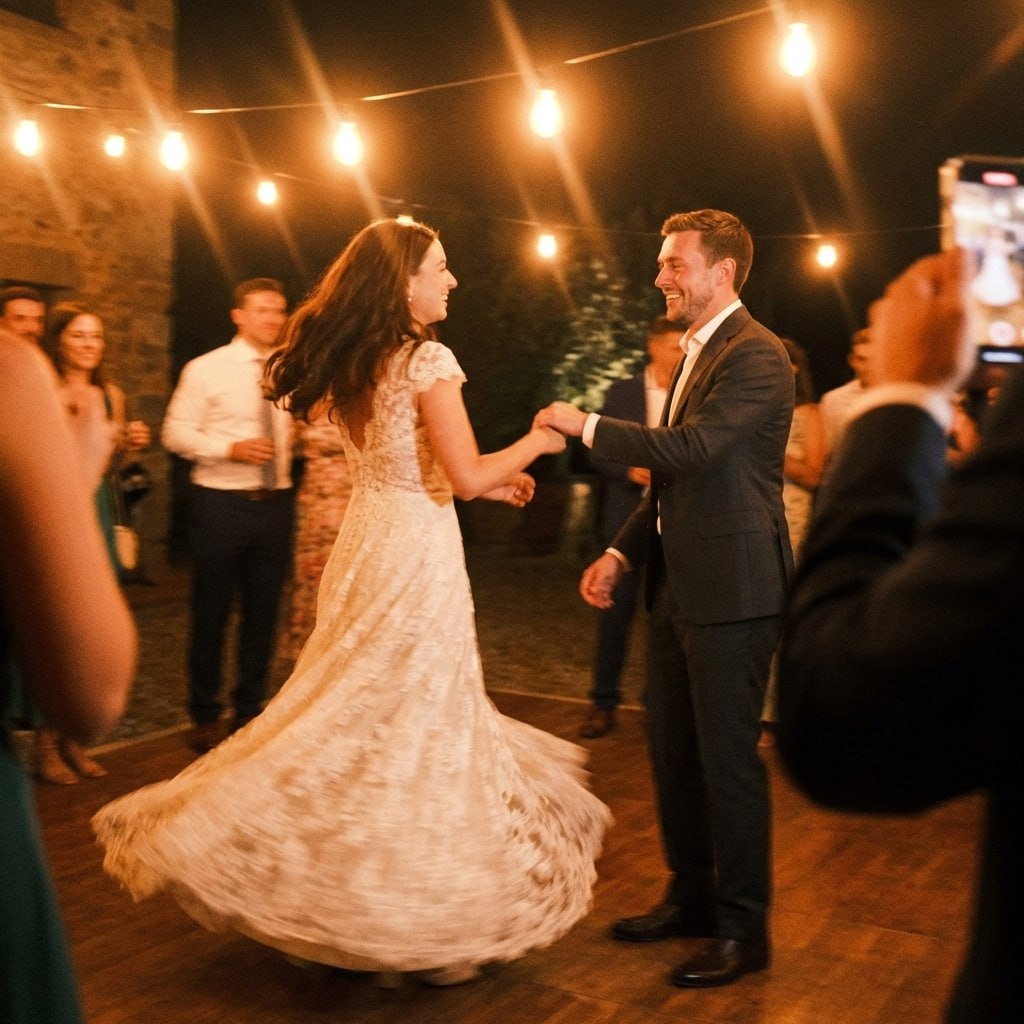
First dance
You guys!!
Set up your album for the enthusiastic uploaders
20 guest uploads free, no card. Test the flow yourself, then place the QR where the enthusiastic guest will find it.
From Mom
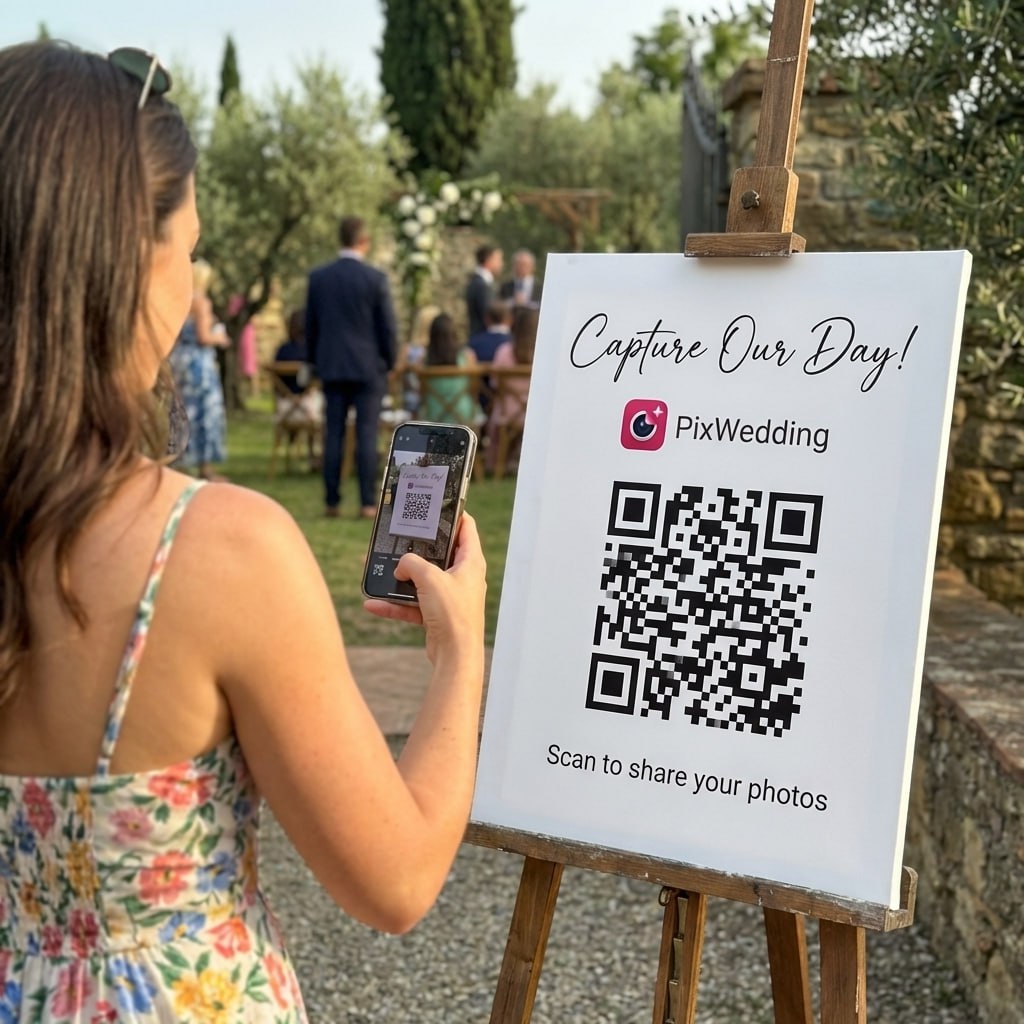
Scan to join the album
No app, no account
UPLOADING
Saving your moment
THE ALBUM
Emma & Jack
June 21, 2026
647 photos · 95 guests

SCAN TO TRY
pix.wedding/
your-wedding
What high-volume albums teach you about setup
The eager guest is already looking for the album on the way to the bar. The hesitant guest is not scanning anything at any placement. Optimizing for the eager guest first means the QR sits near the bar, at each table, and on the welcome sign, all readable at a glance from a seated position.
Enthusiastic uploaders are the whole ballgame. Every extra tap between "scan" and "upload" costs volume from precisely the people driving the album. Our own product design decision to skip account creation on the guest side is a direct consequence of watching what enthusiastic uploaders drop out on.
The enthusiastic uploader keeps uploading for days. Every one of the day-3+ uploads that make up 28.7% of the dataset came from someone who had time to look through their captures after the wedding was over. A tool that closes the window early truncates precisely the guests who care most.
Where "high volume" sits in the dataset
| Percentile | Photos in that album | Reading |
|---|---|---|
| p25 (bottom quarter) | 70 | A modest album |
| Median (middle) | 149 | Where most weddings land |
| Average | 197 | Skewed up by the high-volume tail |
| p75 (top quarter) | 253 | A quarter of albums finish above this |
"High volume" in this composite means the top quarter of the distribution: 253 uploads or more. The 1,365-photo top event and the 60-uploader event both live here. Anything above the p75 line is high volume by definition; anything at the p75 line is a full album already.
Where the high-volume claims stop
What the composite CAN and CANNOT claim
- The maximum single album on the platform (1,365 uploads from just 3 unique guests)
- The maximum unique-uploader count on a single event (60, on a 224-photo album)
- The dataset-wide distribution shape (p25 70, median 149, avg 197, p75 253)
- The behavioral rule (a few high-contribution uploaders drive volume, not broad participation)
- Any single named couple's story (this is a composite)
- Weddings above 80 unique uploaders (we have zero)
- Comparisons to competitor tools we do not have data on
- Anything expressed as a share of guest count (no guest counts on file)
- Anything that would attribute a specific quote to a real person
Where the numbers live
Why we describe it this way
We describe the pattern rather than a single named wedding on purpose. A named-couple case study is more emotionally satisfying to read, and it is also much easier to fabricate. A big wedding album that fills up with hundreds of guest photos is a real pattern in our data. The safest way to write about it honestly is to describe the pattern from real aggregates, with no invented couple, count, or quote attached. That is what this page does, and it is why the biggest figure anywhere on it (1,365 photos from just 3 guests) is a number our database can actually stand behind.
Every number on this page is from our internal aggregates. No number is invented. No couple is described. If you finish this page with an understanding of what a high-volume wedding album looks like on our platform, the composite worked. If you finish with a specific named person in your head, then something on the page failed the test we set for ourselves and we would like to know where.
For the raw distributions behind everything above, see the stats page. That is the source of truth for the numbers this composite is built on.
What high-volume albums do not contain, either
A composite that only tells the flattering half of the story is not a composite, it is a brochure. Here is the honest other side.
5.1% of guest media in the dataset is video. Even at the top end of the volume distribution, the video share does not climb dramatically. A 500-photo album at that mix holds only around 25 video items, and our single biggest album (1,365 photos) was in fact all images, with no guest video at all. If a couple imagines a highlight reel emerging from a busy album, this is where the imagination will not meet the data.
Even eligible high-volume events (Standard-plus paid) rarely use the audio-guestbook feature: only about 6.9% of eligible events on the platform ever see a single attached voice note. High-volume weddings are not more likely to include audio. The under-adoption of the feature is roughly flat across the distribution.
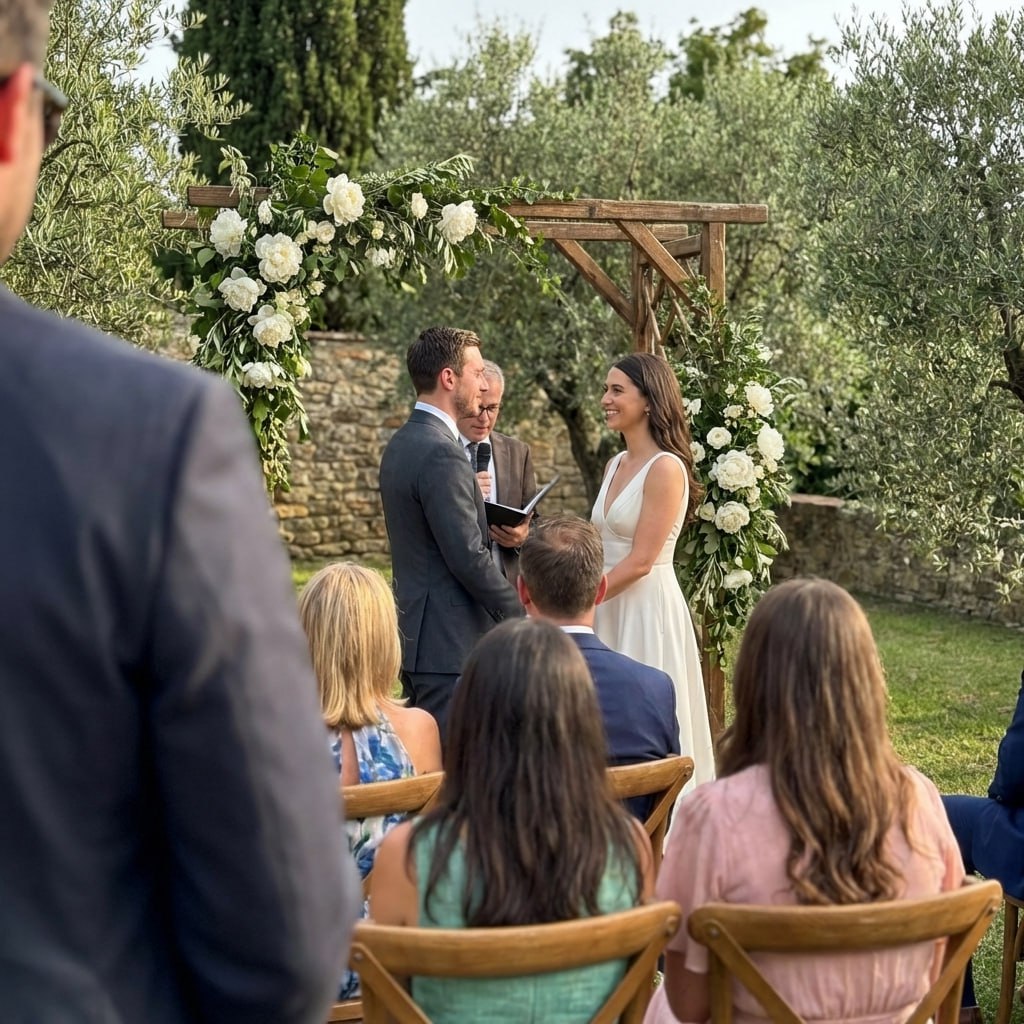
The wedding-day upload curve concentrates in the late evening. High-volume albums are heavy on reception and dance floor, not on ceremony or dinner. A guest photographing the vows is rare; a guest photographing the first dance is common. If the couple wants ceremony coverage, that is a professional-photographer job, not a QR-album job.
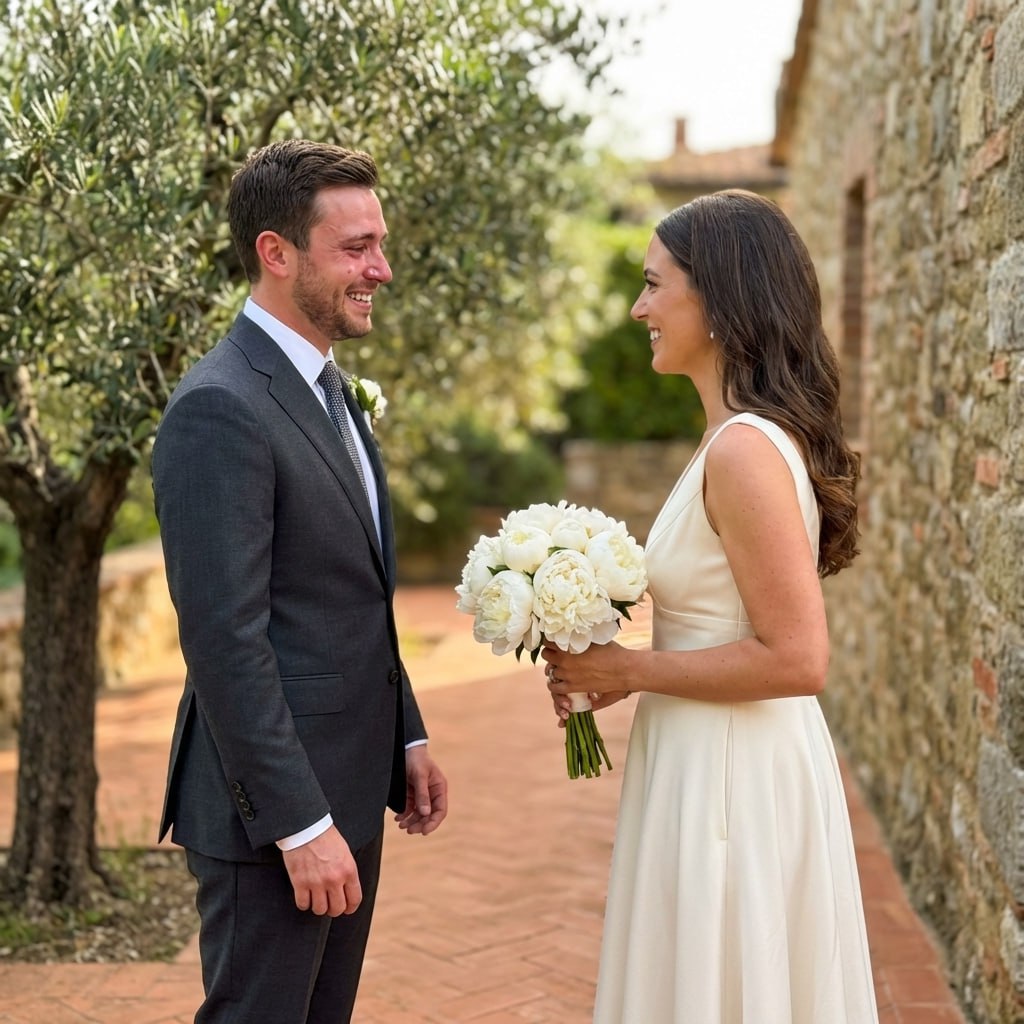
Getting-ready photos are a professional photographer thing on our data. Guests are elsewhere. Even the biggest albums are effectively empty in the pre-ceremony hours because the guests who will drive the volume have not arrived yet.
Where couples aiming for high volume tend to lose it
The dataset shows a couple of clean patterns for how a wedding aiming for a busy album ends up with a modest one instead.
Announcements before dinner land when guests are not in an uploading state. Announcements during dinner are missed because the room is talking. The single announcement worth making is after dinner and before dancing. Weddings that get this wrong tend to sit closer to the p25 or median photo count, not the p75.
A single QR on a welcome sign near the entrance under-captures the dance floor. High-volume albums, without exception in our data, come from weddings that placed the QR near where the enthusiastic uploader would find it: at each table, at the bar, near the dance floor. One placement is a hope. Four placements is a habit.
Nearly 29% of eventual guest uploads land 3 or more days after the wedding. Any product or setting that closes the window early is turning a high-volume album into a modest one purely by administrative choice. High-volume albums come from patient upload windows.
Tools that require guests to install an app or compress uploads on the way in reduce the effective volume without reducing the friction they were designed to. Our own decision to keep the browser flow open with full-resolution uploads is a direct response to what we saw when we watched the top of the distribution.
Three practical moves for a couple who wants a busier album
You probably know the three or four people who are going to shoot everything in sight. Text them the album link the day before. Not a mass invite, a personal message. Those specific guests are the difference between a median album and a p75 album. Making the flow effortless for them at the outset is where the volume comes from.
The dance floor edge. The bar. The photo booth queue. The gift table (surprisingly good because guests linger). Not the welcome sign the guest walked past on entry; that surface is dead by dinner.
A short thank-you text with the album URL sent the morning after typically extends the day-2-plus tail meaningfully. The wave was coming anyway; a follow-up makes it bigger. This is the single cheapest step a couple can take to move an album from median to high-volume without anything else changing.
The 1,365-photo event and the 60-uploader event, compared
The two events at the extremes of our distribution look nothing alike from the inside. This is what the numbers say about each.
| Metric | Top-photo event | Top-uploader event |
|---|---|---|
| Total guest photos | 1,365 | 224 |
| Unique guest uploaders | 3 | 60 |
| Photos per uploader (avg) | ~455 | ~3.7 |
| Above dataset average (197)? | Yes, by 593% | Above by 14% |
| Shape of the album | Deep contribution from a small circle | Wide contribution, shallow per person |
Two very different weddings. Same platform. Same qualifying rules. Neither one is the "correct" version of a high-volume album, they both are. The point is that "high volume" is not a single archetype in our data, and any picture in a couple's head of "the busy wedding album" is probably closer to one of these two shapes than to some averaged middle.
One paragraph a couple can carry with them
A high-volume wedding album on our platform is not a room full of guests each uploading one photo. It is a small circle of enthusiastic guests each uploading dozens, over the course of the wedding and the two or three days after. The couple aiming for a busy album should worry about the flow the enthusiastic guest hits, the timing of the single announcement, the placement of the QR near where a phone is already in hand, and the length of the upload window. Get those four right and the shape of the top of our distribution is available to any wedding, regardless of guest count. Get any one of them wrong and the album lands closer to the median.
For the full underlying distribution, methodology, and honest limitations, see the stats page. For the timing shape that determines when uploads land, see the timing report. Both are the source data for everything on this composite.
More on high-volume albums
How this page relates to the high-volume story
There is a companion story page that walks a single very high-volume wedding day hour by hour. That page is the human version of this pattern; this page is the data version behind it. Both are drawn from the same real, anonymized platform aggregates, and neither names a real couple or states a number our database cannot back. If you want the felt experience of a big album filling up, read the story. If you want the distribution underneath it, stay here.
How to use the composite
Read this alongside our raw stats page, linked throughout this page. The composite here describes what the volume shape actually looks like across large albums on our platform. The stats page carries the underlying distributions and their limits. Together they cover the anatomy of a high-volume album on our real data without needing to name a specific wedding to do so.
Explore more free wedding tools
Everything you need to make your wedding day stress-free and unforgettable.
QR Sticker Designer
Design custom print-ready stickers.
Hashtag Generator
Create unique wedding hashtags.
How to Collect Guest Photos
5 methods ranked by participation rate and ease.
Share Wedding Photos with Guests
Compare every sharing platform by ease and participation.
Best Way to Get Guest Photos
The single method with the highest participation rate.
How to Make a Shared Wedding Album
Step-by-step setup for every platform.
Alternative to Disposable Cameras
Better, cheaper options than disposable cameras.
Alternative to Wedding Photo Booth
5 cheaper alternatives to a $1,000+ photo booth rental.
High-volume album questions
Straight answers to the questions people ask most about this topic.
The largest single wedding album in our dataset holds 1,365 guest uploads from just 3 unique uploaders. It sits at the extreme end of the distribution: the average wedding on the platform has 197 photos and the median has 149. The 1,365-photo album is the outlier, not the norm.
The single wedding with the most unique guest uploaders in the dataset drew 60 distinct people uploading at least one photo. That specific wedding had 224 photos in it, not the platform maximum. The wedding with the most photos (1,365) had only 3 unique uploaders. Big volume does not require big participation.
The shape from our data is more consistent than couples expect: a small handful of enthusiastic guests each uploading dozens or even hundreds of photos each. The top-photo event drew 1,365 photos from just 3 people, an average of about 455 photos per uploader. That is the pattern behind big albums, not a whole guest list contributing evenly.
Roughly the same as the overall dataset: about 5.1% of guest media across all 203 weddings is video. Big albums are big photo albums. If a couple hopes a high-volume album will include a lot of video, they should recruit someone specifically to capture it, not rely on the QR flow.
No. It is a composite picture drawn from real, anonymized data across 203 weddings on our platform. No names, no dialogue, no invented details. We describe the shape of high-volume albums using the actual maximum, average, and uploader-count numbers from our internal aggregates.
It depends much more on friction than on head count. A wedding of 60 people with two very enthusiastic uploaders can easily land more photos than a wedding of 200 people who all uploaded once. The right question is whether the QR is placed well and the announcement is timed right, not whether you invited enough people.