







Only 13% of wedding guest photos are uploaded on the wedding day itself.
The morning after is the biggest wave, and it is bigger than every other bucket combined. Data from 203 real weddings on the Pix platform.
Data pulled 10 July 2026 from 203 qualifying Pix Wedding events (real, non-demo, 20+ photos). Buckets are UTC-based day windows relative to the event date. Timezone caveat in the methodology section.
How the day buckets are drawn
Every timing number on this page comes from the same rule. Reading the caveat before the numbers is the honest way through this page.
Where guest uploads actually land, day by day
| When uploaded | Share of guest uploads | Reading it |
|---|---|---|
| Before wedding day | 4.8% | Rehearsal dinner, arrivals, travel |
| On wedding day | 12.9% | Reception, dance floor, tail |
| Day after | 39.3% | Morning-after wave, biggest single bucket |
| Day 2 after | 14.2% | Second-day tail, brunch and travel-home uploads |
| Day 3 or later | 28.7% | Long tail, guests who forgot until the album email |
How the upload curve shapes across the wedding itself
The 13% of uploads that land on the wedding day itself do not land evenly. The shape has its own story.
Our hourly counts through the morning hours of the wedding day are a low, flat floor. There is no morning-of upload story. The couple is prepping, guests are travelling, phones are in pockets.
The first meaningful upload counts show up around the ceremony window. Guests taking phone photos of the aisle and the vows do upload some of them in near-real-time, but the volume is still low. Most guests take the photo and put the phone away.
Dinner is a quiet stretch in the upload curve. Guests are eating, talking, watching the toasts. If you announce the QR code during dinner, our data suggests almost no one is going to open their phone to act on it right then. Announce it just after dinner instead.
The biggest single-hour bucket in the wedding-day slice of our data lands late evening, around the dance-floor window. This is where the couple who told their MC "one clean announcement after dinner" gets paid back. The dance floor is where guests forget the phone-in-pocket rule and start capturing.
Uploads on the wedding day trend up right through the last hours before midnight. Then they roll into the next-day bucket, which is where the huge morning-after wave takes over.
This is the wave. Guests wake up with phones full of photos from the night before, they look through them, and they upload. Some are still at the venue, some are heading home, some are on the way to brunch with the wedding party. The album goes from half-empty to full over the course of a morning.
Roughly one in seven guest uploads lands two days after the wedding, and almost three in ten land three or more days after. This is the tail. It is not a rounding error. It is where the guests who forgot upload after the couple sends the album link, and where any wedding-week travel photos land after the guests get home.

First dance
You guys!!
Have the album live before the first photo gets taken
Free to start. Guests upload during the day and the morning after, straight into one album.

From Mom
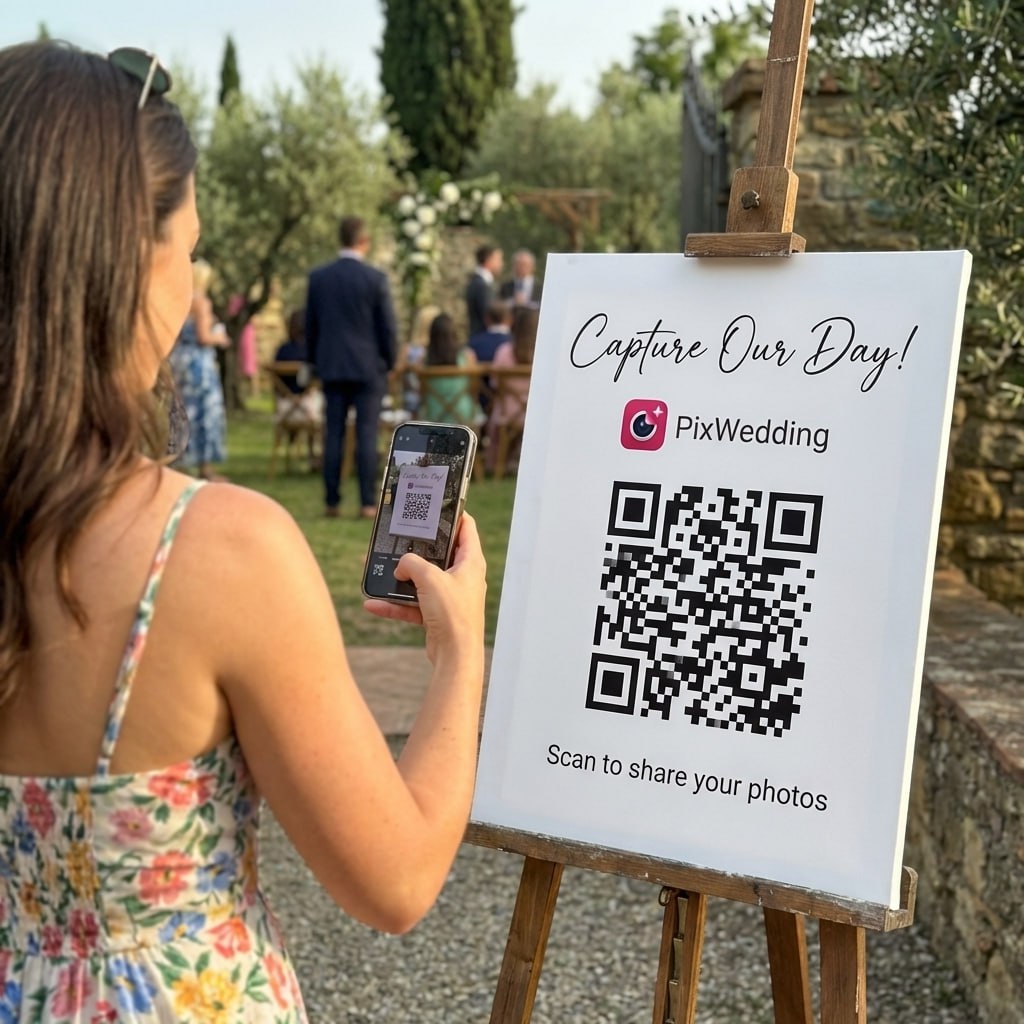
Scan to join the album
No app, no account
UPLOADING
Saving your moment
THE ALBUM
Emma & Jack
June 21, 2026
647 photos · 95 guests


SCAN TO TRY
pix.wedding/
your-wedding
What the timing curve suggests for your day
Dinner is the quiet stretch. Guests are captive but they are not uploading. The window just after dinner is when the evening starts and phones come out. A single MC line lifts the entire late-evening curve. Do it once, do it clearly, do not do it during dinner.
The morning-after wave only happens if guests can still find the album. Guests who could scan the QR at their table have almost certainly lost that piece of paper by breakfast. Send the URL out in a thank-you note the morning after, or add it to your wedding website in a spot that is easy to find. The wave hits either way, but you can grow it.
A window that closes 24 hours after the wedding cuts off almost half the guest content. Even a full week still misses the long tail. Every paid Pix plan holds the window open at least twelve months. The point is not to keep it open forever, it is to be sure the window matches the shape of when guests actually upload.
If a couple expects a full album by the time they leave the venue, they will be disappointed. If they expect a half-full album that fills in over the next morning and week, they will love the platform. The right expectation matters more than the right platform. Set the expectation for the morning-after wave when you plan the day, not when the album is already partly empty.
Where the timing story stops
Already flagged above and worth repeating here. High-offset timezones can push late-evening reception uploads into the next UTC day. The overall shape is correct; the exact split between on-day and day-after slightly understates the wedding day for a subset of weddings.
A guest can take a photo on the wedding day and upload it two days later. Our timing data measures when the upload landed on our servers, not when the guest pressed the shutter. The story is honest (this is when the file arrives at the album), but a couple hoping to see wedding-day capture behavior is looking at a different metric than we are measuring.
Our day-3-or-later bucket runs to the last upload the event ever received on our platform. For events with the upload window closed, that tail is truncated. This means the real long tail is at least as big as the 28.7% we report, and possibly a couple of points bigger.
Because our per-hour counts are UTC, the "dance-floor peak" claim describes the shape of the curve, not a specific local time you should announce at. The right announcement moment is after dinner, before dancing, in your own timezone. Do not try to match a wall-clock hour from our chart to your reception.
The wedding-day curve, hour by hour
Bucket totals across the 24 hours of the wedding day itself (UTC hours after event midnight). Reading these as shape, not local wall-clock time, is the honest way to use them.
| Hour of wedding day (UTC offset) | Guest uploads in that hour | Shape |
|---|---|---|
| Hour 0-6 (early morning) | Very low | Sleep and getting ready |
| Hour 7-11 (late morning) | Low, flat | Travel and pre-ceremony prep |
| Hour 12 (noon) | Small lift | Ceremony window begins for some events |
| Hour 13 (early afternoon) | Notable spike | Ceremony peak for the mid-afternoon events |
| Hour 14-16 (afternoon) | Rising | Cocktails and first candid shots |
| Hour 17-19 (early evening) | Dinner dip | Guests are eating and toasting |
| Hour 20 (evening) | Climbing hard | Reception is on, phones out |
| Hour 21-22 (late evening) | Very high | Dance floor and late-night candids |
| Hour 23 (last hour before midnight) | Wedding-day peak | Biggest single hour on the wedding day itself |
The peak hour is the last hour of the wedding day in UTC. For couples in mid-to-late evening receptions in most Western timezones, that maps to late reception, right around dance-floor time. For high-offset timezones the peak hour shifts, but the shape (quiet morning, dinner dip, sharp evening climb, late-night peak) holds. Then the whole curve rolls into the day-after bucket and the morning-after wave takes over.
What this changes about how you support the couple
The upload curve is not just interesting for couples. Two groups who work weddings professionally get real use out of knowing the shape.
Your professional gallery lands weeks after the wedding. The guest album lands the morning after. Some couples now expect a curated album fast because the guest album trained the expectation. Setting expectations up front (guest album for immediate volume, your gallery for the curated keepsake) turns the guest album from a competitor into a warm-up act.
The single most valuable thing a planner or MC can do for the guest album is one clean line after dinner and before the first dance. Not during ceremony. Not during dinner. Not during speeches. After dinner, before dancing. One announcement in the right minute lifts the entire late-evening curve. Every other placement lifts a lot less.
A projector wall showing guest uploads only earns its keep if it can display the late-evening peak. If the projector goes off before the dance floor opens, you have muted the biggest guest-photo moment of the wedding. Keep the wall on until the reception ends, not until dinner ends.
Common assumptions the numbers do not support
Every one of these is a reasonable-sounding assumption that turns out not to be true in our dataset.
They will not. Ceremony and dinner are near-flat in the upload curve. The wedding-day activity is heavily concentrated in the reception evening and even more heavily in the last hour before midnight. The whole day is not producing uploads. A few hours of it are.
It will be roughly one-eighth full. 12.9% of eventual guest uploads land on the wedding day itself. Setting the expectation that the album fills over the following morning and week is the honest read of the data.
Nearly the opposite. The bulk of guest uploads come from guests who did not upload on the day. The morning-after wave is not a small group of stragglers, it is the biggest single bucket. Any wedding album that closes its upload window quickly is throwing this content away.
Only if the announcement is one someone will remember when the phone is out. An early announcement (during welcome, during ceremony, during dinner) lands when guests are not in an uploading state. The same one line delivered after dinner, before dancing, is worth many times more upload volume.
A three-day window catches roughly 71% of the guest content by our numbers, leaving the day-3+ tail (28.7%) on the guest phones. A "generous" window at wedding scale is at least a week and preferably longer. On paid Pix plans it runs at least twelve months for exactly this reason.
How we would sharpen this data on the next pass
A good data report tells you what it does not answer as clearly as what it does. Here is our list.
We would map every event to its local timezone before bucketing. This is the single biggest improvement possible on this dataset and it is on our list.
EXIF captures often survive on the way through. We would separate "when the photo was taken" from "when the photo was uploaded" so couples can see both curves.
Right now we use midnight of the wedding date as the anchor. Anchoring on the ceremony start time (which we do not capture yet) would be more useful for planners.
Pages built on the same dataset
What the data means, in one sentence
If you are choosing when to announce the QR code, choose the moment guests will remember the next morning. Almost none of them will upload during dinner. Most of them will upload the morning after. Your job on the day is not to trigger uploads on the day, it is to make sure the album is impossible to miss for the guest who is going to check their phone at breakfast tomorrow.
What the data does not mean
The day-after wave is not a failure of the wedding day. Guests really are dancing, eating, watching the toasts. The right expectation is that the wedding day itself produces the memorable moments and the day after produces the album. Any tool that expects a full album to exist by the time you leave the venue is expecting the wrong thing.
Explore more free wedding tools
Everything you need to make your wedding day stress-free and unforgettable.
QR Sticker Designer
Design custom print-ready stickers.
Hashtag Generator
Create unique wedding hashtags.
How to Collect Guest Photos
5 methods ranked by participation rate and ease.
Get Photos After the Wedding
Message templates to gather guest photos post-wedding.
Share Wedding Photos with Guests
Compare every sharing platform by ease and participation.
Best Way to Get Guest Photos
The single method with the highest participation rate.
How to Make a Shared Wedding Album
Step-by-step setup for every platform.
Alternative to Disposable Cameras
Better, cheaper options than disposable cameras.
Timing questions
Everything you need to know about our free tools and how they help your wedding day.
Across 203 real weddings on the Pix Wedding platform, only about 13% of guest uploads land on the wedding day itself. 39% land the day after, 14% land two days after, and another 29% land three or more days after. The single biggest wave is the morning after the wedding.
Roughly 82%. Adding up the day-after, day-2, and day-3-or-later buckets from our timing data gives 39.3% + 14.2% + 28.7% = 82.2% of guest uploads after the wedding day. A small 4.8% land before the wedding day (usually rehearsal-dinner or arrival photos), and 12.9% land on the wedding day itself.
The single biggest hour of guest uploads on the wedding day in our dataset falls in the late-evening reception window, roughly around the dance-floor stretch. The curve builds slowly through the afternoon (ceremony and cocktails), climbs in the evening, and peaks in the last couple of hours before midnight. This is UTC-based, so treat it as a shape not a wall-clock claim.
A few reasons all pointing the same way. Guests are asleep for the last hours of the wedding and wake up with a phone full of photos. The couple often shares the album link after the wedding when things settle down. And the QR code that was in the room is gone once guests have left, so anyone who did not upload on the night uploads when they finally sit down with coffee.
After dinner, before dancing, is the reliable window based on the shape of our timing curve. Guests barely upload during ceremony or cocktails, and by dinner they have a batch of images sitting on their phone. One MC announcement in the calm minute between dinner and the first dance lifts the entire late-evening upload curve.
Long enough to catch the tail. Roughly a third of guest uploads land two or more days after the wedding. A closed window a day after would cut real content. A window of at least a week is the safe minimum. On paid Pix plans it stays open much longer than that.