
The partner who did not think guests would actually upload
One partner is usually the skeptic about a wedding QR photo album. They have seen wedding-day gadgets fall flat before. This is what real, aggregated platform data says about what changes their mind, and what still gives them pause afterward.
Details drawn from real, anonymized weddings on our platform. This page describes a common pattern across many real couples, not one named wedding.
The objection: "guests will not actually use this"
Almost every couple planning a wedding photo album has some version of this conversation. One partner finds a QR code photo-sharing setup, gets excited about it, and pitches it to the other. The other partner is not against it exactly. They are just unconvinced that anyone will bother.
The skeptical partner has usually seen this movie before. A physical guest book that half the room signed with one line and a doodle. A wedding hashtag that nobody remembered by the time the reception started. An app that required a download and a login, and that almost nobody downloaded. From that vantage point, a QR code asking guests to stop what they are doing and upload a photo looks like one more idea that will quietly fail.
This objection is not unreasonable. It is a rational response to having watched other wedding-day extras go unused. The honest answer is not to argue the skeptic out of their doubt with a sales pitch. It is to look at what actually happens across real weddings when this specific setup is used, and let the pattern speak for itself.
Why the doubt is usually reasonable, not stubborn
There is a specific shape to this dynamic that shows up in almost every wedding decision where one partner is more enthusiastic than the other: photographers, venues, favors, seating charts. One person finds something, does the research, and becomes the advocate. The other person is cautious by default and will form a real opinion once they see a real result.
For a QR photo album specifically, the skeptic's doubt usually rests on two assumptions. First, that guests at a wedding are too busy, too tipsy, or too disengaged to bother scanning a code and uploading a photo. Second, that whatever guests do upload will mostly happen during the reception itself, and if the count looks thin by the end of the night, that is the final number.
Both assumptions are the reasonable output of watching other wedding-day gadgets underperform. Neither one holds up against what actually happens across real weddings on our platform, which is exactly why this dynamic is worth describing honestly with data rather than glossing over it with enthusiasm.
The turn: what the skeptic sees once the album actually fills
Across real weddings on our platform, the typical album lands at a median of 149 photos, from 8 unique guest uploaders, with an average of 197 once the larger albums are folded in. That is not a handful of stray phone pics. It is enough real, specific, unposed images to function as an actual archive of the day, sitting alongside whatever the professional photographer delivered weeks later.
For a partner who doubted anyone would bother, seeing that album is a different kind of evidence than hearing about the feature in advance. The photos are not hypothetical. They show the table that was laughing at something during dinner. The candid moment on the dance floor nobody staged. The angle the professional photographer was not standing at because they were covering something else entirely. None of that is persuasive as a pitch. All of it is persuasive as a scrolling experience.
The turn does not usually happen at the wedding itself. It happens in the days after, when the skeptic opens the album expecting a thin, half-used gallery and instead finds a real one. That gap between the expectation and the outcome is what does the convincing, not anything either partner said to the other beforehand.
The specific assumption that trips up most skeptics
A skeptical partner who checks the album at the end of the reception and sees a modest number of photos is not looking at a failure. They are looking at an unfinished number. Across our dataset, 82% of guest uploads land after the wedding day itself, not during it.
Guests are dancing, eating, and talking during the wedding, not stopping to curate and upload a camera roll. The bulk of the album arrives over the following days, as guests get home, look back through what they captured, and upload from the couch with coffee in hand rather than from the venue with a drink in hand. A partner who assumes "whatever is there by the end of the night is the final count" is applying the wrong test to the wrong moment.
This is the single most common place the skeptic's doubt and the actual data diverge. It is not that guests refuse to participate. It is that participation is spread out over roughly a week, and most of it lands after the part of the wedding the skeptic was watching.
What actually does the convincing
It is rarely the total photo count on its own that wins a skeptic over. It is the specific quality of what is in the album: moments the couple did not personally witness. At any wedding, the couple is the center of attention for a fraction of the day, and is circulating, eating, and having one-on-one conversations for the rest of it. Guest photos fill in the parts the couple simply was not present for.
A partner scrolling through a real album for the first time is not evaluating a product. They are re-experiencing a day they thought they already fully knew, and discovering they did not. That re-experience, not a feature list, is what turns "I doubted this would work" into "I was wrong about this."
It is worth being honest that this pattern is common across weddings on our platform, not a promise for any individual couple. Some weddings land closer to the lower end of the distribution, some land well above it. The direction of the pattern, doubt followed by a real album that changes the doubter's mind, is what shows up consistently.
A rough week-by-week look at when the doubt actually resolves
On the wedding night itself, the album is genuinely thin. Guests are busy living the day, not documenting it for later. A skeptical partner glancing at the count during the reception is looking at a small fraction of what will eventually land, and drawing the wrong conclusion from it is understandable.
The morning after is where the shift usually starts. Guests wake up, look through what they captured the night before, and start uploading from their phones over coffee. This is the point where a couple checking the album together for the first time since the wedding tends to notice a meaningfully different number than what they saw at midnight.
Over the following several days, the album keeps growing as more guests get around to it: some upload the same day, some wait until the following weekend when they finally sit down and sort through their camera roll. Since 82% of guest uploads land after the wedding day itself, checking the album once, early, and treating that as the final verdict is the single most common mistake a skeptical partner makes.
By the time a week or so has passed, the album has usually settled close to its real shape: a median of around 149 photos from a handful of guests who kept adding to it a little at a time. That settled number, not the midnight count, is the fair comparison for anyone deciding whether the setup was worth it.
What if the album genuinely stays thin
Being honest about the pattern also means being honest that it is a pattern, not a guarantee. A meaningful share of weddings in our dataset finish well under the median. That is a real, smaller album, not a broken one, and a skeptic who was hoping the data promised a huge album for every wedding would be reading more into it than the numbers support. The full distribution, including how thin the lower end can get, is on the stats page.
If your own album does land on the thinner side, the most likely explanations are the same ones that show up across the dataset: the QR was not visible enough during the reception, there was no single guest who took it on themselves to document heavily, or the announcement never quite landed with the room. None of those are failures of the guests. They are logistics questions a couple can address the next time, or accept as simply how their particular wedding went.

First dance
You guys!!
Let the album convince the doubter for you
Free to start, 20 uploads free. Nothing to argue about once the photos are in.
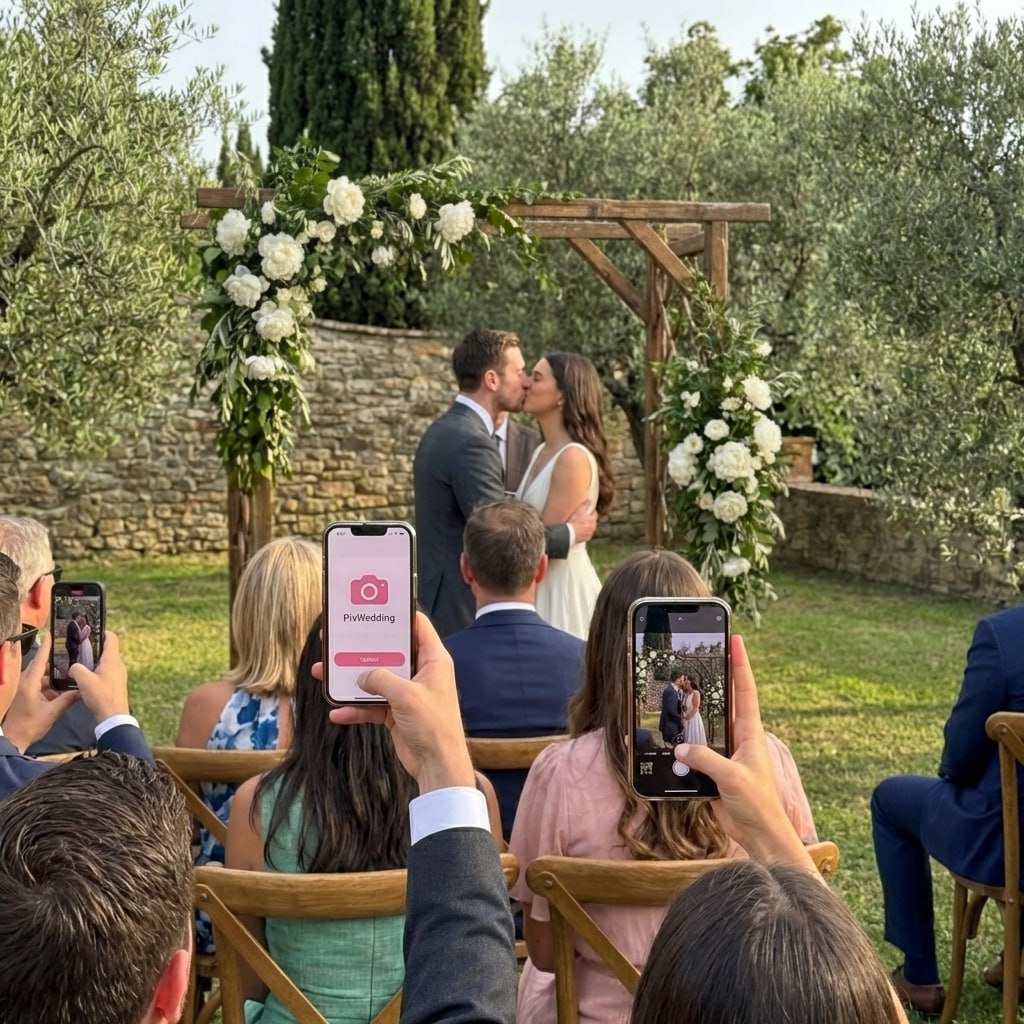
From Mom
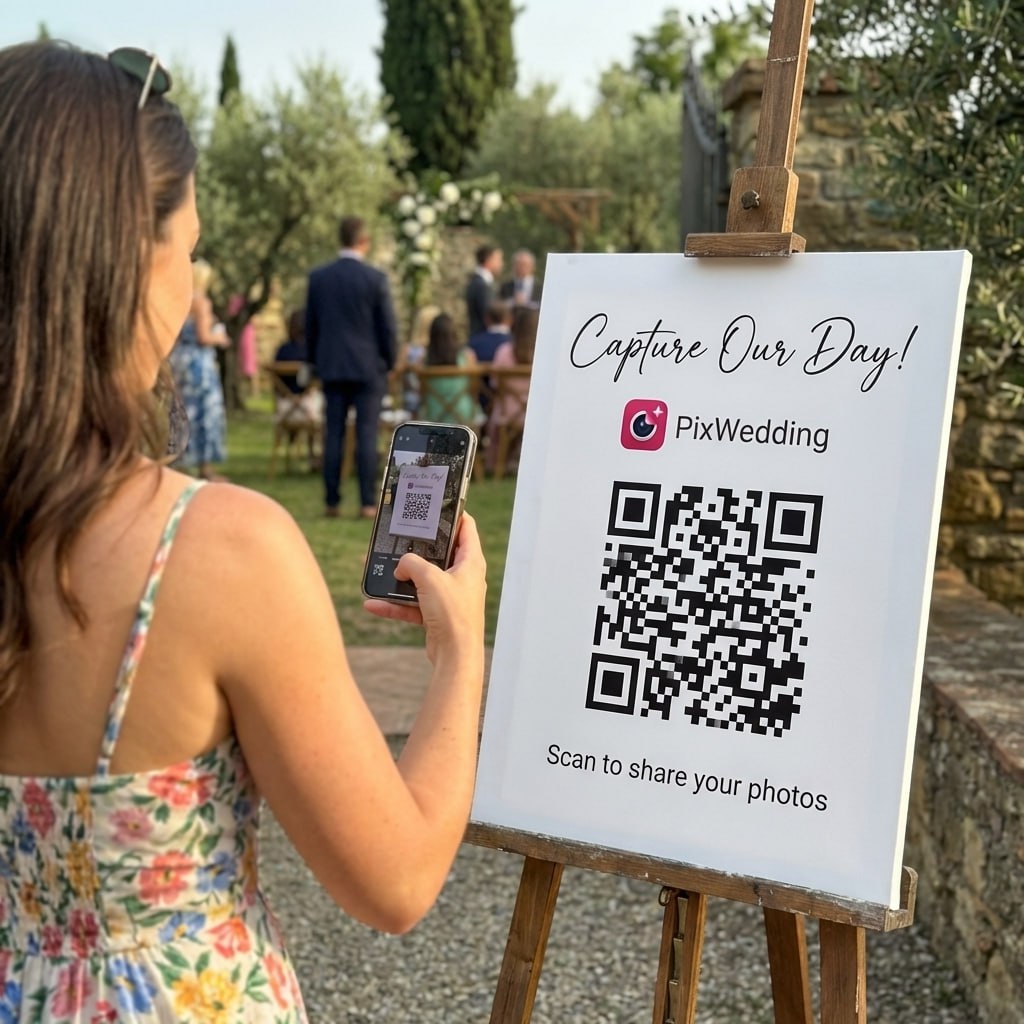
Scan to join the album
No app, no account
UPLOADING
Saving your moment
THE ALBUM
Emma & Jack
June 21, 2026
647 photos · 95 guests



SCAN TO TRY
pix.wedding/
your-wedding
The honest caveat: conversion is not the same as universal participation
Even a fully converted skeptic should keep one reservation: not every guest uploads. Volume comes from a handful of enthusiastic uploaders, not from the whole guest list contributing evenly.
A real album filling up does not mean every invited guest picked up their phone and participated. Across our dataset, a median wedding draws 8 unique guest uploaders. Most weddings have far more guests than that in the room. The album gets full because a small group uploads a lot, often dozens of photos each, not because participation is spread evenly across the guest list.
This is the specific reservation worth keeping even after the doubting partner has come around. The lesson from the data is not "everyone will use this." It is "a handful of people will use this heavily, and that is enough to produce a real archive of the day." A couple should not be disappointed if most of their guest list never opens the link. That is the normal pattern, not a sign that something went wrong.
We also do not have guest headcounts in our own data, so we cannot say what share of any wedding's invite list actually uploaded. Every number on this page is about uploads and unique uploaders, not about participation as a percentage of guests invited. That is a real limit of what this data can honestly claim.
For a skeptical partner, this is actually a reassuring caveat rather than a discouraging one. It means the bar the album needs to clear is not "convince the whole guest list to participate." It is "get a handful of guests uploading, and let them do the rest." That is a much lower and more realistic bar than the one most skeptics assume they are being asked to believe in.
Why we tell this story through data instead of a named couple
This page used to tell the skeptic story through one specific named couple, with an exact photo count, an exact number of uploaders, and an exact amount of time spent scrolling the morning after. We could not verify those specifics against our own records as facts about one real, identifiable couple, so we removed the invented details rather than keep a page standing on numbers we could not stand behind.
What we can stand behind is the pattern itself, because it shows up repeatedly across real, anonymized weddings on our platform: one partner doubts guests will bother, the album fills mostly in the days after the wedding, and the doubting partner tends to come around once they actually see it. Describing that pattern honestly with real aggregate numbers is more useful to a reader than describing one unverifiable couple with specific but unconfirmed details.
If you are reading this because your own partner is the skeptic, the composite framing should not weaken the point. The pattern is not a single anecdote we are hoping generalizes. It is the typical shape across a real dataset, which is a sturdier thing to plan around than any one couple's story, verified or not.
The coverage gap a skeptic usually does not expect
A professional photographer is one person, moving through the venue with intention, following the couple through the moments the couple already knows are happening: the entrance, the first dance, the cake cutting. That coverage is composed, consistent, and valuable, and it is also, by definition, the view from a single set of eyes.
Guest photos come from a different vantage point entirely. They are pointed at whatever a guest happened to find interesting at that moment, which is often something the professional photographer was not covering: the side conversation at a table, a reaction during the toasts, a candid moment on the dance floor two songs before the photographer expected to shoot it.
This is the specific gap that turns a skeptical partner into a convinced one. It is not that the guest photos are technically better than the professional ones. It is that they show a different version of the same day, one the couple was not positioned to see themselves, and that gap is what a doubting partner is not expecting until they scroll through it.
For the full underlying numbers behind this pattern, including the complete distribution and the honest limits of the dataset, see the guest photo upload statistics page. This page describes one behavioral pattern within that dataset; the stats page carries the full picture.
The skeptic's assumptions vs what the data shows
| What the skeptic assumes | What the platform data shows |
|---|---|
| "Nobody actually scans these things" | A median wedding still gets 8 unique guest uploaders, average 197 photos in the album |
| "Whatever comes in will be there by the end of the night" | 82% of guest uploads land after the wedding day, not during it |
| "It will be a handful of blurry phone pics, not a real album" | The typical album lands at a median of 149 photos, enough to be a real archive, not a novelty |
| "Everyone will upload, so it will be chaos to sort through" | Volume comes from a small group of enthusiastic guests, not the whole guest list at once |
Watch: A Real Wedding Album Reveal
Source: Emily Jeanne, "Wedding Album Unboxing | Artifact Uprising." This is the same moment the skeptic in this page eventually has: sitting down with a real, physical set of wedding photos and actually looking through them.
If your partner is the skeptic, three moves that actually work
- 1
Set it up anyway, and set realistic expectations together
Do not oversell it as "everyone will use this." Tell your partner honestly that a small group of guests usually drives the volume, and that is enough. Setting the bar at the median rather than the biggest possible number keeps both partners from feeling let down.
- 2
Do not judge the album by what is there at midnight
Since most guest uploads land after the wedding day, checking the count during the reception and drawing a conclusion is checking too early. Agree in advance to revisit the album together a few days later, once the day-after wave has landed.
- 3
Let the photos make the case, not the pre-wedding pitch
Arguing that a skeptic should trust the feature in advance rarely works, and does not need to. The album speaks for itself once it exists. Set it up, keep the QR visible during the reception, and let the results do what no amount of persuasion could.
- 4
Pick one enthusiastic guest to seed it
Since volume tends to come from a small group rather than the whole room, ask one or two guests you already know will take a lot of photos to try the QR early in the night. A skeptic who sees real uploads landing within the first hour has one less reason to write the whole thing off before the day-after wave even starts.
If you are the skeptic reading this yourself
Maybe you are not the partner who found this page first. Maybe you are the one being asked to trust that a QR code taped near the bar will produce anything worth keeping. Your doubt is fair. Most wedding-day extras really do go unused, and it is reasonable to want more than a pitch before agreeing to add one more thing to plan.
The honest answer is that you do not have to take anyone's word for it in advance. Set your own bar: a real album, from a small group of guests, that fills mostly in the days after the wedding rather than during it. If that bar is not cleared once the album has had a week to settle, your skepticism was correct for your wedding. If it is cleared, which is what happens across most real weddings on our platform, you will have seen the evidence yourself rather than been talked into it.
Either way, the cost of finding out is low. Setting the album up does not require guests to download anything or you to manage anything during the reception. The worst case is a modest album. The typical case is a real one. That asymmetry is worth weighing against the mild inconvenience of one more QR code in the room.
What this pattern can and cannot claim
- The typical album size (median 149, average 197 photos)
- The typical unique uploader count (median 8)
- The share of uploads landing after the wedding day (82%)
- The concentration of volume among a small group of uploaders
- Any single named couple's exact story
- What share of any wedding's guest list participated (no headcounts on file)
- A guarantee about any individual wedding's final numbers
- Comparisons to other photo-sharing tools we do not have data on
The skeptic conversion arc, in four steps
The doubting partner has seen wedding-day extras go unused before and expects the same here.
They look at the count on the wedding night, see a modest number, and assume that is the final result.
Days later, the album has filled to a median of around 149 photos, with moments neither partner had seen before.
A small group of guests did the work, not the whole room. That is the normal pattern, not a shortfall.
Related reading
More on guest photo collection, the underlying data, and how it plays out at real weddings. These pages go deeper into the same questions from different angles.
One paragraph to carry into the conversation with your own skeptic
The doubting partner is usually right that not every wedding-day idea gets used. They are usually wrong that this one will not, because a small group of guests reliably fills a real album, and most of it arrives after the wedding is already over, not during it. Set it up, wait for the days-after wave, and look at the album together. That is the whole case, and it does not need to be argued in advance.
And if it turns out your particular wedding lands closer to the modest end of the range, that is a real possible outcome too, not something this page pretends away. The pattern points one direction more often than not. It is not a guarantee for every guest list.
If your own partner is the skeptic
If you are the one who found the QR album and your partner is the one raising an eyebrow, you are not dealing with a uniquely difficult person. You are dealing with a very ordinary and reasonable form of caution. Most people have sat through at least one wedding-day idea that did not land, and it is fair for a partner to want proof rather than a pitch.
The move that tends to work is not arguing your case harder before the wedding. It is letting the album do the talking after. Set it up, keep expectations realistic (a full room of photographers is not the promise, a handful of enthusiastic uploaders producing a real album is), and revisit it together once the guest uploads have had a few days to land.
Why we tell this as a composite, not a named story
This page used to describe a single named couple with specific, precise details: an exact photo count, an exact number of uploaders, an exact time spent scrolling. We could not stand behind those specifics as verified facts about one real couple, so we removed them rather than let a page look authoritative on details we had not confirmed.
What we can stand behind is the aggregate pattern across real, anonymized weddings on our platform: the typical album size, the share of uploads that land after the wedding day, and the fact that a small group of guests drives most of the volume. Those numbers are traced to our own internal data, described on our statistics page, and they are the honest version of the same story.
Explore more free wedding tools
Everything you need to make your wedding day stress-free and unforgettable.
QR Sticker Designer
Design custom print-ready stickers.
Hashtag Generator
Create unique wedding hashtags.
How to Collect Guest Photos
5 methods ranked by participation rate and ease.
Share Wedding Photos with Guests
Compare every sharing platform by ease and participation.
Best Way to Get Guest Photos
The single method with the highest participation rate.
How to Make a Shared Wedding Album
Step-by-step setup for every platform.
Alternative to Disposable Cameras
Better, cheaper options than disposable cameras.
Alternative to Wedding Photo Booth
5 cheaper alternatives to a $1,000+ photo booth rental.
Skeptic conversion: questions answered
Straight answers to the questions people ask most about this topic.
It is a composite, drawn from real, anonymized weddings on our platform, not a single named couple. No names, no city, no invented dialogue. The pattern it describes, one partner doubting guests would bother uploading and then coming around once the album filled, is common enough across real weddings on Pix that we can describe it honestly using aggregate data rather than a single unverifiable story.
Usually because they have watched other wedding-day gadgets fail to get used: a physical guest book nobody signed properly, a hashtag nobody remembered, an app nobody wanted to download. A QR code is one more thing asking guests to do something, and a skeptical partner has reasonably learned that most of those things do not get used at scale.
Seeing the album, not hearing about it in advance. Across real weddings on our platform, the typical album lands at a median of 149 photos from 8 unique guest uploaders, average 197. That is enough real, specific, unposed photos, many of moments the couple did not witness themselves, to convert a doubter who was unmoved by any pitch beforehand.
Yes, and this is the specific assumption that trips up most skeptics. Across our dataset, 82% of guest uploads land after the wedding day itself. A skeptical partner who checks the album at the end of the night and sees a modest count is looking at an unfinished number. The album keeps filling for days as guests get home, look through their camera rolls, and upload from the couch.
No, and this is the honest caveat worth keeping even after a skeptic is won over. Volume comes from a handful of enthusiastic guests, not universal participation. A median wedding sees 8 unique uploaders contribute the bulk of the album. Most of the guest list never opens the link at all. The album still ends up full because a small group uploads a lot, not because everyone contributes a little.
That the couple cannot predict, ahead of time, which guests will be the enthusiastic uploaders, or promise a specific final count. The data describes a strong pattern across real weddings, not a guarantee for any individual wedding. A couple should expect the album to fill from a small group over the days after the wedding, not from the whole room on the night itself.