
Scared of Getting Married and Leaving Parents: It Is Not Actually Leaving
Marriage does not mean losing your parents. It means expanding your family. Here is how to navigate the transition with love, intention, and zero guilt.
If you are scared of getting married because it means leaving your parents, you are experiencing a real and common grief response, not a sign that something is wrong with your relationship. The fear usually is not about your partner at all. It is about the transition itself: less daily proximity, a shifting role inside your family of origin, and often an unspoken guilt about being the one who chooses to go.
This feeling shows up on wedding forums and in therapy offices constantly, and it appears regardless of how happy the relationship is. It tends to be strongest for people from close-knit or collectivist families, only children, and anyone whose parents are aging or leaning on them more than before. The fear usually softens once a new routine settles in, but you do not have to wait for the wedding to start working through it.
In one sentence: the fear of leaving your parents for marriage is grief for a changing relationship, not evidence you are marrying the wrong person, and it responds well to honest conversations, new routines started early, and boundaries set with love instead of guilt.
Why This Grief Is Real, Even in a Happy Marriage
Attachment does not end at the altar
The bond you have with your parents is an attachment bond, the same category of connection that made your childhood feel safe. That bond does not switch off because you signed a marriage license. When the structure around it changes (a different address, fewer shared meals, a partner now sharing the role of "person you go home to") it is normal for your nervous system to register that as a loss, even while the rest of you is genuinely excited to marry.
This is why the fear can feel confusing: you are not doubting your partner, you are grieving a version of closeness with your parents that is changing shape. Grief and joy are allowed to sit in the same week, even the same day. Neither one cancels the other out.
Healthy separation versus guilt
Family therapists describe a useful distinction here: the difference between healthy separation and enmeshment or guilt-driven closeness. Psychology Today's explanation of Bowen Family Systems Theory describes "differentiation of self" as the capacity to stay closely connected to family while also holding your own emotional autonomy, as opposed to "emotional fusion," where boundaries blur and it becomes hard to tell your own needs apart from your parents' expectations.
Healthy separation feels like: I love my parents, I miss the old rhythm, and I am also building something that is genuinely mine. Guilt-driven fusion feels like: I cannot make a decision about my own life without picturing my parents' disappointment first. Most people carrying this fear are somewhere on that spectrum, and simply noticing where you sit is the first useful step.
If this fear brings persistent distress that does not ease as the wedding gets closer, or shows up with sleep loss, panic, or a dread you cannot shake, it is worth talking to a licensed counselor or therapist. That is not a sign anything has failed. It is the same kind of support many people use for any major life transition.

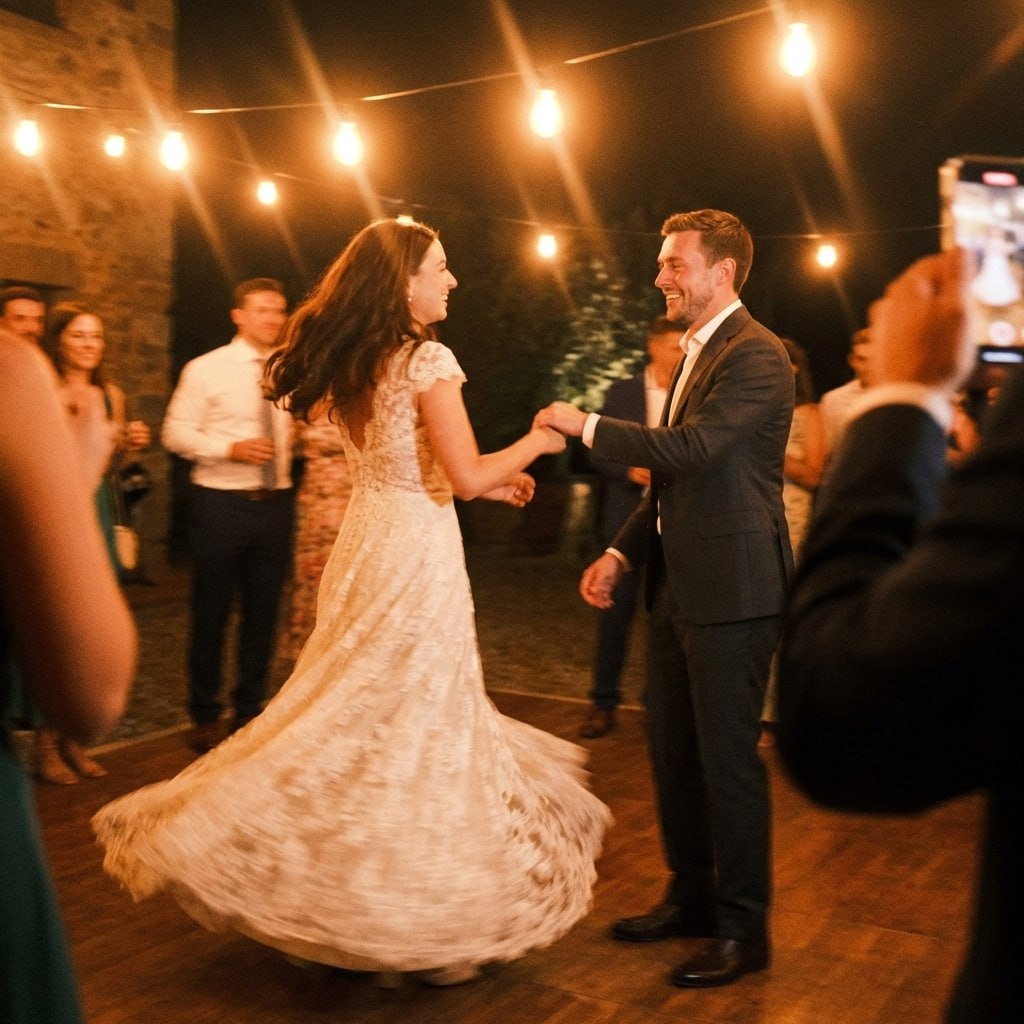
First dance
You guys!!
Both families, one shared album.
Guests from your side and your partner's side scan one QR code, so the small in-between moments, your dad during the first dance, the two families meeting, all land in one place instead of scattered across phones.

From Mom
Scan to join the album
No app, no account
UPLOADING
Saving your moment
THE ALBUM
Emma & Jack
June 21, 2026
647 photos · 95 guests






SCAN TO TRY
pix.wedding/
your-wedding
This Looks Different Across Cultures
Western Family Dynamics
In many Western cultures, moving out after marriage is expected and even encouraged. But that does not make it emotionally easy. If you grew up in a close family, the cultural expectation to be independent can feel like forced separation. You might feel torn between what society says you should want and what actually feels right.
The truth is, there is no rule about how close you need to stay to your parents. Independence and closeness are not opposites. You can build your own life while maintaining a deep bond with your family.
Collectivist Family Dynamics
In South Asian, East Asian, Middle Eastern, Latino, and many other cultures, family is central to identity. Living with or near parents is not just common, it is valued. Marriage can feel like a betrayal of that bond, especially if you are moving to a different household.
The guilt is amplified when parents have sacrificed significantly for you. Moving out can feel like ingratitude. But your parents' love for you is not conditional on your physical presence. Marrying and building your own family honors their legacy, it does not diminish it.
Words for What You're Feeling
Naming the feeling precisely makes it easier to talk about, both with your partner and with your parents.
Attachment
The lasting emotional bond between you and your parents, formed in childhood, that does not switch off simply because you marry.
Differentiation of self
The capacity to stay closely connected to your family while also holding your own emotional autonomy and decision-making. A core idea in Bowen Family Systems Theory.
Emotional fusion
The opposite of differentiation. Boundaries blur until it becomes hard to separate your own needs and decisions from your parents' expectations.
Enmeshment
A pattern where you feel responsible for a parent's emotional wellbeing, or cannot make decisions without their approval, beyond ordinary closeness.
Ambiguous loss
Grief for a relationship that is changing shape rather than ending. Your parents are still alive and loving, but the daily version of the relationship is different.
Individuation
The lifelong process of becoming your own person while remaining in relationship with your family of origin. Marriage is one milestone in that process, not the end of it.
A Quick Self-Check
Most people reading this are experiencing ordinary, healthy transition grief. A smaller number are dealing with something that benefits from extra support. Neither is a character flaw.
Signs of ordinary transition grief
- You feel sad about the change but still excited about the marriage itself
- You can picture your parents being okay, even happy, once the adjustment settles
- Talking it through with your partner or parents brings some relief
- The fear eases a little each time you rehearse the new routine (calls, visits, traditions)
Signs worth a deeper look
- You cannot picture making any decision without a parent's approval first
- A parent responds to the wedding with guilt, withdrawal, or ultimatums
- The fear does not soften with conversation, planning, or time
- You feel physically unwell (panic, insomnia, dread) whenever you think about the move
Reflection Prompts: Redefining, Not Losing, the Relationship
The goal is not to talk yourself out of the fear. It is to picture, specifically, what stays and what evolves.
What does your relationship with your parents actually look like day to day right now, and which parts do you want to keep exactly as they are?
Naming the specifics (Sunday calls, a shared hobby, sitting together at dinner) makes the thing you're protecting concrete instead of a vague fear of loss.
If you pictured your parents five years after your wedding, still close to you and thriving, what would that closeness look like in practice?
Picture the routine, not just the feeling. A five-years-out picture is easier to build toward than an abstract hope.
What is one tradition from your childhood home you want to recreate in your own household?
Carrying a tradition forward is a way of taking your parents with you, not leaving them behind.
What is something your parents taught you that you now want to pass on in your own marriage?
This reframes the transition as continuation of their influence, not an ending of it.
If your parent could name one fear they have about your marriage, what would it be, and have you actually asked them?
Most unspoken fears on both sides shrink once they are said out loud instead of guessed at.
What would it feel like to let your parents be proud of this transition instead of grieving it alongside you?
You are allowed to let their pride sit next to their sadness. Both can be true without you needing to manage either one.
Conversation Scripts for Both Sides
Prepare these in advance so you are not improvising language when the moment is already emotional.
Talking to your partner
When you want your partner to understand the fear
"I need you to know this nervousness isn't about us. It's about learning how to be close to my parents in a new way. I might need some extra patience around holidays and phone calls for a while."
When negotiating where to live or how often to visit
"Living near my parents matters to me more than I realized. Can we talk about what proximity looks like for both of our families, not just mine?"
When you need reassurance instead of a solution
"Can you just remind me that loving them and choosing you aren't in competition? I forget that sometimes when the guilt gets loud."
Talking to your parents
When telling your parents you need room to build your own household
"I'm not moving away from you. I'm building something new, the way you did when you got married, and I still want you close."
When setting a boundary around a decision
"We want your advice, and we'll always ask for it. But some decisions, like where we live or how we spend our money, need to be ours to make first."
When reassuring a parent who is struggling with the change
"I know this is a big shift for you too. Let's pick one thing we do together every week, no matter what, so it never has to feel like we drifted."
How This Shows Up in Real Life
The scenarios below are illustrative composites, not real clients or documented case studies. They are meant to show the shape this fear can take, not to prescribe a single path.
The Only Daughter
Close-knit, multigenerational household
In this illustrative scenario, a woman who grew up in a house with her parents and grandmother felt that moving out for her wedding was a quiet betrayal, even though everyone was thrilled about the marriage itself. She and her mother eventually agreed that Sunday dinner at the family home would stay non-negotiable no matter where she lived. Naming the one thing that would not change gave both of them something solid to hold onto during a season that otherwise felt like loss.
Pick one ritual that survives the move intact. It anchors everyone during the rest of the change.
The Long-Distance Anticipation
Grieving the move before it happens
In this illustrative scenario, a groom relocating three states away for his spouse's job started feeling the sadness of leaving months before the wedding, long before any boxes were packed. Rather than waiting for the grief to arrive on moving day, he and his parents set up a standing weekly video call starting immediately, so the new rhythm was already familiar by the time he actually left. The anticipation eased once the future routine had a shape he could picture.
If you're grieving a move that hasn't happened yet, start the new contact routine early. Rehearsing it removes some of the fear of the unknown.
Two Families, One Holiday Table
Cultural expectation to host at the parents' home
In this illustrative scenario, a couple from a culture where holidays are always hosted at the parents' home had to figure out how to blend that expectation with building their own household. Instead of treating it as an either-or choice, they proposed alternating years and adding one new tradition of their own, a dessert course they cooked together and brought to every gathering regardless of whose house it was. The parents felt honored rather than replaced, and the couple got a tradition that was fully theirs.
When a cultural expectation feels rigid, look for a version that keeps the core of it (whose home matters least than togetherness) while adding something that is genuinely yours.
6 Practical Ways to Stay Close After Marriage
Distance does not have to mean disconnect. Here is how to maintain your bond.
Schedule a weekly call or video chat
Put it in the calendar like any other appointment. Sunday morning coffee over FaceTime, Wednesday night check-ins, whatever works. Consistency matters more than duration. Even 15 minutes of regular contact keeps the bond strong.
Create new family traditions
Monthly family dinners, holiday cooking sessions, annual trips together. These traditions give your parents something to look forward to and ensure your marriage adds to family life rather than subtracting from it.
Include your parents in your new life
Invite them over for dinner. Share photos from your week. Ask for their advice on home projects or recipes. Small acts of inclusion go a long way in showing them that marriage did not create a wall between you.
Live close if proximity matters to you
There is no rule that says marriage means moving far away. If being near your parents is important to you, make that a priority when choosing where to live. Your partner should understand and respect that need.
Involve your partner in the family relationship
The stronger the bond between your partner and your parents, the less it feels like 'leaving.' Encourage shared activities, inside jokes, and genuine relationship-building between your spouse and your family.
Talk to your parents about your fears
Your parents probably felt the same way when they got married. They understand the transition better than you think. Having an honest conversation about your fears can be incredibly reassuring for both of you.
Your First Year Away: A Simple Timeline
The transition is rarely one hard cutoff. It is a series of small adjustments that get easier once a new rhythm exists.
The rawest stretch
The first few weeks after the wedding are usually the hardest, especially if you moved or changed households. Expect the ambiguous-loss feeling to be loudest here. Lean on the weekly call or visit you already scheduled rather than waiting for the feeling to pass on its own.
The new normal starts to form
By this point most couples and parents have found a rhythm, even if it looks different from before. This is a good moment to check in explicitly: is the contact frequency still working for everyone, or does it need adjusting?
The first real test
A first major holiday, a health scare, or a schedule conflict often arrives around now and tests whatever boundaries you set. Treat friction here as information, not failure. It usually means a boundary or a routine needs a small tweak, not a big rethink.
Looking back
Most people report that the fear they felt before the wedding was worse than the reality that followed. Use the one-year mark to name what actually changed and what stayed the same, and to thank your parents for how the transition went, whatever shape it took.
Setting Boundaries Lovingly
Staying close to your parents while building a marriage requires healthy boundaries. Boundaries are not walls. They are guidelines that protect all relationships involved. Without them, enmeshment can create tension between your partner and your family.
Your marriage decisions (finances, living situation, parenting) belong to you and your spouse, with input from parents when you invite it.
Be clear with your parents about what kind of involvement you welcome and where you need independence.
If your parents struggle with the transition, validate their feelings without reversing the boundary.
Your partner deserves to feel like a priority, not a competitor with your parents.
Boundaries are an act of love. They protect the relationship by preventing burnout and resentment.
When Enmeshment Is the Real Issue
There is a difference between loving closeness and emotional enmeshment. Closeness means you enjoy your parents' company and value their input. Enmeshment means you cannot make decisions without their approval, feel responsible for their emotional wellbeing, or experience extreme guilt when prioritizing your own needs.
If you recognize enmeshment patterns, a therapist who specializes in family systems can help you untangle these dynamics without damaging the relationship. This is not about loving your parents less. It is about developing the emotional independence needed to be a healthy partner.
Important: If your parents are using guilt, manipulation, or emotional withdrawal to prevent you from getting married, that is a sign of unhealthy attachment on their end. You can love them deeply while still choosing your own path.
One Day, Two Families, One Shared Set of Memories
Whatever this transition looks like for your family, your wedding day is often the last time both sides of your family are fully in one room together for years. That is worth capturing well. A shared guest photo gallery, like the QR-code uploads on Pix Wedding's photo sharing page, means the small in-between moments, your mother's face during the first dance, the two families meeting for the first time, do not stay stranded on one relative's phone that never gets shared.
Related Guides
Why Leaving Parents for Marriage Feels So Hard
The bond between parent and child is one of the deepest human connections. When marriage enters the picture, it can feel like that bond is being threatened. This fear is especially strong for people who grew up in close-knit families, only children, or those whose parents are aging or in declining health.
What makes this fear unique is that it comes from a place of love, not doubt. You are not questioning your partner or your relationship. You are grieving a transition. And grief during happy moments is confusing because the world expects you to be purely excited.
- •The fear of leaving parents is rooted in love, not weakness
- •Marriage is an expansion of family, not a replacement
- •Cultural background significantly shapes how this transition feels
- •Maintaining regular contact is the strongest predictor of continued closeness
- •Healthy boundaries protect both your marriage and your family relationships
Navigating the Transition With Your Partner
Your partner plays a crucial role in this transition. If they understand and respect your family bond, the process will feel much smoother. Have an open conversation about what family involvement looks like in your marriage. Discuss expectations about holidays, visits, living proximity, and communication frequency.
A partner who dismisses your attachment to your parents or demands that you 'choose' between them is raising a red flag. Marriage should never require you to abandon people you love. A supportive partner will help you find a balance that honors both relationships.
A Note for Parents Reading This
If you are a parent who found this page, know that your child's fear of leaving you is a testament to how much they love you. The best thing you can do is reassure them that your bond does not depend on physical proximity. Give them your blessing enthusiastically. Welcome their partner warmly. And trust that the love you built over decades does not disappear because of a new address.
Your child is not abandoning you. They are doing exactly what you raised them to do: building a loving life of their own. That is your greatest success as a parent.
Explore more free wedding tools
Everything you need to make your wedding day stress-free and unforgettable.
Seating Chart Planner
Plan your reception seating visually.
Guest List Manager
Track RSVPs and dietary needs.
Budget Allocator
Turn your total into a category-by-category plan.
Venues by State
Explore venues across all 50 states.
Countdown Timer
Count down the days to your big day.
Wedding Checklist
Month-by-month planning checklist.
Bachelorette Party Games
15+ games with rules, supplies, and timing.
Alternative to Wedding Guest Book
15 creative alternatives guests enjoy.
Frequently Asked Questions
Straight answers to the questions people ask most about this topic.
Completely normal, especially in close-knit families and collectivist cultures. The guilt comes from love and loyalty, which are admirable qualities. Marriage does not require you to stop caring for your parents. It simply means adding a new primary relationship while maintaining existing ones.
Start by establishing regular communication routines like weekly calls or video chats. Create new family traditions that include your parents. Live nearby if proximity is important to you. Most importantly, talk openly with your parents about your feelings. They likely felt the same way when they got married.
No. A healthy marriage should never require you to cut off your parents, and healthy parents should never ask you to choose them over your spouse. Both relationships can coexist and thrive. The key is establishing boundaries and expectations that everyone respects.
The fear of leaving parents is usually about the transition and the relationship with your family of origin, not about your partner's character or the health of your relationship. If your worry is specifically about your partner's trustworthiness, compatibility, or behavior, that is a separate question worth exploring in its own right, not the same thing as grieving a family transition.
If your parents are using guilt, emotional manipulation, or withdrawal to prevent your marriage, that is an unhealthy dynamic that needs attention. You can love your parents and still choose your own path. A family therapist can help navigate this conversation in a way that preserves the relationship while asserting your independence.
If the fear is mild and eases with conversation and planning, working through it yourself with the tools on this page is usually enough. If it brings persistent distress, panic, sleep loss, or a dread that does not lift as the wedding approaches, a licensed counselor or therapist who works with family systems can help you sort healthy attachment from guilt-driven fusion, without judgment.