pixPix Weddingwedding
First-hand setup guide

Live Wedding Photo Slideshow: The Honest Setup Guide

A screen that updates in real time as guests upload from their phones. Here is what it costs, what hardware to use, and the small choices that decide whether the slideshow feels electric or awkward.

Short answer

A live wedding photo slideshow is a TV or projector at the reception that shows guest-uploaded photos within 30 seconds of upload. You need three things: a screen, a laptop or streaming device to drive the display, and a wedding photo app like Pix Wedding that handles uploads + sorts photos by moment + projects the live feed.

Total setup time: 30-45 minutes day-of. Total cost: $250-500 depending on whether you rent or buy the screen.

Setup walkthrough

Eight steps to a working live slideshow on the wedding day

From three weddings we have set this up at, in the order they actually need to happen.

  1. 1

    Decide TV or projector four weeks out

    Visit the venue with the lights set to "reception level" and walk to the spot you plan to put the screen. If you can read the printed dinner menu without squinting, a TV will work. If the room is dim or the throw distance is over 15 feet from a clean wall, go projector. Decide now because rentals book up two weeks out.

  2. 2

    Reserve the screen + driver device

    Screen rental from a local AV company runs $150-400 with delivery and pickup included. Add a $30 HDMI cable and a laptop or a $35 Chromecast/Fire Stick to drive the display. Have the rental contract include a 90-minute setup window before guests arrive.

  3. 3

    Set up the Pix Wedding album the week before

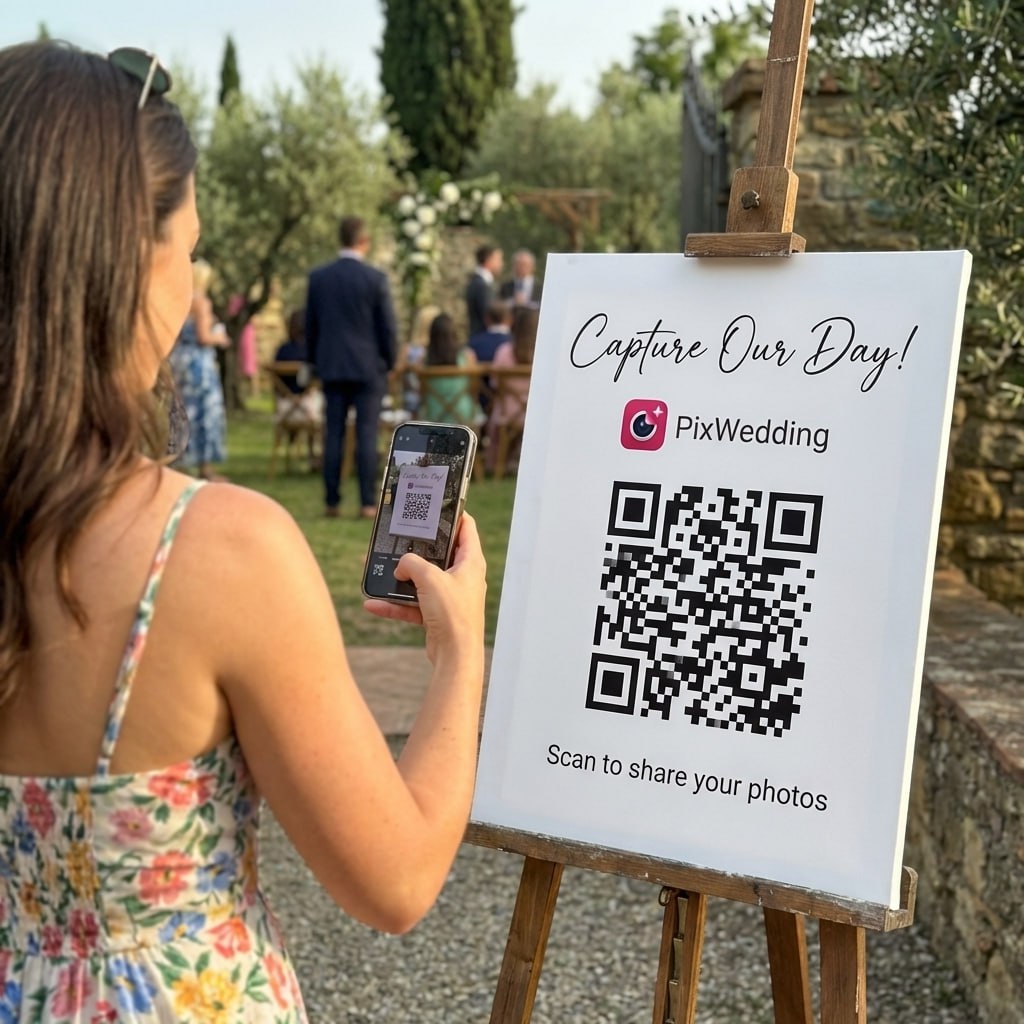
    Names, date, cover photo. Generate the QR code. Print 15-20 table cards with the code. The slideshow URL is automatically generated from the same album, so you do not configure it separately.

  4. 4

    Test the WiFi 24 hours before the wedding

    This is the step most couples skip and regret. Show up at the venue with the laptop. Connect to the venue WiFi at the exact spot the screen will sit. Open the slideshow URL. Watch a sample photo upload from your phone. If anything stutters, you have 24 hours to fix it (mobile hotspot, extender, ethernet drop) instead of 24 minutes before the ceremony.

  5. 5

    Day-of: physical setup 90 minutes before guest arrival

    Mount the TV or place the projector. Run the HDMI cable. Plug in the laptop or streaming stick. Connect the venue WiFi. Open the slideshow URL in Chrome, press F11 for full-screen. Verify it shows the placeholder "waiting for first photo" screen. Tape the cables down. Done.

  6. 6

    Hand the QR cards to the table coordinator

    Whether that is your wedding planner, your maid of honor, or your most type-A friend. Their job: one QR card per table, plus one near the bar. Do not skip the bar card. It catches guests during cocktail hour when they are most likely to upload.

  7. 7

    Brief the DJ on the freeze cue

    The DJ pauses the slideshow during the first dance and during the speeches by tapping a button in the Pix Wedding admin dashboard. Walk them through it during setup. They will not remember if you mention it in passing, make them do it once.

  8. 8

    During the reception: nothing

    If the setup was done right, the slideshow runs itself. Photos appear, get displayed for 7-10 seconds, get replaced by the next one. You do not touch the laptop. You enjoy your wedding.

A reception screen that builds itself in real time

Pix Wedding includes the live slideshow on Standard tier and up. Same QR code your guests scan to upload also drives the screen at the reception. One purchase, no extra software.

Aunt Janet

Aunt Janet

9:41

ALBUM

Emma & Jack

June 14, 2026

634 photos · 94 guests

AllMomentsMine
Wedding guest photo 1 from album preview
Wedding guest photo 2 from album preview
Wedding guest photo 4 from album preview
Wedding guest photo 5 from album preview
Wedding guest photo 6 from album preview
Wedding guest photo 7 from album preview
Wedding guest photo 8 from album preview
Wedding guest photo 9 from album preview
Wedding guest photo 10 from album preview
Add photosShare your moments
Bar just sharedJames K. · +6 new photos
Decision framework

TV vs projector vs LED wall

If/then framework that has held up at every wedding we have set this up for.

If the room is normally lit, pick a TV (65-75 inch)

Best for: Reception halls with overhead lighting, restaurant venues, daytime weddings. Cost: $150-250 rental, $400-700 buy. Setup time: 15 minutes. Image quality: sharp, 4K available, no rebooting mid-night. Downside: max practical size is 85 inches before the price triples.

If the room is dim and has a clean wall, pick a projector

Best for: ballrooms, tented receptions after sundown, venues with high ceilings, modern minimalist spaces with one good blank wall. Cost: $200-400 rental, $600-1,200 buy. Setup time: 30 minutes (alignment is fiddly). Image size: 100-150 inches feels dramatic. Downside: sensitive to ambient light. Single overhead bulb in the wrong spot washes out the image.

If budget is no concern, pick an LED video wall

Best for: luxury weddings, ballrooms with wow-factor budgets, weddings where the slideshow is part of the centerpiece décor. Cost: $1,500-5,000+ rental for a 10x6 foot wall. Setup time: a half day with a hired tech. Image quality: visible from anywhere in the room, daylight-bright. Downside: the price.

Real numbers

What a live slideshow setup actually costs

All-in pricing for the three most common configurations, based on real rentals we have priced in 2026.

Cost itemBudget setup (TV)Standard (projector)Premium (LED wall)
Screen rental$150-250$200-400$1,500-5,000
Stand or mount$25 (included w/ rental)$50Included
Driver (laptop or Fire Stick)$35 (Fire Stick)$35 (Fire Stick)Included
HDMI + extension cables$20$30Included
Pix Wedding Standard$59 (one-time)$59 (one-time)$59 (one-time)
AV tech (optional)$0 (DIY)$0-200$400-800
Total range$289-389$374-724$1,959-5,859

For comparison, a photo booth rental for the same evening typically runs $1,000-1,500 with an attendant. The live slideshow gets used by 3-4x more guests at a third of the cost.

Vignette 1: Priya & Marcus, converted brick warehouse, Hudson NY, September 2025

This was a Saturday in mid-September 2025, 156 guests, a converted brick warehouse on Warren Street in Hudson, NY. The venue had high exposed ceilings and good ambient lighting from Edison-bulb strands. We rented an LG 75-inch UR8000 from a local AV company called Hudson Valley Sound for $185, delivered and picked up. They threw in a rolling floor stand. We brought our own 15-foot HDMI cable ($14 at the hardware store two blocks away), a Fire Stick 4K that was already in the bag, and ran Pix Wedding Standard ($59 one-time). Total hardware and software cost: $258.

The TV went on the stand between the bar and the edge of the dance floor, about 11 feet from the kegs. QR cards on all 18 tables, one taped to the back of the bar with a strip of gaffer tape, one standing in a small acrylic frame next to the guest book. The Pix Wedding slideshow URL was open in Chrome, full-screen, on the Fire Stick's Silk browser by 4:45 PM, a full 90 minutes before cocktail hour started.

First photo hit the screen at 5:47 PM. Priya's cousin Ananya uploaded a bar selfie with three friends. Within 12 minutes, nine more photos were rotating. By 6:34 PM the feed had 51 photos and guests were visibly clustering near the screen to watch. Marcus's mother teared up when a photo of her late father-in-law appeared in a collage that Ananya had uploaded from her camera roll. That moment alone was worth the $258.

The DJ, a guy named Colin who had never worked with a live slideshow before, got a two-minute walkthrough during setup. We made him tap Freeze mode once so he knew exactly where the button was in the Pix Wedding dashboard on his phone. He froze it cleanly before the four speeches at 7:12 PM and again before the first dance at 8:03 PM, both times without a nudge. The freeze landed on Priya and Marcus's engagement portrait that we had pre-loaded as the frozen frame. Clean.

At 8:14 PM, 11 minutes into dinner service, the venue WiFi dropped. No warning. The screen went to a blank white browser tab. We hot-spotted off Marcus's iPhone 15 Pro for the next 43 minutes until the venue router rebooted itself. Hotspot handled the slideshow display fine but photo upload rates from guests slowed because some guests' phones could not see the Pix Wedding upload URL. Upload rate dropped from roughly 7 photos per 10 minutes to 2. When the venue WiFi came back at 8:57 PM, there was a backlog flush and 22 photos hit the album in about 4 minutes.

By 11:30 PM the album held 487 photos and 23 voice messages. The slideshow ran unattended for five and a half hours after the WiFi came back. The wedding photographer asked us to add a "screen reaction" note to the shot list because the cluster of guests watching themselves appear generated three genuinely funny candid frames.

  • Lesson learned: Test the venue WiFi 24 hours before, not 24 minutes. If we had discovered that router was flaky during the walk-through visit, we could have arranged a dedicated ethernet drop at the TV stand for $0 extra. We will not skip that step again.
  • Cost breakdown: LG 75-inch UR8000 rental (Hudson Valley Sound) $185, HDMI cable $14, Fire Stick 4K (already owned) $0, Pix Wedding Standard $59. Total $258.

Vignette 2: Lina & Diego, tented vineyard, Sonoma CA, last weekend of June 2025

The last weekend of June 2025. 94 guests. A tented reception on a working vineyard just outside Sonoma, CA. The couple had been going back and forth between projector and TV for weeks. We pushed for projector here because the tent had a large white canvas side wall that faced the seating area and the reception ended after dark. Rented an Epson EX9240 short-throw projector with a tripod stand from a local production company called Vine Street AV for $260, one-day rental with delivery. The projection area on the canvas wall hit about 110 inches diagonal. The image looked genuinely dramatic, especially once the string lights dimmed after 8 PM.

Driver device was a MacBook Air that the best man, Tomasz, brought specifically for this. We ran Chrome full-screen with the Pix Wedding slideshow URL. HDMI to the projector via a USB-C adapter that Tomasz already owned. Fourteen table cards, two cards near the self-serve wine station at the tent entrance, one zip-tied to the front of the bar. Pix Wedding Standard at $59. Total rental-plus-software cost: $333.

First photo appeared at 6:02 PM, about 18 minutes into cocktail hour. Diego's brother uploaded a candid of the couple sneaking a quiet moment by the vines before the reception started. That photo stayed in heavy rotation for most of the night because guests kept asking "when was that taken?" By 7:15 PM the feed had 68 photos. By 9:00 PM it had 194.

The DJ freeze cue was the one rough edge. Lina and Diego's DJ had not worked with Pix Wedding before and had the dashboard open on an older Android tablet with a small screen. During the first dance at 7:58 PM, she tapped Freeze mode 40 seconds late, so the screen was cycling through new uploads while the couple was mid-dance. Not a disaster, but Lina noticed. Going forward the instruction is: give the DJ the admin link on their phone, not a tablet, and do a timed rehearsal during setup so they know the exact moment they need to tap, not a rough window.

Upload pattern at this wedding was notably different from an indoor venue. Guests who were outside walking the vineyard rows during cocktail hour were uploading on cellular, not venue WiFi. That actually kept uploads coming steadily even when the tent WiFi got congested during dinner. The second big upload wave hit at 9:43 PM right after the bouquet toss, 31 photos in 8 minutes. The slideshow feed looked almost live-broadcast at that moment.

One issue unique to projectors: a waiter walked between the projector and the wall twice during dinner service and briefly cast a shadow across the screen. Easy fix with a rope barrier and a small printed sign. We added that to the setup checklist. Three guests under 35 also tried to scan the QR from the projected image on the wall rather than from the table card, which does not work because the projected QR distorts slightly at that scale. One walk-through with the nearest table sorted it.

  • Lesson learned: Brief the DJ with a phone, not a tablet, and run a timed freeze rehearsal with them. Forty seconds late on a freeze during a first dance is the kind of thing couples remember.
  • Lesson learned: Add a rope barrier around the projector throw path before guests arrive. Takes 2 minutes, prevents shadow interruptions all night.
  • Cost breakdown: Epson EX9240 projector rental with stand (Vine Street AV) $260, HDMI-to-USB-C adapter (already owned) $0, Pix Wedding Standard $59, gaffer tape and rope barrier supplies $14. Total $333.
Templates

Scripts for the DJ and MC to plug the slideshow

Three short prompts that, when read at the right moment, double the upload rate.

Cocktail hour announcement (read once around 30 min in)

"Hey everyone, real quick: the screen by the bar is live with photos
you are taking right now. Scan the QR on your table to add yours,
and watch the screen, you might see yourself."

Right after the first dance (when energy peaks)

"Beautiful. Quick reminder: every photo you took during that dance
just landed on the screen. If you got a great angle, scan the QR
on your table to add it. The bride and groom get to keep all of
these forever."

Late night (around the cake or the bouquet toss)

"Last call for photos on the screen. Anything you grabbed tonight,
upload it now and it makes the album. The QR is on your table or
on the bar."

Eight common mistakes setting up the live slideshow

  • Not testing the venue WiFi the day before. Discover dead spots while you still have time to fix them, not 24 minutes before guests arrive.
  • Pointing the projector at a textured wall. Stucco, brick, or wood grain destroys the image. Either reposition or rent a projection screen.
  • Leaving the laptop screen visible behind the TV. Guests see your desktop and Slack notifications. Press F11 for full-screen browser mode and turn off notifications.
  • Forgetting to brief the DJ on the freeze cue. They will not pause the slideshow during the first dance unless you walked them through it. Make them do it once during setup.
  • Putting the screen in a corner nobody walks past. Best location is between the bar and the dance floor. Worst is "we hid it so it does not clash with the centerpieces."
  • No QR card near the bar. Bar is where guests have time to fumble with their phone. A QR card taped to the back of the bar gets more scans than any table card.
  • Cable management at the last minute. Buy gaffer tape ahead of time. Tape the HDMI cable down so the catering staff does not yank the screen off a stand.
  • Skipping the moderation buffer. Enable the 30-second pending queue in Pix Wedding. You will use it maybe twice all night but the night you do is the night you really need it.
Timing guide

When to run live vs frozen, hour by hour

5:00 PM

Pre-cocktail, show a static welcome slide

Couple's names, date, and a "scan to add your photos" prompt. Guests arrive and learn the screen exists.

5:30 PM

Cocktail hour, live mode, fastest rotation (7-second per photo)

Guests are most likely to upload now. Fast rotation makes the screen feel alive and pulls more eyeballs.

7:00 PM

Speeches and toasts, FREEZE on couple's portrait

Nobody competes with the speaker. Screen becomes part of the décor, not a distraction.

8:00 PM

First dance, FREEZE on couple's engagement photo

First dance is sacred. Do not let it compete with a chaotic feed.

8:15 PM

Dance floor opens, live mode resumes, slowed rotation (10-second)

Dancing creates a lot of motion-blur photos. Slow the rotation so guests have time to see them go by.

10:30 PM

Late night, live mode, highlight reel mixed in

Pix Wedding can intersperse a "best of tonight" rotation between new uploads. The screen feels like a recap building in real time.

12:00 AM

Last call, static thank you slide

"Thanks for being part of our wedding. Album lives forever at pix.wedding/[album]." Encourages guests to keep uploading from home in the days after.

Glossary

Live slideshow terms decoded

Throw distance

How far a projector needs to be from the wall to produce a sharp image at a given size. Short-throw projectors handle 4-8 feet, standard projectors need 10-20+ feet.

Lumens

Brightness rating for projectors. Under 3,000 lumens is dim-room only. 3,000-5,000 handles most reception lighting. 5,000+ for bright spaces.

Moderation buffer

A delay between guest upload and the photo appearing on the screen. Lets you remove anything inappropriate before the room sees it. 30 seconds is standard.

Freeze mode

Pauses the slideshow on a single image. Used during speeches and first dance. Two-tap toggle in the Pix Wedding admin.

Rotation speed

How long each photo stays on screen before the next one. 7-10 seconds is the sweet spot. Faster feels frantic, slower feels stale.

Driver device

The laptop, Fire Stick, Chromecast, or Apple TV that runs the slideshow URL and outputs to the screen via HDMI. The simplest setup uses a streaming stick.

Keep planning your photo flow

Related guides for the rest of the reception photo experience.

Why a live photo slideshow lands differently at a reception

The first time we set up a live wedding photo slideshow, we underestimated how much it pulled the room together. Guests started crowding the screen during cocktail hour to see their own uploads. By the end of dinner, people who never take photos at weddings were taking them just so they could see their phone show up on the TV.

That is the unique mechanic of a live slideshow. It is not just a passive display. It is a participation loop, where every upload makes the next guest more likely to upload too. The screen does the marketing for itself.

  • It builds participation through visible social proof
  • It gives older guests a place to "see what is happening" without scrolling a phone
  • It serves as a memorable backdrop for the dance floor without competing with the music
  • It saves you the post-wedding "send me all your photos" text chain
  • It costs less than a photo booth and gets used by 3-4x more guests

When a live slideshow is the wrong call

Smaller weddings under 30 guests do not get the social proof flywheel going because every upload is already known. The screen ends up showing the same handful of faces on rotation and the magic of "someone I do not know just shared something cute" never happens.

Outdoor weddings in bright daylight also struggle because TVs wash out and projectors are unusable. If your reception ends at sunset or runs entirely outdoors before dark, the slideshow is a great idea for the after-party indoors but not for the ceremony or daylight cocktail hour.

What to budget for the screen plus the software

Hardware is usually the biggest cost. A 65 inch 4K TV runs $400-700 to buy new or $150-250 to rent. A short-throw projector with a tripod stand runs $600-1,200 to buy or $200-400 to rent. Your venue may have a screen included in the rental package, so ask before purchasing anything.

Software is the smaller cost. Pix Wedding starts at $49 one-time for Starter (no live slideshow) and $59 one-time for Standard which includes the live slideshow plus unlimited photos and HD video. So the total slideshow setup, screen included, is typically $250-500 depending on whether you rent or own the hardware.

Explore more free wedding tools

Everything you need to make your wedding day stress-free and unforgettable.

Real questions couples ask before committing to a live reception display

Live Wedding Photo Slideshow FAQ

Everything you need to know about our free tools and how they help your wedding day.

A live wedding photo slideshow is a screen or projector at the reception that displays photos from guests as they upload them from their phones, in near real time. Photos appear within 10-30 seconds of being uploaded. Most setups use a TV mounted in the room or a projector pointed at a wall, with the slideshow URL opened in full-screen browser mode. Pix Wedding handles the upload, sorting, and display end of this without extra hardware beyond a screen.

The first wave hits during cocktail hour because that's the slowest portion of the night and guests have time to fiddle with their phones. The second wave comes during dinner. The third (biggest) wave hits right after the first dance because that's an emotional, photo-heavy moment. Expect the slideshow to build from 20 photos at hour one to 400+ by midnight on a 120-guest wedding.

TV is sharper, more reliable, and works in bright rooms. Projector covers a larger area, looks more dramatic on a wall, but needs a darker room and a longer throw distance. For most weddings under 200 guests in a venue with normal lighting, a 65-75 inch TV on a stand near the dance floor is the better call. For ballrooms with high ceilings and dimmed lights, a projector at 100+ inch image is the move.

Pause it. Most live slideshow apps including Pix Wedding let you freeze the screen on a single image during key moments. The convention is: live updating during cocktail hour, dinner, dancing, and late-night. Frozen on a couple's portrait during speeches and first dance. The freeze takes 2 seconds from the dashboard.

Set up a moderation buffer so photos sit in a pending queue for 30 seconds before appearing on the slideshow. Pix Wedding has this built in. In practice, the buffer almost never catches anything spicy because guests at weddings police themselves once they know the screen is live, but it is a real concern for chaotic crowds and the buffer is the answer.

Three places. A QR table card with one sentence ("Scan to add your photos, they appear on the screen"). A line in the program/menu ("Photos guests upload during the night land on the screen by the dance floor"). And one DJ announcement around the time the slideshow gets busy ("Hey, the screen by the bar is live with all the photos you are taking, keep them coming").