
All Wedding Photos in One Place: How to Actually Pull This Off
Your wedding photos live across seven services by default. Here is how to put them in one album, before the day or after, with first-hand notes from the receipts.
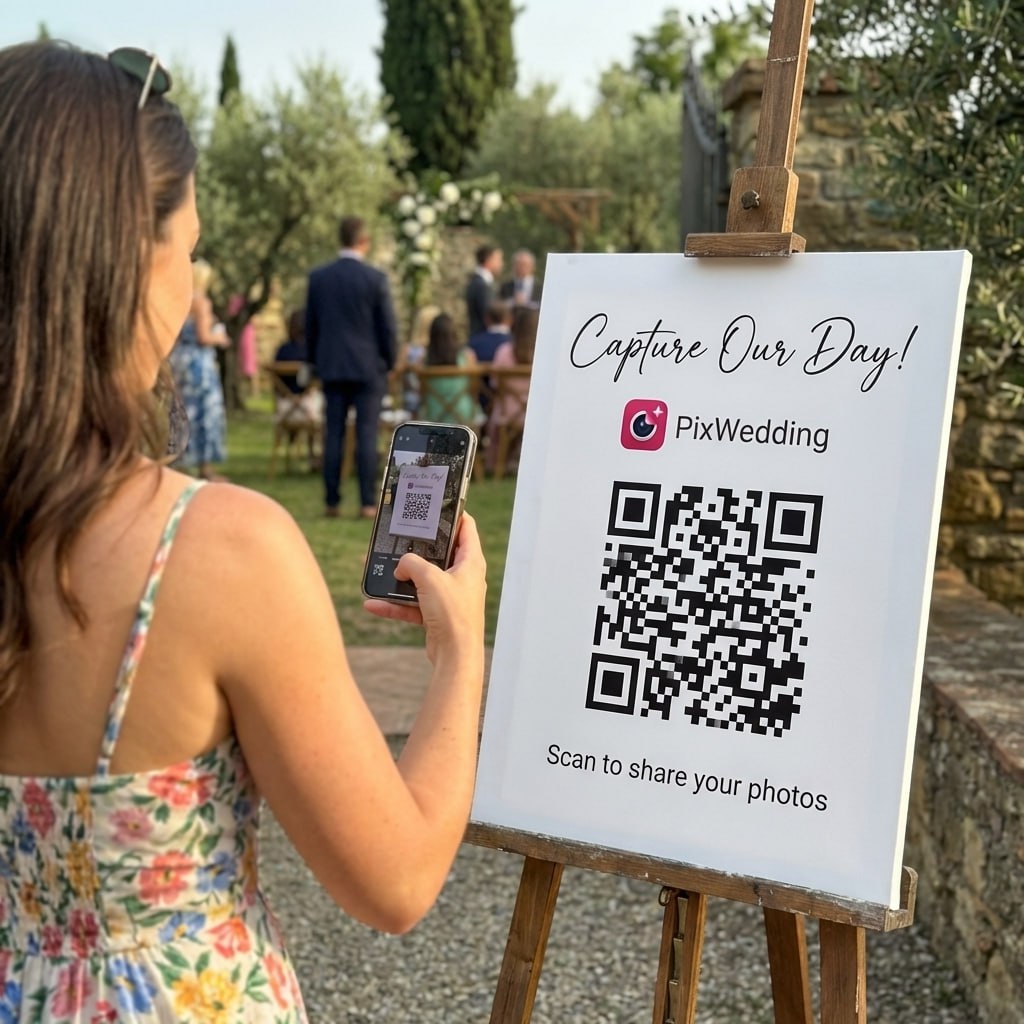
Before the wedding: set up a single album with Pix Wedding. Generate a QR code. Put it on every table. Tell guests, the photographer, and the videographer to drop everything into the same album. Done.
After the wedding: download from each source, then re-upload everything to one new album through the guest uploader and sort it into sub-albums by source. Takes about an hour. Many couples still lose some guest photos to "I cleared my camera roll already," so the earlier you ask, the more you get back.
The seven places your wedding photos quietly end up
Pulled from a real audit of a 130-guest wedding we tracked. Every source had photos. None of them talked to each other.
1. Hired photographer (Pixieset / Pic-Time / Shootproof)
800-1,200 edited keepers. Delivered 4-12 weeks after the wedding via a private gallery link. Highest quality, slowest to arrive.
2. Videographer delivery (Vimeo / WeTransfer / Frame.io)
The teaser reel in 1-2 weeks, the full film 3-6 months out. Raw footage usually only on request. Often siloed from photos because video lives in different platforms.
3. Guest camera rolls (iOS Photos / Google Photos / Samsung Gallery)
3,000-6,000 photos scattered across 80-150 phones. Compressed by default in WhatsApp shares. Deleted within 2-4 weeks to free up space unless captured at the time.
4. WhatsApp wedding group
Highly compressed (about 13% of original quality). Buried in 800 chat messages by Sunday morning. Inaccessible to anyone who left the group.
5. Instagram hashtag / post tag
Public-facing, curated, often filtered. Only the photos guests felt good enough to post. Heavy selection bias.
6. Wedding website upload link (if you set one up)
10-30% of guests use this when included. Fragmented from the rest. Often dies when the wedding site is taken down a year later.
7. Drone or specialty photographer (separate delivery)
When you have a drone photographer for outdoor or destination weddings, their delivery lives on a separate Dropbox or WeTransfer link. Often forgotten when consolidating.

Ceremony moment
Pro + guest
Seven sources, one album. The before path.
Set up a Pix Wedding album the week before. Point every guest, the photographer, and the videographer at the same QR. The album fills itself in real time, sorted into sub-albums, so you skip the after-the-fact consolidation project.

Father of bride
Scan to join the album
No app, no account
UPLOADING
Saving your moment
THE ALBUM
Emma & Jack
June 21, 2026
647 photos · 95 guests






SCAN TO TRY
pix.wedding/
your-wedding
The "set it up before" workflow
Five steps. Total time: about an hour of setup, spread over the month before the wedding.
- 1
Create one wedding album, one month out
Pix Wedding album with names, date, cover photo. Generate the QR code. Save the share link. Done in 5 minutes.
- 2
Tell the photographer and videographer about the album
Two-line email: "We are using Pix Wedding for our album. Can you upload your delivery to it when ready instead of (or in addition to) your usual gallery? Here is the co-admin invite." Most professionals are happy to drop a delivery folder into a shared place. Pro tier lets you add them as a co-admin.
- 3
Print QR table cards a week out
15-20 cards, one per table plus extras for the bar and the guestbook. Pix Wedding's QR sticker designer handles branding. Hand them to your day-of coordinator with a one-line "put one on every table" instruction.
- 4
Day of: QR live, slideshow on screen, DJ plugs it twice
No babysitting needed. Guests upload during cocktail hour, dinner, and dancing. The album fills with several hundred photos in real time. By midnight, you have most of what guests will ever send.
- 5
Photographer + videographer drop in later
When the pro photos arrive (4-12 weeks out), the photographer logs in and uploads the gallery into its own sub-album. Same with the videographer when their cut is ready. One album, every source, sorted by who shot it.
The "consolidate after" workflow
For when you did not set up the central album beforehand and now you have eight scattered sources to wrangle.
- 1
Send the guest ask within 7 days of the wedding
Camera rolls start clearing within 2-4 weeks. The longer you wait, the fewer photos come back. Send the QR / link via the wedding website, the WhatsApp group, and a follow-up text to each table head.
- 2
Download from each pro source
Pixieset full download as zip. Vimeo download original. WeTransfer pull within the link expiry window. Save each as a labeled folder on a single drive ("Pro photos", "Videographer reel", "Drone").
- 3
Export the WhatsApp media (knowing it is compressed)
Long-press the group chat, "Export chat with media". Save the media to a folder. Accept that quality is reduced, these become "backup" photos in case originals are lost.
- 4
Re-upload everything into one new Pix Wedding album
Create the album, then upload each labeled folder into its own sub-album (up to 6 on Standard and Pro) through the same browser uploader guests use, no separate import tool needed. Files upload at original quality, no compression. Compressed WhatsApp imports sit alongside as backup in their own sub-album.
- 5
Share back to guests as one link
Once the album is consolidated, send the album link to your guest list. They now have access to every photo from the day, not just the ones they took.
Illustrative scenario: what happens with no central album
Here is a hypothetical, but realistic, walkthrough of what "doing nothing proactive" tends to look like. A couple gets married at a mid-sized venue with around 130 guests. They hire a photographer whose gallery is delivered several weeks later, and a separate videographer who delivers a short highlight reel even later than that. No central album is set up before or on the day.
Roughly how the sources tend to shake out months later, in an example like this:
- A batch of edited photos from the hired photographer, delivered via a private gallery link weeks after the event. Still accessible later on. Highest quality source, generally reliable.
- A handful of still frames and short clips that the videographer extracted for the highlight reel. Accessible, but raw footage is often withheld unless it was specifically negotiated in the contract.
- A separate delivery from a drone or specialty photographer, if one was booked, usually via a download link that expires after a set number of days. If nobody downloads it in time, those photos are gone for good.
- An estimated several thousand photos spread across dozens of guest camera rolls. Only a fraction typically make it back to the couple, by WhatsApp, AirDrop, or a follow-up text. The rest get deleted to free up phone storage, sent only as compressed screenshots, or simply never sent despite being asked for.
- A pile of photos in the wedding WhatsApp group, heavily compressed. Useful as backup reference, not usable for large prints.
- A small set of photos on Instagram under the couple's hashtag. Curated, filtered, and biased toward flattering posed shots.
- A few dozen photos uploaded to a wedding website guest page, if one was set up, until the site itself goes offline.
Add it up months later and the couple typically has a solid set of professional photos, but only a minority of what guests actually captured. A late-expiring drone delivery can vanish entirely if nobody grabs it in time, and ordinary camera-roll attrition quietly erodes the rest.
In scenarios like this, what stings most usually is not the volume, it is the specific moments that got missed: an older relative who traveled a long way and was photographed by several guests throughout the day, with only a few of those photos ever making it back.
Lessons from a scenario like this: (1) Download every third-party delivery link as soon as it arrives, do not rely on the link staying live. (2) The window to ask guests for photos is the first week or two after the wedding. The longer you wait, the less you get back. (3) A professional photographer's gallery arriving weeks out is not the problem. Guest photos disappearing within a few weeks is the problem, and it moves faster than the professional timeline.
Illustrative scenario: setting the album up in advance
Now here is a hypothetical walkthrough of the before path. A couple gets married at a mid-sized venue with under 100 guests. They set up a Pix Wedding album a few weeks before the wedding, generate the QR code, and print a batch of custom table cards using the QR sticker designer at low cost through a local print shop. The day-of coordinator places a card at every table, plus a few extra at the bar and near the guest book.
They email their photographer a few weeks out with a short note: "We are centralizing everything in one album, would you be able to upload your edited gallery there instead of (or in addition to) a separate gallery link? Here is the admin invite." Photographers who are given enough notice tend to say yes. If the videographer is not set up for direct upload access, sending a download link as a fallback once the cut is ready still works, it just needs a manual upload into the album afterward.
Here is roughly how the sources tend to play out, start to finish, in a scenario like this:
- Guest uploads on the day: the first photos tend to land during cocktail hour, shortly after the ceremony ends. By the end of dinner the album usually has photos from dozens of different guests, and by the end of the night that number keeps climbing as the DJ plugs the QR code more than once during the reception.
- Post-day uploads (the following week): posting the album link in the wedding WhatsApp group the morning after typically brings in another wave of guest uploads over the following days.
- Photographer delivery: the photographer uploads their edited gallery directly into its own sub-album a few weeks after the wedding. Guests can browse the professional shots and the guest candids from the same day side by side, in separate sub-albums, instead of juggling two links.
- Videographer delivery: the finished film arrives later still, usually delivered separately and then uploaded manually into the album so it sits alongside the still photos.
In a scenario like this, the couple typically ends up with a meaningfully larger and more complete set of photos and videos than the "no setup" scenario above, mostly because guest uploads happened live instead of relying on people remembering to send things later. The remaining gap is usually guests who simply never uploaded anything.
What tends to go wrong: venue WiFi sometimes requires accepting a splash-page login, which can trip up guests trying to upload during cocktail hour. A simple fallback, like using a phone as a hotspot for the first stretch of the night until the venue's event WiFi comes online, usually solves it without losing any photos, just a short delay before the live slideshow starts populating.
A rough cost picture for a setup like this: a Pix Wedding one-time plan (Starter, Standard, or Pro depending on how much you need), plus the cost of printing a small batch of QR table cards at a local print shop. Everything else is zero marginal cost. Compare that to the "no setup" scenario above, where the couple ends up relying entirely on scattered guest goodwill after the fact.
Lessons from a scenario like this: (1) Ask the photographer about direct album access weeks out, not days out, they are far more likely to say yes with notice. (2) Venue WiFi and event WiFi are often two different networks, test the upload QR on the actual event network during the venue walkthrough. (3) A DJ announcement during dinner tends to drive more scans than reminder cards alone, a live human prompt outperforms a printed one.
Six things that quietly lose wedding photos forever
- Waiting more than 30 days to ask guests. Camera rolls clear. Photos vanish. The phrase "I think I deleted them" gets common around week 5.
- Relying on a WhatsApp group as the archive. Compression, no central download, and the photos die when people leave the group.
- Trusting the wedding website upload long-term. Many wedding sites auto-archive after 12 months. The photos go with them.
- Saving everything to iCloud Optimize. The "originals" get evicted from your phone and replaced with low-resolution versions. Disable Optimize for the wedding period.
- Letting the photographer's gallery be the only copy. Pixieset, Pic-Time, and Shootproof galleries often auto-archive or auto-delete after 1-3 years. Download a full backup immediately when the gallery arrives.
- Not labeling sources during consolidation. If you dump everything from every source into one folder without labels, you lose track of who took each photo. Upload each source into its own sub-album (or turn on guest name tracking) instead of a single unlabeled dump.
Path 1 (before) vs Path 2 (after): which fits
Use Path 1 (before) when
- ·The wedding is more than 2 weeks away
- ·You want guests to see the album build during the night
- ·You want the live slideshow at the reception
- ·You want to capture the most guest photos possible in the moment, before camera rolls get cleared
Use Path 2 (after) when
- ·The wedding has already happened and you have scattered sources
- ·You did not set up a central album in advance
- ·You know you will get back fewer guest photos than if you had set the album up in advance
- ·You have an hour to consolidate after the honeymoon
How the approach affects how many photos you actually get back
There is no independent published study measuring exact guest-photo recovery rates by method, so treat the ordering below as directional, not a precise formula:
- Wedding-day QR album in place from the start: generally the strongest result, because uploads happen in the moment instead of relying on memory later
- Mixed approach (QR on the day plus a delayed photographer drop): still strong, guest uploads are captured live and pro photos fill in later
- WhatsApp group plus a post-wedding ask within 7 days: moderate, some camera-roll attrition has already started
- Manual ask 4+ weeks after the wedding: meaningfully weaker, many guests have already deleted or forgotten what they took
- No proactive collection at all (only the photographer and an Instagram tag): weakest, you are limited to whatever guests chose to post publicly
The gap between the best and worst approach can be large. The single biggest lever is having one album set up before the wedding day with a QR code guests scan in the moment, rather than asking for photos after the fact.
Pre-wedding checklist for one-album consolidation
Print this and tick it off in the four weeks before the wedding.
4 weeks out
- Create the Pix Wedding album
- Generate the QR code
- Email the photographer about co-admin access
- Email the videographer about delivery destination
1 week out
- Print QR table cards (15-25)
- Brief the day-of coordinator on placement
- Test the slideshow URL on a TV
- Brief the DJ on the QR plug + freeze cue
Day after
- Send the album link to all guests
- Post link in the wedding WhatsApp group
- Confirm the photographer's ETA for delivery
Photo-source terms decoded
Pixieset / Pic-Time
Two of the most common wedding photographer delivery platforms. Private gallery links, watermarked preview, originals available for download usually with a passcode.
Camera roll eviction
When a guest's phone runs low on space, iOS or Android will delete the local copy of older photos. The "original" disappears even though a thumbnail remains in iCloud / Google Photos. Often happens 2-4 weeks after a heavy photo event.
WhatsApp media compression
WhatsApp recompresses photos sent in chat to about 13% of original quality. Once a photo passes through WhatsApp, the original is unrecoverable from the chat history.
Multiple admins
Pro lets you add multiple admins. For photo delivery alone, Standard and Pro include a private photographer upload link that sends files to a separate photographer sub-album, with no photographer account needed.
Sub-albums
Up to 6 separate folders inside one Pix Wedding album (Standard and Pro plans) that you organize manually, for example one per source (photographer, videographer, guests) or one per event moment. Guest name tracking lets you also see who uploaded what.
Source label
A tag that survives the consolidation process and tells you which platform a photo originally came from (photographer, guest, videographer). Useful for filtering when building a photo book later.
Related guides
Why "all the photos in one place" feels impossible by default
Modern weddings are filmed and photographed from more angles than ever before. The hired photographer gets 800-1,200 keepers. The videographer ends up with 4-12 hours of raw footage. Then 80-150 guests with phones in their hands each take 20-40 photos and short videos. By Monday morning after the wedding, "the photos" live across 7-9 different services, links, and camera rolls, none of which talk to each other.
Trying to manually reach out to each guest and ask for photos works for the first ten people you message and stops working from message eleven onward. People forget. People delete. People send 3 of the 47 photos they took. Centralizing after the fact is a 6-week project. Centralizing in advance is a 10-minute setup.
- •The hired photographer (Pixieset, Pic-Time, or Shootproof gallery)
- •The videographer (Vimeo, WeTransfer, or Frame.io)
- •80-150 guest camera rolls (iOS Photos, Google Photos, Samsung Gallery)
- •A WhatsApp group with compressed guest photos
- •An Instagram hashtag or post tag
- •A wedding website upload page
- •Sometimes a drone photographer with a separate Dropbox link
The two paths to one album
Path one (recommended): set up a single wedding photo app before the day, point everyone at it, watch the album fill itself in real time. Guests scan a QR and upload. The photographer drops their delivery into the same album when ready. The videographer attaches their reel.
Path two: after the wedding, manually pull everything from every source, then re-upload it into a new central album through the same guest uploader, sorting into sub-albums by source (photographer, videographer, guests) as you go. Doable but slower and more manual than setting it up in advance. Path two also has gaps: photos guests deleted in the 2-4 weeks before you got around to asking are gone for good.
What "one place" actually unlocks
Past the obvious convenience, there are four things only a single unified album can do. (1) Make a real photo book without source-juggling. (2) Get every guest photo before camera rolls fill up. (3) Share back with guests in one link rather than seven. (4) Find a specific moment (e.g. "photos of grandma") across the entire event, not just one source.
The album becomes the canonical memory of the wedding, not a list of links you have to maintain.
Explore more free wedding tools
Everything you need to make your wedding day stress-free and unforgettable.
QR Sticker Designer
Design custom print-ready stickers.
Hashtag Generator
Create unique wedding hashtags.
How to Collect Guest Photos
5 methods ranked by participation rate and ease.
Share Wedding Photos with Guests
Compare every sharing platform by ease and participation.
Best Way to Get Guest Photos
The single method with the highest participation rate.
How to Make a Shared Wedding Album
Step-by-step setup for every platform.
Alternative to Disposable Cameras
Better, cheaper options than disposable cameras.
Alternative to Wedding Photo Booth
5 cheaper alternatives to a $1,000+ photo booth rental.
All Wedding Photos in One Place FAQ
Straight answers to the questions people ask most about this topic.
A typical wedding generates photos from 5-7 sources: the hired photographer (Pixieset or Pic-Time gallery), the videographer (Vimeo or WeTransfer), 80-150 guest camera rolls (Apple Photos, Google Photos, Samsung Gallery), a WhatsApp group, an Instagram tag, a wedding website upload, and sometimes a drone photographer with their own delivery. Nobody designed this to be unified. By default, you end up with seven different links bookmarked.
Two paths. (1) Plan ahead: set up a wedding photo app like Pix Wedding before the day, point all guests at the same QR code, ask the photographer and videographer to drop their delivery into the same album. (2) Consolidate after: download everything from each source, then re-upload it through the same guest uploader into sub-albums (Standard and Pro plans support up to 6 sub-albums) so photographer, videographer, and guest photos stay sorted. Path 1 saves hours of post-wedding work. Path 2 is for when you wish you had used path 1.
Yes. Most photographers deliver via a private gallery link, but can also upload directly into the guest album. With Pix Wedding, the photographer can be added as an admin (Pro tier supports multiple admins), uploads their delivery into its own sub-album, and guests can tag names on their own uploads. The bride and groom open one album and browse pro shots and guest shots side by side instead of juggling two separate links.
Probably not. Phone camera rolls fill up. Guests delete to make space. iCloud photos sync, get optimized, and the originals get evicted. Within 2-4 weeks, the photos guests took at your wedding start disappearing from their phones. The longer you wait to ask, the fewer you get back. The fix is asking during the wedding day with a QR code, uploads happen in the moment, not weeks later from people's memory.
Yes. Pix Wedding accepts photos and HD video in the same album, sorted into the same moments. Short clips from guests live next to professional videographer cuts. You do not need a separate video platform unless you want post-production editing (in which case the album becomes the source-of-truth + you edit elsewhere).
On Pix Wedding, hosting time is tied to the plan: Starter includes 6 months of storage, Standard 1 year, Pro 2 years, all with a full-quality ZIP download included so the actual files are yours to keep even after the album storage window ends. Compare that to "share a folder" services that often expire after 30-90 days or need an ongoing monthly payment just to keep the link alive. Paying once for a storage window plus a permanent local backup is a different trade-off than paying every month to keep a link online.