




















pixPix Weddingwedding
Wedding Invitation Etiquette 2026

Is It Tacky to Put a QR Code on Your Wedding Invitation? An Honest 2026 Verdict

No, QR codes on wedding invitations are not tacky in 2026, when placed correctly. Nearly 49% of couples now include them on save-the-dates or formal invitations, and every major etiquette authority has updated its guidance to permit them. The caveat is placement, design, and a "know your crowd" rule explained below.

The 3-Second Answer

Not tacky if:
  • Placed on the back of the invite or a separate card
  • Styled to match your invitation palette
  • Labeled so guests know what it does
  • A printed URL backup is included
  • Links to something genuinely useful (RSVP or website)
Tacky if:
  • Placed on the front of the invitation
  • Default black-and-white with no design effort
  • No label explaining what it links to
  • No alternative for guests without smartphones
  • Links to a low-value or broken destination
The stat that ends the debate:

49% of couples now include QR codes on save-the-dates or invitations (WeddingWire, 2024-2025 data). When nearly half the wedding industry has adopted something, it is not a novelty; it is a convention.

The "Know Your Crowd" Rule

The single most useful framework for deciding how to handle QR codes on your invitation is your specific guest list, not a universal rule. Here is how to apply it.

Tech-savvy guest list (mostly under 50)

Go for it without hesitation. Your guests will expect digital RSVPs and appreciate not having to mail a reply card. Style the QR well and include a URL for completeness.

Recommendation: Full QR suite, no print backup required

Mixed-age guest list (some guests over 65)

Use a hybrid approach. Include the QR code, but print the full URL below it and keep a paper RSVP option available. A brief note ("You can also RSVP at [URL]") covers everyone comfortably.

Recommendation: QR plus printed URL plus phone/email backup

Majority older guest list (70%+ over 65)

Consider omitting the QR code from the main invitation entirely and using a traditional reply card. You can still have a wedding website and digital tools; just route older guests via phone or mail.

Recommendation: Traditional suite, digital tools for younger guests separately

Where to Place the QR Code: Ranked

Placement is the biggest predictor of whether a QR code reads as elegant or clunky. These five options are ordered from most to least recommended.

Back of the main invitation card

Best for RSVP or website links

Clean, expected, and keeps the front pristine. Most stationery designers now offer a "QR back" layout option.

Separate enclosure or details card

Best for multiple links

A dedicated "digital details" insert lets you include QR codes for RSVP, registry, hotel block, and photo gallery without crowding the invitation itself.

Save-the-date card

Best for early website access

Save-the-dates are lower-formality than formal invitations and an ideal place to introduce the wedding website link via QR code. Many guests scan these first.

Reply card

Use only if it IS the RSVP method

Some suites replace the traditional reply card with a QR code that links directly to an RSVP form. This works only if you include a postal option for guests without smartphones.

Front of the invitation

Never

The front of a formal wedding invitation is reserved for the couple's names, host line, and date. A QR code here reads as a design mistake regardless of how well-styled it is.

The 5 Ways a QR Code Actually Becomes Tacky

The question is not whether to include a QR code. It is whether you have avoided the five specific failure modes that cause guests to notice it negatively.

Front-of-invite placement

A QR code next to your names and date is the single most cited reason guests call them tacky. Keep the front clean.

No label explaining what it does

A mysterious QR code with no text causes confusion. Always add one line: "RSVP here" or "View our wedding website."

Generic black-and-white design

A default unstyled QR on an elegant invitation reads as an afterthought. Match your palette and corner style.

No print backup for older guests

A QR-only RSVP with no printed URL or paper option excludes guests without smartphones. Always offer an alternative.

Low-value destination

Linking to a blank page, a generic map, or a page that requires sign-up wastes guest goodwill. Link to something immediately useful.

What to Link Your QR Code To: Ranked by Value

Not all QR code destinations are created equal. Linking to something genuinely useful earns guest goodwill. Linking to something low-value wastes it.

1

RSVP form

Eliminates reply card postage and manual data entry. Instant, trackable, and most guests prefer it.

2

Wedding website

Centralizes all details: venue, hotel blocks, registry links, FAQs, and timeline in one tap.

3

Registry

Useful on a separate details card or the back of the invitation. Never on the front (same rule as cash requests).

4

Guest photo gallery

Links guests to a private upload gallery for candid shots. Best placed on day-of materials rather than the formal invite.

5

Directions or venue map

Lower value since most guests use Google Maps anyway, but acceptable on a details card.

6

Event schedule

Useful for multi-day weddings or destination events with complex logistics.

What Etiquette Experts Actually Say

Modern etiquette authorities (2026)

The Knot, Brides magazine, and WeddingWire all updated their guidance between 2023 and 2025 to explicitly permit QR codes on invitation suites. The consensus: the code should not appear on the front of the invite, should be labeled, and should be tested before printing. Beyond those guardrails, it is fully acceptable.

WeddingWire forum data from 2024-2025 shows that among couples who posted questions about QR codes on invitations, the vast majority of peer responses were supportive, with the main feedback being about placement and design rather than the concept itself.

Traditional formalists (pre-2023 guidance)

Older etiquette resources, particularly those written before QR codes were common in everyday life, tend to view any non-traditional printed element with skepticism. These resources typically allow exceptions only for destination weddings or "informal" celebrations.

This guidance is outdated for most couples. If your wedding is formal or traditional in tone, apply extra care to placement and design. But the presence of a well-designed QR code is no longer an etiquette violation by any mainstream authority's standard.

Making QR Codes Work for Every Guest, Including Grandparents

The most common objection to QR codes on invitations is concern about older guests. Here are four specific approaches that eliminate the problem without removing the QR code.

1

Always print the URL

Below every QR code, print the full destination URL in small but legible type. Guests who cannot scan simply type it in. This adds one line and costs nothing.

2

Offer a phone or email RSVP

A brief note like "Prefer to RSVP by phone? Call [number]" covers every guest who does not use a smartphone. Most couples with older guests already have this.

3

Send a brief "how to scan" note to known tech-hesitant guests

For grandparents or family members you know will struggle, a personal handwritten or typed note with the URL and simple instructions is both helpful and thoughtful.

4

Designate a family helper

Ask a younger family member (a cousin, sibling, or family friend) to be the informal point of contact for any guests who need help. One person can support a dozen older guests with minimal effort.

QR Code Design Tips for Wedding Invitations

A well-designed QR code is invisible in the best sense: guests notice what it links to, not the code itself. These specs ensure scannability and visual coherence.

Technical requirements

  • Minimum size: 2.5 cm x 2.5 cm (about 1 inch). Smaller codes fail to scan on most phones.
  • Color contrast: the dark foreground must be at least 40% darker than the light background. Light-on-dark works; similar-tone pairs do not.
  • Error correction: use Level Q (25%) or Level H (30%) error correction if you add a logo to the center. This allows the code to scan even with part of it obscured.
  • File format: always export as SVG or high-resolution PNG (300 dpi minimum) for print. Low-resolution screenshots look pixelated in print.
  • Test before you print: scan the final file with an iPhone, an Android, and an older device. If any fail, the code needs adjustment.

Design recommendations

  • Match your wedding palette: if your invitation is blush and gold, use blush as the QR background and a deep rose or gold as the foreground.
  • Soften the corners: rounded corner modules look more elegant than the default sharp squares. Most QR generators offer this option.
  • Add a monogram or icon to the center: a small ring, heart, or your initials in the center makes the code feel intentional. Keep it under 30% of the code area.
  • Keep breathing room: surround the QR code with at least 4mm of clear space (the "quiet zone"). Crowding it with text on all sides reduces scan reliability.
  • Label it simply: one line of text below is enough. "RSVP online" or "Our wedding website" is clearer than nothing.

Real Wording Examples for Your QR Code Label

The label beneath your QR code is as important as the code itself. Here are three options for different tones.

Minimal
"RSVP here"

Works when the context makes the purpose obvious. Best on a reply card replacement.

Warm
"We would love to have you. RSVP and find all the details at our wedding website."

Friendly tone that matches a casual or rustic invitation suite.

Formal
"Kindly reply via our wedding website"

Matches black-tie or traditional invitation wording. Avoids "RSVP here" informality.

QR-Only vs QR + Print vs Print-Only: Pros and Cons

QR Code Only

Pros

  • - Saves reply card printing and postage costs
  • - Responses collected automatically in one place
  • - Modern aesthetic that younger guests prefer

Cons

  • - Excludes guests without smartphones
  • - No fallback if the link breaks
  • - Can feel impersonal for formal weddings
Best for: tech-forward guest lists, casual to semi-formal weddings

QR Code + Printed URL

Recommended

Pros

  • - Works for all guests regardless of tech comfort
  • - URL as fallback if QR scan fails
  • - Balanced: modern but not exclusionary
  • - Etiquette-safe by every modern standard

Cons

  • - Slightly more text on the suite
  • - Still requires some design care
Best for: mixed-age guest lists, any formality level

Print-Only (No QR)

Pros

  • - Traditional, unambiguous, universal
  • - Appropriate for formal or older guest lists
  • - No tech troubleshooting required

Cons

  • - Higher postage and printing costs
  • - Manual RSVP tracking required
  • - No digital record of responses
Best for: formal or black-tie weddings, majority older guest lists

The Photo Gallery QR Code: A Different (and Underused) Approach

Most couples think about one QR code on their invitations: the RSVP link. But there is a second, increasingly popular use that most stationery guides have not caught up with yet: a QR code linking to a guest photo gallery.

How it works

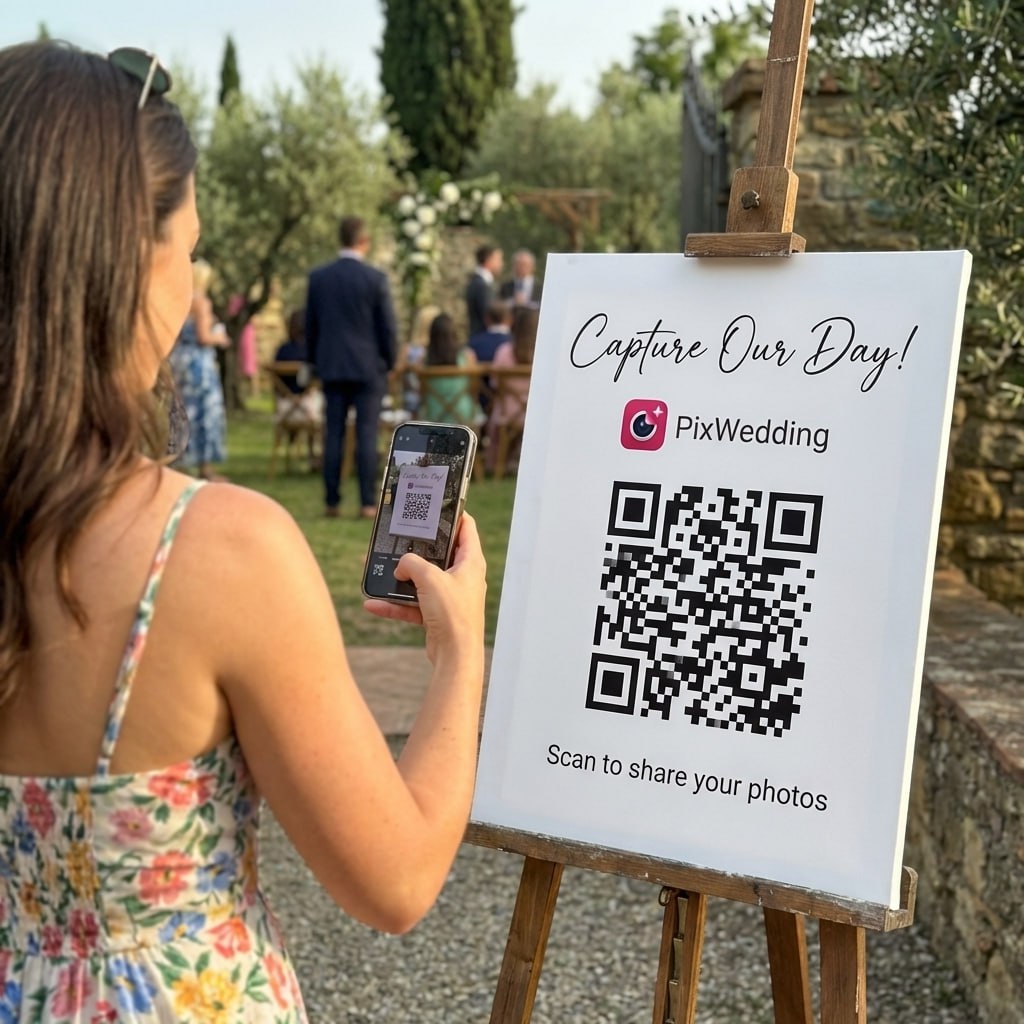
A photo gallery link, separate from the RSVP QR code, goes on your wedding day materials: the ceremony program, a table card, or tucked as an insert into the invitation suite. When guests arrive, they scan once and can upload their own photos throughout the event.

The result is a crowd-sourced second album: candid moments from multiple angles that your professional photographer could not capture. This is how couples end up with 400 natural, unposed shots alongside their formal portrait gallery.

Why keep it separate from the RSVP code

The RSVP code is a pre-wedding administrative tool. The photo gallery code is a day-of engagement tool. They serve different moments and should live in different places. Combining them confuses guests and reduces the scan rate on both.

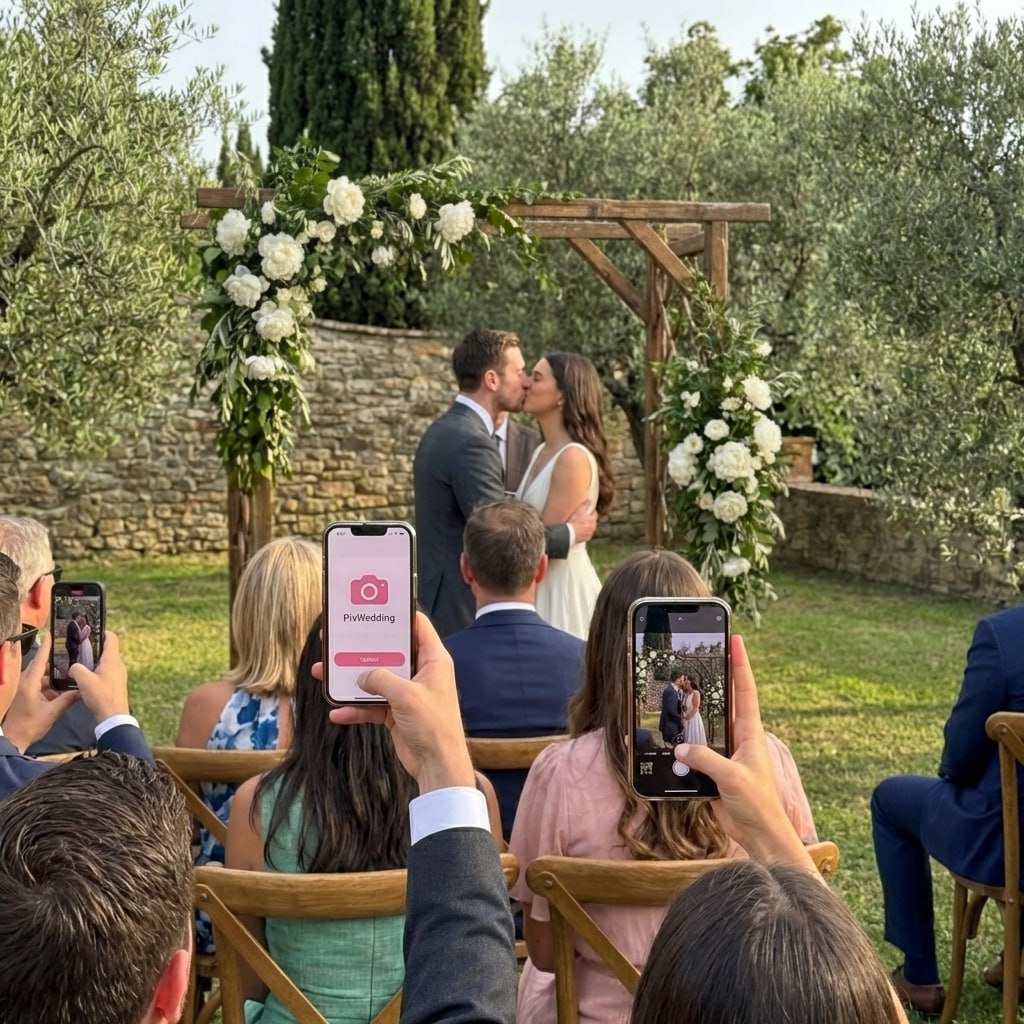
With Pix Wedding, you create a private gallery, generate a QR code in your wedding colors, and share it. Guests do not need to download an app. They scan, upload, and your gallery grows in real time. The design tool lets you match the QR to your invitation palette.

Related Wedding QR Code Guides

A QR code guests will actually appreciate.

The best QR codes do something useful. Pix Wedding's QR opens your guest photo album instantly - no app, no login, just tap and share.

From Mom

From Mom

9:41

ALBUM

Emma & Jack

June 14, 2026

634 photos · 94 guests

AllMomentsMine
Wedding guest photo 1 from album preview
Wedding guest photo 2 from album preview
Wedding guest photo 4 from album preview
Wedding guest photo 5 from album preview
Wedding guest photo 6 from album preview
Wedding guest photo 7 from album preview
Wedding guest photo 8 from album preview
Wedding guest photo 9 from album preview
Wedding guest photo 10 from album preview
Add photosShare your moments
Table 4 just uploadedSarah B. · +12 new photos

The History Behind the Etiquette Debate

QR codes went mainstream in the US during 2020 and 2021 as restaurants replaced physical menus. By 2022, wedding vendors began incorporating them into stationery. By 2024, WeddingWire reported a sharp uptick in couples asking stationery designers for QR-ready invitation suites.

The etiquette debate is essentially a generational one. Traditional wedding etiquette authorities, writing for audiences who grew up with formal engraved invitations, initially frowned on anything printed below the reply card. Modern etiquette authorities, writing for couples in their late 20s and early 30s who live on their phones, consider QR codes a convenience upgrade, not a breach of formality.

By 2026, the conversation has largely shifted from "should I?" to "how should I?" That is the right framing. The question is not whether a QR code belongs on an invitation suite; it is where, for what purpose, and with what design care.

  • 2020-2021: QR codes normalize via restaurant menus during the pandemic
  • 2022: Wedding stationery designers begin offering QR-compatible suites
  • 2023: Major etiquette publications revise guidance to permit QR codes
  • 2024-2025: Nearly 49% of couples include them on invitations or save-the-dates
  • 2026: The design quality of the QR code, not its presence, determines perception

The Design Checklist for a Non-Tacky QR Code

A QR code that matches your invitation suite does not read as tacky because it signals intentionality. A generic black square pasted onto a watercolor floral invite signals carelessness. The difference is almost entirely about design effort.

Most QR code generators let you customize foreground color, background color, corner shape, and add a small logo or icon to the center. Use your wedding palette. If your invitation is blush and sage, a blush-tinted QR on a white background looks intentional. A stark black square does not.

  • Minimum scan size: 2.5 cm x 2.5 cm (about 1 inch) - smaller codes fail to scan reliably
  • Color contrast: foreground must be at least 40% darker than background for reliable scanning
  • Match your invitation palette: use brand colors, not the default black-on-white
  • Add a center logo: a small ring icon or your monogram is acceptable and does not break scannability if under 30% of the code area
  • Always test: scan your final print file with three different phones before going to print
  • Label it: one short line below the code explaining what it does ("RSVP here" or "Our wedding website")
  • Include the URL: print the destination URL in small type below the QR as a fallback

QR Codes for Photo Sharing vs RSVP: A Different Use Case

Most couples think of QR codes on invitations as RSVP shortcuts. But a second, equally valuable use is a guest photo gallery link. These two QR codes serve very different purposes and should be treated separately.

An RSVP QR code belongs on the invitation itself, typically the back or an enclosure card, and should link directly to a simple form. A photo gallery QR code is better placed on wedding day materials: table cards, the ceremony program, or a small card tucked into the invitation suite. This keeps the invitation clean while ensuring guests have the gallery link at the moment they are most likely to use it.

Using a service like Pix Wedding, you can generate a private gallery link and a matching QR sticker in your wedding colors. Guests scan once during the reception and upload candids for the rest of the weekend, giving you a crowd-sourced second album alongside your professional photos.

Explore more free wedding tools

Everything you need to make your wedding day stress-free and unforgettable.

Answers to the most common questions couples ask at 11pm

QR Code on Wedding Invitation: FAQ

Everything you need to know about our free tools and how they help your wedding day.

No. QR codes on wedding invitations are widely accepted in 2026. Nearly 49% of couples now include them on save-the-dates or formal invitations, and major etiquette authorities including The Knot and Brides magazine consider them appropriate when placed correctly. The key is placement (back of the invite or a separate enclosure card), a clear label explaining what it does, and a printed URL backup for older guests.

The best placements are the back of the main invitation card, a separate enclosure or details card, or the save-the-date card. Never place a QR code on the front of the invitation. Front-of-card placement is the single most common reason guests perceive QR codes as tacky. Keep the front clean and elegant; let the back or an enclosure carry the digital layer.

The most useful uses in ranked order are: (1) RSVP form, (2) wedding website with full details, (3) registry, (4) guest photo gallery, (5) directions or venue map, (6) event schedule. Avoid linking to a generic homepage or a page that requires guests to create an account. The fewer taps between scanning and completing the action, the better.

Some do. The best approach for a mixed-age guest list is to include a printed URL below the QR code, add a brief note like "You can also visit [URL] directly," pre-install the camera app walkthrough in a letter to guests you know are less tech-comfortable, and ask a younger family member to help at the event. Printing a full paper RSVP option alongside a digital one removes the friction entirely.

There are 5 specific failure modes: (1) placing it on the front of the invitation next to the couple's names, (2) using a default black-and-white generic QR with no design, (3) including no label so guests do not know what it does, (4) omitting any print backup (URL or paper RSVP) for non-smartphone guests, and (5) using it for something low-value like just a map link when directions are already printed. Avoid these five and you will be fine.

Yes, and this is one of the best uses. A QR code linking to a dedicated guest photo gallery (separate from your RSVP code) lets guests upload candid shots throughout the wedding weekend. Many couples add a second QR code specifically for photos on a table card or back-of-invitation note, keeping it visually distinct from the RSVP code. Tools like Pix Wedding let you create a private gallery link in minutes.

Is It Tacky to Put a QR Code on Your Wedding Invitation? An Honest 2026 Verdict | Pix Wedding