
How to Write Good Wedding Vows That Actually Move People
Good vows are forgettable. Great vows are quoted at anniversaries ten years later. Here is what separates them, with 10 quality markers, before/after editing examples, and the mistakes that make vows mediocre.
Try the AI Vow GeneratorThe Short Answer
Good wedding vows are specific, not general: they name a real moment, a real habit, and a real promise instead of relying on lines that could belong to any couple. What makes them good rather than just heartfelt is the editing pass: cutting the throat-clearing opening, replacing cliché phrases with concrete details, and reading the draft aloud until nothing snags.
Quality is a revision skill more than a writing skill. Most people can produce an emotionally honest rough draft on the first try. What separates good vows from a decent first attempt is what happens in the next three passes: the specificity check, the cliché cut, and the read-aloud pass covered in detail below.
The Core Principle: Show, Do Not Tell
Most vows tell your partner how you feel. The best vows prove it. They contain evidence, stories, and specifics that could only come from your relationship. Here is how to get there.
"I promise to love and cherish you for the rest of my life and be by your side through everything."
"I promise to be the person who refills your water before you ask, who remembers which sushi place you like when you are too tired to decide, and who stays on the phone with you until you fall asleep on the hard nights."
First dance
You guys!!
Good vows deserve a great album.
Your vows will move people. Pix Wedding makes sure those reactions are saved. Guests scan a QR, upload photos and videos, and everything lands in one shared album.
From Mom
Scan to join the album
No app, no account
UPLOADING
Saving your moment
THE ALBUM
Emma & Jack
June 21, 2026
647 photos · 95 guests

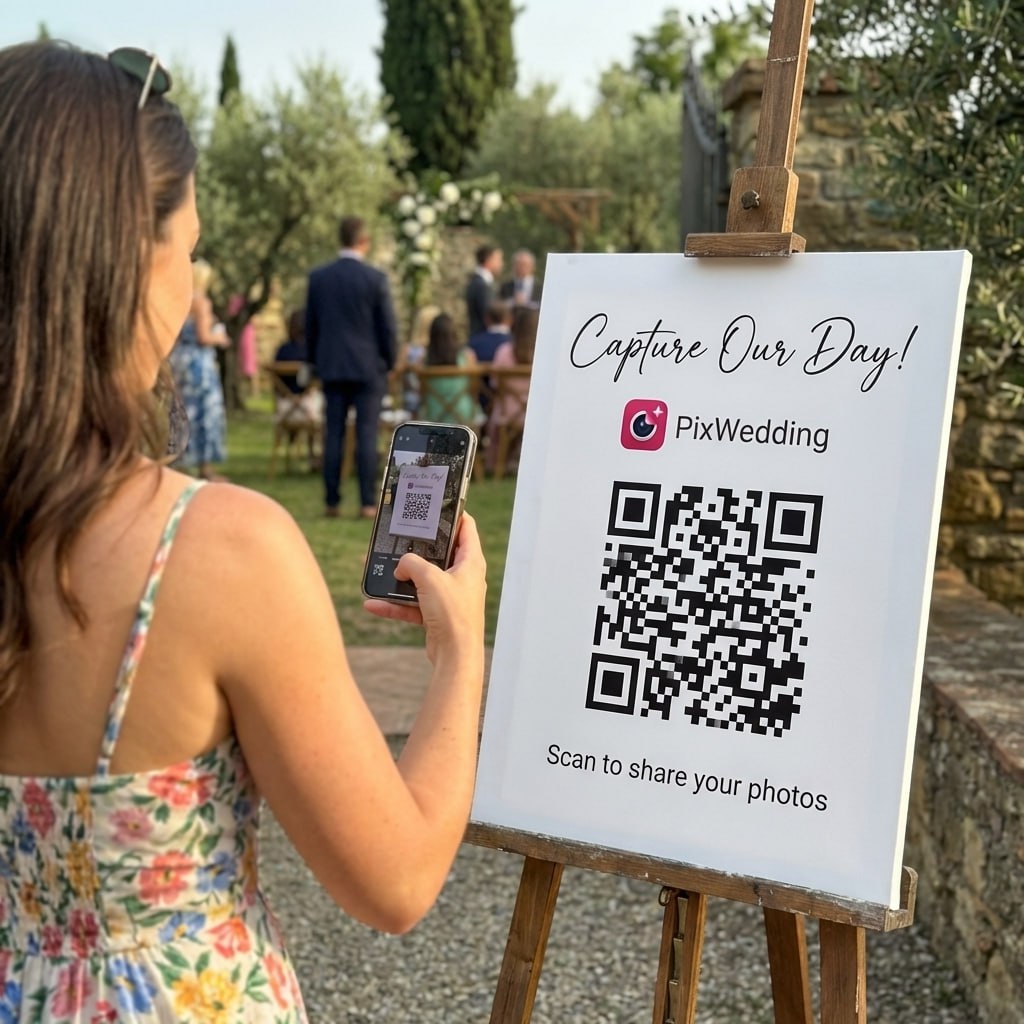
SCAN TO TRY
pix.wedding/
your-wedding
10 Quality Markers of Great Wedding Vows
Run your draft through this checklist. Great vows hit at least 7 of these 10 markers. Elite vows hit all 10.
Specificity
Names real moments, habits, or details unique to your relationship rather than universal sentiments.
Emotional Truth
Acknowledges imperfection and real life rather than presenting a fantasy version of the relationship.
Personal Voice
Sounds like you, not a template. Your natural speech rhythm and vocabulary should be present.
Sensory Language
Contains at least one image, sound, smell, or texture that transports the listener to a real moment.
Concrete Promises
Commitments are behavioral and specific rather than abstract ("I will make your coffee every Sunday" beats "I will care for you").
Earned Humor
Any lightness comes from your actual relationship, not generic jokes that could appear in any wedding.
Story Arc
Has a beginning, middle, and end: where you came from, who you are now, where you are going.
Vulnerability
Contains at least one moment of genuine emotional exposure rather than staying safely surface-level.
Auditory Rhythm
Reads aloud smoothly without tongue-twisting phrases or sentences that require a breath mid-thought.
Memorable Close
Ends with a line so specific and true it will be quoted by family members for years afterward.
Watch: A Step-by-Step Vow Writing Walkthrough
If you would rather watch the process than read it, this walkthrough covers a vow outline, a full example, and the same kind of common mistakes to avoid that are broken down throughout this page.
Hallmarks of Good Vows vs Weak Vows
Quality is easier to spot side by side. Use this comparison to sort your own draft into what to keep and what to cut.
Hallmarks of Good Vows
- Names one real memory instead of describing the relationship in general terms
- Uses behavioral promises ("I will drive you to every early flight") over abstract ones ("I will support you")
- Sounds like the person speaking it, with their real vocabulary and rhythm
- Includes one moment of genuine vulnerability, not just admiration
- Ends on the single most specific, most true line in the whole piece
- Reads comfortably aloud in one breath per sentence
Hallmarks of Weak Vows
- Could be read at any wedding and still make sense word for word
- Leans on greeting-card phrases like "you complete me" or "you are my soulmate"
- Lists five or more qualities back to back with no story behind any of them
- Stays safely positive with no acknowledgment of real, lived-in love
- Opens with "from the moment I met you, I knew" (the most repeated line in vow writing)
- Requires a full breath mid-sentence or reads stiffly when spoken aloud
8 Common Mistakes That Make Vows Mediocre
Recognizing these patterns in your own draft is the fastest path to a stronger final version.
The Greeting Card Opening
Starting with "From the moment I met you, I knew you were the one." Every vow starts this way. Open with a specific scene instead.
The Laundry List of Qualities
Listing your partner's positive traits for two minutes reads like a performance review. Show one quality through a story rather than naming ten.
Promise Inflation
"I promise to always be your rock, your shelter, your light, your anchor..." Stacking promises dilutes each one. Three real promises outweigh ten grand ones.
Memorizing Without Rehearsing
Knowing the words and knowing the delivery are different skills. Memorize vows but also rehearse the emotional beats so you do not break down mid-sentence.
Writing for the Audience
Vows are for your partner, not for the applause of guests. Lines that feel written for laughs or for Instagram often ring hollow to the one person who matters most.
Skipping the Edit Pass
First drafts almost always contain throat-clearing paragraphs at the start. Cut the first three sentences and your vows are usually 30% stronger immediately.
Clichéd Pinterest Lines
Wedding speech professionals specifically flag lines like "nothing made sense until you came into my life" as generic filler borrowed from quote graphics rather than your actual voice.
Tone Mismatch With Your Partner
One partner writes a comedy routine while the other writes something solemn, and the ceremony feels disjointed. A short conversation about tone beforehand (not the content) prevents this.
Before and After: Vow Editing in Practice
These examples show the same emotional intent transformed from generic to specific. Notice how the "after" version still fits the speaker's meaning, but proves it instead of declaring it.
Illustrative examples only, written to demonstrate the editing technique, not real vows from a specific couple.
"I promise to always be there for you and support you through everything life throws our way."
"I promise to be in the passenger seat for every 3am grocery run, every airport pickup, every waiting room where the Wi-Fi does not work. For everything life throws our way, I will be the person throwing things back alongside you."
"You are my best friend and I love everything about you."
"You are the only person I text when something funny happens before I have even stopped laughing. You are the person I want to tell first, every time, about everything. That is what best friend means to me."
"I promise to be honest and faithful to you always."
"I promise to tell you the truth even when it is easier to stay quiet, and to choose you again on every ordinary Tuesday when choosing is a decision rather than a feeling."
"You complete me, and I cannot imagine my life without you."
"You make the ordinary parts of my week better just by being in them: the grocery runs, the Sunday laundry, the fifteen minutes before we fall asleep. I do not want to imagine those minutes without you, and today I do not have to."
"I promise to love you through the good times and the bad times."
"I promise that on the good days I will be the first person you want to call, and on the bad days I will be the one still in the room after everyone else has gone home."
The Self-Edit Checklist
Before you call your vows finished, run the draft through this list. Answering "no" to any item flags exactly where to revise next.
- Would this exact sentence make sense at any other couple's wedding? If yes, rewrite it with a real detail.
- Does at least one line include a sensory detail (a sound, a smell, a texture, a specific place)?
- Have you cut your opening paragraph and started at what was previously paragraph two or three?
- Are there fewer than five stacked promises, each one specific and behavioral?
- Does the closing line feel like the single truest sentence in the whole piece?
- Have you removed every phrase that also appears on a generic quote graphic (soulmate, complete me, better half)?
- Did you read it aloud without stumbling, running out of breath, or losing the emotional thread?
- Does the tone match what you and your partner already agreed on (serious, light, or a mix)?
- Is the total length under 2.5 minutes when read at a natural, unhurried pace?
- Did at least one other person (a friend, not just your partner) hear or read a draft and react honestly?
The Read-Aloud Pass: Cut the Clichés, Cut the Stumbles
Two things separate a written draft from spoken vows: how it sounds out loud, and whether it leans on borrowed phrases instead of your own.
Read It Aloud, Three Times
Read once alone at full speaking volume, once to a trusted friend, and once into a phone recording you play back. Each pass catches something different: the alone read catches stumbles, the friend catches lines that sound like a template, and the recording catches pacing and length.
If you trip over the same phrase three times, the sentence is the problem, not your delivery. Simplify it rather than practicing around it.
Six Clichés Worth Cutting
Wedding speech professionals specifically warn against leaning on quote-graphic phrases because they signal the vow was borrowed rather than written. Search your draft for these and replace each one with a specific detail:
- "You complete me"
- "You are my soulmate"
- "You are my better half"
- "Nothing made sense until you came into my life"
- "From the moment I met you, I knew"
- "You are my everything"
The 6-Step Revision Process
This is the actual sequence for turning a rough draft into good vows. Follow it in order; skipping the earlier steps makes the later ones harder.
- 01
Finish the Full Draft First
Write the entire draft in one sitting without editing as you go. Editing mid-draft produces a stalled, over-polished opening and a rushed, thin ending.
- 02
Cut the First Paragraph
Delete your opening paragraph entirely. First drafts almost always open with throat-clearing. Your real opening is usually your second or third paragraph.
- 03
Run the Specificity Check
Highlight every sentence that could be said by any couple at any wedding. Rewrite each one with a real detail, memory, or behavior unique to your relationship.
- 04
Cut the Clichés
Search for generic lines like "you complete me" or "you are my soulmate" and either delete them or replace them with a specific image that proves the same feeling.
- 05
Read It Aloud Three Times
Read once alone, once to a trusted friend, once into a phone recording. Fix any sentence you stumble over, any line that sounds stiff, and any section that runs too long for one breath.
- 06
Trim to Time and Rehearse Delivery
Time the final read at a natural pace. If it runs past 2.5 minutes, cut the weakest promise rather than trimming every line equally. Then rehearse the emotional beats, not just the words.
Sensory Language Techniques
The brain processes vivid sensory language almost identically to real experience. Use this to your advantage.
"The sound of you laughing in the next room is still the thing that makes me exhale."
"Your hand on my back in a crowded room is the clearest signal I know that I am not alone in this."
"You reading on the couch on a Sunday morning is the image I return to whenever I try to picture home."
"Your jacket still smells like the hotel from our first trip. I keep it in the closet for that reason."
"You are the warm version of every cold thing I was afraid of before I met you."
What Wedding Professionals Say About Editing Vows
These are real, sourced perspectives from people who help couples write and deliver vows for a living, not invented quotes.
"It's so important to practice your vows to ensure you can capture the tone and speed you want," since nerves will affect delivery on the actual day.
Wedding planner Sandy Brooks, quoted via The Knot
There is "a fine line" between humor and offense in vows; avoid jokes that could make your partner feel self-conscious or diminish the ceremony's dignity.
Brian Franklin of Vows & Speeches, quoted via The Knot
Focus on "what is something that only you can say to your beloved" rather than repeating what others will already say in their toasts.
Vow coach Maureen Cotton, quoted via The Knot
Wedding speech experts recommend avoiding "generic Pinterest quotes," such as "nothing made sense until you came into my life" or "you are my soulmate," because they do not make the vows unique to the couple.
Via Fox News Radio
Quality vows use "hyper-specific expressions that encapsulate your unique bond" rather than generic platitudes, and should be practiced aloud to fit within a natural time limit.
Via Loverly
More Vow and Speech Resources
The Specificity Principle: Why General Vows Fall Flat
The single most important concept in vow writing is specificity. Generic statements like "I promise to be there for you" are well-meaning but invisible. They slide off the memory because they contain no texture, no story, no proof. Your partner has heard those words before.
Specific vows do the opposite. They prove the promise rather than stating it. Instead of "I promise to support your dreams," try: "I promise to be the person who drives you to the airport at 5am for that conference, who asks about your presentation the night before, and who celebrates every small win like it is the biggest thing that happened that week." That version shows, it does not just tell.
The specificity principle also extends to your partner's qualities. Rather than "you are my best friend," name what that friendship looks like: the texts at midnight, the inside references only the two of you understand, the way they know when to push and when to just sit quietly. Those details are what your guests will remember years later.
- •Replace "I love you deeply" with a specific moment that proves that love
- •Name habits and quirks that make your partner irreplaceable to you
- •Anchor each promise to a real behavior, not an abstract intention
- •Reference your shared history to make promises feel earned
Sensory Language and Emotional Anchoring in Vow Writing
Sensory language is the difference between vows that are read and vows that are felt. The human brain processes sensory details the same way it processes real experience. When you describe the smell of their coffee at 6am, the sound of their laugh, or the warmth of their hand during the flight you were both terrified on, listeners are transported there.
Emotional anchoring works by pairing a specific sensory memory with a forward-looking promise. "The first time I saw you nervous was the night of your big presentation, hands wrapped around a coffee cup that was already empty. I want to be the person you call the night before every hard thing for the rest of your life." That structure moves from memory to promise in a way that feels natural rather than formulaic.
Strong vows often use contrast as well: the hard moment that revealed something true, followed by the promise that grew from it. Before and after structures ("before I met you... / now I know...") create natural emotional arcs that feel complete rather than truncated.
- •Use at least one sensory detail (sound, smell, texture, temperature)
- •Anchor promises to real memories rather than hypothetical scenarios
- •Use contrast structures to create emotional depth
- •Write for the ear, not the eye: read aloud, edit what sounds stiff
Explore more free wedding tools
Everything you need to make your wedding day stress-free and unforgettable.
AI Speech Pro
Banger toasts for Best Man & more.
Hashtag Generator
Create unique wedding hashtags.
Thank You Notes
Generate personalized thank you notes.
Father of the Bride Toast
Full example toasts, structure, and delivery tips.
Invitation Wording
Perfect wording for your invitations.
Couple Name Combiner
Blend your names into the perfect couple name.
Photo Sharing QR
The best way to collect guest photos.
Wedding Checklist
Month-by-month planning checklist.
Wedding Vow Writing: Common Questions
Everything you need to know about our free tools and how they help your wedding day.
Good vows typically run between 150 and 300 words when spoken aloud, which equals about 1 to 2.5 minutes. Shorter vows (under 100 words) can be extremely powerful if each word earns its place. Longer vows risk losing emotional momentum. Quality always beats length.
The most common mistake is being too general. Phrases like "I will always love you" are forgettable because they could apply to anyone. The fix is specificity: name the exact moment, the specific habit, the real story that makes your relationship uniquely yours.
Rhyming vows can work beautifully if they feel natural, but forced rhymes often make vows sound like greeting cards rather than genuine promises. If rhyming comes naturally to your voice and relationship, use it. If it feels awkward, skip it entirely.
Read them aloud to yourself while imagining your partner's face. If you feel a catch in your throat, the vows are working. You can also read them to a trusted friend who knows your relationship. If they get teary or laugh at the right moments, you are on track.
Absolutely. Tools like the Pix Wedding AI vow generator are excellent starting points for structure and phrasing. The key is to then personalize every line with your own specific memories, promises, and voice. Use AI-generated text as scaffolding, not a final product.
Three to five specific promises are ideal. Too few can feel thin; too many dilute each promise's weight. Each promise should feel concrete and behavioral (what you will actually do) rather than abstract (how you will feel).