
Funny Maid of Honor Speech: How to Get Real Laughs Without Ruining the Moment
Joke structures that work, funny openers, what humor to avoid, and how to balance real laughs with genuine tears in front of a mixed room.
Generate a Funny Speech Draft with AIThe Three Rules of Wedding Speech Comedy
Wedding humor has its own rules. Breaking them does not just fall flat, it can make the whole room uncomfortable. Follow these three principles and your funny speech will land beautifully.
Rule 1: Punch Sideways, Not Down
The best wedding humor targets situations, coincidences, and your own reactions. Not other people's appearance, choices, or character flaws. Affectionate teasing is fine; anything that could actually sting is not.
Rule 2: Earn the Laugh with Specificity
Generic jokes get polite smiles. Specific, recognizable details about the bride get real laughs. The more specific the story, the harder the room laughs, because the audience recognizes truth.
Rule 3: Use Humor to Set Up Emotion
The most powerful use of humor in a wedding speech is as a setup for an emotional moment. The laugh relaxes the audience; the sincere moment that follows hits twice as hard because of the contrast.
Funny Openers: 8 Lines to Start Strong
The first ten seconds decide whether the room settles in or braces for something awkward. These openers are original templates meant to be adapted with your own names and details, not read as-is. For a complete example speech built around one, see the full speech examples.
"I have exactly one qualification for this speech: I have known [Bride] longer than anyone else standing up here today, and I promise that is the only reason I am nervous."
A self-aware credibility opener. It earns the room's trust before you have made a single joke.
"Before I start, I want everyone to know I timed this speech. It is four minutes. My mother does not believe me. She is right not to."
Sets a runtime expectation and gets an easy first laugh at your own expense.
"[Bride], if you are worried about what I am about to say, I want you to know I removed the worst story. You are welcome. The second worst story is still in here."
A tension-release opener. It reassures the bride out loud while promising the room something is coming.
"I have been asked to describe [Bride] in one sentence for this speech, so here it is: she is the reason our group chat has an unread count in the hundreds."
A single-sentence character opener that establishes a detail you can call back to later.
"Hi, I am [Name], the maid of honor, which apparently means I am contractually required to make you cry today. I am going to try to make you laugh first, though."
Names the emotional expectation of the room and playfully pushes back on it.
"I wrote and deleted the opening line of this speech eleven times. This is attempt twelve. If it does not land, please picture the other eleven, because none of them were better."
A process-reveal opener. Vulnerability about the writing process is always disarming.
"[Groom], welcome to the family group chat. It has a lot of messages. It has more emojis than words. You will adjust."
An address-the-groom opener that is warm, brief, and gives him a small, kind laugh of his own.
"I want to start with a fact: [Bride] has planned this wedding with the same energy she once used to plan a two-person dinner reservation six months in advance. It has been a joy to watch."
A callback-establishing opener. It sets up a running joke about a real, recognizable trait.
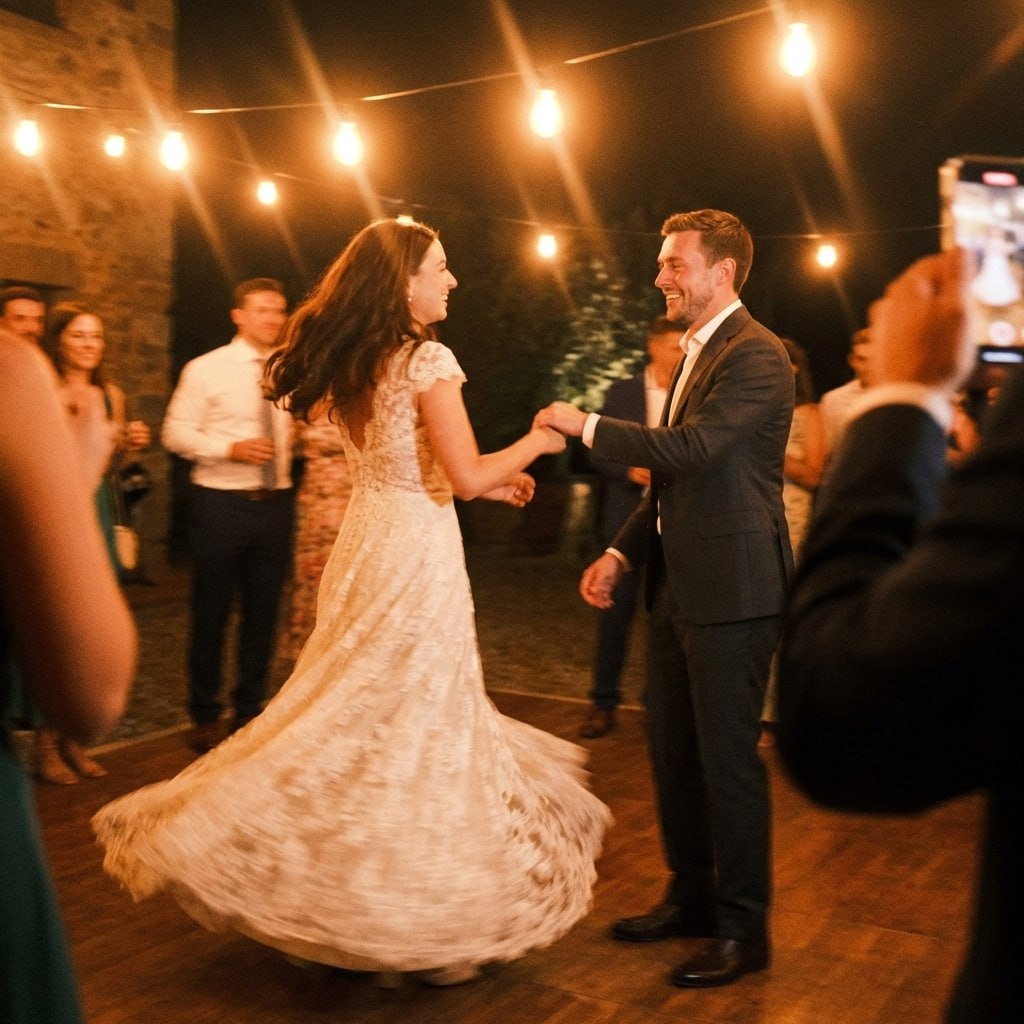
First dance
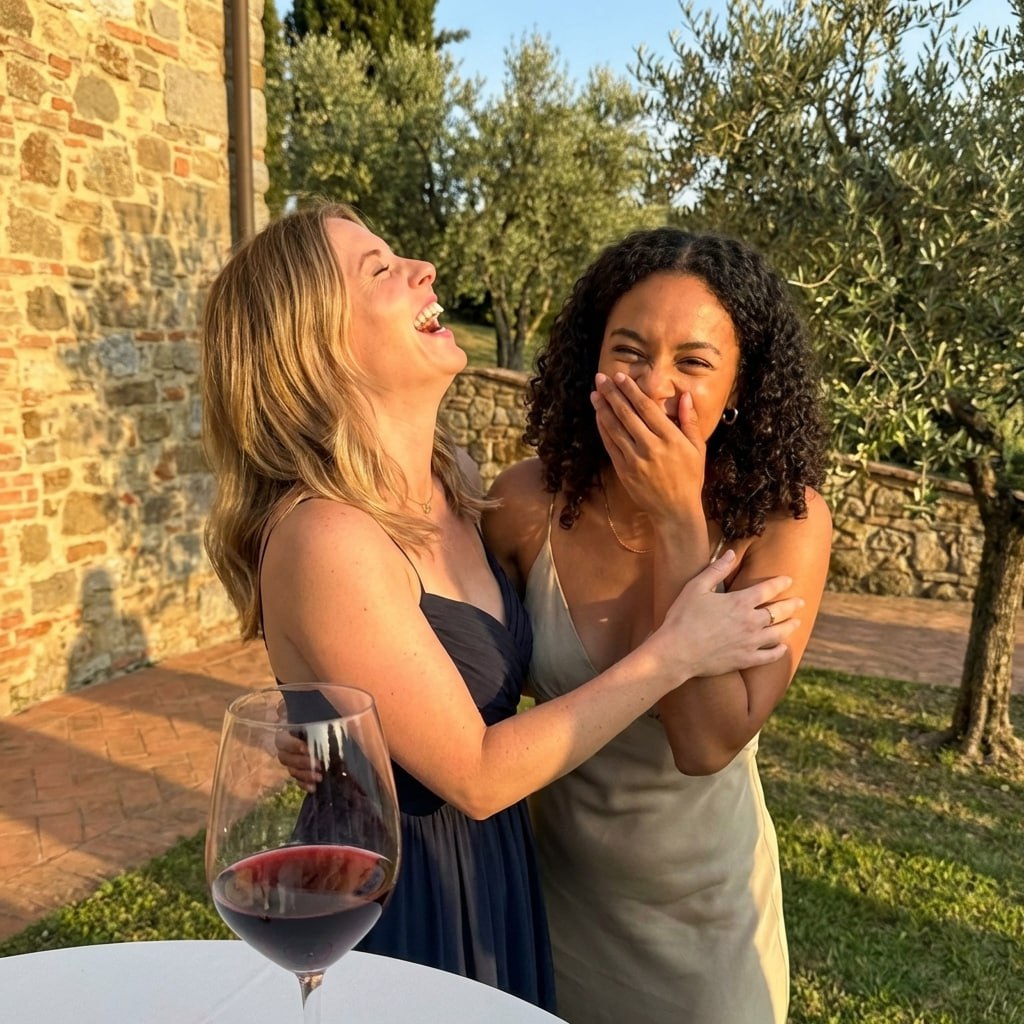
You guys!!
Let AI draft your funny opener.
Answer a few quick questions about your friendship and Pix Wedding's speech generator drafts an opener, a funny middle, and a heartfelt close you can rewrite in your own voice.
From Mom
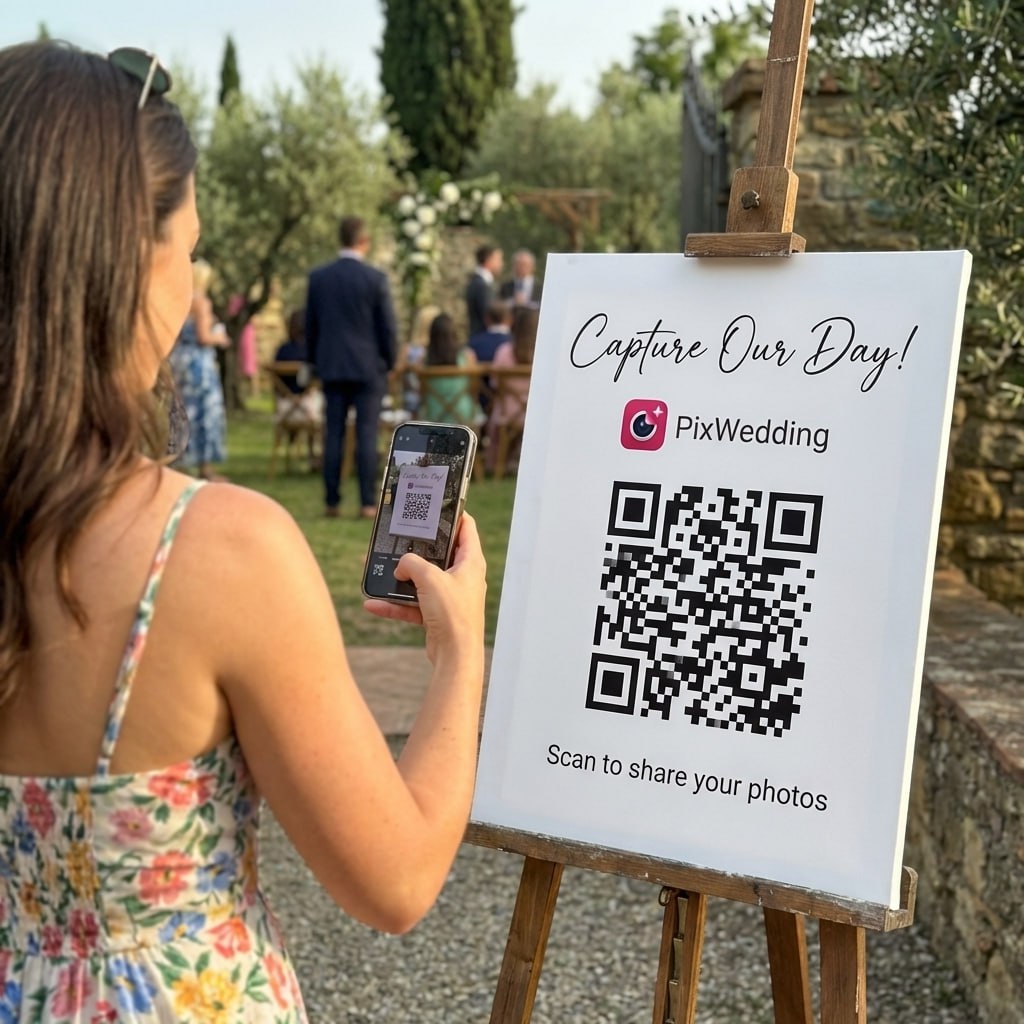
Scan to join the album
No app, no account
UPLOADING
Saving your moment
THE ALBUM
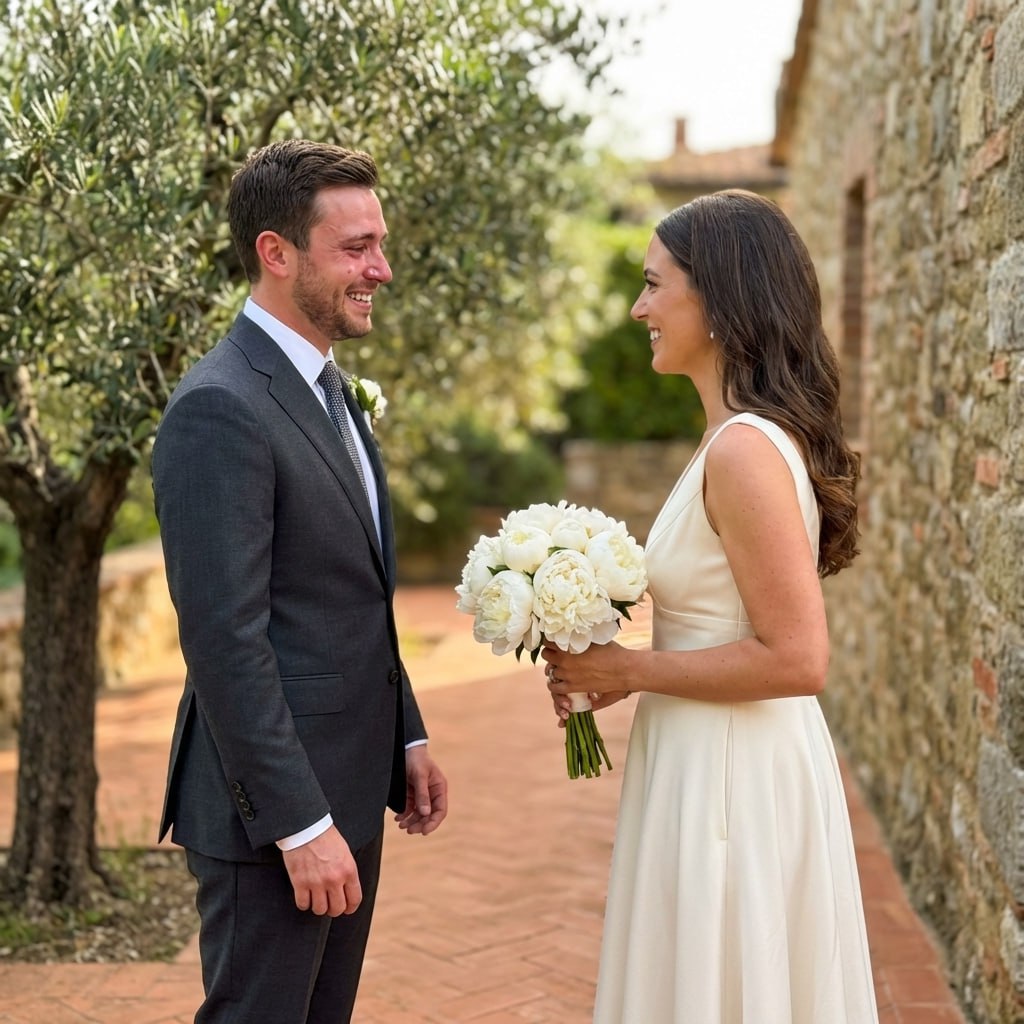
Emma & Jack
June 21, 2026
647 photos · 95 guests
SCAN TO TRY
pix.wedding/
your-wedding
Joke Structures That Actually Land
You do not need to be a comedian to be funny in a speech. You need to recognize a handful of reusable structures and plug your own true details into them. Here are the five that show up most often in speeches that get real laughs.
The Rule of Three
Setup, setup, twist.
List two expected things, then break the pattern with a third that surprises the room. The first two items build a rhythm; the third subverts it. This is the single most reusable joke structure in any speech.
The Callback
Plant early, pay off later.
Introduce a small, specific detail early in the speech, then reference it again near the close without explaining it. The audience remembers, and the second mention gets a bigger laugh than the first because they feel in on it.
Misdirection
Point one way, land another.
Build a sentence that sounds like it is heading toward one conclusion, then resolve it somewhere unexpected but still true. This works especially well for jokes about the groom, since it lets you praise him after a beat of mock suspicion.
The Specificity Payoff
Vague setup, exact number.
A joke about "a lot of" anything is weaker than a joke about an exact, oddly specific number. "Forty-seven questions" is funnier than "many questions" because the precision itself reads as the punchline.
The Self-Deprecating Frame
The joke is on you.
Redirect the humor toward your own nerves, preparation process, or inadequacy as a public speaker rather than toward the bride or groom. It is the lowest-risk structure in this entire guide and it almost always works.
A Quick Glossary of Wedding Speech Comedy Terms
A few terms come up repeatedly in this guide. Here is what each one actually means in practice.
Recognition humor
A joke that works because the audience immediately recognizes it as true about the bride, rather than because it is clever. The most reliable humor type in a wedding speech.
Deadpan
Delivering a funny line without any change in facial expression or tone. It makes the line sound like a plain statement of fact, which is often what makes it funnier.
Callback
Referencing an earlier detail again later in the speech without re-explaining it. The audience feels rewarded for having paid attention the first time.
Punching down
Making a joke at the expense of someone with less power in the moment, such as a shy relative or the groom in front of his new in-laws. Wedding speeches should never do this.
The room
Shorthand for the full mixed audience at a wedding, not just your closest friends. Every joke should be written for the room, not for the group chat.
8 Funny Speech Excerpts (Adapt and Use)
These excerpts are ready to adapt for your own speech. Replace the bracketed details with your own specifics and adjust to match your voice. Looking for a full speech instead of standalone lines? Start from a complete template.
"[Bride] and I spent approximately eighteen months swiping through dating apps together. We had a system. I had opinions. None of my opinions resulted in any long-term relationships, which is why I am here today as her maid of honor and not her life coach."
Why it works: The self-deprecation takes the pressure off the bride and lands the laugh on the speaker.
"When [Bride] told me she was seeing someone, I asked approximately forty-seven questions. [Groom], I want you to know that you passed all of them. I also want you to know there were forty-seven of them."
Why it works: Frames the protectiveness as humor while also being genuinely touching to the groom.
"There was a version of [Bride] I knew before [Groom]. She was wonderful. She was also the person who once made a spreadsheet to decide where to go for dinner. I am not saying [Groom] fixed that. I am saying she now has better things to make spreadsheets about."
Why it works: Affectionate, specific, and sets up the romantic pivot naturally.
"After every girls' night for the last three years, [Bride] mentioned [Groom]. Once on the way to dinner. Once at dinner. Once after dinner. Once in the car home. And once in a text from her couch at midnight. I have been tracking the ratio. It has been climbing steadily."
Why it works: Shows the depth of the relationship through accumulated evidence rather than direct statement.
"I have been a public speaker zero times in my life before today. I prepared for this by reading articles about public speaking, practicing in front of my mirror, and eating an amount of cheese this morning that I will not specify. I am ready."
Why it works: Immediately relaxes the audience and the speaker, vulnerability is always funny and endearing.
"The first time [Bride] described [Groom] to me, I thought: that sounds great, we will see. The second time she described him to me, I thought: okay, that is very good. The third time, I thought: I should probably actually meet this person, because apparently he is real."
Why it works: Captures the friend's skepticism-to-belief journey in a way that feels universal and warm.
"I want to say, for the record, that [Bride] was completely calm and reasonable throughout the entire wedding planning process. I also want to say that I have been her maid of honor and I take my confidentiality obligations seriously."
Why it works: The implication is funnier than the statement. The bride will laugh hardest at this one.
"I know I have been up here for a while. I have three more pages. Just kidding. Mostly."
Why it works: A simple audience-awareness beat that resets attention and gets a laugh right before the emotional close.
Comedy Dos and Don'ts
Not all humor belongs in a wedding speech. Here is an honest guide to what works and what tanks.
Do: Make jokes about shared experiences and situations
Don't: Make jokes that require knowing the bride to understand
Do: Use self-deprecation about your own nerves or speech-writing process
Don't: Make jokes about the bride's appearance or weight, ever, in any framing
Do: Warm, affectionate humor about recognizable character traits
Don't: Roast-style humor without the bride's explicit advance blessing
Do: Brief, loving humor about meeting the groom's standard
Don't: Anything that references exes, even in a "comparison" framing
Do: Story-based humor that audiences can follow even without context
Don't: Inside jokes that require specific knowledge to decode
Do: Test all jokes on people outside your friend group first
Don't: Assume something is fine because your closest friends thought it was funny
What to Absolutely Avoid: Four Common Traps
The Do's and Don'ts above cover the broad strokes. These four traps are where funny maid of honor speeches most often go wrong in practice, and why each one backfires even when the intention was good.
The Inside Joke Trap
Why it backfires: A reference that only five people in the room understand creates a room full of confused faces and five people laughing too hard. Everyone else feels left out during your speech, not included in it.
Do this instead: Translate the inside joke into a version anyone can follow. Keep the feeling, cut the specific reference that requires prior knowledge.
The Ex Reference Trap
Why it backfires: Any joke that references a past relationship, even framed as a compliment to the current partner ("finally, someone who treats her right"), reminds the room of something that has nothing to do with today and can read as a dig at either person.
Do this instead: Cut it entirely. There is no framing of an ex reference that adds more than it risks.
The Embarrassing Story Trap
Why it backfires: A story that is funny to you because you were both there can be mortifying to the bride when it is retold in front of her employer, her grandmother, and 150 witnesses. What felt like a fun memory becomes a public disclosure she did not agree to.
Do this instead: If the story would make the bride visibly wince rather than laugh, it does not belong in the speech, no matter how funny it is to you.
The Unapproved Roast
Why it backfires: Roast-style humor depends entirely on the target finding it funny. Without her explicit advance blessing, a joke that reads as affectionate teasing to you can land as public criticism to her, and there is no way to take it back once the room has heard it.
Do this instead: Ask the bride directly if there is any material she wants cut. If you have not asked, assume the answer is yes for anything roast-adjacent.
How to Balance Laughs with Genuine Emotion
A speech that is only funny feels shallow. A speech that ends on a laugh feels like the speaker was not willing to be vulnerable. The goal is both, in the right order.
Opening (0-60 sec)
Warm, possibly funny
Establish your voice, relax the room, introduce the relationship. A light laugh here is valuable for both you and the audience.
Friendship Section (60-180 sec)
Primarily funny with warmth underneath
This is where your funniest material goes. The laughter here earns the emotional payoff that comes later.
Pivot and Couple Section (180-240 sec)
Warming toward genuine emotion
The tone shifts naturally toward sincerity. One more light moment is fine, but the overall movement is toward the emotional close.
Toast (240-300 sec)
Sincere, short, beautiful
Do not end on a joke. End on something true and lovely. The contrast with the earlier humor makes this landing more powerful.
Delivering Humor: The Mechanics of Getting the Laugh
Writing something funny and delivering it funny are two different skills. Here is how to make sure the laugh lands in the room the way it did in your head.
Pause after the punchline
Give the audience time to laugh. Do not rush to the next line. Count two full beats in your head after your funniest moment.
Keep a straight face
The less you laugh at your own joke, the funnier it is. Deadpan delivery is often funnier than enthusiastic delivery.
Smile but do not signal
A slight smile tells the audience something is coming without telegraphing the punchline. Do not do the face that says "this is going to be funny."
Commit to the specifics
The funnier details are always more specific. Say "forty-seven questions" not "a lot of questions." Specificity creates the laugh.
Slow down for the setup
Speed up slightly through ordinary lines, then slow your pace as you approach the funny line. The change in rhythm signals that something is coming.
Match the room, not your rehearsal
A joke you rehearsed at conversational volume in your bedroom needs more energy in a reception hall. Read the room's energy and adjust up, not down.
Reading the Room: Adjusting Humor for Every Family
The same joke can land perfectly at one wedding and fall flat, or worse, at another. None of this is about being less funny, it is about aiming your humor at the actual room you will be speaking to.
Multi-generational audience
Grandparents and young cousins are usually in the same room as the bride's college friends. Favor humor that a nine-year-old and a ninety-year-old would both understand: shared situations and universal feelings, not slang or references tied to one age group.
Alcohol references
A brief, affectionate mention of a wild night out can land fine with some families and land badly with others, especially if religion, recovery, or a dry reception are part of the picture. If you do not know the family's comfort level, cut or soften any drinking references.
Cultural and religious context
Some traditions expect a more formal, restrained toast; others expect big laughs from the whole room. When in doubt, ask a parent or the couple directly what tone fits the ceremony and reception, rather than guessing from weddings you have attended before.
Divorced or blended families
Be extra careful with any joke that touches on family structure, past marriages, or "who raised who." What feels like harmless trivia to you can be a genuinely sensitive subject for specific relatives in the room.
Recovery Techniques: When a Joke Does Not Land
Even well-rehearsed material can meet a room that reacts differently than expected. A calm recovery reads as confidence. A visible scramble is what actually makes a moment awkward.
The joke gets silence instead of laughter
Keep moving. Do not repeat the line, do not explain the joke, and do not apologize for it. A speech that continues confidently past a quiet moment reads as poised. A speech that stops to address the silence makes the silence the main event.
You start laughing before the room does
Let yourself laugh for one beat, then say something like "give me a second, I have been trying not to laugh at this part all week," and continue. It usually earns a second, smaller laugh and resets your composure.
Someone reacts oddly to a line you thought was safe
Do not look at them or address it. Most of the room will take its emotional cue from your energy, not from one guest's reaction. Continue at the same pace you planned.
You lose your place mid-laugh
Use the laughter as cover to glance at your notes. A brief pause during a laugh reads as comedic timing, not as forgetting your speech, so there is no need to rush.
Test Your Jokes Before the Big Day
Every joke that feels funny while you are writing it alone needs to survive contact with an actual audience before the wedding. Here is a simple, low-effort way to workshop your material in advance.
Step 1: The Two-Listener Test
Read each joke out loud to two different people: one who knows the bride well and one who barely knows her. If both laugh, the joke is safe for a mixed room. If only the person who knows her laughs, the joke leans too heavily on inside knowledge.
Step 2: Record Your Delivery
Record yourself reading the speech out loud on your phone and watch it back once. You will hear pacing problems and awkward phrasing far more clearly on playback than you will while reading silently.
Step 3: Cut on Hesitation
If you hesitate before saying a line out loud, even slightly, that hesitation is information. Cut the line or soften it. A speech with fewer, fully-confident jokes always outperforms one padded with material you are unsure about.
Step 4: Final Read-Through With the Bride
If any material references the bride directly, even lightly, consider a final check-in with her about tone (not content, to preserve the surprise). A simple "there is a joke about your dating-app era, are you comfortable with that being public" avoids any wedding-day surprises.
Final Humor Checklist Before You Print Your Speech
Run through these eight questions the night before the wedding, with your final draft in hand. If you cannot confidently answer yes to all of them, go back and revise before you print.
Have I read every joke out loud to at least one person who does not know the bride?
Does every joke pass the "most conservative relative in the room" test?
Have I cut every reference to an ex, even a flattering one?
Have I removed every inside joke that requires context to understand?
Would the bride be delighted, not just tolerant, if she heard this line played back to her?
Does my funniest material come before the emotional close, not after it?
Have I timed the full speech out loud, including pauses for laughter?
Is there a backup line ready in case a joke does not land the way I expect?
More Maid of Honor Speech Resources
The Psychology of Funny Wedding Speeches
What makes a wedding speech funny is different from what makes a comedy set funny. The wedding audience is predisposed to love everyone at the front of the room. They are not waiting to be impressed. They are waiting to feel something. That means even modest humor lands hard if it is genuine.
The most powerful comedy in wedding speeches is not clever. It is specific. The audience laughs at the details that confirm what they already know or suspect about the bride, delivered at exactly the right moment. This is recognition humor: "yes, that is exactly her, and it is perfect."
The second key is contrast. A laugh that comes right before or right after an emotional moment is funnier, and the emotional moment lands harder. The contrast of tones amplifies both. This is why the best wedding speeches alternate between warmth and humor rather than committing entirely to one or the other.
- •Recognition humor (this is so her) is more reliable than wit or wordplay
- •Two or three well-placed laughs beat constant jokes every time
- •The laugh that sets up the emotional moment is the most powerful tool you have
- •Specificity is what makes wedding humor land, generic jokes get polite smiles
- •Your own nervousness or self-deprecation is always safe and often charming
Building Jokes That Work in a Wedding Room
Wedding room comedy has specific rules. The audience is mixed: family members of different generations, friends from different parts of the bride's life, possibly people who barely know her. A joke that plays perfectly to her college friends might land flat with her grandmother.
The safest comedy is story-based rather than punchline-based. Tell a funny story rather than setting up a traditional joke. Stories give the audience time to get on board, and they can follow a story even if they miss a reference. A punchline without setup just creates confusion.
Test every piece of humor against this question: "If the bride's most conservative relative heard this, would anyone be uncomfortable?" If the answer is yes, it is worth reconsidering. The bride should be able to listen to every word of her maid of honor speech with pure delight, not anxiety about what comes next.
- •Story-based humor is safer and often funnier than setup-punchline jokes
- •Test every joke against the most conservative person in the room
- •The bride should be delighted by every word, not anxious about what comes next
- •Mixed-age rooms respond best to universal human experiences, not generational references
- •Self-deprecation (about you, not the bride) is almost always safe and relatable
Explore more free wedding tools
Everything you need to make your wedding day stress-free and unforgettable.
AI Vow Generator
Write "banger" vows in seconds.
Hashtag Generator
Create unique wedding hashtags.
Thank You Notes
Generate personalized thank you notes.
Father of the Bride Toast
Full example toasts, structure, and delivery tips.
Invitation Wording
Perfect wording for your invitations.
Couple Name Combiner
Blend your names into the perfect couple name.
Photo Sharing QR
The best way to collect guest photos.
Wedding Checklist
Month-by-month planning checklist.
Funny Maid of Honor Speech FAQs
Straight answers to the questions people ask most about this topic.
The golden rule of wedding speech humor is: punch sideways, never down. Make jokes at the expense of situations, shared experiences, and your own reactions, not at the expense of specific people. Warm, affectionate humor that the bride would laugh at herself is always the safest and funniest path.
The most reliably funny maid of honor topics include your initial impression of the groom (framed with love), the contrast between who the bride was before versus now, mutual experiences that went sideways in a funny way, the specific ways she is a particular kind of person (with warmth), and your own nerves or inadequacy as a public speaker.
Yes, absolutely. Test your jokes on at least two people, one who knows the bride and one who does not. If both people laugh, you are safe. If only the person who knows the bride laughs, the joke depends too much on inside knowledge. If neither laughs, cut it regardless of how funny you think it is.
Aim for two or three genuinely funny moments, not a constant stream of jokes. Speeches that try to be funny every thirty seconds feel exhausting. Place your best laughs strategically: one early to set the tone, one in the middle, and let the end lean more emotional. The contrast makes both the humor and the sentiment land harder.
Yes, but carefully. Keep any groom jokes warm and brief. "I was screening you, and I want you to know you passed" is fine. Anything that could read as genuinely critical, even in jest, is not. When in doubt, make the joke about your own process of evaluating him rather than about a quality he has.
Avoid jokes about exes (even framed as jokes), anything the bride told you in confidence, humor that requires alcohol to seem funny, self-deprecating jokes that make you the center of attention, anything that could embarrass the family, roast-level material without explicit advance approval, and any joke you are not fully confident the bride will love.