
Free Wedding Planning Templates for Every Stage
Checklists, budgets, timelines, seating charts, and guest lists. Every template type explained, with free digital tools that do the heavy lifting for you.
The short answer
Every wedding needs five core templates: a master checklist, a budget tracker, a day-of timeline, a seating chart, and a guest list. Each one is available below as a free Pix Wedding tool, and two of them also have a deeper, standalone spreadsheet guide if you want a single downloadable-style document instead of separate tools. None of the Pix Wedding tools on this page requires a purchase, an email address, or a file download to try.
The 5 Templates Every Couple Needs
These five template categories cover the full planning lifecycle. Each one has a specific job, a specific time to introduce it, and a free tool that delivers it, no formatting from scratch required.
Master Wedding Checklist
Start immediately after engagementMonth-by-month tasks from 18 months out to the honeymoon. Covers venue booking, vendor contracts, RSVPs, and final week logistics.
Use the Free Checklist ToolWedding Budget Template
Before booking any vendorsCategory-by-category budget with columns for estimated cost, actual cost, deposit paid, and remaining balance. Includes allocation percentages.
Use the Free Budget AllocatorWedding Day Timeline
3-6 months before the weddingHour-by-hour schedule for the ceremony and reception. Separate columns for the wedding party, photographers, and venue staff.
Use the Free Timeline BuilderSeating Chart Template
After RSVPs close (6-8 weeks out)Table-by-table layout with guest names, dietary notes, and relationship to the couple. Visual drag-and-drop or grid format.
Use the Free Seating Chart PlannerGuest List Manager
As soon as you start building the listFull guest database with RSVP status, meal choice, address, gift tracking, and thank-you note sent fields.
Use the Free Guest List Manager
First dance
You guys!!
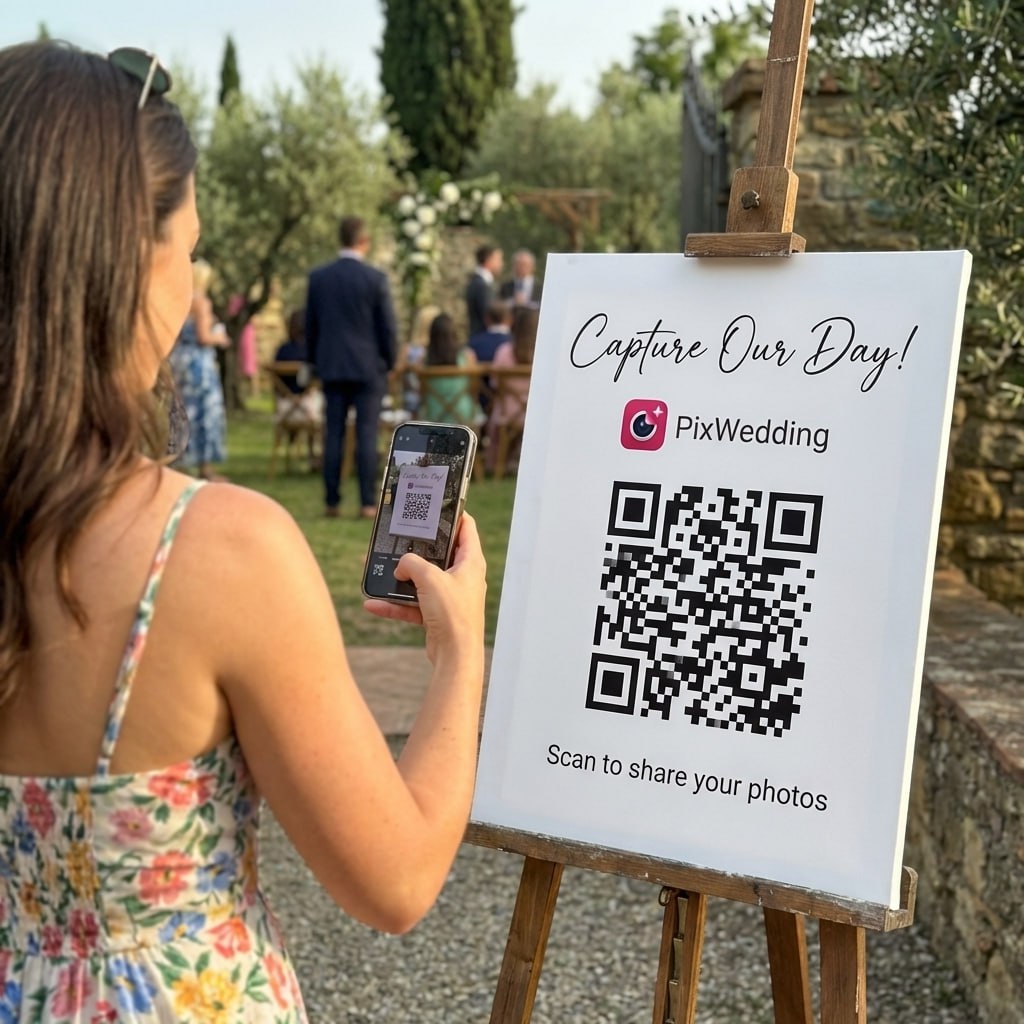
One template you cannot download but should use.
A QR code for guest photo sharing. Guests scan it, photos arrive in one album automatically. No template needed, it just works.

From Mom
Scan to join the album
No app, no account
UPLOADING
Saving your moment
THE ALBUM
Emma & Jack
June 21, 2026
647 photos · 95 guests







SCAN TO TRY
pix.wedding/
your-wedding
Which Template Do I Need?
Match your current situation to the template on the right. This is a decision framework, not a ranking, pick the row that matches where you are today.
You just got engaged and do not know where to start
You have not set a total budget yet
Your guest list keeps changing and RSVPs are hard to track
RSVPs have closed and you need to seat people
Vendors need a run-of-show for the day
You want one spreadsheet that covers budget, guests, vendors, and timeline together
Budget is the only piece you need help with right now
Do I need both a checklist and a spreadsheet template?
Usually not both in full. A checklist tracks tasks and deadlines; a multi-tab spreadsheet like the Wedding Planning Spreadsheet Template tracks tasks, budget, guests, and vendors together in one file. Pick the checklist if you mainly need reminders, and pick the spreadsheet guide if you want one document that replaces four or five separate tools.
Going Deeper: The Full Spreadsheet Guides
This page stays broad on purpose, it is the directory. These two guides go deep on one template format each with a full copyable structure.
Wedding Planning Spreadsheet Template
A full walkthrough of one multi-tab spreadsheet that combines budget, guest list, vendor tracker, and timeline into a single file.
Best if you want everything in one document instead of switching between separate tools.
See the full spreadsheet guideWedding Budget Template (Google Sheets)
A dedicated budget-only Google Sheet with category formulas, deposit tracking, and running totals.
Best if budget is the one piece you need to nail down right now.
See the budget sheet guidePrintable vs. Digital Templates
There is no universally right answer. Here is how to decide which format suits each task.
| Feature | Digital | |
|---|---|---|
| Best for offline use | ||
| Real-time collaboration | ||
| Auto-calculating totals | ||
| Day-of physical reference | ||
| Filter and sort data | ||
| No internet required | ||
| Share with vendors by link | ||
| Works for non-tech family members |
When printable wins
- You are handing a reference sheet to a coordinator, parent, or wedding party member the day of
- You want a physical binder you can flip through without a device
- The venue has spotty wifi or you want a backup that never loses signal
When digital wins
- Two or more people need to edit the same document at the same time
- The template needs totals, filters, or sorting (budget, guest list)
- The list changes weekly and reprinting would be wasted effort
How to Build a Wedding Planning Binder
A binder organizes all your printed templates, contracts, and notes in one physical place. Here is a tab structure many wedding planners use as a starting point.
Tab 1: Vision & Inspiration
Mood board printouts, color swatches, venue photos, style notes
Tab 2: Budget
Budget overview sheet, payment schedule, deposit receipts
Tab 3: Guests
Guest list printout, RSVP tally, dietary requirements, seating chart
Tab 4: Vendors
Vendor contact sheet, contract summaries, notes from meetings
Tab 5: Timeline
Master checklist, day-of schedule, ceremony order of events
Tab 6: Admin & Legal
Marriage license checklist, name change steps, honeymoon documents
Template Formats Explained
Free wedding templates come in several formats. Each has trade-offs depending on how you plan and who you are collaborating with.
Excel (.xlsx)
Best for couples who are comfortable with formulas. Supports SUMIF for budget totals, VLOOKUP for RSVP data, and conditional formatting to flag overdue tasks. Works offline.
Excel template guideGoogle Sheets
Best for collaboration. Share a link with your partner, planner, or parents. Real-time editing, automatic cloud backup, and mobile access from any phone browser. No software to install.
Google Sheets guidePDF Printable
Best for physical binders and day-of reference. No editing after printing, but ideal for checklists, timelines, and vendor contact sheets that coordinators can hold in hand on the wedding day.
Printable planner guideInteractive Web Tools
Best for couples who want zero setup. Pix Wedding's free tools have guided inputs, automatic calculations, and clean output with no formatting required. No download, no account needed for basic use.
Browse all free planning toolsWhere Free Wedding Templates Come From
Most free wedding templates online trace back to a handful of sources. Here is what each one is good for and where "free" has limits, checked against each company's own pages in September 2026.
| Source | What you get | Cost to use | Worth knowing |
|---|---|---|---|
| Microsoft Word templatesMicrosoft Word wedding templates | Editable invitations, save-the-dates, event programs, bridesmaid checklists and more | Free templates. Word for the web is free with a Microsoft account | Best for printed pieces and the day-of paper suite, not for budgets or RSVP counts |
| Notion Template MarketplaceNotion wedding templates | All-in-one wedding planner workspaces built by independent creators | A mix of free and paid templates, so check the price tag on each one | The Notion Free plan allows up to 10 external guests, enough for a partner, a planner and a few family helpers |
| Google SheetsGoogle One storage policy | A blank spreadsheet you shape into a budget, guest list or full planner | Free with a Google account, with 15 GB of storage shared across Gmail, Drive and Photos | Best for shared budgets and guest lists that need live totals |
| Pix Wedding free toolsAll free planning tools | Checklist (60+ tasks), budget allocator, timeline, seating chart and guest list tools | Free in the browser, no download | Our own tools, listed here so you can compare them with the options above |
Word for the web is part of Microsoft's free Office apps for the web. Paid marketplace templates can be worth it if you love a creator's design, but none of the five core templates on this page needs one.
The Fine Print on "Free"
Three numbers that tell you how far each free option stretches before you hit a limit.
Microsoft labels its Word wedding templates free and editable, covering invitations, save-the-dates, programs and bridesmaid checklists.
Microsoft Word wedding templates ->The external guest limit on the Notion Free plan. Invite more people than that to a Notion planner and you will need a paid plan.
Notion pricing ->Free Google storage, shared across Gmail, Drive and Photos. A wedding spreadsheet takes up a tiny slice of it.
Google One storage policy ->Watch: A Free Checklist, Task by Task
If the master checklist is the first template you open, this video shows how one couple-friendly checklist is ordered, so you can see why budget and guest count come before almost everything else.
Source: Jamie Wolfer, "The Ultimate Free Wedding Planning Checklist"
When to Introduce Each Template
Introducing templates at the wrong time creates busywork. Here is a month-by-month rollout that keeps planning manageable.
7 Template Mistakes That Derail Planning
Templates only help if you use them correctly. These are the most common ways couples waste time on their planning documents.
Too many templates
Using 6 different spreadsheets for one wedding creates duplicated data and confusion. Pick one tool per task.
No shared access
A spreadsheet only one partner can edit becomes a bottleneck. Use Google Sheets or a shared tool both partners can open.
Skipping formulas
Manually typing totals in a budget template guarantees errors. At minimum, use =SUM() on cost columns.
Over-customizing
Spending three hours making a template look beautiful before entering a single guest name is procrastination. Fill first, format later.
No version control
Emailing template files back and forth creates conflicting versions. Use a cloud tool or at minimum rename files with dates.
Printing too early
Printing the seating chart in month 10 means reprinting it four times. Wait until two weeks out when the list is stable.
Ignoring mobile access
If you cannot update the guest list from your phone when an RSVP arrives, it will not get updated. Choose tools that work on mobile.
Must-Have Fields in Each Template Type
Generic templates often miss the fields that matter most for wedding planning. Here is what each template type must contain to be useful.
Checklist Must-Haves
Budget Must-Haves
Guest List Must-Haves
Timeline Must-Haves
Free Templates vs. Paid Wedding Planning Apps
Some wedding planning apps charge a subscription or keep features behind a paid tier. Here is our own feature-by-feature read of the category versus what free templates and tools provide.
Bottom line: free templates and Pix Wedding's free tools cover most of what paid apps offer. Reach for a dedicated app only if you specifically need a vendor directory or automatic reminder notifications.
Explore Specific Template Guides
Template Adaptations for Different Wedding Styles
A standard wedding template does not cover every wedding type without modification. Here is how to adapt the core templates for common variations.
Micro wedding (20-40 guests)
Simplify the guest list to one page. Merge the vendor list and budget into one tab. Remove the seating chart and replace with a single table diagram. The checklist is shorter: cut venue search tasks and large-vendor coordination items.
Destination wedding
Add a travel logistics tab: guest hotel blocks, transportation from airport, local vendor contacts list in a different time zone. Add currency conversion columns if vendors are in another country. Include visa and legal documentation rows in the checklist.
Two-ceremony wedding
Duplicate the timeline tab: one for each ceremony. Budget needs two venue rows and two catering rows with separate deposits. Guest list needs an attendance column for each ceremony (some guests attend both, some only one).
Elopement or courthouse wedding
Strip all templates to essentials. The checklist shrinks to under 20 tasks. Budget has three to five line items. No seating chart needed. Add a post-elopement celebration planning section if relevant.
How to Use Budget Templates Without Overspending
The most common budget mistake is starting with vendor quotes instead of category allocations. Here is the correct order of operations.
- 1Set your total budget ceiling firstBefore talking to a single vendor, decide the maximum you are willing to spend. This number drives every category allocation. Never skip this step.
- 2Allocate by percentage to categoriesCommonly cited wedding-budget guides use rough starting ranges such as venue 35-40%, catering 25-30%, and photography 10-12%. Enter these allocations in your budget template before researching vendors, then adjust them to your priorities.
- 3Research vendors within the category ceilingNow get quotes. If venues in your area cost more than your allocation, decide whether to adjust the allocation (and reduce another category) or change the venue criteria.
- 4Update estimates as quotes come inReplace the estimated column with actual vendor quotes. Your budget template should show estimated vs. actual side-by-side. Watch the total remain under the ceiling.
- 5Track deposits and final payments separatelyAdd a deposit date and a balance due date for every vendor. Cash flow planning is as important as total budget management.
- 6Keep a 5-10% buffer unallocatedReserve part of the total for costs you did not anticipate: vendor tips, alterations, late additions to the guest list, emergency day-of expenses.
Printable vs. Digital: Choosing the Right Format
Both printable and digital wedding templates have a role to play. The right choice depends on how you think, how you collaborate, and how hands-on your planning partners will be.
Printable templates are ideal for visual planners who like to see everything at once, for family members who are not tech-savvy, and for day-of reference sheets that vendors and coordinators can hold. A printed seating chart on a clipboard is far more useful at the venue than scrolling through a spreadsheet.
Digital templates win for budget tracking (automatic totals), guest list management (filter by RSVP status, meal choice, table number), and any task that requires frequent updates. Cloud-based options like Google Sheets let both partners edit simultaneously from different devices.
- •Print: master checklist, day-of timeline, vendor contact sheet, seating chart backup
- •Digital: budget tracker, RSVP log, guest list with notes, vendor payment schedule
- •Hybrid: start digital, print a final copy one week before the wedding
How Pix Wedding Free Tools Replace Templates
Most couples download a template, spend an hour formatting it, and then struggle to keep it updated. Pix Wedding's free interactive tools skip the setup and go straight to the work.
The Wedding Budget Allocator automatically splits your total budget across categories using commonly cited allocation ranges. The Wedding Checklist covers 60+ tasks from 12 months out to the wedding day, with checkboxes. The Seating Chart Planner handles drag-and-drop table assignments. The Guest List Manager tracks RSVPs, meal choices, and contact details.
These tools run in the browser with no download, no account required for basic use, and no spreadsheet formulas to debug. For couples who want a quick start, they are the fastest path from engaged to organized.
This Page vs. the Deep-Dive Spreadsheet Guides
This page stays broad on purpose. It is the directory: a short description of every template type plus a link to the free tool or full guide that delivers it, so you can find the right starting point in under a minute.
Two sibling guides go deep instead of wide. The Wedding Planning Spreadsheet Template covers a full multi-tab spreadsheet that combines budget, guest list, vendor tracker, and timeline into one document. The Wedding Budget Template (Google Sheets) covers a single dedicated budget sheet with category formulas. Use this hub to decide which one you need, then click through.
Explore more free wedding tools
Everything you need to make your wedding day stress-free and unforgettable.
Seating Chart Planner
Plan your reception seating visually.
Guest List Manager
Track RSVPs and dietary needs.
Budget Allocator
Turn your total into a category-by-category plan.
Timeline Builder
Plan your entire wedding day.
Venues by State
Explore venues across all 50 states.
Countdown Timer
Count down the days to your big day.
Bachelorette Party Games
15+ games with rules, supplies, and timing.
Alternative to Wedding Guest Book
15 creative alternatives guests enjoy.
Free Wedding Planning Templates: FAQs
Straight answers to the questions people ask most about this topic.
The five essentials are: a master checklist (sorted by months-before-wedding), a budget tracker (with category allocations), a day-of timeline, a seating chart, and a guest list with RSVP status. Start with these before adding anything else.
Printable templates work well for visual thinkers who like to write things out, keep a physical binder, or hand off a reference copy to family helpers. Digital templates are better for real-time collaboration with a partner or planner, automatic calculations, and access on your phone. Most couples use both: a printed checklist on the fridge and a shared spreadsheet online.
Google Sheets is better for most couples because it is free, always backed up, shareable with your partner in real time, and accessible on any device. Desktop Excel is better if you are offline often or want more advanced pivot-table analysis, though Sheets can also work offline in Chrome or Edge once you turn on offline access. Both support the same formulas for budgeting.
Use tabbed dividers for: Vision & Inspiration, Budget, Guests, Vendors, Timeline, and Admin & Legal (marriage license, name change). Print each template at the start of its section and keep receipts and contracts behind it.
This page is the library: it explains every template type (checklist, budget, timeline, seating chart, guest list) and points you to the right free tool or deep-dive guide for each one. The Wedding Planning Spreadsheet Template guide goes deep on a single multi-tab spreadsheet that combines budget, guest list, vendor tracker, and timeline into one file, which is useful if you want everything in one document instead of separate tools.
As soon as you are engaged. The 12-18 months before the wedding is when the most critical vendor bookings happen. Start with the master checklist and budget template first, then add the guest list and timeline as you get closer to 6 months out.