
Father of the Groom Rehearsal Dinner Speech: 6 Examples and a Toast
The rehearsal dinner gives the father of the groom something the reception rarely does: room to breathe. A more casual tone, a longer format and a crowd that is ready to laugh. Here are six example speeches, a full sample you can adapt, short toasts and the hosting etiquette that goes with them.
What a rehearsal dinner speech needs to do
Speak for four to seven minutes. Open by welcoming both families (you are often the host), tell one longer story about your son that is too long for the reception, say something specific to the bride and her parents, give your son a few words that are only for him, and end with the toast. Keep your reception material separate so nobody hears the same story twice.
Longer than the reception, one full story fits
Welcome, tone, story, bride, her family, bridge, toast
Six examples and excerpts plus one full sample speech
Raise the glass at the close, never the middle
Does the father of the groom give a speech at the rehearsal dinner?
Usually, yes. In the American tradition the groom's parents host the rehearsal dinner, so the groom's father often opens the evening with a welcome and the first toast. It is a custom, not a rule: if the couple or the bride's family hosts, the host speaks first and you can keep your words short or save them for the reception.
- 1
The host
Often the father of the groomWelcomes everyone, thanks both families and gives the first toast. When the groom's parents host, this is you.
- 2
The bride's parents
Optional, commonA welcome back to the groom's family and a few words about their daughter. Many save the longer speech for the reception.
- 3
Siblings, friends, wedding party
As the couple choosesThe rehearsal dinner is where the stories that do not fit the reception get told. Some couples open the floor.
- 4
The couple
Often lastA short thank-you to both families and everyone who traveled, then the evening turns into dinner and conversation.
Rehearsal dinner vs reception speech
If you are speaking at both events, know the differences before you write either one.
| Rehearsal dinner | Reception | |
|---|---|---|
| Tone | Casual, conversational, intimate | Polished, formal, designed for scale |
| Length | 4-7 minutes | 2-4 minutes |
| Stories | Full version, more detail, even the embarrassing ones | Condensed, family-appropriate |
| Audience | Close family and wedding party | All guests, including distant relatives and colleagues |
| Hosting duty | Welcome both families explicitly | Less hosting responsibility |
| Overlap | Unique stories not repeated at the reception | Different material from the rehearsal dinner |
Writing the reception speech too? Our father of the groom reception speech guide covers the shorter, more polished version for the wedding day.
The 7-part rehearsal dinner speech structure
Follow this order and the speech will feel natural, even if it is the first one you have ever given. The timings add up to about four and a half to seven minutes.
- 1
Host Welcome
30-45 secondsOpen by welcoming everyone present. Introduce yourself briefly if there are guests who do not know you. Name the bride's family specifically. This is your hosting duty, not an extra.
- 2
Set the Evening Tone
20-30 secondsOne or two sentences about why this night matters. Not about tomorrow, about tonight. The people in the room and the threshold you are all crossing together.
- 3
Longer Personal Story
2-3 minutesThe rehearsal dinner is where the full story lives. Pick one story about your son that takes real time to tell, the version you cannot fit into the reception speech. Let it breathe.
- 4
Acknowledge the Bride
45-60 secondsAddress her directly. What you see in her that tells you this is right. Specific over general. One observation that shows you know who she is.
- 5
Welcome the Bride's Family
30-45 secondsName her parents directly. One thing you know or have come to appreciate about them. This is the moment that makes the evening feel like a union of two families.
- 6
Bridge to Tomorrow
20-30 secondsAcknowledge everyone who traveled and made an effort. The threshold feeling. Then pick up your glass.
- 7
The Toast
20-30 secondsShort, specific, emotionally true. Name the couple. One wish that echoes something you said in the speech. Raise the glass.
6 father of the groom rehearsal dinner speech examples
Use these as starting points. Replace every name and detail in brackets with your own. Keep the structure and the tone, make the content yours.
All examples on this page are illustrative, written for this guide. They are not transcripts of real speeches.
The Host Welcome Opening
Use it for: your first 30 secondsFor those of you we have not met yet, I am [name], father of this impossibly well-dressed young man at the end of the table. My wife [name] and I are so grateful that both families are here tonight. We have been looking forward to this moment for longer than I will admit publicly. On behalf of the [family name] family, welcome. All of you.
Welcoming the Bride's Family
Use it for: the moment you turn to her parentsI want to take a moment to say something specific to [bride]'s parents. You raised someone remarkable. She is kind in a way that is not performance, she is strong in a way that does not need to announce itself, and she has made my son into someone I recognize more fully than I did before he found her. The fact that you raised her tells me something excellent about you. We are glad to be in the same family.
The Longer Embarrassing Story
Use it for: the story the reception is too short forI have a story I have been saving for tonight because it is too long for the reception. When [son] was about nineteen, he called me in a panic from a city he was not supposed to be in, about a situation I am not going to fully describe. What I will say is that it required three phone calls, a wire transfer, and a promise I have now kept for eleven years not to tell his mother. Tonight I am choosing not to break that promise. You are welcome, [son]. The point is: I have been bailing him out his whole life. He is now, clearly, in extremely capable hands.
Setting the Tone for Tomorrow
Use it for: the bridge into the toastTomorrow will go beautifully. I know this because I know these two, and I know that the thing you see in them when they are in the same room is real and earned and not going anywhere. Tonight is for the people who helped get them here. For the families and friends who said the right things at the right moments and showed up when it mattered. You are all part of tomorrow even before tomorrow begins.
The Practical Dad Version
Use it for: the whole speech, if short is more youI am not much for long speeches. My son will tell you this. He will also tell you that the speeches I do give tend to have one quality, which is that I mean them. So: [bride], I am proud to call you family. [Son], I am proud of the person you chose and the person you became for her. And to everyone at this table: thank you for being the kind of people worth flying across the country for. Now let's eat.
The Toast
Use it for: your last 20 secondsPlease join me in raising a glass. To the couple: may you always find your way back to tonight when the harder days come, because tonight reminds you what you built this on. To both families: may this be the beginning of something that makes both sides richer. And to everyone who made the trip: we see you and we are grateful. Cheers.
A complete sample speech, about 5 minutes
The seven parts put together into one speech of roughly 620 words, which is about five minutes at a relaxed pace with room for laughter. The treehouse story and the Thanksgiving moment are placeholders: swap in your own.
Good evening, everyone. For those I have not met yet, I am [your name], [son]'s dad, and [partner's name] and I are hosting tonight. Thank you for being here. Some of you drove an hour, some of you crossed three time zones, and every one of you made the trip because you love these two. Welcome.
I want to start with [bride's parents' names]. The first time we all sat down together at [place], I remember how easy it was. Nobody was performing. We talked for three hours and nobody checked a phone. That told me a lot about the home [bride] grew up in. Tonight belongs to your family as much as ours, and we are so glad to share it with you.
Tomorrow is the big day, and tomorrow I will keep it short. Tonight is the rehearsal dinner, which means a dad gets to tell the long version. You are stuck with me for a few minutes.
When [son] was twelve, he decided he was going to build a treehouse. By himself. No plans, no help, a borrowed hammer and a stack of old fence boards from the garage. The first version lasted two days. The second version lasted a week. The third one is still standing in our backyard, a little crooked, and it held three kids and a very confused dog through five summers. Every version came with a lesson. The first one taught him about nails. The second one taught him what happens when three twelve-year-olds jump at the same time. The third one taught me that my son is more stubborn than I am, which I did not think was possible. I asked him once why he never asked me for help. He said, "Because then it would be your treehouse." That is [son]. He wants to build things that are his, and he does not quit when the first version falls down. I have watched him do the same thing with his work, with his friendships, and now with the life he is building with [bride].
[Bride], I knew you were the one at our first Thanksgiving together. My mother could not reach the gravy, and you quietly moved it next to her, then spent twenty minutes asking her about the farm she grew up on. Nobody asked you to. [Son] did not even notice. I did. And at the end of the night you were the one drying dishes with [partner's name] while the rest of us argued about football. [Son], if you ever wonder why your mother likes her more than you, that was the night. [Bride], you pay attention to people, and that is the best thing anyone can bring into a family.
[Son], a few words just for you. I am proud of you. Not for the job or the degree, although those are fine. For the way you treat people, and especially the way you treat her. You are a better man than I was at your age, and I say that as someone who thinks I turned out all right. I love you.
To everyone who made the trip, who wrote the cards, who took the late-night phone calls over the years: tomorrow happens because of you. Some of you have known [son] since he was in diapers. Some of you met him last year. All of you helped shape the man sitting at the end of this table, and we are grateful. You are part of tomorrow before it even starts.
So please raise your glass. To [bride] and [son]: may you keep building things that are yours, and may the first version never be the last. And to two families, sitting at one table tonight. Cheers.
Illustrative sample written for this guide. Read it aloud once with a timer: if you land well under four minutes, let your own story run longer.
Want a first draft built from your own stories?
The free Pix Wedding speech generator has a Father of the Groom role. Add your son's name, a story or two and the tone you want, pick a length up to 5 minutes, and edit the draft into your rehearsal dinner speech.
Father of the groom rehearsal dinner toast examples
Just need the toast, or the last lines of your speech? Five short ones in different tones, each under 20 seconds. Memorize the one you pick.
Father of the groom toast at the rehearsal dinner
In some regions the rehearsal dinner is still called the groom's dinner, because the groom's family traditionally hosts it. That is why the groom's father usually gives the first toast of the night. If you are giving a toast rather than a full speech, keep it to three or four sentences: thank everyone for coming, welcome the bride's family, say one true thing about the couple and raise your glass. The five toasts below work on their own or as the last lines of a longer speech.
“To [bride] and [son]. May tomorrow be the easiest yes you ever say, and every day after it a little easier than the last. Cheers.”
“I have given [son] a lot of advice over the years, and he has ignored almost all of it. The one time he listened, he found [bride]. So here is my last piece of advice: keep listening to her. To the couple.”
“Tonight two families share one table. Tomorrow we share one name for the people we love most. To the [bride's family name] and the [your family name] families, and to the two people who brought us together.”
“To my son, who grew up, and to the woman who makes him glad he did. We love you both.”
“To everyone who traveled, cooked, planned, and showed up: thank you. Let's make tomorrow the kind of day these two tell stories about for the rest of their lives. Cheers.”
Toast lines are illustrative. Swap in the couple's names and one detail only your family would know.
Email yourself the outline and examples
The 7-part outline, all six examples, the full sample and the toasts in one email, ready to print and edit.
Email me my speech outline and examples
Get your speech outline and examples sent straight to your inbox so it doesn't get lost.
No spam. Unsubscribe anytime.
The welcome speech and your hosting duties
When the groom's family hosts the rehearsal dinner, your speech carries hospitality duties beyond personal remarks. If you only say a short welcome, these four things are the whole job.
Open with both families
Begin by welcoming everyone and naming the bride's family. It signals that the dinner belongs to everyone, not just the groom's side.
Name people specifically
Everyone in the room knows everyone else. Use names. Generic references feel like a reception speech, names feel like a dinner party.
Set the emotional tone
Your opening sets the mood for the whole evening. Warm, generous and celebratory is the target, and the rest of the night will follow your lead.
Bridge to tomorrow
Acknowledge that tonight is the threshold. Mention the people who traveled, the effort made and the love that put everyone in one room tonight.
Still planning the dinner itself (venue, guest list, who pays)? That lives in our rehearsal dinner guide.
What your son needs to hear tonight
The welcome, the families and the story are the structure. The core of this speech is a few sentences spoken directly to your son. Not about him. To him. Most dads undersell this in the draft and feel it hardest in the room, so give it its own paragraph, look at him when you say it, and keep it short and completely true.
- One specific thing you are proud of that he probably did not know you noticed
- What you see in his relationship that makes you sure about it
- What it means to you to call her family
- That you love him, said out loud, in those words
Choosing your tone: four approaches
The rehearsal dinner lets you be fully yourself. Choose the tone that matches how you talk, not the one that sounds most impressive.
The Warm Host
Leads with gratitude and welcome. The whole speech is an act of hospitality, and every sentence makes the room feel seen. It works especially well when the two families are meeting for the first time.
You are naturally warm and at ease in a host role.
The Storyteller
One long, well-told story that earns everything it tries to say. The director's cut. You have been waiting for the right audience to tell this one properly, and tonight is that audience.
You have one great story and the confidence to take your time.
The Proud Father
A direct emotional declaration. Not a story, not a performance, just the plain truth of what it is to be his father right now. It does not need much. It needs everything you mean.
You say love directly rather than through a story.
The Reluctant Speaker
Brief, dry, completely earnest. The power comes from the fact that you clearly do not give speeches, and yet here you are saying something true. Restraint on purpose is a choice, not a weakness.
Short speeches are more you than long ones.
Five prompts to write the speech, four questions to test it
Most rehearsal dinner speeches feel generic because they start from a blank page. Start from these five prompts instead. Your answers are your speech.
- 1
What is the one thing about your son that most people in the room do not know?
Not his achievements. His character. The quality you have watched in him since he was young that you have never heard him describe himself.
- 2
When did you know she was the right person for him?
A specific moment, a specific thing she said or did, that told you this one was real. That moment is almost always your best material.
- 3
What do you want to say to the bride's family that you have not had a natural chance to say yet?
There is usually something. A thank-you, an observation, a welcome that has been felt but not spoken. This is your opening.
- 4
If you could only say one true thing to your son tonight, what would it be?
Write it down exactly as you would say it if nobody else were listening. That sentence goes in the speech.
- 5
What do you want the couple to carry from this night into tomorrow?
Not advice. An image, a feeling, a wish rooted in who they are. The answer is usually your toast.
Ready when your draft answers all four
Are both families welcomed, for real?
Not in a ceremonial way but in a specific, named, warm way. The bride's parents should feel you mean it, not that you are reading from an etiquette guide.
Does the story show who your son is?
Not a list of achievements or adjectives. One specific moment that shows the room something true about his character they probably did not know.
Does your son know what you think of him?
Not the room. Him. At least one moment in the speech should be only for him, said directly and completely meant.
Does the toast land on the right note?
Short, specific and rooted in something from the speech. It should feel like the natural end, not a line tacked on.
Rehearsal dinner speech: dos and don'ts
Do these things
- Tell the full version of the story you cut from the reception speech
- Use people's names throughout, since everyone in the room knows everyone
- Welcome the bride's parents directly and specifically
- Let yourself run to 6 or even 7 minutes, the crowd can handle it
- Prepare a written version but speak from connection, not recitation
- Practice the toast line so you deliver it with confidence
- Acknowledge guests who traveled long distances for the weekend
Avoid these
- Repeat the same stories you plan to use at the reception
- Ignore the bride's family in an extended speech about your son
- Tell stories that need the bride's consent when you have not asked
- Open with "I am not good at speeches", it only raises everyone's anxiety
- Read from your phone, a printed page commands more presence
- Let the speech pass 8 minutes, even at the most intimate dinner
- Forget that this speech and the reception speech are two different pieces
Delivery tips for the non-speaker
Most fathers of the groom are not professional speakers. These practical habits close the gap between what is on the page and what lands in the room.
Print at 16pt font
A printed page in 16pt is readable at arm's length without glasses. Skip the phone as your notes at a dinner table.
Mark your pause points
Put a double slash (//) after every sentence where you want the room to catch up. Rehearsal dinner crowds respond out loud, so give them room.
Know the toast cold
The rest of the speech can have notes. The toast should be memorized. It is ten seconds and it is the last thing they hear from you.
Look at who you are talking about
Look at your son when you talk about him, at the bride when you address her, at her parents when you welcome them. Notes are for the words, eye contact is for the moments.
Pick up the glass before the toast line
Have the glass in your hand before you say the toast so the cue is visual. Guests should see you raise it as you speak, not scramble for it after.
Pause after the laughter
At a rehearsal dinner the crowd will laugh. Do not talk over it. Smile, let it come down, then continue.
The phones come up with the glasses
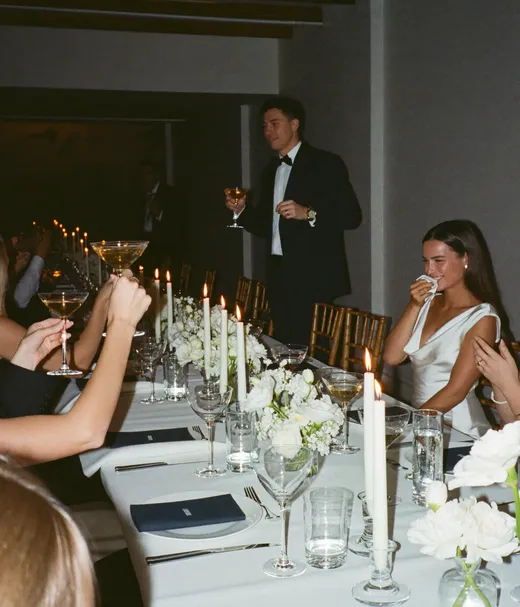
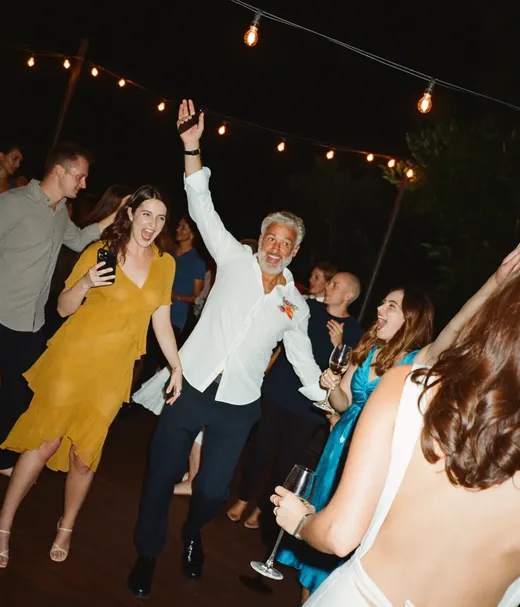
You give the toast once. Guests catch it from every table: the opening line, your son's face, the clink at the end.
A real father of the groom speech at the rehearsal dinner
Hearing a real dad deliver it helps more than any outline. Notice how the speech splits into words to his son, words to the bride, and words to both of them.
Charlie Vogt at his son Danny's rehearsal dinner
Filmed by BSR Wedding Films, a Dallas wedding videography company, and posted on YouTube. The video chapters follow the same shape as our outline: to the son, to the bride, then to both. It runs longer than the 4 to 7 minutes we suggest, which is a good reminder to time yours.
Common mistakes and what to do when it goes off script
Most rehearsal dinner speeches that fall flat make the same predictable errors. Knowing them in advance is most of the fix.
Speaking too formally
The rehearsal dinner is not the reception. Reading a highly polished speech at an intimate dinner table creates a tonal mismatch. Let your guard down. The room came for you, not a performance.
Forgetting the hosting role
If your family is hosting, this speech is partly hospitality. Skipping the welcome for the bride's family gets noticed. Two sincere sentences to her parents change the whole evening.
Using the same material twice
If you speak at both events, many guests will hear both. Repeating stories or even the same emotional beats makes the second speech feel like a lesser copy.
Going long without a shape
The rehearsal dinner allows longer speeches, but length without structure feels like rambling. Seven minutes with a clear arc beats seven minutes of warm free association.
Skipping the toast
The toast turns a speech into a celebration. End with it, keep it short and make it about this couple. A generic toast lands flat after a specific speech.
Forgetting the groom
Some dads spend so long welcoming families and telling old stories that they never speak to their son directly. He needs to hear something from you tonight. Do not let the hosting crowd it out.
When things go off script
The room is louder than expected
Wait. Do not start over the noise. Make eye contact with the person nearest you and say their name. The table will quiet in about ten seconds.
You lose your place
Look at your notes. Do not apologize or announce it. Find the line and continue. A moment of silence reads as composure, not confusion.
Someone starts a toast mid-speech
Smile, let them finish, then take the floor back with a line like "I was getting to that." At a rehearsal dinner these moments are usually charming.
You get more emotional than expected
Pause. Let it happen. Look at your notes if you need to. In a room this small, visible emotion from the father of the groom is not an interruption. It is the point.
If you are the only speaker tonight
Some rehearsal dinners are informal enough that the groom's father ends up as the only speaker. Then you are not just opening the evening, you are the whole arc of it.
Start slowly and let people settle
Give the room a moment to quiet and land. A warm welcome and a short introduction get everyone present before the part that matters.
Cover all the families
With no other speakers, you are the only one welcoming everyone. Spend more deliberate time on the bride's family. Name people. Be specific.
Allow yourself more story
As the only speaker you have room for the extended version of the story you might have cut. The audience wants to be in it with you.
Close with a toast that does several jobs
With no other toasts coming, your close should honor the couple, both families and the people who traveled. Two or three sentences that cover all of it end the evening properly.
Everything you need at a glance
Print this part and keep it next to your speech.
- Length: 4 to 7 minutes
- Tone: casual, conversational
- Notes preferred over memorized
- Audience: close family and wedding party
- Toast: at the end, not the middle
- A welcome for both families
- One specific story about your son
- Direct words to the bride
- Her parents welcomed by name
- A proper toast at the close
- Repeating reception speech material
- Ignoring the bride's family
- Stories that need consent you do not have
- Going past 8 minutes
- Generic toasts
Rehearsal dinner photos.
One album for the whole weekend.
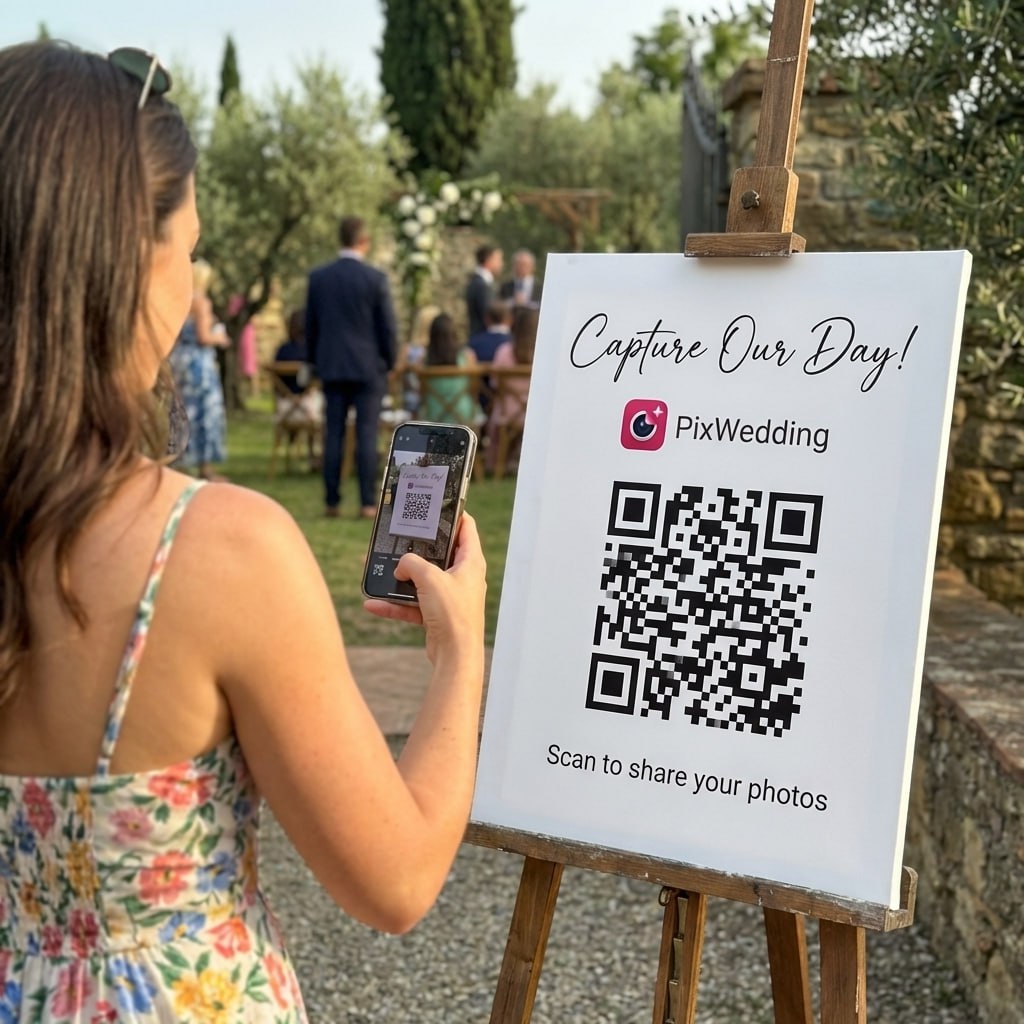
Every phone comes out when the father of the groom raises his glass. Watch how guests scan one QR code and add their photos and videos to a shared album in the browser. No app, no account, under 30 seconds.
WEDDING WEEKEND ALBUM
Emma & Daniel
Example album
First dance
You guys!!
Rehearsal dinner. Wedding day. Capture both.
Pix Wedding collects guest photos and voice messages across the whole celebration weekend, so nothing from the toasts or the big day gets lost. 20 guest uploads free, no card, then one payment, no subscription.
From Mom
Scan to join the album
No app, no account
UPLOADING
Saving your moment
THE ALBUM
Emma & Jack
June 21, 2026
647 photos · 95 guests
SCAN TO TRY
pix.wedding/
your-wedding
More wedding speech resources
The reception speech, the other parents, and ready-made toasts.
Rehearsal Dinner vs Reception: Understanding the Tonal Difference
The rehearsal dinner speech and the reception speech serve different purposes and call for different approaches, even if you are the same speaker at both events. The reception is a performance: polished, intentional, designed to land for a large mixed audience of close family and distant acquaintances alike. The rehearsal dinner is a conversation: warmer, longer, more willing to get into the details.
At the rehearsal dinner, you can tell the full version of the story that you distill to a single line at the reception. You can reference people in the room by name, knowing that everyone present knows who you are talking about. You can be more self-indulgent with memory and more willing to let the audience sit in a moment before you move on.
The rehearsal dinner also carries explicit hosting responsibilities that the reception speech does not. As the groom's father and often the co-host of the event, your speech should acknowledge both families, set the emotional tone for the evening, and make everyone in the room feel welcomed and named.
- Rehearsal dinner: longer, more personal, more anecdote-driven
- Reception: shorter, more polished, designed for a mixed large audience
- Hosting duties at the rehearsal dinner include welcoming both families by name
- Do not repeat the same stories at both events
What to Do If You Are Giving Both Speeches
When you speak at both the rehearsal dinner and the reception, you cannot repeat yourself, but you are the same person with the same relationship to your son. The fix is to split your material by story.
Keep the longer, more intimate and funnier stories for the rehearsal dinner. Save the shorter, more polished and most universal sentiment for the reception. Think of the rehearsal dinner speech as the director's cut and the reception speech as the theatrical release: same emotional material, different audience, different edit.
If one line is so strong it belongs in both, use it only at the reception. The rehearsal dinner crowd is a subset of the reception crowd, and anyone at both events will notice repetition.
- Rehearsal dinner: longer stories, more detail, the full version
- Reception: the distilled, universally accessible version of your best sentiment
- Never repeat the same anecdote at both events
- Write both speeches before finalizing either so the material stays separate
- A line strong enough for both events belongs in the reception speech
Toasting Etiquette and Hosting Duties
When the groom's family hosts, the father of the groom traditionally gives the first toast of the evening. Your role is broader than one speech: you set the hospitality tone for the night, and your opening should make both families feel the room belongs to all of them.
When you welcome the bride's family, be specific. Naming her parents and mentioning something you have come to appreciate about them during the engagement signals a real welcome rather than a ceremonial one.
The toast always ends the speech. Raising the glass is a call to everyone in the room, and it lands best after the story and the words to the couple. Give your remarks, land your close, then raise the glass.
- Open with a hosting welcome before any personal remarks
- Welcome the bride's family by name with one specific observation
- The toast comes at the end, not the middle of the speech
- The couple stays seated and does not drink to a toast in their honor
Explore more free wedding tools
Everything you need to make your wedding day stress-free and unforgettable.
AI Vow Generator
Write "banger" vows in seconds.
Hashtag Generator
Create unique wedding hashtags.
Thank You Notes
Generate personalized thank you notes.
Father of the Bride Toast
Full example toasts, structure, and delivery tips.
Invitation Wording
Perfect wording for your invitations.
Couple Name Combiner
Blend your names into the perfect couple name.
Photo Sharing QR
The best way to collect guest photos.
Wedding Checklist
Month-by-month planning checklist.
Rehearsal dinner speech: your questions
What dads ask before the rehearsal dinner: whether they speak at all, how long to go, what order the toasts follow, and how to keep it different from the reception speech.
Usually, yes. In the American tradition the groom's parents host the rehearsal dinner, so the groom's father often opens the evening with a welcome and the first toast. It is a custom, not a rule. If the couple or the bride's family hosts, the host speaks first and the father of the groom can give a shorter toast later or skip it.
The usual order is: the host (often the groom's father) welcomes guests and gives the first toast, then the bride's parents, then anyone else the couple has asked to speak, such as siblings, the wedding party or old friends. Many couples close the evening with a short thank-you of their own. The rehearsal dinner is more open to extra speakers than the reception.
Aim for four to seven minutes. The crowd is smaller and more relaxed than at the reception, so a longer speech with one full story lands well. Around seven minutes is the practical ceiling before even a friendly room starts reaching for the bread basket. If you are the host and only welcoming people, one to two minutes is plenty.
Yes, the rehearsal dinner has more room for embarrassing stories, as long as they are affectionate rather than damaging. The smaller crowd likely knows the story already or knows your son well enough to take it in the right spirit. Still skip anything about exes, serious failures, or anything you have been asked privately not to mention.
Yes. The rehearsal dinner speech is more personal, longer, more conversational and built around a story. The reception speech is shorter, more polished and written for a larger mixed audience. If you give both, use different stories, a different tone and a different close.
Yes, if you are hosting or co-hosting. Welcoming the bride's family by name, with one specific thing you appreciate about them, sets the tone for the whole evening and makes the dinner feel like two families joining rather than a dinner for the groom's side.
The host gives the first toast. Toasts from the bride's parents and anyone else the couple has chosen follow. Everyone raises a glass at the close of each toast. The couple stays seated and does not drink to a toast given in their honor, and the person giving the toast raises the glass at the end, not the start.
That is normal and, in that room, welcome. The crowd is small and everyone knows you. If tears come, pause, breathe, look down at your notes and continue. Do not apologize. The audience will wait for you without any discomfort.
A short conversation is enough. You do not need to share the whole speech, but a quick "I am opening with the welcome and then telling the camping story" helps both of you avoid telling the same story or making the same point twice.