

One Party
$49one-time
For a single celebration
Unlimited photos, videos & guests






Original quality (no compression)
Film roll mode with shot limit & revealNEW
QR code template designs




3 months upload from party date
6 months storage + ZIP download
 wedding
Guests need a signed-in Google account to add photos to a Drive folder, the role that adds is the role that deletes, and the free 15 GB is shared with Gmail. All three come from Google’s own help pages, quoted below, along with the cases where Drive is still fine.
Free to try with 20 uploads, no card. Guests need no app and no account.






It works as storage, not as guest collection. Google says only signed-in Editors can add files to a shared folder, and the same Editors can delete or move any file in it. The free 15 GB is shared with Gmail and Google Photos, and a full account stops uploads. For a small group that all uses Google, Drive is fine. For a crowd, a QR album that needs no account is easier.
15 GB
free per Google account, shared by Drive, Gmail and Google Photos
30 days
in the Trash, then Google deletes the files forever
7 days
of access for a Workspace visitor without a Google account
20,000
photos or videos is the most a Google Photos album holds
Sources: Google Drive Help on storage, the Trash and visitor sharing, and Google Photos Help on album limits. Checked 3 October 2026.
Most posts on this topic come from apps that compete with Drive, and so does this one. So instead of our opinion, here are six sentences copied from Google’s own help pages, each with a link, and what each one means on the night of an event.
“If they’re signed into a Google account, people can open, edit, delete, or move any files within the folder. People can also add files to the folder.”
The role that lets guests add photos is the same role that lets them delete or move every photo, and it is tied to a signed-in Google account.
Read Google’s page“To answer this question, responders need to sign in to a Google Account.”
The usual workaround, a Google Form with a file upload question, asks every guest to sign in too.
Read Google’s page“up to 15 GB of storage which is shared among Drive, Gmail, and Photos”
Event photos and video share one free pool with the host’s email and their own phone backups.
Read Google’s page“When your account reaches its storage limit, you won’t be able to upload or create files in Drive, send or receive emails in Gmail, or back up photos or videos to Google Photos.”
A big video night can stop more than the photo folder. It can stop the host’s email.
Read Google’s page“Files you move to the Trash are deleted forever after 30 days.”
If a photo goes missing, you have a month to notice and restore it. After that it is gone.
Read Google’s page“Anyone who has the link can use your file, without signing in to their Google Account.”
Link sharing is generous for opening one file. The upload step in a folder still points back to a signed-in account.
Read Google’s pageSwipe for all six quotes
Quotes copied from Google’s English help pages, checked 3 October 2026. Google updates these pages, so the link is the final word if anything has changed.
The same guest, the same three photos, four methods. With a Drive folder we count 7 steps and 2 stops before the upload starts for a guest who is not signed in to Google. With a QR album it is 4 steps and nothing in the way.
Swipe for all four methods
These are the steps as we map them from Google’s help pages for a guest who is not signed in, rose numbers mark a stop. A guest already signed in to Google on their phone skips the sign-in step, and a different phone or browser can add or skip a tap. Stops matter more than taps: each one is a point where a guest at a busy event puts the phone away.
Every Google cell below comes from Google’s help pages, read on 3 October 2026. Rose chips mark the cell that usually decides against a method at a big event.
Guests scan one QR code or open a link and upload in the phone browser with no app and no account. The host manages the album and decides whether guests can view and download.
| Method | Google account to add | Who can delete | Capacity | What guests can see | Guest opens it in |
|---|---|---|---|---|---|
Pix WeddingNo-account pick | Not needed, and no app | The host, from the dashboard | 20 uploads free. Paid plans: unlimited photos and videos, photos up to 30MB and videos up to 100MB each | The host turns guest viewing and downloads on or off | The phone browser, from a QR code or link |
| Google Drive folder | Yes, Editors add files when signed in | Any signed-in Editor can delete or move any file | 15 GB free per Google account, shared with Gmail and Google Photos | Everyone with access can open every file | The browser or the Drive app |
| Google Forms file upload | Yes, Google requires responders to sign in | Files land in a new folder in the form owner’s Drive | The owner sets the number of files and the maximum file size | A form, not a shared gallery | The browser |
| Google Photos shared album | Yes, adding is tied to a Google account | Removing a person removes all of their photos | Up to 20,000 photos or videos per album | Anyone with the link can view the album | The browser to view, an account to add |
Swipe to compare all 4
Google limits from Drive sharing, Drive storage, Forms file upload, Photos sharing, Photos album controls and Photos album limits. Checked 3 October 2026.
The column people skip: what guests can see
In a Drive folder, anyone who can add can also open every other file. At a wedding that may be fine. At a school event or a work party, where some photos should reach the host only, it is a reason to pick a tool where the host controls guest viewing.
Want the feature-by-feature view?
This page is about Google’s documented limits. Pricing, slideshow and storage plans side by side are in Pix Wedding vs Google Drive and Pix Wedding vs Google Photos.
Drive has three folder roles. Two of them cannot add files. The one that can, Editor, also opens, edits, deletes and moves every file in the folder. There is no upload-only role on a personal Drive folder, so the moment guests can add their photos, they can also remove everyone else’s.
Only one role can add photos
“People can see the folder and they can open all files within the folder.”
“People can make comments and suggestions for files in the folder, but can’t change or share items in the folder with others.”
“If they’re signed into a Google account, people can open, edit, delete, or move any files within the folder. People can also add files to the folder.”
Quoted from Google Drive Help: share files and folders. Checked 3 October 2026.
30 days
is how long a file sits in the Trash before Google deletes it forever, per Drive Help. Google also says that if you’re not the owner of a file, you won’t be able to delete it, only remove it from your Drive.
See the three Drive roles in action
A walkthrough of Viewer, Commenter and Editor on Google Drive for both Gmail and Workspace accounts. Watch the Editor part before you send a folder link to a crowd.
Watch on YouTubeGoogle gives every free account 15 GB, shared by Drive, Gmail and Google Photos, and only the files you own count. Photos are rarely the problem. Video is. Move the sliders to your own event and see where the meter lands.
Does your event fit in 15 GB?
3.2 GB
for 400 photos and 30 clips
9.2 GB
of the 15 GB free, with what the account already holds
Fits, with about 5.8 GB to spare. Video is what moves this number most: raise the clip size and watch the meter.
Illustrative only. Photo and clip sizes depend on the phone, the format and the video length, so check one real file from your own phone. Google counts the files the account owns, and the 15 GB is shared with Gmail and Google Photos.
Video is the variable
A one-minute 4K clip from a recent iPhone can pass 100MB on its own. Ask guests for 1080p or short clips, whichever tool you use. On Pix Wedding, videos can be up to 100MB each and photos up to 30MB each.
Need more than 15 GB?
Google sells more space through Google One plans, billed monthly or yearly, with prices that vary by country. Check the price in your own account before the event.
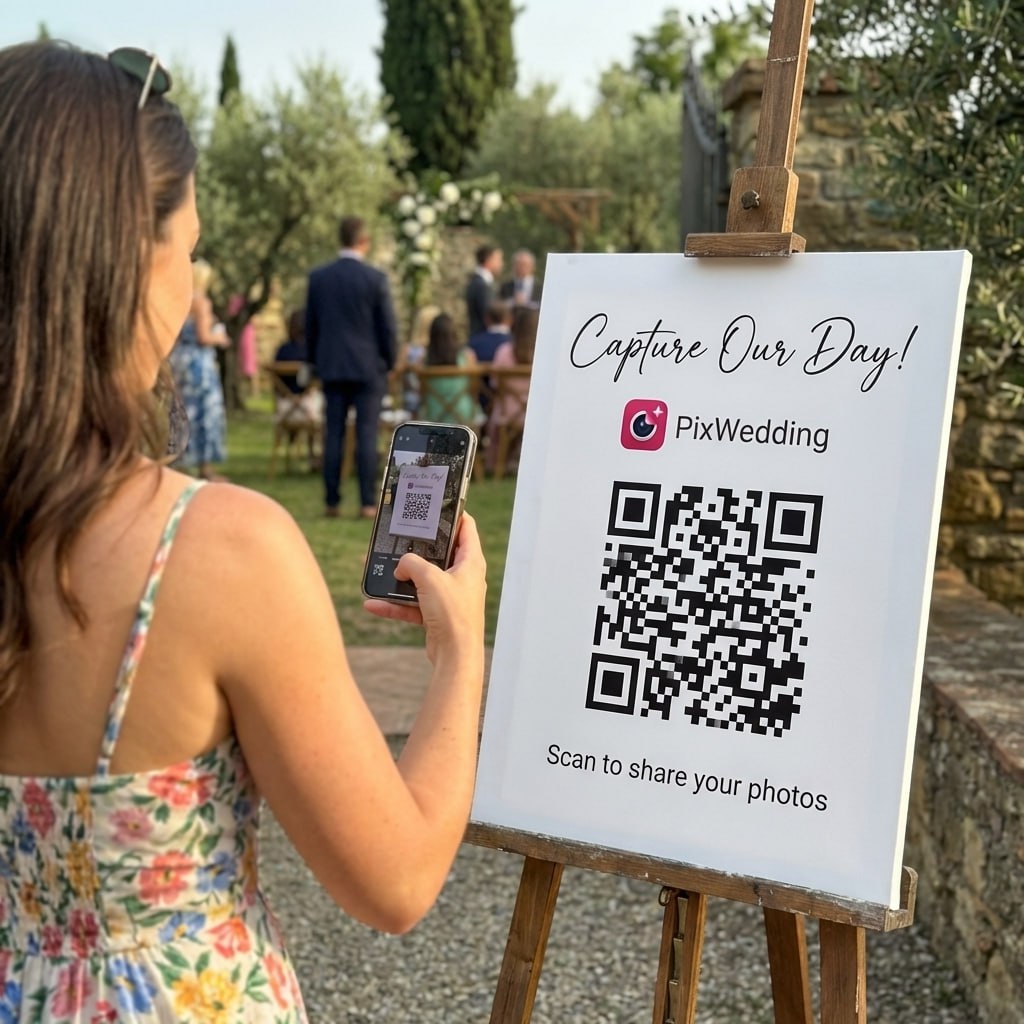
With a QR album, guests scan the code or tap the link and the upload page opens in the phone browser. No app, no account and no folder to rearrange. The host decides whether guests can see the album and download from it.
Scan to join the album
No app, no account
UPLOADING
THE ALBUM
Example album
186 photos · 41 guests

For photos, a Google Photos shared album fits better than a Drive folder: it is built for pictures, it can be shared by QR code and anyone with the link can look. Adding photos is still tied to a Google account.
If your contact doesn’t have a Google Account, you can send them a link or share using another app instead.
Drive is a good tool used for a job it was not designed for. If your event looks like the left column, use it and skip the rest of this page.
A quick test: if you would hand every guest the keys to delete the whole folder, and every guest already uses Google on their phone, Drive is enough. If either answer is no, use a tool where guests only add and the host manages. A lot of hosts do both: a QR album on the day, then a copy in Drive as the long-term backup. If you do use Drive, give the event its own Google account so it does not share 15 GB with your Gmail, share with named people rather than an open Editor link, and when uploads close switch Editors to Viewers and download a full copy.
Watch a guest scan the QR code and add photos from the phone browser in seconds, with no app and no Google account. The host sees every upload land in one album.
EVENT ALBUM
Example album
Maya's 30th
186 photos, no sign-ins
One QR code or link. Guests upload photos and videos from the phone browser with no app and no account, and you decide whether they can view and download. 20 uploads free, no card.
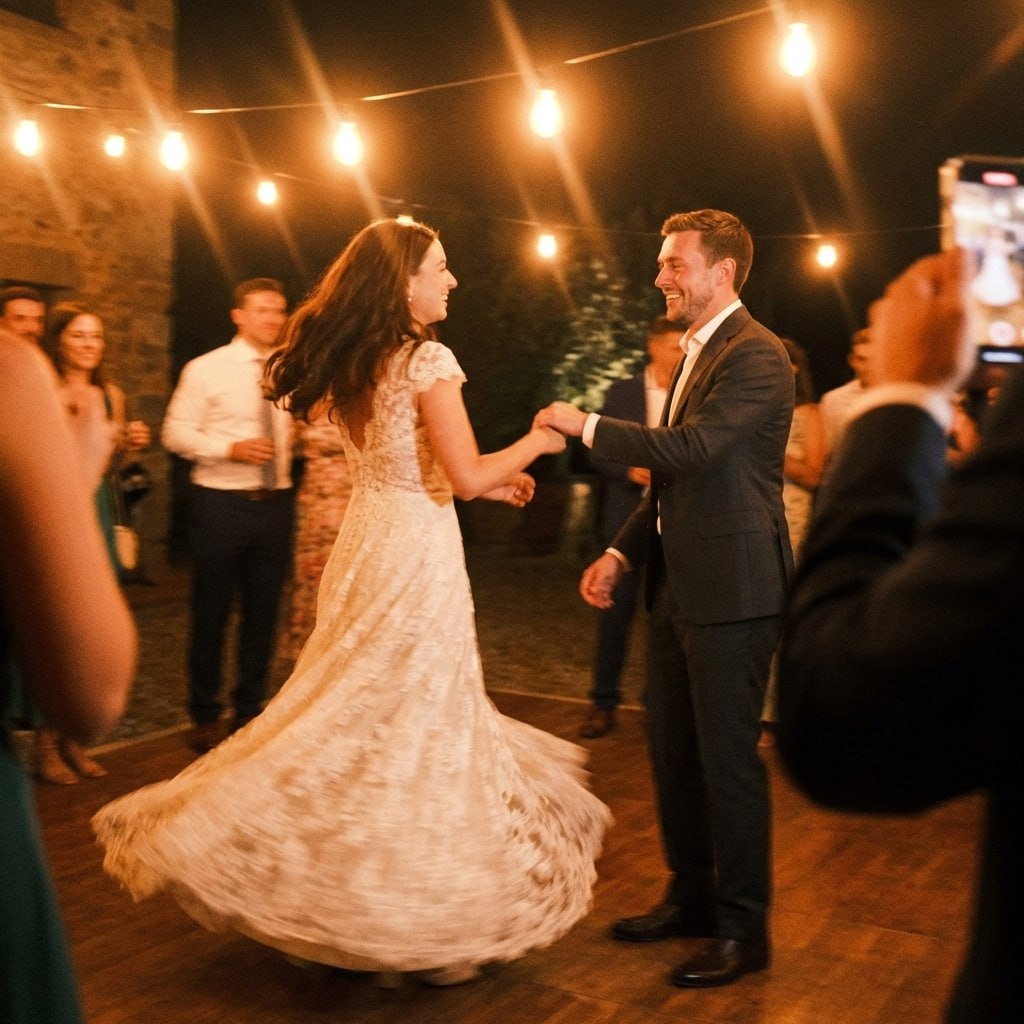
From the dance floor
Scan to join the album
No app, no account
UPLOADING
THE ALBUM
Example album
186 photos · 41 guests
SCAN TO TRY
pix.wedding/
your-wedding
Free to try with 20 uploads, no card. Every paid plan is a one-time payment with unlimited photos, videos and guests. What changes between them is how long the album takes uploads, how long it is stored and the extras.
For a single celebration
For a crowd, a screen and a dance floor
One-time payment, no subscription
For big guest lists and repeat events
One payment. Yours to keep. No subscription. No renewals. No surprise charges.
Secure checkout. Polar, Apple Pay, Google Pay.
Money-back guarantee: if your guests never upload a single photo, you get 100% back. See how it works
Quick answers on accounts, storage, compression, deleted files, moving a folder and when Drive is the right call.
Not on a personal Google account. Google’s help page says people who are signed into a Google account can add files to a folder shared with the Editor role, and the same role can open, edit, delete or move any file in it. Visitor sharing, which gives people without a Google account 7 days of access, is a work and school feature for shared drives. A QR album such as Pix Wedding takes uploads in the phone browser with no app and no account.
The limit that matters at an event is storage, not a folder count. A free Google account has 15 GB, shared by Drive, Gmail and Google Photos, and when it is full Google says you can’t upload to Drive. Use the calculator on this page with your own guest count and clip sizes, because video fills it fastest.
Drive keeps files as files and has no quality setting for photos. The compression question belongs to Google Photos, where Storage saver resizes photos larger than 16 MP down to 16 MP. Google says both Original quality and Storage saver count toward your storage.
A QR code photo album built for events. With Pix Wedding, guests scan one QR code or open a link and upload photos and videos from the phone browser, with no app and no account, and the host manages the album from a dashboard. It is free for 20 uploads, and paid plans are a one-time payment from $49 with unlimited photos, videos and guests.
When the group is small, everyone already uses Google and you trust every contributor with edit rights. Drive also works well as the archive after the event, where the finished set lives next to the photographer’s files. For a large crowd, mixed ages or guests you have never met, the sign-in step and the Editor delete rights get in the way.
Yes. Set the Drive folder to view only, download the files on a computer (Google’s help page shows the select, right-click, Download route) and then add them through the album’s upload link in a browser. On Pix Wedding photos can be up to 30MB each and videos up to 100MB each, and a large folder needs a paid plan because the free tier covers 20 uploads.
Yes. Google says a Viewer can see the folder and open all files within it, and an Editor can open, edit, delete or move any file. There is no setting that lets a guest add photos without seeing the rest of the folder. On Pix Wedding the host turns guest viewing and downloads on or off in Settings.
Check the Trash first, because Google keeps files there for 30 days and then deletes them forever. Google also notes that a person who does not own a file can’t delete it for good, only remove it from their own Drive, which is why the folder owner should look in their own Trash. To stop it happening, switch guests to Viewer once the upload window closes and download a full copy.
The product comparisons, the Google Photos question, and the guides for collecting and keeping the photos once they are in.
Sources, checked 3 October 2026
Maya's 30th, the guest names, the file names and the counts in the phone mockups on this page are illustrative. The Google screens are simplified mockups, not screenshots. Storage examples use stated assumptions. Photos are from our own library.
Free tools for the QR code, the shot list and the guest messages that go with your album.
Design custom print-ready stickers.
Create unique wedding hashtags.
5 methods ranked by participation rate and ease.
Compare every sharing platform by ease and participation.
The single method with the highest participation rate.
Step-by-step setup for every platform.
Better, cheaper options than disposable cameras.
5 cheaper alternatives to a $1,000+ photo booth rental.