
What Is the Best Way to Share Photos with a Group?
The answer changes with group size, event type, and how tech-fluent your guests are. This guide cuts through all of it, with concrete picks by tier and ready-to-send message templates.
See How Pix Wedding WorksDirect answer
For most groups over 15 people: a browser-based album page accessed via a QR code or short link. Guests tap the QR, the album opens in their phone browser, and they can view and upload photos without creating an account or installing anything. For smaller groups under 10 where everyone shares a platform already (WhatsApp, iMessage), a group chat is fine. The QR album method scales from a birthday party to a 300-person wedding without changing anything about the guest experience.
Read on for the full tier breakdown, a use-case table by event type, participation data from real events, and four copy-paste message templates you can use today.
The right method by group size
Group size is the first variable to pin down. Each tier below has a different optimal method because the assumptions you can safely make about your guests shift as the headcount grows.
2 to 5 people
Direct message or shared link
For a tight group where everyone knows each other and shares the same messaging platform, a direct link in iMessage, WhatsApp, or even email is perfectly sufficient. You do not need to build infrastructure for 4 people going camping. A simple Dropbox link or iCloud shared album handles it cleanly.
Watch out: If even one person in the group is on a different platform, or if quality matters for printing, upgrade to an album page.
6 to 15 people
Shared cloud album or group chat (platform-dependent)
At this size, platform assumptions usually still hold. A WhatsApp group chat, iCloud Shared Album for Apple-only circles, or a Google Photos shared album for Android-heavy groups all work without much friction. The key word is "platform-dependent": only pick this if you genuinely know the entire group is on that platform.
Watch out: One person without the app breaks the loop. If you have any doubt, go with a browser-based album page instead.
16 to 50 people
Browser-based album page with QR code
At 16 or more people, diversity of devices, ages, and technical comfort grows fast. A browser-based album page accessed by a QR code or short link is the only method that works equally well for a 22-year-old on a Pixel and a 68-year-old on an iPhone SE. No install, no sign-in, no guessing.
Watch out: Print the QR code at minimum 4 inches across. Anything smaller does not scan reliably in dim event lighting.
50+ people
QR album page with physical cards at every seat
At 50 or more guests, you cannot rely on a single sign display or a message in a group chat everyone ignored. Physical table cards with the QR code printed on them are the distribution method. Saturation beats a single point of presence every time. Couples and event planners who put QR cards at every place setting consistently outperform those who rely on a single poster at the door.
Watch out: Seed the album with at least 10 photos before the event starts. An empty album on first scan makes guests think they hit the wrong page.
Group photo sharing without the group chat
Watch a shared live album in action: everyone uploads from the browser, nobody installs anything.
The real Pix Wedding demo album, exactly what your guests see after scanning the QR code.
Setting up a shared album in Google Photos
If your group of 6 to 15 is Android-heavy, this walkthrough shows how the Google Photos shared album option from the tier above actually works, so you can compare the setup effort against a QR album page.
Best method by event type
Different events carry different expectations. A corporate retreat has different constraints than a funeral. Here is the recommended method for each common event category.
| Event type | Recommended method | Why it fits |
|---|---|---|
| Wedding (80 to 200 guests) | QR album | Mixed ages and devices; guests want to see and upload; must preserve original quality for the print album |
| Family vacation (6 to 20 people) | Group chat or link | Familiar group, same platform likely, casual quality is fine for most shots |
| Corporate retreat (20 to 60 employees) | QR album | All on company devices, but Slack is not universally beloved for photos; QR page keeps it clean and keeps HR out of personal chat |
| Memorial or funeral (30 to 120 people) | QR album | Emotionally sensitive; guests span all ages; no one wants to troubleshoot an app at a hard moment |
| Class reunion (40 to 150 people) | QR album + link | Scattered geography; people are already coordinating on social; the QR at the venue plus the link in the Facebook event covers both in-person and remote attendees |
The QR album page wins in 4 out of 5 event categories. The exception is an intimate family group where everyone is already on the same chat.
Before and after: three illustrative scenarios
Participation numbers tell the story more clearly than any feature list. These are illustrative, composite scenarios based on the participation-rate pattern seen across QR-album events, not named case studies, showing what typically happens when a group switches from an account-gated or single-platform method to a browser-based QR album.
Wedding in Austin, TX (167 guests)
Before
First attempt: a WhatsApp group. Three guests without WhatsApp dropped out immediately. After 48 hours the group had 94 photos from 18 contributors, about 11 percent participation.
After
Switched to a QR album page printed on 167 place-setting cards. By midnight: 742 photos from 119 contributors, 71 percent participation. Final album after follow-up link sent the next morning: 1,340 photos.
Corporate offsite retreat (44 employees)
Before
The HR team created a shared Google Drive folder and sent the link in a company-wide email. By end of day: 31 photos, all from the same 4 people who had Google accounts active on their phones.
After
The office manager created a QR album page, printed it on the welcome packet, and mentioned it once at the opening remarks. By end of offsite: 287 photos from 38 employees, 86 percent participation, no installs.
25-year class reunion (88 attendees)
Before
The organizer created a private Facebook album and shared it in the event group. Result: 63 photos, mostly from the 8 people who still check Facebook regularly. Attendees over 55 did not engage at all.
After
Added a QR album page link inside the Facebook post AND printed a card at every table. Participation from all age groups. Final count: 491 photos from 61 contributors, 69 percent participation, including 14 photos from guests who could not attend in person but shared old reunion photos through the same link.
Four ready-to-send message templates
Knowing the right method is half the battle. The other half is asking guests in a way that actually gets responses. Copy any of these and swap in your own details.
Wedding invitation insert (print)
Share your photos with us!
Point your phone camera at the QR code below.
No app needed, no sign-in required.
Every photo you share becomes part of our forever album.

[QR CODE HERE]
Or visit: pix.wedding/your-album-link
WhatsApp message to guests (day before)
Hey! Tomorrow is the big day and we want YOUR photos too.
We have set up a shared album anyone can add to, no app required.
Just scan the QR on your table card or tap this link: pix.wedding/your-album
Takes 30 seconds. The more the better!
Email to guests (day after)
Subject: Your photos from yesterday would mean the world to us

Hi [Name],

We had the most incredible time and we know you captured moments we missed.

You can add your photos to our shared album here: pix.wedding/your-album
No account needed, just tap and upload.

The album will stay open for the next two weeks.
Thank you for being there.
Event emcee script (read aloud during reception)
Before we move on, a quick 30-second ask from the couple.
Everyone take out your phone.
You will find a small card at your seat with a QR code.
Scan it now and you will see their photo album open right in your browser.
Any photos you took tonight, please add them. No account, no download, just tap upload.
It takes less than a minute and they will treasure every single shot.

Group selfie
All here!
The shortest answer to that long question.
One private QR album where every guest, every phone, every photo lands without group chats, lost shots, or a download wall.
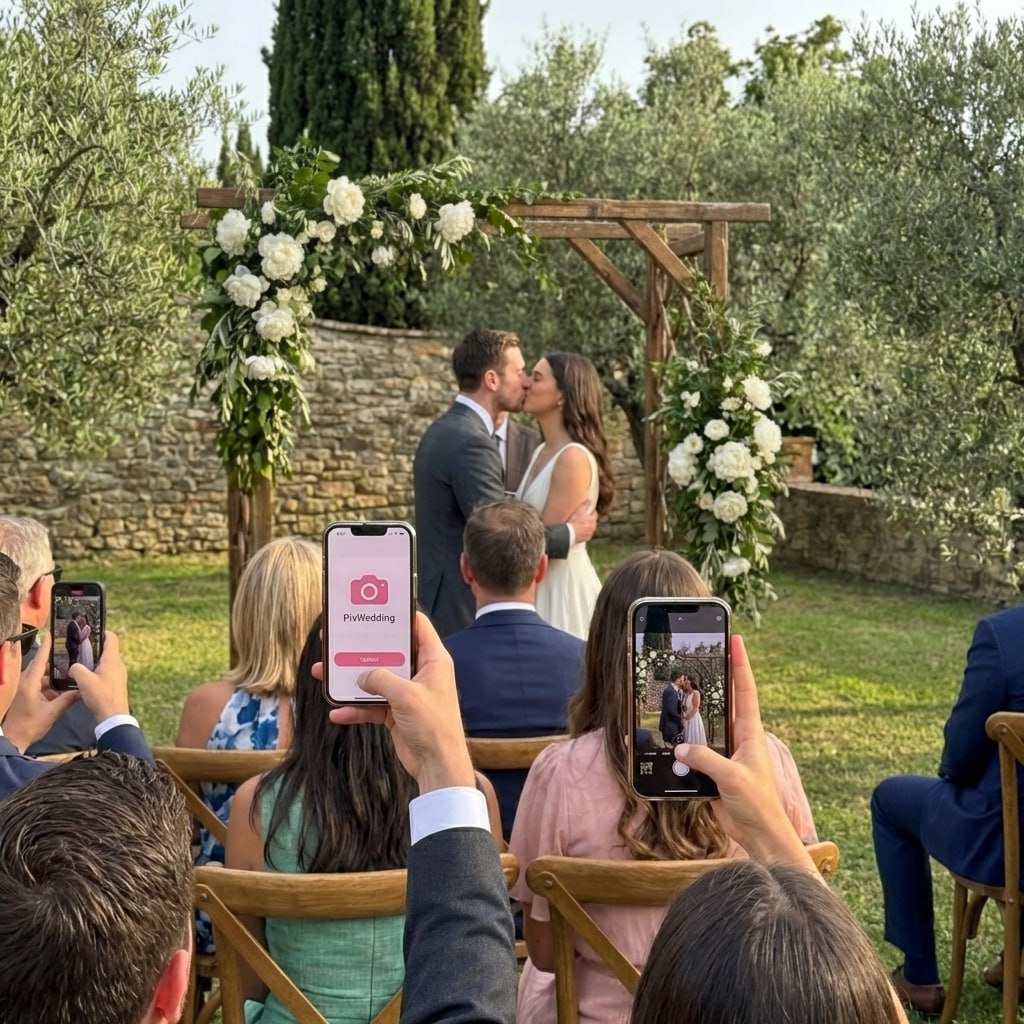
From Mom
Scan to join the album
No app, no account
UPLOADING
Saving your moment
THE ALBUM
Emma & Jack
June 21, 2026
647 photos · 95 guests



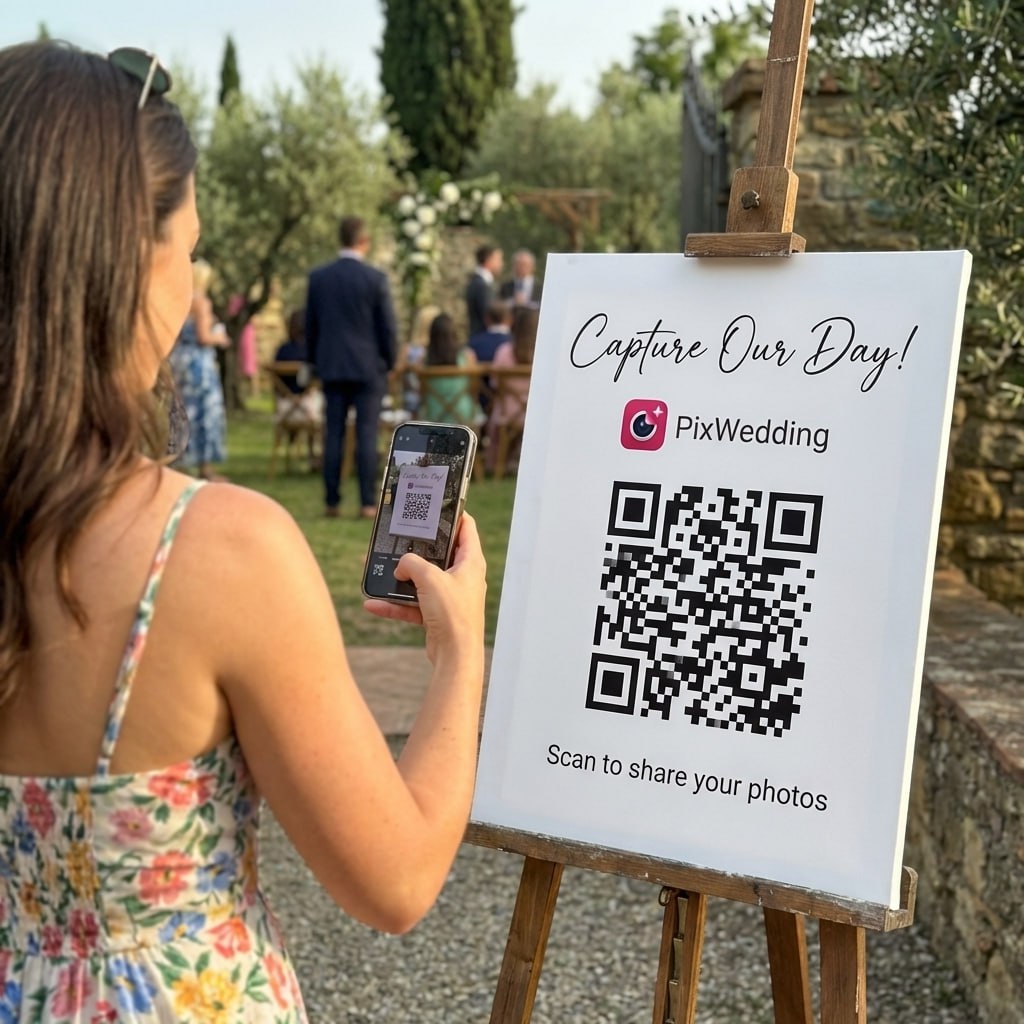


SCAN TO TRY
pix.wedding/
your-wedding
When does the answer change?
Five edge cases that flip or modify the standard recommendation.
1. International guests with foreign SIM cards
A QR code that opens in browser is the right call here, but pair it with the venue Wi-Fi password printed on the same card. International data roaming is expensive and some guests will have it turned off. If your venue has no Wi-Fi, send the album link via SMS the day before the event so they can bookmark it while still on their home network.
2. No-Wi-Fi or low-signal venue
Barns, hilltop villas, and rural estates often have dead zones. The QR code still makes sense because most uploads happen the same night or the next morning from home. Send the follow-up link via SMS or email to every confirmed guest so they can add photos when they are back on Wi-Fi. Expect 30 to 40 percent of total uploads to arrive 12 to 48 hours after the event.
3. Privacy-sensitive guests who do not want their photos visible to strangers
Set the album to upload-only mode during the event and switch to view-enabled after you have reviewed contributions. Good album services let you hold uploads for moderation before making them visible. This covers situations involving public figures, domestic-safety concerns, or simply guests who are uncomfortable with wide photo sharing.
4. A children's birthday party (guests are mostly parents)
Child privacy laws and parental preferences flip the default. Do not use a public-link album where any forwarded URL gives full access. Use an album service that requires an access code in addition to the link, and communicate it only to the parent list you have confirmed. Limit the album to close family unless you have explicit consent from each family present.
5. A memorial or death-related gathering
The emotional weight of the event changes the UX requirements. Instructions must be even shorter than usual, people are distracted and grieving. A single printed card with one sentence of instruction and a QR code is the right format. Choose a sober cover photo for the album page. Avoid any gamification or upload-count displays. The goal is to collect family memories, not drive engagement metrics.
6 mistakes that quietly sink group photo sharing
1. Choosing the method YOU use rather than the method your slowest guest can handle
Your photo-sharing setup is only as strong as the person least likely to figure it out. Design for your most tech-reluctant guest and everyone else will be fine.
2. Sending one reminder and assuming everyone saw it
Event invitations get buried. A single mention of the album in the invite is not enough. Plan for at least three touchpoints: the invite, a day-before reminder, and a day-after follow-up link with a direct request.
3. Using a method that compresses photos and calling it done
If you share via WhatsApp and then try to print a large album from those images, you will be disappointed. By default WhatsApp sends photos at a reduced, compressed Standard quality rather than the original file, and even its optional HD quality setting does not deliver the true original, so images can look soft once you print them larger than a small snapshot.
4. Relying on a single QR display point at the entrance
People miss signs. They are talking, looking at each other, checking their outfits. Put the QR code at every table, on every printed card, on the bathroom mirror frame, and inside the welcome bag. The more touchpoints, the more uploads.
5. Opening the album to the general public with an easily guessable link
A link like albumapp.com/smithwedding is guessable. Use the unique random-ID link that your album service generates by default, not a custom vanity URL that a search engine or random person could find.
6. Closing the album within 24 hours of the event
The second wave of uploads, from guests who forgot during the event or who drove home before uploading, comes 12 to 72 hours later. Keep the album open for at least two weeks. Some of the best shots arrive days later from guests who had to charge their phones first.
QR album pages: the honest pros and cons
The QR album page wins in most scenarios, but it is not perfect. Here is a balanced look before you commit.
Pros
- Works on every device: iPhone, Android, Windows laptop, Chromebook. The browser is the universal platform.
- No install required: guests scan or tap, and the album opens immediately.
- Bidirectional by default: the same page lets guests both see photos and add their own.
- Original quality: good album hosts store full-resolution files, not compressed previews.
- Persistent access: the album lives on after the event and you can share the link months later.
- Works for any group size: the setup is identical whether you have 8 guests or 800.
Cons
- Requires setup time: 5 to 10 minutes to create the page, generate the QR, and print cards before the event.
- Needs a service: you are relying on a third-party host; check the privacy policy and confirm originals are stored.
- Internet required to upload: guests in a dead zone must wait until they have signal to contribute.
- Some older guests still hesitate: the QR scan step is universally understood after the pandemic menu era, but occasionally someone needs a 10-second demo.
Related guides
More on collecting and sharing photos from groups and events.
The one-line takeaway
If you only remember one thing: the best way to share photos with a group is the method with the least friction for the people uploading. For a big one-off event, that is a QR-code album no one has to download. For an ongoing friend group, a shared album inside the phones everyone already uses wins. For work, it is the platform your team is already inside. Match the tool to who is in the group, not to the longest feature list.
Why the right answer depends on group size more than anything else
Most advice on group photo sharing pretends there is one universal winner. There is not. The right method for six friends on a weekend trip is genuinely different from the right method for a 200-person wedding reception. Group size is the single variable that matters most because it determines how many different devices, operating systems, age groups, and comfort levels you have to design for simultaneously.
When a group stays small, shared assumptions hold. You can guess that everyone is on WhatsApp, that no one minds a Google sign-in, that someone will just AirDrop the highlight reel later. When a group grows past 15 or 20 people, those assumptions start breaking. One guest does not have WhatsApp. Another has never set up a Google account. A third is on a Galaxy S10 and cannot do iCloud anything. The method that works for everyone is the one that requires the least from each individual person, and that is always a browser-based album page with a QR code or link.
- •Groups of 2 to 5: direct messaging and cloud links are fine and often the right call
- •Groups of 6 to 15: a shared album link works if the group is already on the same platform
- •Groups of 16 to 50: a browser-based QR album page is the safest choice
- •Groups of 50 or more: QR album page with printed cards is the only method that scales without excluding anyone
- •Mixed ages always push the recommendation toward the simpler, browser-only method
How participation numbers shift based on the method you pick
The most overlooked part of group photo sharing is the upload rate, meaning what percentage of guests actually contribute photos versus just viewing them. When a couple or event organizer asks what the best way to share photos with a group is, they usually mean they want a lot of photos back, not just a way to push their own photos out.
Photo-sharing platforms and event planners commonly report the same pattern: QR album pages where guests need no account tend to see the highest participation, account-gated group chats land in the middle, and email-based sharing trails behind. The friction of each extra step, sign in, install, fill out a form, measurably cuts how many guests bother to contribute. The simplest path gets the most photos back.
Timing also matters. Guests are most likely to upload photos within 4 hours of taking them, while the event feeling is still fresh and the battery is not dead. That is why physical table cards with the QR code beat a link sent in a follow-up message the next week, even though both methods lead to the same album. The card is there at the moment of motivation.
- •QR album page with no sign-in: 55 to 90 percent upload participation
- •WhatsApp group: 20 to 40 percent, higher when the group is already active
- •Email invite with shared link: under 15 percent in most real event data
- •Guests upload 60 percent of their photos within the first 4 hours after the event
- •A follow-up SMS with the album link the next morning adds another 25 to 30 percent of final contributions
What to look for when choosing an album hosting service
Not all album hosting services are equal, and the wrong choice costs you photo quality or guest participation. Before you commit to a service, check three things: whether guests can upload without creating an account, whether originals are stored at full resolution, and whether the album stays accessible for at least 30 days after the event.
Privacy policy is the fourth variable most organizers skip. A good service will explicitly state that your photos are not used for advertising, not shared with third parties, and not indexed by search engines. Read that section before you put 1,200 family photos on a platform you have never used before.
- •No guest account required for upload: non-negotiable for mixed-age groups
- •Full-resolution storage: confirm before the event, not after you find blurry prints
- •Album stays live for 30 or more days: contributions arrive in waves, not all at once
- •Clear privacy policy: your guests' faces should not train someone's AI model
- •Export option: you should be able to download everything in a single ZIP, not photo by photo
Explore more free wedding tools
Everything you need to make your wedding day stress-free and unforgettable.
QR Sticker Designer
Design custom print-ready stickers.
Hashtag Generator
Create unique wedding hashtags.
How to Collect Guest Photos
5 methods ranked by participation rate and ease.
Get Photos After the Wedding
Message templates to gather guest photos post-wedding.
Share Wedding Photos with Guests
Compare every sharing platform by ease and participation.
Best Way to Get Guest Photos
The single method with the highest participation rate.
How to Make a Shared Wedding Album
Step-by-step setup for every platform.
Alternative to Disposable Cameras
Better, cheaper options than disposable cameras.
Group photo sharing, answered
Everything you need to know about our free tools and how they help your wedding day.
A browser-based album page accessed by a QR code or short link. It requires no app install, works on every phone and laptop regardless of operating system, and lets guests both view and upload from the same page. For groups over 20 people with any mix of ages or devices, nothing else comes close.
Yes. For 2 to 5 people who all know each other and share the same messaging platform, a direct message thread is perfectly fine. For 6 to 15, a shared cloud link or iCloud album works if everyone is on Apple. Above 16 people, or any time age ranges mix, a QR album page is the reliable default because it assumes nothing about what is already on anyone's phone.
Print a QR code on table cards at every seat and post a copy near the entrance. Use a hosting service that does not require guests to sign up or install an app. Pre-load 8 to 10 photos from the morning getting-ready session so the album is not empty when the first scan happens. Couples using this method consistently collect between 60 and 90 percent guest participation, versus 10 to 20 percent when they use WhatsApp groups.
Google Drive requires a Google account to upload, which excludes Apple-only users who do not have one or simply do not want to sign in. Viewing is also clunky on mobile compared to a purpose-built album page. For an informal team or family that is already in Google Workspace, Drive is fine. For a mixed public group at an event, it adds friction that costs you uploads.
Yes. For small groups under 10 people, iCloud Shared Albums (Apple only) and WhatsApp are both free and require nothing extra. For larger or mixed groups, dedicated album-page services like Pix Wedding let you create your album and start for free with no credit card required, then offer one-time paid plans from $49 when you are ready to go live.
Ask the venue for the guest Wi-Fi password and print it on the same card as your QR code. If the venue has no Wi-Fi at all, set up a temporary hotspot from a spare phone. Guests who still cannot connect at the event can use the short link sent in a follow-up message the next morning, and contributions often keep coming in for 3 to 5 days after an event.