
Who Walks the Mother of the Groom Down the Aisle?
This page is only about her entrance: who can escort her, where she falls in the processional for Christian, Jewish, civil and two-groom ceremonies, where she sits, the music cue, and what changes when parents are divorced, she is widowed, or the walk itself is hard.
- 01GrandparentsGroom's side, then bride's side
- 02Mother of the groomOn her escort's arm, father of the groom beside or just behind
- 03Mother of the brideSeated last, the signal that the processional is next
- 04ProcessionalWedding party, then the bride
Who escorts the mother of the groom? In one paragraph
Traditionally, an usher or groomsman escorts the mother of the groom down the aisle, with the father of the groom walking just behind or beside her. Today the groom himself often walks her. She enters after the grandparents and just before the mother of the bride, and sits in the first row on the right side in Christian ceremonies.
Jewish weddings work differently: she and the groom's father walk the groom down the aisle between them, and the groom's side is on the left. Everything else on this page is about the exceptions.
An usher or groomsman by tradition. Today often the groom, or the father of the groom.
After the grandparents, just before the mother of the bride.
First row on the groom's side: right in most Christian ceremonies, left in Jewish ones.
She usually walks the groom in herself, with the groom's father on his other side.
Looking for her whole role, from the engagement to the send-off? That lives on our mother of the groom duties checklist. This page stays on the aisle.
Who can walk the mother of the groom: seven options
None of these is wrong. Pick by two things: how the groom is getting to the front, and who she would want on her arm on a day she may be nervous.
| Escort | Why couples pick it | Best when | Watch for |
|---|---|---|---|
| An usher or head usher | The original etiquette. In Emily Post's 1922 wedding the head usher walks her in and the groom's father follows alone. | Formal church weddings, or when the groom enters from a side door and cannot leave the front. | Introduce them at the rehearsal so he knows her on sight. |
| A groomsman | Does the usher's job when the wedding has no separate ushers. | Most modern weddings with a wedding party of four or more. | If he also walks in the processional, give him time to get back to the rear. |
| The groom, her son | A private moment with her son before the ceremony starts. The Brownstone's processional video shows the groom walking his mother in. | A close relationship, and a groom who is not already standing at the front. | He seats her and goes straight to his spot, so the walk does not read as a second entrance. |
| The father of the groom | They walk in as a couple. Emmaline Bride names him as the traditional choice. | Married parents, relaxed weddings, venues with a narrow aisle. | Nobody else needs to be briefed, which also means nobody is watching the cue. Tell them when to go. |
| Her husband or partner | When the groom's parents are divorced and she has remarried, her partner walks her and sits beside her. | Remarried mothers, blended families. | Settle the rows for both sides of the family before anyone hears it secondhand. |
| Another son, daughter or grandchild | Gives a sibling or grandchild a job when they are not in the wedding party. | Widowed mothers, big families, a sibling who was left out of the party. | Young grandchildren need a practice run, and an adult ready to help. |
| Walking alone | Some mothers prefer it. A confident solo walk reads as a choice, not a gap. | Independent mothers, small ceremonies, second marriages. | Give her a clear music cue so the room turns to look. |
Does the groom walk his mother down the aisle?
He can, and plenty of grooms do. It works when the groom walks in from the back rather than from a side door. He seats her in row one, kisses her cheek if that is their thing, and goes straight to his place at the front before the mother of the bride comes in.
What the father of the groom does
If an usher or the groom walks her, the father follows alone and sits beside her. If he is her escort, they walk in as a pair. Either way, tell him which one it is, because this is the part most families forget to decide.
What is the mother of the groom processional order?
Her place moves with the ceremony. Here are four common orders side by side, first person in at the top. Her step is marked in rose.
Christian or traditional US
Church or venue ceremony- 1Officiant takes their place
- 2Grandparents of the groom, then of the bride
- 3Mother of the groom, escorted, father of the groom beside or behind
- 4Mother of the bride, escorted and seated last
- 5Groom and best man, from the side or down the aisle
- 6Groomsmen and bridesmaids
- 7Maid or matron of honor
- 8Ring bearer and flower girl
- 9Bride with her escort
Emily Post's 1922 order and The Brownstone's video both put the groom's parents right before the bride's mother.
Jewish
Chuppah ceremony- 1Rabbi and cantor
- 2Bride's grandparents
- 3Groom's grandparents
- 4Groomsmen, in pairs or single file
- 5Best man
- 6Groom, with his mother and father on either side
- 7Bridesmaids
- 8Maid or matron of honor
- 9Ring bearer and flower girl
- 10Bride, with her mother and father
Both sets of parents usually stand under the chuppah instead of sitting. Order per Smashing the Glass and 18Doors.
Civil or courthouse
Small room, no set order- 1Guests find seats, usually without ushers
- 2Mother of the groom walks in with the groom, the father of the groom or her partner, or is simply seated
- 3Mother of the bride, the same way
- 4Officiant takes their place
- 5The couple, together or one at a time
Illustrative. The rules for a civil ceremony cover the license, officiant and witnesses, not who walks first.
Two grooms or modern
Order set by the couple- 1Officiant
- 2Grandparents
- 3Each groom's mother, walked by her son or with her partner, or both families together
- 4Wedding party, often mixed
- 5First partner, alone or with parents
- 6Second partner, or both partners together
Inside Weddings describes grooms walking one after the other, down two aisles at once, or together.
Jewish processional, per Chabad.org"The groom is escorted by his parents."
Chabad adds that in chassidic communities his father and future father-in-law walk him instead, and that if parents cannot, another Jewish married couple may be given the honor. 18Doors describes the same picture for modern Jewish weddings: the groom walks with a parent on either side.
Catholic weddings, per the USCCB"The procession to the altar then takes place in the customary manner."
That line is from the current English Order of Celebrating Matrimony (no. 46). The bishops' August 2016 newsletter reads it as leaving "considerable latitude" in how the procession is done, so ask your parish what it expects.
Who Walks Who Down The Aisle? Processional Walking Order
The Brownstone, a wedding venue in Topeka, Kansas, goes through the full order: officiant, grandparents, the groom's parents with the groom walking his mother, the mother of the bride, the wedding party, ring bearer, flower girl, and the bride. Useful to send to both families before the rehearsal.
The Brownstone on YouTube, May 2023Want the whole entrance, not just the parents? Our wedding ceremony entrance order guide covers the full wedding party, and who walks the mother of the bride covers the other mother.
When does the mother of the groom walk down the aisle?
Near the end of guest seating, after the grandparents and right before the mother of the bride. Here is how that plays out on the clock for an illustrative 4:00 pm ceremony.
- 3:30 pm
Guests arrive and ushers seat them. Prelude music plays. The mothers wait out of sight near the entrance with their escorts.
- 3:50 pm
Grandparents are escorted in, the groom's side first, then the bride's. This is often the first music change guests notice.
- 3:53 pm
The mother of the groom walks in on her escort's arm, with the father of the groom beside or just behind her, and takes the first row on the groom's side.
- 3:55 pm
The mother of the bride is seated last. Once she sits, nobody else is seated from the center aisle.
- 3:57 pm
If you use an aisle runner, it goes down now: Emily Post lists laying it "before the processional" as an usher job. The officiant and groom take their places.
- 4:00 pm
Processional music starts. The wedding party walks, then the bride.
Pick a seating song
Many couples use one piece for all family seating, others give the mothers their own. Either way, tell the musicians or DJ which song belongs to her walk.
Cue on a person, not a bar count
The coordinator nods when she reaches the door. Musicians loop until then, so nobody rushes her to hit a phrase.
Time the real aisle
A slow walk down a long aisle takes longer than a rehearsal stroll. Walk it at her pace at the rehearsal and check the song is long enough.
Leave a beat after the mothers
A short pause between the bride's mother sitting and the processional music tells the room the ceremony has begun.
Times are illustrative, not a rule. Build your own run of show in the free wedding day timeline builder, and see how long a wedding ceremony lasts for the part after she sits. Aisle runner timing from Emily Post, wedding attendants.
Where does the mother of the groom sit?
First row on the groom's side. Which side that is depends on the tradition, and the two most common ones are mirror images of each other.
The Emily Post Institute, on ceremony seating"The parents of the bride always sit in the first pew or row on the left, facing where the ceremony will be held; the groom's parents sit in the first row on the right."
Jewish ceremonies flip it
At a traditional Jewish wedding, facing the chuppah, the bride's side is on the right and the groom's side is on the left. Both sets of parents usually stand under the chuppah for the ceremony, so her front-row seat may stay empty until the end.
No sides at all?
Plenty of couples tell guests to pick a seat, not a side. The front rows still get reserved cards for both families, so the mothers are never hunting for a chair. If the reception has assigned tables too, the free seating chart planner handles both lists.
Who seats the mother of the groom, step by step
If an usher or groomsman walks her in, this is the sequence he follows. It is the same whether the ceremony is in a church, a barn or a garden.
How Emily Post described it in 1922"The groom's mother goes down the aisle on the arm of the head usher and takes her place in the first pew on the right; the groom's father follows alone, and takes his place beside her; the same usher returns to the vestibule and immediately escorts the bride's mother."
- 01
She waits at the back
Once the grandparents are seated, she and her escort stand at the entrance with the father of the groom, ready for the cue.
- 02
The escort offers his right arm
WeddingWire's usher guide: "When escorting a female guest, you will offer your right arm to her." She takes it with her left hand.
- 03
The father of the groom follows
In the 1922 order he walks alone just behind. Today he often walks beside her if the aisle is wide enough for three.
- 04
Slow, even pace to row one
She sets the speed. The escort matches her, not the music.
- 05
He sees her into the row
She takes the seat nearest the aisle or one in, and the father of the groom sits beside her.
- 06
The escort moves on
An usher goes back for the mother of the bride. If the escort was the groom, he takes his place at the front.
Right-arm detail from WeddingWire's usher guide (Kim Forrest, January 2017), checked 27 September 2026.
Every guest saw her walk in. Collect what they caught.
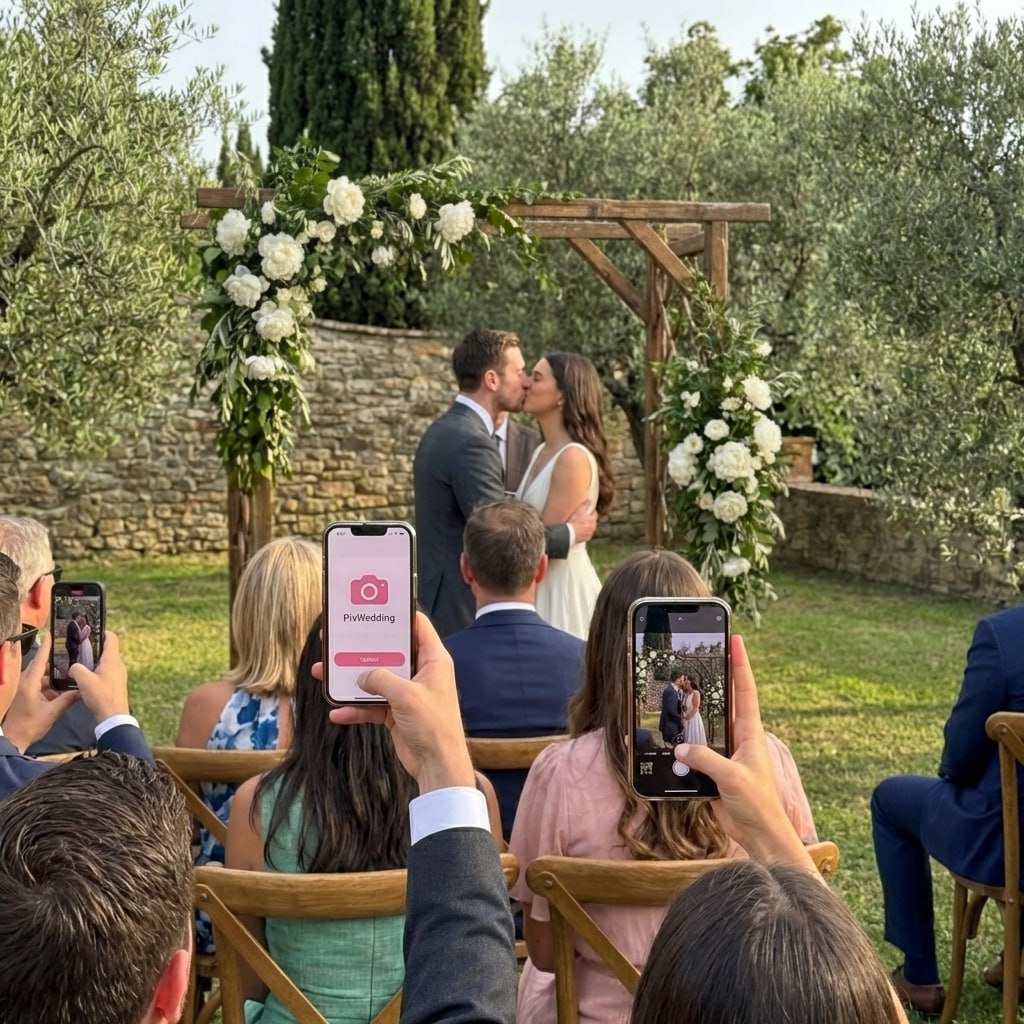
Put a QR code on the programs and the guests on the aisle add their photos of the family entrance to one album. No app and no account needed.
Scan to join the album
No app, no account
UPLOADING
Saving your moment
THE ALBUM
Emma & Jack
June 21, 2026
647 photos · 95 guests

What if the groom's parents are divorced?
The rule of thumb: his mother keeps the first row unless the groom decides otherwise, and nobody has to walk past an ex to get to a seat. The rest depends on how well everyone gets along.
Divorced, on good terms
Walk in togetherShare row one, with new partners beside them if everyone is comfortable.
Divorced, and it's tense
Separate walksMother and her partner keep row one. The father sits a few rows behind.
Both parents remarried
Two couples, two rowsMother and stepfather in row one, father and stepmother in row two.
Raised mainly by his father
Flip the orderThe parent who raised him takes row one and the last escorted walk.
| If | Then |
|---|---|
| Parents divorced and get along | They can walk in together and share the first row, with new partners beside them if everyone is comfortable. Ask both, separately. |
| Divorced, and things are tense | Emily Post's guidance for divorced parents: the mother and her partner in the first row, the father a few rows behind. Applied to the groom's side, she keeps row one. |
| Both have remarried | One common setup: mother and stepfather in row one, father and stepmother in row two. Each couple walks in separately. |
| The groom was raised mainly by his father | Flip it. The parent who raised him takes the first row and the last escorted walk on his side. |
| Each parent is escorted separately | Seat the second-row couple first and the first-row couple last, so nobody walks past the other to reach a seat. |
| One parent will not attend if the other does | That is a conversation for the groom, not a seating problem. Settle it months ahead, not at the rehearsal. |
The divorced-parents seating comes from the Emily Post Institute, which describes it for the bride's parents; the groom's side follows the same logic. Checked 27 September 2026.
Where does the groom's stepmother walk and sit?
She is family, and she is also not the mother of the groom on the program. Most of the tension disappears once both women know the plan in advance.
She walks with the father of the groom
The stepmother usually comes in on her husband's arm, or both are escorted in together, before the groom's mother.
Second row is not a demotion
Row two, right behind the groom's mother, keeps her close to the front and out of a comparison.
If she raised him, say so
Inside Weddings notes a biological parent and a stepparent can both escort. A stepmother who raised the groom can have her own escorted walk.
Tell his mother first
The mother of the groom should hear the plan for the stepmother from her son before anyone else, not from the seating chart.
Two parents, one walk
Inside Weddings points out that a biological parent and a stepparent can both be part of an escort. It is written about walking the couple, but the same idea works for a groom who wants his mother and stepmother to both feel included in the entrance.
Who walks a widowed mother of the groom?
The walk can be the hardest minute of the day for her. The right escort is whoever steadies her, and the right memorial is the one she agrees to.
Her son walks her
The most common choice when the father of the groom has died: the groom walks his mother in, then takes his place at the front.
Another child or her brother
A daughter, another son, her own brother or a grandchild. Choose the person she would lean on at a family funeral.
A seat saved beside her
A flower or a small framed photo on the chair next to hers. It sits quietly in the first row without anyone needing to explain it.
A line from the officiant
One sentence naming him before the vows. Agree on the wording with her first, some mothers would rather it stay private.
Something of his, carried
A photo charm on her bouquet or wrist corsage, or his ring on a chain. Small, and easy for her to hold.
Or no walk at all
Some widowed mothers prefer to be seated before the family entrances begin. Ask her which she wants, and take the answer as final.
If walking the aisle is hard for her
A wheelchair, a walker, a bad knee or a long uneven lawn should never decide whether she has a moment. Change the route, not the honor.
Wheelchair users
The escort walks beside her while whoever she trusts pushes, or she wheels herself with the escort alongside. Take the end seat out of row one so she sits in the row, not in the aisle.
A cane or walker
Shorten the walk: bring her in through a side door to row one, or seat her before the family entrances. The walk is a tradition, not a requirement.
Aisle width
The 2010 ADA Standards set 36 inches as the minimum clear width for an accessible route (section 403.5.1). A useful number to give your venue when they set the chairs.
Ushers are there for this
Emily Post lists it as an usher duty: "Be on hand to assist any guests who are infirm or disabled." Name one usher for her.
A chair under the chuppah
In Jewish ceremonies the parents usually stand for the whole service. Put a chair under the chuppah if standing is hard for her.
Grass, sand and runners
Fabric runners on grass catch wheels, canes and heels. Ask the venue for a firm path or boards under the runner for an outdoor aisle.
Scan. Upload.
Every aisle photo.
The guests on the aisle catch the moment she walks in from angles your photographer cannot. Watch how a guest scans the QR code on the program and adds photos from the phone browser in seconds, no app and no account.
WEDDING ALBUM
Maya & Daniel
Example album
Row one, right side
From the aisle seats
Her walk, from every seat in the room
Put one QR code on the ceremony programs and every guest can add the photos and videos they took of the processional, straight from the phone browser with no app and no account. The first 20 uploads are free, no card.
From Aunt Lena
Scan to join the album
No app, no account
UPLOADING
Saving your moment
THE ALBUM
Maya & Daniel
Example album
647 photos · 95 guests
SCAN TO TRY
pix.wedding/
your-wedding
How to rehearse the mother of the groom's walk in eight steps
Most entrance mix-ups are decided the night before. Run these at the rehearsal, with her there, and the day takes care of itself.
- 01
Confirm her escort
Decide who walks the mother of the groom, ask them properly, and make sure the father of the groom knows where he goes too.
- 02
Walk it with the real music
At the rehearsal, play her own seating song and walk the full aisle at her pace. Adjust the song or the start point if it runs short.
- 03
Mark her seat
Put a reserved card on row one of the groom's side: right in most Christian ceremonies, left in Jewish ones. Mark the stepparent row too if there is one.
- 04
Decide what she carries
Flowers or a clutch go in her outside hand, so the arm on her escort's side stays free.
- 05
Plan the escort's route afterwards
An usher goes back for the mother of the bride. A groom goes to the front. Walk that part too.
- 06
Give the order to one person
Write the family entrance order with names and hand it to the coordinator or the officiant, whoever runs the door.
- 07
Tell the photographer
Her walk is a shot on the list, and so is the moment she sits. Name her escort so they know who to follow.
- 08
Pick her waiting spot
Somewhere near the entrance but out of the guests' view, so she is not mingling in the aisle when the music changes.
Writing the officiant's cues? The free ceremony script generator drafts the whole ceremony, including where the family entrance sits.
Put "mother of the groom walks in" and "mother of the groom seated" on the photographer's shot list as two separate moments.
Four things to say before the day
Illustrative wording, swap in your own names. The goal is that nobody learns their part from the program.
The groom asking his mom
Asking a groomsman to escort her
Telling divorced parents the plan
A widowed mother
Seven entrance mistakes families make
Nobody told the escort
The groomsman finds out at the door. Name him at the rehearsal and point him at her.
The wrong side in a Jewish ceremony
The groom's family sits on the left facing the chuppah, the reverse of most church weddings. Reserved cards prevent the mix-up.
Seating the bride's mother first
The mother of the bride is seated last by tradition. Swapping them sends a message neither family meant.
No music cue
She starts walking over chatter and half the room misses it. Give her walk its own cue.
Leaving the father of the groom stranded
If the groom walks his mother, somebody needs to tell his father whether he walks too or is already seated.
Making one ex walk past the other
Seat the back rows first and the front row last, so divorced parents never cross paths in the aisle.
Assuming she wants the spotlight
Some mothers love the walk, others dread it. Ask before you plan it.
After she sits, the day keeps going
This page ends when she reaches row one. These pick up from there.
The mother of the groom's entrance in five lines
If you remember five things about walking the mother of the groom down the aisle:
- An usher or groomsman is the traditional escort; the groom, the father of the groom, another child or walking alone all work
- She walks after the grandparents and before the mother of the bride, who is seated last
- She sits in the first row on the groom's side: right at most Christian ceremonies, left at Jewish ones
- At a Jewish wedding she usually walks the groom in with his father, then stands under the chuppah
- Rehearse it with the real music and tell every escort their job the night before
Tradition vs what families do now
The 1922 version is precise: the head usher walks her in, the groom's father follows alone, and the usher goes straight back for the bride's mother. Formal church weddings still run close to that.
Most weddings today loosen it. The groom walking his mother is a popular choice, blended families adjust the rows, and couples who skip sides still reserve the front for both mothers. The order around her rarely changes: grandparents first, the bride's mother last.
Explore more free wedding tools
Everything you need to make your wedding day stress-free and unforgettable.
Seating Chart Planner
Plan your reception seating visually.
Guest List Manager
Track RSVPs and dietary needs.
Budget Allocator
Turn your total into a category-by-category plan.
Venues by State
Explore venues across all 50 states.
Countdown Timer
Count down the days to your big day.
Wedding Checklist
Month-by-month planning checklist.
Bachelorette Party Games
15+ games with rules, supplies, and timing.
Alternative to Wedding Guest Book
15 creative alternatives guests enjoy.
Questions about the mother of the groom's walk
Escorts, timing, seating and the exceptions: short answers with sources.
By tradition an usher or groomsman escorts her, with the father of the groom walking just behind; in Emily Post's 1922 wedding the head usher does it. Today the groom often walks his mother in himself, or she walks with the father of the groom, her partner, another of her children, or alone. In Jewish ceremonies she usually walks the groom in, with his father on the other side.
He can, and many do. The groom walks his mother to the first row on his side, seats her, and then goes to his place at the front before the mother of the bride is seated. It works best when the groom is not already standing at the altar, so plan his route at the rehearsal.
After the grandparents and just before the mother of the bride, near the end of guest seating and before the processional music starts. In a Jewish processional she walks later, with the groom, after the groomsmen and best man.
The mother of the groom. The mother of the bride is traditionally the last person seated before the processional, which is why Emily Post's 1922 order has the usher go straight back for her after seating the groom's parents.
In the first row on the groom's side. At most Christian ceremonies that is the right side as you face the front, per the Emily Post Institute. At Jewish ceremonies the sides are reversed, so the groom's family sits on the left facing the chuppah, and his parents often stand under the chuppah instead.
Yes. There is no rule that she needs an escort. Some mothers prefer walking alone, especially at small or second weddings. Give her walk a clear music cue so guests know to turn and look.
Usually her partner, if she has remarried, or an usher, the groom, or another of her children. The Emily Post Institute's seating advice for divorced parents puts the mother and her partner in the first row and the father a few rows behind; if both remarried, a common setup is mother and stepfather in row one and father and stepmother in row two.