
What it feels like to wake up to your wedding album
Coffee. A quiet chair. The album already sitting there from the night before. And somewhere inside it, one photo neither of you knew existed until this exact moment.
Details drawn from real, anonymized weddings on our platform.
"We came downstairs, made coffee, and just sat with the album for a while before either of us said anything. Somewhere in there was a photo we had never seen a guest take. We do not even know when it happened."
A composite reflection representative of patterns we see across real weddings on our platform, not a verbatim quote from any single couple.
The morning nobody plans for
Every wedding has a schedule. The morning after does not. There is no vendor arriving, no timeline to hit, no photographer waiting for a specific pose. For most couples, it is the first unstructured hour since the engagement itself.
That unstructured quality is exactly why it becomes the moment the album gets opened for real. During the wedding, a couple is inside the day, not watching it. They are greeting people, being seated, being directed from one photograph to the next. There is no room, in the middle of your own wedding, to sit back and look at what everyone else was seeing.
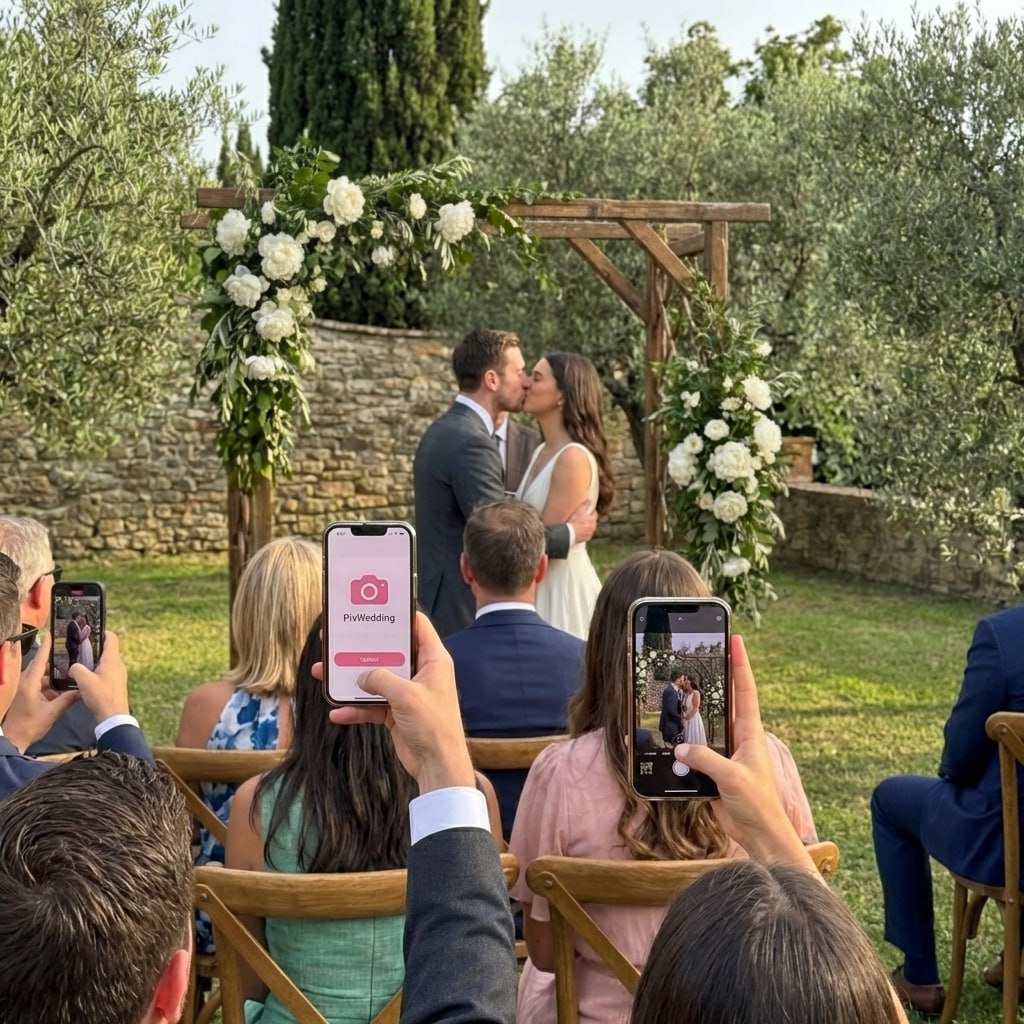
The next morning is different. Coffee gets made properly instead of grabbed on the way somewhere. A phone gets picked up not to check messages but to open one specific link. And for the first time since the ceremony, the couple sees their wedding from outside their own experience of it, through however many guests happened to be standing nearby with a camera in hand.
Across the accounts we see repeated on the platform, this sequence shows up again and again with small variations. Sometimes it is one person scrolling while the other sleeps in. Sometimes it is both of them, shoulder to shoulder, taking turns holding the phone. The setting changes. The shape of the moment does not: a couple, a quiet room, and an album that filled itself in without either of them watching it happen.
What makes it land emotionally is the contrast with the day itself. The wedding day is loud, fast, and full. The morning after is slow, small, and private. The album does not change between those two moments. What changes is the couple's ability to actually see it.
The photo neither of you knew about
Almost every account we hear describes some version of the same discovery: scrolling through a full album, mostly familiar, mostly expected, and then stopping on one image that is neither. Not a posed shot. Not a moment either half of the couple remembers being photographed for. Just something that happened, that a guest happened to see, and that neither of them knew had been caught at all.
It could be almost anything. A parent's face for one unguarded second before composing it again for the room. Two people who had not spoken in years, caught mid-laugh at a table nobody was supposed to be watching. A hand held a beat too long. None of these are dramatic. That is precisely what makes them land. They are ordinary, private, and completely unrehearsed.
A couple cannot photograph their own blind spots. They are, by definition, at the center of their own wedding, which means there are entire angles of the day they were never positioned to see. A guest standing slightly off to the side, not performing for anyone, not managing a room, is sometimes the only person who could have caught it.
This is not a claim that guest photos are better than professional photography. It is a narrower, more specific claim: guests occupy positions in the room that the couple themselves cannot occupy, because the couple is busy being the couple. Whatever a guest happens to notice from that position is something the couple could never have caught on their own, no matter how skilled their photographer was.
The photo itself is rarely technically perfect. It is often slightly off-center, sometimes a little blurred, occasionally taken at an angle that makes no particular sense. None of that matters once the moment inside the frame is recognized. Technical polish is not what makes this photo the one. Surprise is.
The feeling, and the data behind it
We keep a separate page that answers this same question with numbers instead of a scene: how big is the morning-after wave, exactly, and how does it compare to every other hour of the wedding weekend. That page exists because the feeling described here is real, but a feeling is not a dataset, and readers deserve both.
If you want the honest emotional version of what the morning after tends to feel like, this is that page. If you want the hour-by-hour curve across 203 real weddings, the percentage of uploads that land on the wedding day itself versus the day after versus later, and the full methodology behind those figures, that lives on our morning-after data page.
The two pages are meant to be read as a pair, not as duplicates of each other. This page is about the single, human-scale moment: a couple, a chair, a coffee, one photo. The data page is about the aggregate shape of that same pattern repeated across hundreds of weddings, with the percentages, the caveats, and the honest limits of what our own dataset can and cannot show.
A note on how this page is built
An earlier version of this URL described a single named couple, a specific city, a specific date, and a specific photo count. We audited that version and could not verify any of those details against a real, consenting source. Rather than leave invented specifics online because they read as convincing, we rebuilt the page around what we could actually stand behind: a real, repeated pattern in our own anonymized platform data.
We think that trade-off is worth making even though a specific name and date are, on the surface, more compelling than a composite. A fabricated specific is not more true for being specific. It is just more convincing while being false. A pattern drawn honestly from real data is less colorful, and it is the thing we can actually defend if anyone asks us to.
If you came looking for a single tidy story with a name attached, we understand the disappointment. What is here instead is something we can actually stand behind a year from now, which mattered more to us than keeping a more colorful version online.
What a guest can catch that a hired photographer structurally cannot
This is not a case against professional photography. It is a plain description of what one person, however skilled, can and cannot physically be present for during a single wedding day.
| What worked | What it cannot replace |
|---|---|
A hired photographer covering the planned moments of the day | Being in every corner of the venue at the same time |
A guest catching something small and unplanned nearby | Guaranteeing any specific moment gets caught by anyone |
An album that keeps filling in overnight as guests upload | Replacing the intentional, technical skill of professional coverage |
The couple discovering a photo they never knew was taken | Being scheduled, briefed, or planned in advance |
A quiet morning where the day is handed back to the couple | Happening if nobody made it easy for guests to upload in the first place |
A day, handed back
There is a specific kind of loss built into being the person the wedding is for. The couple experiences their own day only from the inside: their own nerves, their own vantage point, whatever they happened to be looking at during each moment. Everything else, everything that happened just outside their line of sight, is simply gone from their own memory of the day.
An album filled by guests is one of the only mechanisms that gives some of that back. Not all of it. Not a replacement for having lived the day. But a genuine widening of what the couple gets to know actually happened at their own wedding, seen from angles they were never standing in.
That is the quiet, underlying reason the morning-after moment carries weight far beyond what a photo count would suggest. It is not about the number of images. It is about a couple discovering, over coffee, that their wedding was bigger and fuller than what either of them personally witnessed. The album hands the day back to them in a form neither of them could have captured alone.
This is also why the timing matters so much. Receiving that same discovery weeks later, once the professional photos arrive polished and curated, is a different experience entirely. It still matters, but the rawness has settled by then. The morning-after album arrives while the day is still vivid, while the couple is still, in some sense, inside it. That proximity is part of what makes the single photo hit as hard as it does.
What a single morning cannot tell us
We are describing a pattern, not a proof. We cannot tell you that every couple experiences a morning like this, or that a specific photo is waiting in every album. What we can say is that this sequence, coffee, a quiet room, one surprising photo, shows up often enough across real, anonymized accounts on our platform that it stopped feeling like an outlier.
We also cannot tell you which photo it will be, or whether it will be dramatic or small. Based on the patterns we see, it is usually small. A glance, a laugh, a hand on a shoulder. The moments that matter most rarely announce themselves in advance, in an album or anywhere else.
What we did not do here is invent a named couple, a wedding date, or a headline photo count to make this feel more concrete. Doing that would make the page read more like a testimonial and less like what it actually is: an honest description of a repeated pattern, built from real anonymized data, not a single verified individual's story.
If you want the closest thing we have to hard proof that this pattern is real and not just a nice story, it is the timing data itself. Guest uploads do not taper off after the wedding day, they spike again the day after, which is consistent with exactly the kind of morning described here: guests waking up, looking through what they shot, and finally uploading it.
From ceremony to coffee: the rough shape of a day
No two weddings follow the exact same clock, but the broad shape repeats often enough to describe in general terms.
- 1
During the ceremony and reception
Guests are shooting constantly, but few stop to upload. Phones stay in pockets, or photos stay in the camera roll until there is a break.
- 2
Late in the night
The first uploads start landing as the room thins out. This is when a guest, winding down, finally opens the link and shares a handful of shots from earlier.
- 3
Overnight
The quietest stretch. Most guests are asleep, and the album grows slowly if at all.
- 4
The next morning
The biggest single wave. Guests wake up, scroll through what they shot, and upload once they have a spare minute, often before the couple is even awake.
- 5
Coffee, that same morning
The couple opens the album for the first time as something to sit with rather than something to manage. This is where the one unexpected photo tends to get found.
How to give your own morning-after moment better odds
None of this can be guaranteed. But the odds of a guest catching something worth finding the next morning go up considerably when the upload path is easy, visible, and open the whole day, not just during the reception.
- 1
Share the album link before the wedding starts, not after.
Guests upload what is easy to find. If the link only appears once, printed small on a table card discovered halfway through dinner, most of what guests shot never makes it into the shared album at all.
- 2
Put a QR code somewhere guests naturally look, more than once.
One sign at the entrance is easy to miss. A code on the welcome table, another near the bar, another on the reception tables, means the guest who forgot at 6pm has another chance at 9pm.
- 3
Make the upload path work from a browser, no app required.
Every extra step between a guest noticing something worth photographing and that photo landing in the shared album is a place where the upload quietly does not happen. A link that opens straight to an upload screen removes that friction.
- 4
Do not check the album on the wedding night itself.
Uploads are still trickling in, guests are still awake, still shooting, still adding more. Checking too early means seeing a half-finished album and forming an impression before the fuller picture has arrived.
- 5
Make the morning-after look genuinely quiet on purpose.
A slow breakfast, phones mostly down, coffee made properly instead of grabbed on the way out, gives the album its best possible audience: two people who are actually present enough to notice the one photo that matters.
What this does not require
It does not require a lavish venue, a destination location, or a particular kind of wedding. The pattern we are describing has nothing to do with scale or setting. It requires guests who are present, phones that are already in most pockets anyway, and a place for whatever they catch to actually land instead of staying trapped in a personal camera roll that the couple will never see.
It does not require a large guest list either. A morning-after album with a handful of uploaders can hold exactly the same kind of unexpected photo as one with dozens. What determines whether the moment gets caught is not the size of the crowd, it is whether at least one person who cares was standing in the right place with an easy way to share what they saw.
And it does not require the couple to do anything on the day itself beyond making the link easy to find. The best version of this moment happens precisely because the couple was not managing it. They were living their wedding. Someone else, quietly, was catching the parts they could not see.
Why the file quality behind that one photo matters
The moment a couple finds the photo that matters, the next instinct is almost always to zoom in. To look closer at the face in the background, to check who is holding whose hand, to see the detail that made the photo worth stopping on in the first place. That instinct only rewards the couple if the file behind it can actually hold up to being zoomed into.
When a guest sends a photo through a messaging app instead of uploading it to a shared album, it is often compressed automatically on the way. Many messaging apps quietly shrink images to a fraction of their original resolution. A modern phone camera captures far more detail than that. The gap only becomes visible later, when someone tries to print the photo or view it larger than a phone screen and the detail simply is not there anymore.
A shared album that preserves the original upload matters most for exactly this one photo, the one nobody planned for and nobody would think to re-shoot. Every other photo in the album is, in some sense, replaceable. This one is not. If the file has already been compressed down before it reaches the couple, there is no way to get that resolution back.
This is a quiet, unglamorous detail compared to the emotional weight of the moment itself, but it is the difference between a photo that stays on a phone screen and one that eventually gets printed and framed. The feeling of discovery happens the morning after. Whether that discovery survives being looked at closely, months or years later, depends on a much less romantic decision made long before the wedding: which upload path the couple set up for their guests.
Does wedding size change whether this moment happens?
Guest count changes the scale of the album. It does not appear to change whether a moment like this shows up, based on the patterns we see across weddings of very different sizes on the platform.
Intimate wedding (a few dozen guests)
Fewer total uploaders, but each one tends to be someone close to the couple. What they catch is more likely to carry personal weight because they know the people in frame, not just the event.
Mid-size wedding (roughly 50 to 120 guests)
More total photos, more vantage points, and a wider spread across the venue. The odds that at least one guest was standing in the right corner at the right second go up simply because more corners are covered.
Large wedding (100+ guests)
The biggest albums, but also the most noise to scroll through before finding the one photo that matters. The morning-after moment still happens, it just takes a little longer to find.
What stays constant across all three sizes is the underlying mechanism: a guest who cares, standing somewhere the couple was not, with an easy way to share what they noticed. A bigger wedding does not manufacture more of that. It just gives more people the chance to be that guest.
Questions worth sitting with before your own wedding
None of these have a right answer. They are worth thinking through anyway, if the moment described on this page is something you would want for your own morning after.
Who at your wedding notices what nobody else does? Every guest list has at least one person like this, and they rarely need to be asked twice to share what they saw.
Where are the corners of your venue your photographer's shot list will not cover? Every venue has hallways, gardens, and side rooms that fall outside a planned itinerary.
Will your morning after be quiet enough to actually notice a photo like this? A rushed departure for a flight the next morning gives the album far less room to be discovered properly.
Have you made it embarrassingly easy for guests to upload, or just theoretically possible? A link mentioned once during a toast is not the same as a code sitting on every table.
What would it mean to see your own wedding from an angle you were never standing in? That is the honest promise of a guest-filled album, not more photos, but more of the day.
Are you the kind of couple who checks the album at midnight, or the kind who waits for coffee? Neither is wrong, but the second tends to be where this exact moment happens.
Related reading
The feeling described on this page is one specific angle of a much bigger, data-backed pattern. These pages go deeper into the numbers behind it.
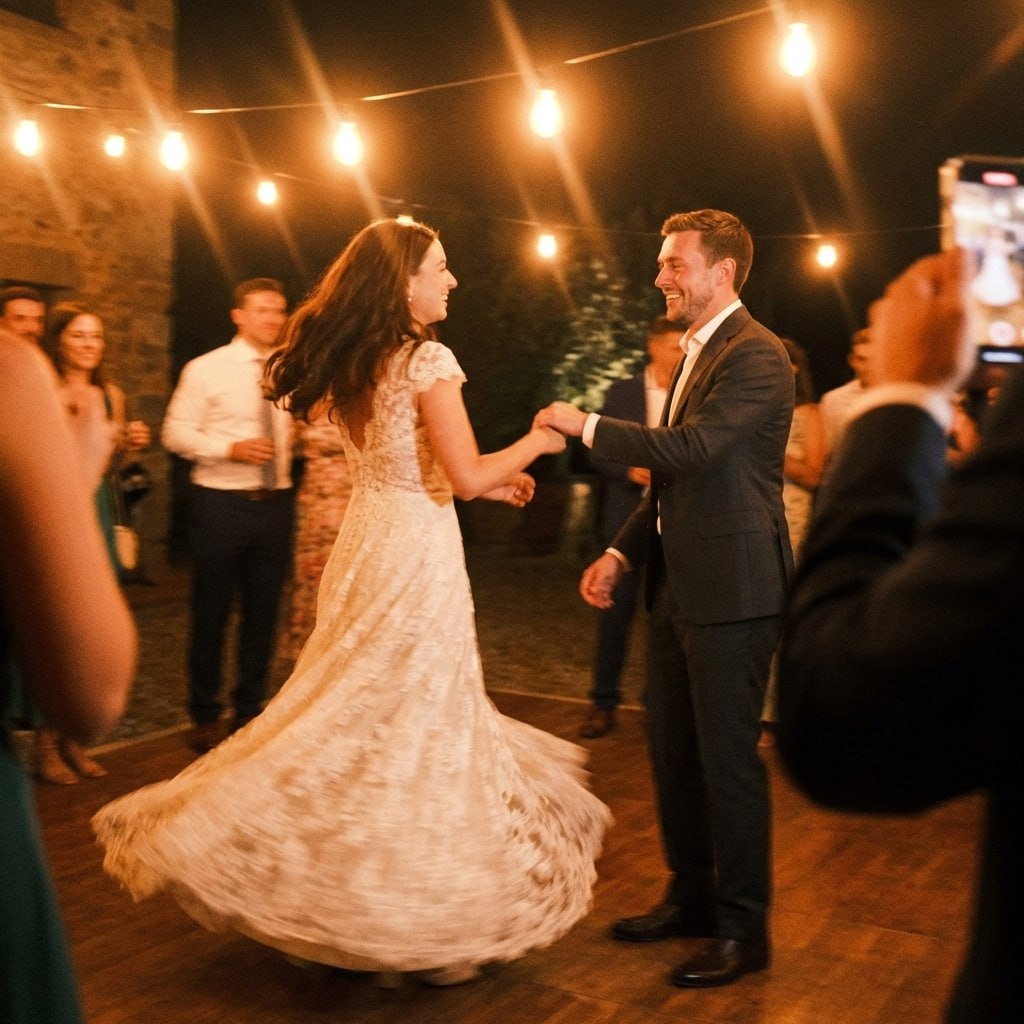
First dance
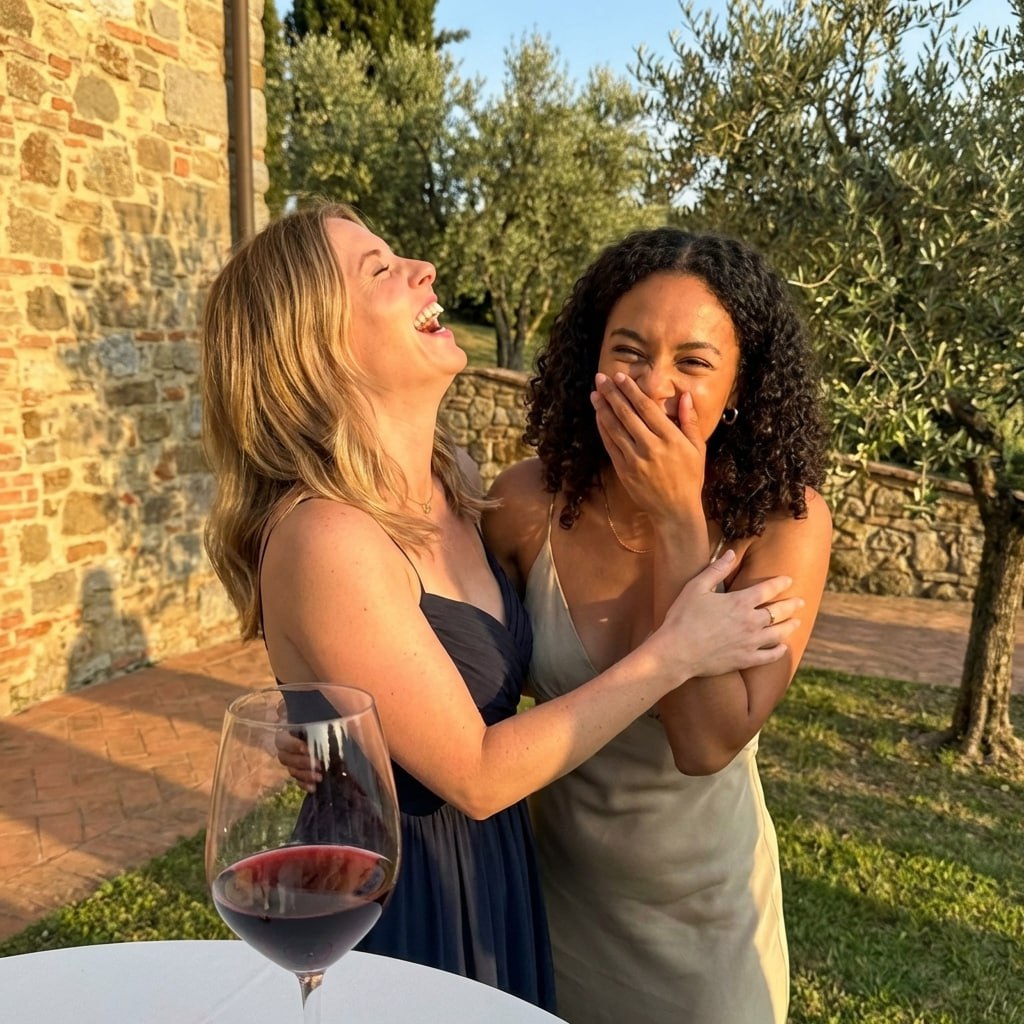
You guys!!
Wake up to the photos your guests took
Free to start, no app for guests. The morning after, the album is already waiting.
From Mom
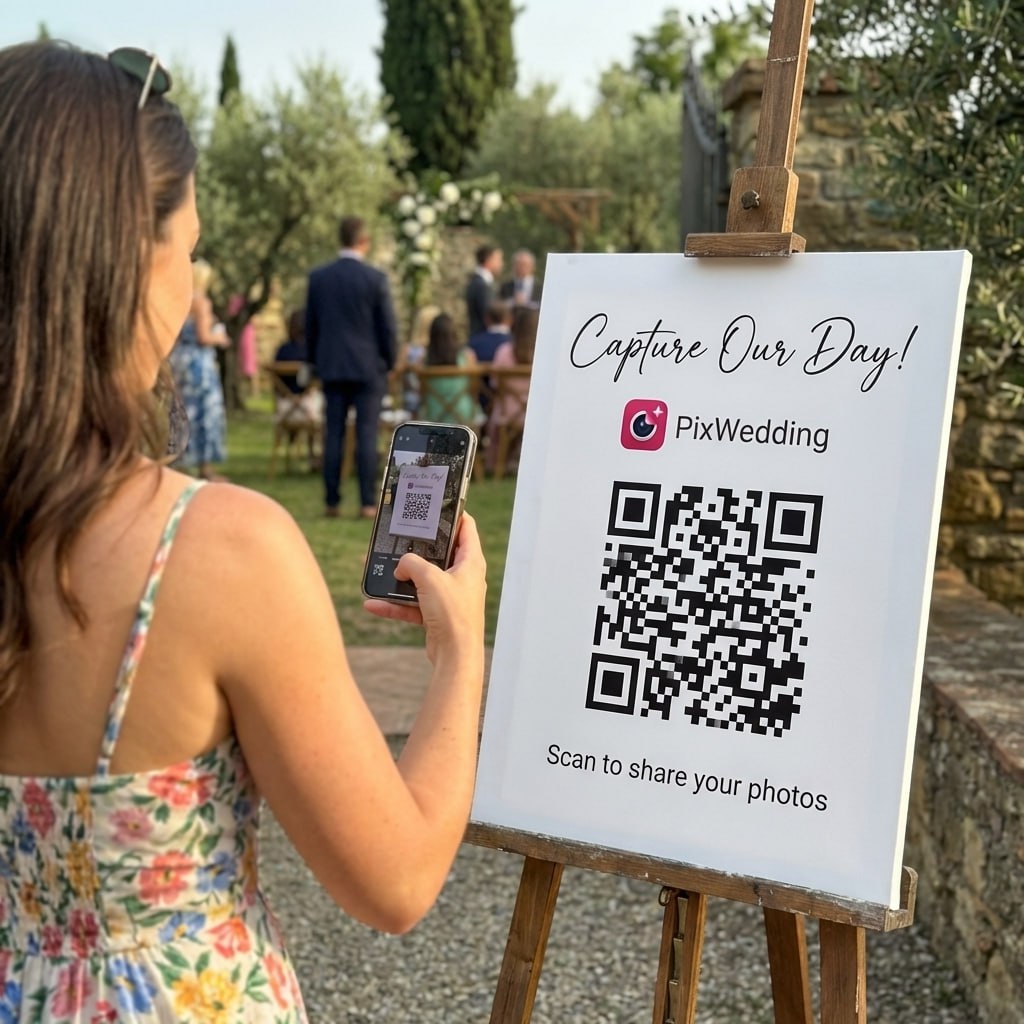
Scan to join the album
No app, no account
UPLOADING
Saving your moment
THE ALBUM
Emma & Jack
June 21, 2026
647 photos · 95 guests
SCAN TO TRY
pix.wedding/
your-wedding
An unedited album, on purpose
Part of what makes the morning-after album work is that nobody has curated it yet. Every photo a guest uploaded overnight is still in there, unsorted, unedited, in whatever order it arrived. Some of it will be forgettable. A few will be blurry, duplicated, or taken at an angle that makes no sense out of context.
That lack of curation is exactly what makes the discovery feel real rather than staged. Nobody selected the one photo that matters and placed it at the top for the couple to find. It is sitting in the scroll order among everything else, waiting to be noticed the same way a guest would notice it: by accident, mid-scroll, over coffee.
Eventually, most couples do sit down and choose a smaller set of favorites for a printed book or a frame. That editing happens later, deliberately, once the emotional discovery has already occurred. The morning after is not that editing session. It is the raw, unfiltered first look, and that rawness is part of what gives it weight.
That is also why we would rather leave this page as a described pattern than dress it up as one tidy, curated story. A curated story picks the best details and smooths the rest away. The real version, like the real album, is a little messier than that, and the messiness is part of what makes the one photo, when it turns up, feel earned rather than staged.
Watch: How a QR Code Turns Into a Shared Wedding Album
Source: QR Code Generator, "QR Code for Wedding Pictures: Share & View Guest Photos."
Why the morning-after moment keeps showing up in real accounts
Across the weddings we see on the platform, one pattern repeats often enough that it stopped feeling like a coincidence. The wedding day itself is a blur for most couples: greetings, timing, a hundred small logistics happening at once. The morning after is the first slow moment. It is the first time a couple sits with the day rather than runs through it.
That is also, structurally, the first time most couples actually look at what their guests photographed. Not because guests were slow to upload, but because the couple was busy being the couple during the wedding itself, and the album is easiest to sit with once there is coffee, a chair, and nowhere else to be.
What this page is, and what it is not
This page describes a composite pattern, not a single verified couple's story. We built it this way on purpose. A specific named couple with an invented date and an invented number would be easy to write and easy to make sound convincing, but it would not be true, and we would rather describe a real, repeated pattern honestly than dress up a fabricated one.
Where we cite a number, it traces back to our own aggregated, anonymized platform data, the same dataset behind our guest photo upload statistics page. We link out to that page and to our timing data page rather than repeating every figure here, so nothing on this page drifts out of sync with the source numbers.
Explore more free wedding tools
Everything you need to make your wedding day stress-free and unforgettable.
QR Sticker Designer
Design custom print-ready stickers.
Hashtag Generator
Create unique wedding hashtags.
How to Collect Guest Photos
5 methods ranked by participation rate and ease.
Share Wedding Photos with Guests
Compare every sharing platform by ease and participation.
Best Way to Get Guest Photos
The single method with the highest participation rate.
How to Make a Shared Wedding Album
Step-by-step setup for every platform.
Alternative to Disposable Cameras
Better, cheaper options than disposable cameras.
Alternative to Wedding Photo Booth
5 cheaper alternatives to a $1,000+ photo booth rental.
Questions about the morning-after album moment
Straight answers to the questions people ask most about this topic.
Neither, exactly. This page is an anonymized composite drawn from patterns we see across many real weddings on the Pix Wedding platform. We are not naming a specific couple, city, or date, because doing so would mean either fabricating details or exposing a real couple's private wedding without consent. The moment described, waking up to an album a guest quietly filled overnight, is a pattern we see repeated across real accounts, not a single invented story.
Across 203 real weddings on the Pix platform, the median album lands at 149 photos from 8 unique guest uploaders, with an average of 197 photos. By the morning after, a large share of that total is typically already sitting in the album, because guests keep uploading late into the night and again first thing when they wake up themselves. For the full hour-by-hour curve, see our guest photo upload statistics and morning-after data pages.
Because a wedding has more corners than any one couple, or any one hired photographer, can be in at once. The couple is at the center of their own day, greeting people, dancing, being photographed. A guest standing off to the side, not performing for anyone, sometimes catches something small and real that never crosses the couple's field of vision at all. It is not that the couple was not paying attention. It is that nobody can be everywhere in their own wedding.
The day after is the single biggest wave. In our dataset, 39% of all guest uploads land the day after the wedding itself, which is more than any other single day, including the wedding day. Guests wake up, look through what they shot the night before, and upload once they have a quiet minute. For the complete timing breakdown, see our page on when guests take the most photos.
Yes, and often more distinctly. A smaller wedding does not mean fewer meaningful photos, it usually means the few guests who do upload are close enough to the couple that what they catch tends to matter more, not less. The scale of the album changes with guest count. The odds of one guest catching something quiet and real do not depend on a large crowd, they depend on someone who cares being nearby with a phone.
This page is about the feeling of one specific kind of moment, opening the album the morning after and finding a photo you did not know existed. Our data pages exist to show the numbers behind that pattern in full: how many photos, how many uploaders, and exactly when uploads land across the full timeline. If you want the feeling, stay here. If you want the curve and the methodology, those pages are linked throughout this one.