
Getting Cold Feet Before Your Wedding? Let Us Figure This Out Together
The fact that you are searching for answers shows self-awareness, not weakness. This guide will help you understand what you are feeling and what to do about it.
Cold Feet Exist on a Spectrum
Not all cold feet are the same. Your experience falls somewhere on this range, and knowing where helps you decide what to do next.
Butterflies, excitement mixed with anxiety, occasional "what if" thoughts that pass quickly. This is completely normal and affects most engaged people.
Persistent worry that disrupts sleep or focus, difficulty feeling excited, frequent comparison to other couples. Worth addressing but rarely a sign of a wrong decision.
Consistent dread, relief at the thought of canceling, avoidance of your partner, hiding your feelings. This level warrants honest conversation and possibly professional guidance.
6 Questions to Ask Yourself
Answer honestly. There is no score or judgment. This is a framework to help you understand your own feelings.
When you picture your life 5 years from now with your partner, how do you feel?
Excited but nervous about the unknown
Uneasy or unable to picture it at all
If you could skip the wedding and just be married, would you?
Yes, absolutely. It is the event that stresses me out.
I am not sure I want to be married either.
When you think about your partner specifically, what comes up?
Love, warmth, maybe some frustration about planning
Resentment, distance, or numbness
Have you been avoiding conversations about the future?
No, we talk openly even if some topics are tough
Yes, I change the subject or shut down
Is there a specific issue driving your cold feet?
It is vague and hard to pin down
Yes, and I have been ignoring it for months
How do you feel after spending a full day with your partner?
Good. We enjoy each other even during stressful times.
Drained, relieved to be alone, or frustrated
Important: If most of your answers fall in the "likely jitters" column, take a deep breath. You are experiencing what millions of couples go through. If several answers land in the "worth exploring" column, consider speaking with a therapist or trusted advisor before the wedding.
5 Coping Strategies That Actually Help
Have "the conversation" with your partner
Choose a calm moment (not during a planning argument) and say: "I have been feeling nervous about the wedding and I want to talk about it." Most partners respond with empathy and often share that they feel the same way.
Practice grounding techniques daily
When anxious thoughts spiral, try the 5-4-3-2-1 method: name 5 things you see, 4 you can touch, 3 you hear, 2 you smell, and 1 you taste. This pulls you out of your head and into the present moment.
Challenge your catastrophic thinking
Your brain is an expert at worst-case scenarios. When a "what if" thought appears, ask yourself: "What is the evidence for this? What is the evidence against it? What would I tell a friend feeling this way?"
Separate wedding stress from relationship stress
Make two columns on a piece of paper. Label one "wedding stress" and one "relationship stress." Write down every source of anxiety. Most people find that 80% or more falls in the wedding column.
Consider a few sessions with a couples therapist
Pre-marital counseling is not a sign of problems. It is preparation. A therapist provides a safe space to voice fears, learn communication tools, and build a stronger foundation before you say "I do."
Cold Feet by the Numbers
of brides reported cold feet in the weeks leading up to the wedding
of grooms reported similar feelings, often without telling anyone
before the wedding is when cold feet typically peaks for most couples
of people whose cold feet was event-related reported it vanishing on the wedding day
engaged people say they told no one about their doubts, fearing judgment
Cold Feet Myths vs. Reality
Many people suffer longer because they believe things about cold feet that simply are not true.
Myth
Cold feet means you are with the wrong person.
Reality
Cold feet is almost always about the event or the commitment concept, not the person. It is extremely common even in the most compatible couples.
Myth
If you really loved them, you would not have doubts.
Reality
Doubt and love are not opposites. In fact, the people who feel nothing may have disengaged emotionally. Anxiety often signals how much this matters to you.
Myth
Cold feet always predicts divorce.
Reality
One study did show a link, but only between unaddressed doubts and later dissatisfaction. Couples who talked through their cold feet had similar outcomes to those who felt no doubt at all.
Myth
You should not get married if you have cold feet.
Reality
Most therapists advise the opposite: examine the cold feet, but do not automatically cancel. For event-related nerves, the wedding day itself typically resolves the anxiety.
Myth
Cold feet only happens to people who are unsure about their partner.
Reality
Many people with cold feet are deeply in love and completely certain about their partner. The anxiety is purely about the performance, the public commitment, or the life transition.
Myth
Telling your partner will scare them or hurt them.
Reality
In most cases, honesty brings couples closer. Partners who hear "I am nervous about the wedding" often say "me too" and the shared vulnerability deepens connection.
Myth
Cold feet only happens to brides.
Reality
Research consistently shows grooms experience cold feet at similar rates but are less likely to name or discuss it. Male cold feet is just as common and just as normal.
Hour-by-Hour: Your Wedding Day Calm Plan
When cold feet peaks on the day itself, having a structured plan gives your anxious mind something to follow instead of spiral through.
Wake with intention
Do not check your phone first. Take three slow breaths. Say aloud: "Today, I marry my person." Eat a proper breakfast within 30 minutes of waking.
Give your phone to your point person
Hand your phone to your maid of honor, best man, or coordinator. Vendor texts and family drama are their responsibility now. You are off-duty from logistics.
Getting-ready with a quiet playlist
Request calming music in the room. Limit people to your closest three to five. Allow yourself to be present in the rituals of getting dressed and ready rather than mentally jumping ahead.
Write a letter to your partner
Spend 15 minutes writing why you chose this person. Not vows. A private note. Read it to yourself before the ceremony. This reorients your focus from the crowd to the relationship.
Pre-ceremony breathing
Find a private corner for five minutes. Do box breathing: four counts in, four hold, four out, four hold. Repeat six times. This physiologically lowers your heart rate.
Walk toward them
As you approach the ceremony, look only at your partner. The crowd disappears when you have an anchor. Every study on public speaking anxiety confirms: a focal point reduces performance fear by up to 40%.
Reception: let it unfold
Your planning is done. Your job now is to receive the day. Accept that something small will go sideways and decide in advance that it does not matter. Imperfect weddings make the best memories.
Scripts for the Moments That Feel Hardest
Having the words ready reduces hesitation. Use these as starting points, then make them your own.
Telling your partner you are nervous
"I love you and I want you to know something. I have been feeling really nervous about the wedding, not about us, but about the day itself and everything it represents. I wanted to tell you because I did not want to carry it alone. Have you felt anything like that?"
Responding when someone asks "are you excited?"
"Yes, and also genuinely nervous. It is a big day. I think most people feel both and I am just being honest about it." (You do not owe anyone a performance of pure joy.)
Asking for space on the wedding morning
"I need 10 minutes by myself before we continue getting ready. I am fine, I just need a moment to breathe. Can you all give me a little space? I will be right back."
Grounding yourself during the ceremony if nerves spike
(Internal, not spoken aloud.) "I see you. This is the moment I have been preparing for. Breathe in. Look at their face. That is the reason I am here. Everything else can fall away."
Talking to a therapist or mentor when cold feet escalates
"I am engaged and I am having strong cold feet. It does not feel like I am with the wrong person, but the feelings are intense and I want to talk to someone objective. Can you help me understand what I am actually afraid of?"
Extended Coping Toolkit for Wedding Cold Feet
Beyond the self-assessment, these eight targeted techniques address the specific anxiety of getting cold feet before the wedding event.
Physiological sigh
Double inhale through the nose (sniff, then sniff again to fully inflate), then a long slow exhale. This deflates overinflated air sacs and rapidly activates the parasympathetic system. Use it whenever anxiety spikes suddenly.
Tell one trusted person
You do not need to announce your cold feet broadly. But telling even one person who will listen without judgment reduces the burden significantly. Secrecy amplifies anxiety. Even a brief "I have been feeling nervous" lightens the load.
The "skip the wedding" test
Ask yourself: if you could be married to this person without the ceremony, would you want that? If yes, your cold feet are entirely about the event. If no, there is something deeper to examine. Most people answer yes immediately.
Physical movement daily
Walking, running, yoga, or any movement burns off the adrenaline that fuels anxiety. Twenty minutes of walking every day during the engagement period has a measurable effect on baseline anxiety levels.
Co-write your future vision
Sit with your partner and take turns completing sentences: "In 5 years, I see us..." and "One thing I am genuinely looking forward to about being married is..." This converts the abstract "forever" into a concrete, shared, livable picture.
One or two therapy sessions
You do not need ongoing therapy. A single session with a therapist who specializes in pre-marital anxiety can provide an outside perspective that shifts everything. Many therapists offer brief consultation packages specifically for this purpose.
Read back through the best moments
Find your earliest texts, notes, or letters from early in the relationship. Read them. Your current anxious mind has access to only the present stress. Your past self recorded what made you fall in love. Reconnecting with that record counters the tunnel vision.
Name what you are afraid of, exactly
Vague anxiety is harder to address than named fear. Sit with a piece of paper and write: "Specifically, what I am afraid of is..." Fill it in as concretely as you can. "I am afraid I will lose my sense of self" is more workable than "I am just scared."
Three Real Scenarios of Getting Cold Feet Before a Wedding
Cold feet before the wedding looks very different from person to person. These scenarios show the range and what actually helped.
Lauren, 27
The Performance Anxiety Type
Lauren had zero doubt about her partner. She loved him completely. But as the wedding approached, she became consumed by one thought: 200 people staring at her. She had always hated being the center of attention and the ceremony felt like a performance she had not rehearsed for. Three weeks before the wedding, she started practicing the walk-down-the-aisle in her apartment. She ran it 40 times. By the wedding day, the muscle memory was stronger than the fear. She says she was nervous for exactly the first two seconds, then the crowd disappeared and it was just her and him.
Performance anxiety responds to rehearsal and having a focal point.
Mike, 33
The "Am I Good Enough" Type
Mike's cold feet were not about his fiancee. They were about himself. He kept thinking: she is wonderful and I am going to disappoint her. I am not the husband she deserves. This imposter syndrome about marriage is more common than people realize. He finally told his fiancee. She laughed, but kindly, and listed exactly what she valued in him. It did not fix everything instantly, but it broke the spiral. He also saw a therapist twice before the wedding. On the day, he cried during the vows, not from fear, but from relief.
Self-doubt about worthiness responds best to honest conversation and outside perspective.
Aisha, 30
The Logistics Overload Type
Aisha's cold feet were entirely practical. She was managing a 180-person wedding largely on her own, fielding texts from vendors, family, and guests simultaneously. The anxiety felt like doubt but it was exhaustion and overwhelm. Two weeks before the wedding, a friend offered to take over as day-of coordinator. Aisha handed over the contact sheet and said yes immediately. The next morning she woke up without dread for the first time in months. She realized the cold feet had been about carrying too much, not about the marriage at all.
When cold feet is actually burnout, delegating is the cure, not self-examination.
8 Reflection Prompts to Untangle the Cold Feet
Give yourself 20 minutes and a notebook. These prompts cut directly to the heart of what cold feet is usually really about.
If someone filmed my life on an ordinary Tuesday with my partner, what would I hope they saw?
Reconnects you with the day-to-day quality of the relationship, not the wedding event.
What does the version of me who regrets canceling look like in 10 years?
The regret test is a reliable clarifying tool. The answer is often immediate.
If I could describe my cold feet to my partner honestly right now, what would I say?
Writing this out often makes it easier to eventually say out loud.
Is there a specific moment in the upcoming ceremony that I am most anxious about?
Isolating the specific trigger makes it far more addressable than general "I am nervous about the wedding."
What is one thing about the wedding day that I am genuinely looking forward to?
Cold feet creates tunnel vision toward fear. This prompt forces the brain to find the counterevidence.
What would I tell my partner if they came to me saying they were nervous about the wedding?
We extend far more grace to others than to ourselves. Borrow some of it.
Have I eaten and slept adequately in the past 48 hours?
Not rhetorical. Low blood sugar and sleep deprivation dramatically worsen perceived anxiety and doubt.
What was the moment I first knew I wanted to marry this person?
Sometimes returning to the origin cuts through all the noise of the planning period.
Explore related topics
Hour-by-Hour Wedding Morning Calming Plan
Follow this schedule from wake-up to ceremony. Each hour has one specific action designed to quiet your mind and anchor you in the moment.
Wake up and drink a full glass of water before reaching for your phone. Hydration lowers cortisol faster than almost any other single action.
Write three sentences in a notebook: why you love your partner, one thing you are grateful for today, and one word you want to feel tonight.
Eat a proper breakfast, protein and complex carbs. Eggs on toast, oatmeal with nuts, or a smoothie with peanut butter. Skipping breakfast amplifies anxiety.
Take a slow shower or bath. Do 10 minutes of box breathing: breathe in for 4 counts, hold for 4, out for 4, hold for 4. Repeat until the timer ends.
Hand your phone to your maid of honor or best man. They handle all vendor questions and logistics from this point. You have no decisions left to make.
Read a handwritten note from your partner if you have exchanged them, or read old texts that remind you why you said yes in the first place.
Step outside for 5 minutes of fresh air. Feel the ground under your feet. Name five things you can see, four you can hear, three you can touch.
Gather your people for a quiet group moment. No phones, no tasks, just a few deep breaths together. Say out loud: today is going to be beautiful.
Do a final mirror check, not for flaws, but to look yourself in the eye and say your own name. You are ready. Walk out and begin the best day of your life.
"The morning of my wedding I followed a schedule like this almost exactly and it was the only thing that kept me from spiraling. Having a plan made it feel manageable." A real bride, shared after her wedding.
What to Do If the Plan Breaks Down
Even the best morning schedule falls apart sometimes. A vendor calls with an issue. Someone is running late. A family member says something stressful. If that happens, do not try to get back on the schedule. Instead, do just one thing: go somewhere quiet for 3 minutes and breathe.
The schedule is a guide, not a contract. Its purpose is to give you anchors when you feel adrift. If one anchor breaks, you still have the others. Trust the plan until you do not need to, and then trust yourself.
Remember: the people in that room are not there to watch you perform. They are there because they love you and want to celebrate with you. You could trip on the way down the aisle and every single person watching would only feel more endeared to you. The day belongs to you both, not to an imaginary standard of perfection.
Quick reminder
Cold feet and cold heart are not the same thing. One is nerves. The other is doubt. Know the difference and you will know exactly what to do next.
Last thought
Every feeling you have today, including the anxious ones, is part of the story of your wedding. Years from now, you will remember exactly how human it felt to stand on the edge of this and step forward anyway.
Six Signs Your Cold Feet Are Normal Nerves (Not a Warning)
- 1Your doubt is focused on the wedding event itself, the crowd, the attention, the pressure, rather than on your partner or your future.
- 2When you imagine being married and settled into daily life with this person, you feel calm and happy.
- 3Your anxiety increases with each planning decision and decreases on quiet evenings with your partner.
- 4You can name a specific fear (what if I cry, what if something goes wrong, what if I forget the vows) rather than a vague sense of wrongness.
- 5Friends or family who know you well are not concerned. They see you as nervous, not uncertain.
- 6Your cold feet appeared during engagement or the weeks before the wedding, not years earlier in the relationship.
First dance
You guys!!
When the nerves settle, the moments rush in.
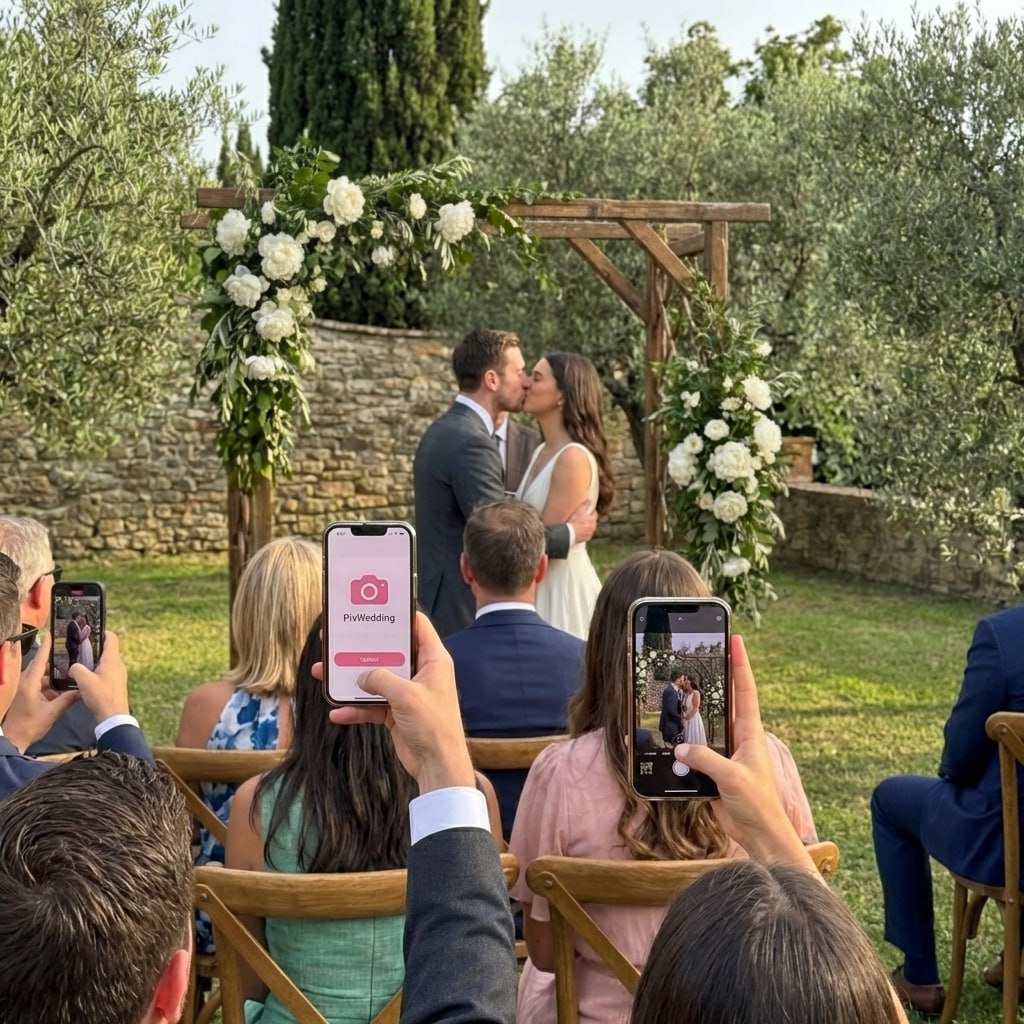
Guests scan a QR code and every photo they take goes straight into your shared album. You just show up and get married.
From Mom
Scan to join the album
No app, no account
UPLOADING
Saving your moment
THE ALBUM
Emma & Jack
June 21, 2026
647 photos · 95 guests


SCAN TO TRY
pix.wedding/
your-wedding
Why 'Getting Cold Feet' Feels So Isolating
One of the hardest parts of getting cold feet before your wedding is the loneliness. Everyone around you seems excited. Your family is thrilled. Your friends are posting countdowns. And you are sitting with a knot in your stomach wondering if something is wrong with you.
Nothing is wrong with you. The reason cold feet feels isolating is that our culture treats weddings as purely joyful events. There is no space in the narrative for doubt, fear, or ambivalence. But these emotions are normal, healthy, and experienced by nearly half of all engaged people. The silence around them is the problem, not the feelings themselves.
- •Nearly 50% of engaged couples experience cold feet but few talk about it openly
- •Social media amplifies the 'everyone is happier than me' illusion
- •Cultural pressure to be the 'happy bride/groom' makes honest expression difficult
- •Cold feet often peak 2 to 4 weeks before the wedding day
- •Talking about it with even one trusted person reduces anxiety significantly
The Timeline of Cold Feet: When It Usually Gets Better
For most couples, cold feet follows a predictable pattern. It tends to build in the weeks leading up to the wedding as final decisions are made and the reality of the event becomes concrete. It peaks around 1 to 3 weeks before the date, often triggered by a stressful planning moment.
Then something shifts. As the day approaches, the logistics settle, decisions are final, and there is nothing left to do but show up. Most people report that the actual wedding day brings a wave of calm they did not expect. Seeing their partner, being surrounded by loved ones, and finally living the moment they have been planning erases the noise of doubt.
What Therapists Say About Pre-Wedding Anxiety
Marriage and family therapists consistently report that pre-wedding anxiety is one of the most common issues they see in engaged couples. Dr. John Gottman's research, widely considered the gold standard in relationship science, emphasizes that doubt before commitment is a universal human experience, not a predictor of marital failure.
What does predict problems is avoidance. Couples who refuse to discuss their fears, who sweep concerns under the rug, or who silence their doubts to keep the peace are the ones who tend to struggle after the wedding. The healthiest thing you can do is acknowledge what you feel and work through it, whether on your own, with your partner, or with professional support.
Explore more free wedding tools
Everything you need to make your wedding day stress-free and unforgettable.
Seating Chart Planner
Plan your reception seating visually.
Guest List Manager
Track RSVPs and dietary needs.
Timeline Builder
Plan your entire wedding day.
Venues by State
Explore venues across all 50 states.
Countdown Timer
Count down the days to your big day.
Bachelorette Party Games
15+ games with rules, supplies, and timing.
Alternative to Wedding Guest Book
15 creative alternatives guests actually enjoy.
Wedding Menu Builder
Design and print your reception menu.
Frequently Asked Questions
Everything you need to know about our free tools and how they help your wedding day.
No, and actually weeks-before cold feet is the most common type. It usually coincides with final planning decisions, dress fittings, or when the wedding becomes 'real' in your mind. Cold feet weeks before the wedding is typically stress-related and tends to ease as the day approaches and logistics settle.
Ask yourself this question: 'If I could skip the wedding ceremony and just be married to this person tomorrow, would I want that?' If yes, your cold feet are about the event. If no, your cold feet are about the relationship. The first is normal. The second deserves a deeper conversation.
Escalating anxiety is your mind telling you it needs attention. Start by talking to your partner honestly. If that does not help, schedule one or two sessions with a therapist who specializes in pre-marital counseling. Getting worse does not automatically mean the wedding should not happen, but it does mean the feelings need to be addressed rather than ignored.
In almost all cases, yes. Frame it with care: 'I love you and I am excited about our future, but I have been feeling anxious about the wedding and I want to be honest with you.' Most partners respond with understanding. Hiding these feelings creates distance, which can make the cold feet worse.
One widely cited study from UCLA found a correlation between pre-wedding doubts and lower marital satisfaction years later. However, it is important to note that doubt alone was not the predictor. It was unaddressed doubt. Couples who acknowledged their fears and worked through them had outcomes similar to couples who never experienced doubt.
Completely. The engagement period is when the abstract idea of marriage becomes real. Some people experience cold feet immediately after saying yes, while others feel it closer to the wedding date. Early cold feet often reflects the magnitude of the commitment rather than a problem with the relationship.