
Cold Feet Before Your Wedding? Here Is What Is Actually Normal
In the final weeks before a wedding, doubt, restlessness, and a knot in your stomach are far more common than the wedding industry likes to admit.
The short answer
Yes, cold feet before a wedding is normal, and it is usually about the event, the attention, the finality, the logistics, rather than the relationship. Clinical psychologist Thea Gallagher of NYU Langone Health describes cold feet as a broad umbrella for the doubt, anxiety, and uncertainty that naturally shows up as people prepare for a serious commitment, and one study published in the Journal of Family Psychology found that at least one partner in the large majority of couples surveyed reported some doubts before their wedding, as reported by The Knot.
That said, not all cold feet is the same. The distinction that actually matters is whether your doubt is about the wedding day itself or about your specific partner and your shared future. Below: a comparison you can use honestly with yourself, a six-week timeline of when cold feet tends to spike and what helps at each stage, a script for the conversation with your partner, a dedicated section for grooms (who report it just as often but talk about it far less), and guidance on when the feeling is worth bringing to a professional.
Why Cold Feet Shows Up in the Final Weeks
Understanding why you feel this way is usually the fastest path to feeling better about it.
The size of the decision, not the person
Marriage is one of the largest commitments most people ever make. It is normal for the brain to flag a decision this permanent with a jolt of doubt, even when the relationship itself is solid.
The weight of being watched
Standing in front of everyone you know and performing a life-defining moment adds a layer of pressure that has nothing to do with how you feel about your partner.
Trying to picture "forever"
Permanence is genuinely hard for the brain to process. Saying "forever" out loud can trigger doubt not because you do not mean it, but because forever is abstract in a way daily life is not.
Burnout from the planning itself
Months of decisions, budgets, and logistics leave people emotionally worn down. It is easy to mistake wedding-planning exhaustion for doubt about the relationship. They usually are not the same thing.
Anxiety that spikes around big events
If you tend to run anxious in general, a wedding is exactly the kind of high-stakes event that amplifies it, independent of how sure you are about your partner.
Old wounds surfacing
If a past relationship hurt you, the vulnerability that marriage asks for can stir up old fears. That is usually your history speaking, not a verdict on the relationship in front of you.

First dance
You guys!!
One less thing to carry into the wedding.
Guests scan a QR at each table and every photo they take lands in one shared album automatically. You get to focus on the day, not on managing memory cards.
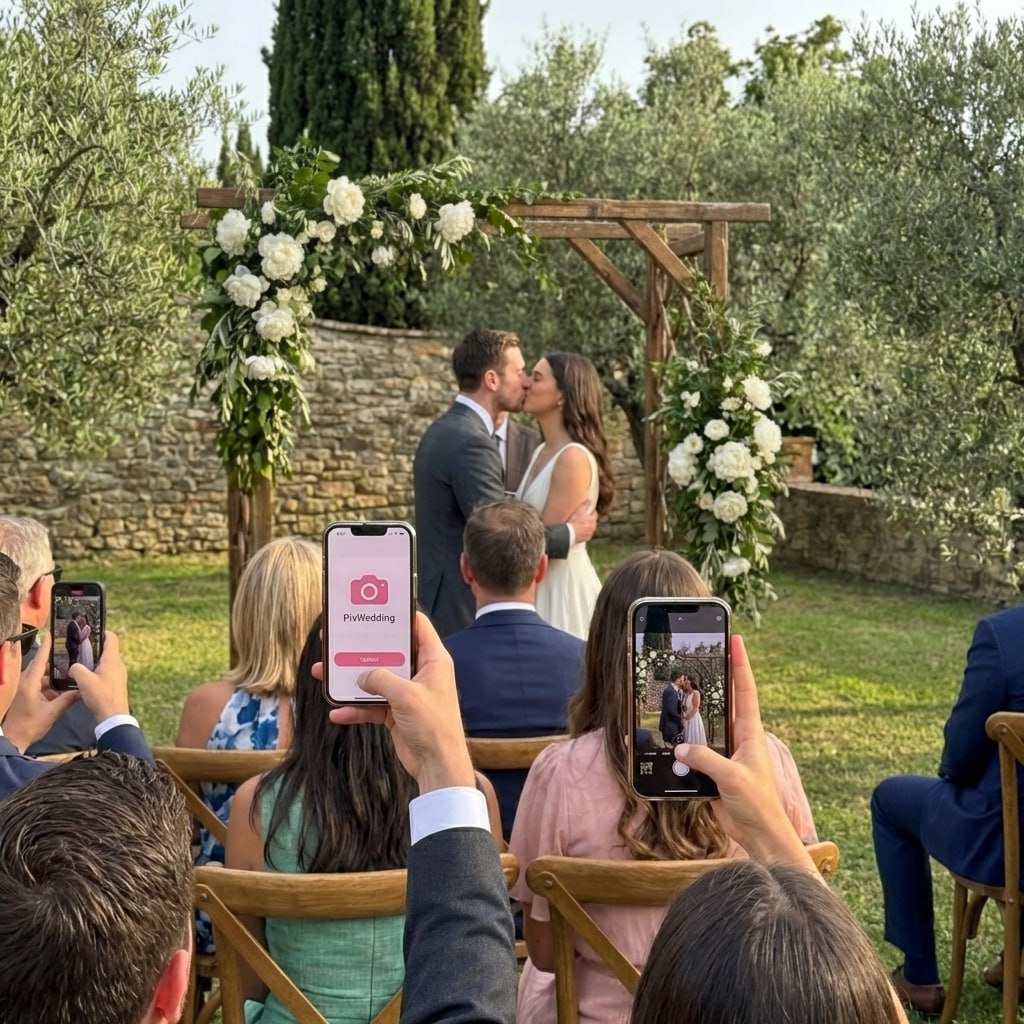
From Mom
Scan to join the album
No app, no account
UPLOADING
Saving your moment
THE ALBUM
Emma & Jack
June 21, 2026
647 photos · 95 guests


SCAN TO TRY
pix.wedding/
your-wedding
Normal Jitters vs. Signs Worth Examining
This is not a diagnosis, just a compass. Use it honestly with yourself, and treat a pattern across several rows as more meaningful than any single one.
| Usually normal jitters | Worth examining closely |
|---|---|
| Butterflies, restlessness, or a knot in your stomach that comes and goes | A steady, low-grade dread that does not lift even on good days |
| Occasional "what if" thoughts that pass within minutes | The same specific fear returning for weeks without resolving |
| Feeling overwhelmed by logistics, budgets, or family drama | Feeling numb or distant when you picture your partner specifically |
| Wanting to skip the ceremony but not the marriage itself | A flash of relief when you imagine the wedding being cancelled |
| Crying from stress, exhaustion, or plain overwhelm | Avoiding any real conversation about your shared future |
| Nerves about being the center of attention for a day | Hiding your actual feelings from your partner out of fear of the reaction |
One or two items in the right-hand column, present briefly around a specific stressful moment, rarely means anything is wrong. A consistent pattern across several of them, present for weeks and not tied to a single event, is the signal to talk to a therapist before the wedding rather than after it.
The Last Six Weeks: When Cold Feet Tends to Spike
Cold feet rarely arrives evenly. It tends to cluster around specific pressure points in the final stretch before a wedding. Knowing what is coming can make the feeling less alarming when it shows up.
The abstract becomes concrete
What is often happening: This is often when the wedding stops feeling like a distant plan and starts feeling like a real, approaching event. Final headcounts, remaining payments, and dress or suit fittings can all make the commitment feel suddenly heavier.
What tends to help: Name what is actually making you anxious in a notebook. Separating "the guest list stresses me out" from "I am scared of marriage" already does a lot of the work.
Comparison creeps in
What is often happening: Seeing other couples online, other weddings, or hearing family opinions can trigger quiet comparison: is our relationship as solid as it should be, are we doing this right.
What tends to help: Limit wedding-planning social media for a week. Comparison is rarely a fair measure of your own relationship and tends to amplify doubt rather than resolve it.
Decision fatigue peaks
What is often happening: Final vendor confirmations, seating charts, and last-minute changes pile up. Decision fatigue is real, and it can feel indistinguishable from relationship doubt when you are exhausted.
What tends to help: Hand off one entire category of remaining decisions to a partner, parent, or planner. Reducing the decision load often reduces the anxiety that gets mistaken for cold feet.
Family and money pressure surface
What is often happening: Final payments come due and family opinions can intensify. Financial stress and family tension both tend to peak here, and both can masquerade as second thoughts about the marriage itself.
What tends to help: Have one direct conversation with your partner naming the actual stressor (money, a relative, logistics) rather than letting it sit as vague unease.
The "is this really happening" feeling
What is often happening: A wave of surrealness is common here. The wedding stops being a project and starts being an imminent, personal event, which can feel disorienting even when nothing is wrong.
What tends to help: Write down one specific memory of why you said yes. Concrete memories counter the vague, floaty feeling that this stage often produces.
Performance nerves take over
What is often happening: For most people, whatever remains at this point is nervousness about the ceremony itself, being watched, saying vows out loud, not doubt about the relationship. Many describe this easing considerably once the day actually begins.
What tends to help: Keep the final 48 hours as decision-free as possible. Delegate logistics fully and protect time with the people who calm you down.
What to Say When You Need to Talk About It
Having the words ready in advance removes a lot of the hesitation. These are illustrative starting points, adjust them to sound like you.
Opening the conversation
"I love you, and I want to be honest about something. I have been feeling nervous about the wedding lately. I do not think it is about us, but I did not want to carry it alone, so I wanted to tell you."
If your partner reacts with worry
"This is not me pulling away from you. It is me trying to be honest instead of pretending everything feels effortless. I still want to marry you. I just needed to say the nervous part out loud."
If your partner says they feel it too
"Okay, that actually helps. Can we check in with each other once a week until the wedding, just so neither of us is sitting with this alone?"
If the feeling is about something specific, not just nerves
"There is something specific bothering me and I have been putting off bringing it up. Can we set aside real time this week, not the middle of planning, to actually talk it through?"
Asking for a pause without alarming anyone
"I am fine, I just need a quiet ten minutes. Can you give me some space? I will come find you after."
Researchers who study premarital doubt note that one of the most reliable ways to reduce its intensity is simply admitting it out loud to your partner rather than managing it alone. Silence tends to make the feeling grow, not shrink.
If You Are the Groom, This Part Is for You
Cold feet gets discussed as though it only happens to brides. It does not. Grooms report it at similar rates, but social conditioning around confidence and stoicism makes them far less likely to say so out loud, which is exactly why it deserves its own space here.
Provider anxiety
A sudden felt weight of financial and practical responsibility, the pressure to already have it all figured out.
Loss of independence
Not about wanting anyone else. Usually about spontaneity, solo time, or making small decisions without checking in first.
Fear of repeating family patterns
If you grew up around a rocky or absent marriage, the fear of becoming that can feel powerful even when you know you are different.
Discomfort with public vulnerability
Crying at the altar or being emotionally exposed in front of a crowd can feel uncomfortable for men raised to keep feelings contained.
If any of this sounds familiar, the practical fix is small but effective: say the actual sentence out loud to your best man or a trusted friend, "I am nervous about this," instead of joking your way past it. Suppressed nerves tend to leak out sideways, as irritability, withdrawal, or overdoing it at the bachelor party, rather than disappearing.
When It Is Worth Talking to a Professional
Most cold feet resolves on its own once the wedding day arrives. But some doubt genuinely benefits from an outside, trained perspective, and there is nothing wrong with seeking it out.
If your doubt has been persistent for weeks, is specifically about your partner or your shared future rather than the event, or comes with real distress that is affecting your sleep, appetite, or daily functioning, it is worth speaking with a licensed counselor or therapist before the wedding. This is not a sign that anything is broken. It is a sign of taking the decision seriously.
Research on premarital doubt, including the Journal of Family Psychology findings referenced above, found that doubt itself was not the strongest predictor of later dissatisfaction, leaving it unaddressed was. Couples who talked openly about their doubts, whether with each other or with a couples therapist, tended to fare better than those who stayed silent about them.
Pre-marital counseling is also a reasonable option even without a specific crisis. A handful of sessions with a therapist who works with engaged couples can give both of you language and tools that carry well past the wedding day itself.
Cold Feet Myths vs. Reality
Many people sit with this feeling longer than they need to because of things they believe about it that are not actually true.
Myth
Cold feet means you are with the wrong person.
Reality
Cold feet is far more often about the event and the size of the commitment than about the specific person you are marrying. It shows up even in strong, compatible relationships.
Myth
If you really loved them, you would not feel any doubt.
Reality
Love and doubt are not opposites. People who feel nothing at all may have already emotionally disengaged. Nervousness often signals how much the decision matters to you.
Myth
Cold feet always predicts divorce.
Reality
Research has found a link between unaddressed premarital doubt and later dissatisfaction, but the same research found that couples who talked through their doubts had outcomes similar to couples who reported none at all.
Myth
You should call off the wedding if you feel any doubt.
Reality
Most therapists advise examining the doubt honestly rather than reacting to it immediately. For event-related nerves, the wedding day itself typically resolves the anxiety without any drastic action needed.
Myth
Only people who are unsure about their partner get cold feet.
Reality
Plenty of people with cold feet are completely certain about their partner. The anxiety is about the performance, the permanence, or the life transition, not the relationship quality.
Myth
Telling your partner will scare them or ruin the mood.
Reality
In most cases, honesty brings couples closer. Hearing "I am nervous about the wedding" often gets the reply "me too," and the shared vulnerability tends to deepen connection rather than damage it.
Myth
Cold feet is mostly a bride thing.
Reality
Grooms report it at similar rates. They are simply less likely to name it out loud, which makes it look rarer than it actually is.
A Few Illustrative Scenarios
These composite examples are illustrative, not real testimonials, and are meant to show how differently cold feet can show up from person to person.
Illustrative example: the performance-anxiety type
Picture someone who has zero doubt about their partner but becomes consumed by the thought of two hundred people watching them say vows out loud. In this kind of case, rehearsing the walk down the aisle a few times in private and picking one focal point in the crowd, usually the partner's face, tends to shrink the fear considerably by the time the day arrives.
Illustrative example: the burnout type
Picture someone managing most of a large wedding alone, fielding vendor texts and family opinions daily. The anxiety looks like doubt about the marriage but is actually exhaustion. Handing the coordinator role to a trusted friend two weeks out is often the single change that resolves it, because the dread was never really about the relationship.
Illustrative example: the honest-conversation type
Picture a couple where one partner has been quietly worried about how differently they handle money. Naming it directly, weeks before the wedding rather than the night before, turns a vague anxious feeling into a specific, workable conversation, sometimes with a financial planner or counselor involved.
Six Reflection Prompts
Give yourself a few quiet minutes with each one. The goal is not to answer perfectly, just to move the feeling from vague to specific.
Is this feeling about the wedding day, or about the person I am marrying?
Separating the event from the relationship is the single most useful first question.
If I could skip the ceremony and just be married tomorrow, would I want that?
A quick yes usually points to event stress rather than relationship doubt.
What is the single, specific thing I am most anxious about right now?
Vague dread feels heavier than a named, specific worry.
When did I last feel completely certain about this relationship?
Recall something concrete, a conversation, a quiet evening, a shared decision.
Have I actually said any of this out loud to my partner yet?
Unspoken worries tend to grow. Spoken ones usually shrink.
What would I tell a close friend who described feeling exactly this way?
We are almost always kinder and clearer with others than with ourselves.
Glossary
Cold feet
Situational doubt, anxiety, or restlessness in the weeks before a wedding, distinct from a settled desire to end the relationship.
Event doubt vs. relationship doubt
The core distinction used throughout this guide: nervousness about the wedding day is common and manageable, while persistent doubt about the partner deserves closer examination.
Decision fatigue
Mental exhaustion from making too many choices in a short window, common during the final weeks of wedding planning and easily mistaken for doubt about the marriage.
Premarital counseling
A short series of sessions, often just one to a few, with a therapist who works with engaged couples, aimed at building communication tools before the wedding rather than resolving a crisis.
When You Are Ready to Celebrate, Let the Photos Take Care of Themselves
Working through cold feet is its own project. Once the day arrives and you are ready to just be present, it helps to have one less logistical thing to manage. Pix Wedding lets guests scan a QR code and upload photos straight into a shared album, so nobody, including you, has to chase down pictures after the fact.
Related: doubts, fears and cold feet
However you are feeling right now, it is valid.
Talk to your partner, give yourself permission to feel two things at once, and when the day comes, let Pix Wedding handle the photos so you can just be there.
Get Started FreeWhy Cold Feet in the Final Weeks Feels So Isolating
Part of what makes cold feet hard in the last stretch before a wedding is the timing. Everyone around you is deep in countdown mode, excited, asking about final details, assuming pure joy. There is little cultural room for admitting doubt, nervousness, or ambivalence this close to the day.
That silence is the actual problem, not the feeling itself. Cold feet in the final weeks is one of the most searched pre-wedding topics precisely because so many people experience it privately while assuming they are the only one.
- •Cold feet in the run-up to a wedding is widely reported and rarely predicts anything about the marriage on its own
- •The most common trigger is the event and the size of the commitment, not the relationship itself
- •Naming the specific worry, out loud or on paper, tends to shrink it
- •Grooms experience it at similar rates to brides but talk about it far less often
- •Unaddressed doubt, not doubt itself, is what research links to later difficulty
Cold Feet vs. Wedding-Planning Burnout
It is worth separating cold feet about the marriage from plain exhaustion caused by planning it. Months of vendor calls, budget spreadsheets, and family opinions can leave anyone depleted, and depletion often gets mislabeled as doubt about the relationship.
A useful test: picture skipping the ceremony entirely and simply being married tomorrow. If that idea brings relief, your cold feet is very likely about the event, not the partnership, and it is a solvable, temporary problem rather than a signal to reconsider anything.
What Tends to Happen on the Wedding Day Itself
For the large majority of people whose cold feet was tied to the event rather than the relationship, the feeling eases considerably once the day begins. Seeing your partner, being surrounded by people who came because they love you, and finally living the moment rather than anticipating it tends to quiet the noise that built up in the weeks before.
That does not mean the feelings along the way were not real or worth taking seriously. It means that, for most couples, the final destination resolves what the anticipation stirred up.
Explore more free wedding tools
Everything you need to make your wedding day stress-free and unforgettable.
Seating Chart Planner
Plan your reception seating visually.
Guest List Manager
Track RSVPs and dietary needs.
Budget Allocator
Turn your total into a category-by-category plan.
Venues by State
Explore venues across all 50 states.
Countdown Timer
Count down the days to your big day.
Wedding Checklist
Month-by-month planning checklist.
Bachelorette Party Games
15+ games with rules, supplies, and timing.
Alternative to Wedding Guest Book
15 creative alternatives guests enjoy.
Frequently Asked Questions
Straight answers to the questions people ask most about this topic.
Yes. Reports of pre-wedding doubt in at least one partner are common, according to a Journal of Family Psychology study cited by The Knot, and clinical psychologists describe cold feet as a normal response to the size of the commitment rather than a sign something is wrong.
Ask whether the feeling is about the wedding event, attention, cost, logistics, or about your specific partner and your shared future. Brief, event-focused nerves are common. A persistent, weeks-long pattern of dread specifically about the relationship is worth an honest conversation, ideally with a therapist.
Many couples describe it building in the final six weeks as logistics become concrete, then easing as the wedding day itself approaches and there is nothing left to do but show up. The last few days before the wedding are often more about performance nerves than relationship doubt.
In most cases, yes. Frame it around your own feelings rather than blame, for example: 'I have been feeling nervous about the wedding, not about us.' Many partners respond with relief because they have been feeling something similar and did not know how to bring it up either.
Grooms report it at similar rates to brides, but social pressure to appear confident and unbothered makes them far less likely to talk about it. The feelings themselves, provider anxiety, loss of independence, discomfort with public vulnerability, are just as common and just as normal.
If the doubt has lasted for weeks, is specifically about your partner rather than the event, or comes with distress affecting your sleep, appetite, or daily life, it is worth speaking with a licensed counselor or therapist before the wedding. Seeking that support is a sign of taking the decision seriously, not a sign of failure.