
Cold Feet Before Marriage: When the Fear Is About “Forever,” Not the Party
If picturing the ceremony does not scare you, but picturing the marriage does, you are not nervous about the flowers, the DJ, or the seating chart. You are nervous about the lifelong commitment itself, and that deserves a different kind of conversation than "wedding jitters."
Two Very Different Types of Cold Feet
The short answer: cold feet before marriage means your anxiety is attached to the idea of a permanent, legal, lifelong bond, not to the logistics of a single day. It is normal, it is common, and it is worth naming precisely rather than lumping in with generic "wedding stress." A quick test: imagine you could be married quietly tomorrow, no ceremony, no guests, no planning. If the fear disappears in that scenario, it was about the event. If it does not, it is about the marriage, and this page is written for you.
- -Anxiety about being in front of a crowd
- -Stress from vendor coordination and planning
- -Worry about things going wrong on the day
- -Financial pressure from the event cost
- -Disappears if you imagine eloping instead
- -Fear of the legal and emotional permanence
- -Worry about losing freedom or identity
- -Questioning if this is the right person forever
- -Anxiety about what marriage will change
- -Persists even if you imagine a private ceremony
If you are reading this page, you are likely in the second category. That is okay. Let us work through it, starting with a quick map of where your fear actually sits.
Decision Tree: Is It the Wedding Day, or the Marriage Itself?
Follow the branches. Each question narrows down what your cold feet is actually about, and points you toward the right next step instead of a generic "just relax."
Start here
Picture being married quietly tomorrow, with no ceremony at all. Does the fear disappear?
Yes, it disappears
Your fear is about the event, not the commitment. This is wedding-day cold feet: performance anxiety, logistics stress, or being watched by a crowd.
Next step: simplify or delegate the event, not the relationship.
Read: Nerves Before Wedding, 12 Practical Tips →No, it stays
Your fear is about the marriage itself. The next branch separates whether that fear is about your specific partner or about the idea of "forever" in general.
Is it about your partner specifically?
Concrete, specific concerns about their values, honesty, or behavior are worth examining directly, not talking yourself out of.
Read: Having Doubts Before Marriage →Or is it about the idea of "forever" itself?
If your partner feels right but the concept of a permanent, legal, lifelong bond is what triggers the fear, keep reading. The self-quiz and glossary below are built for exactly this.

First dance
You guys!!
Choose each other. Let guests handle the rest.
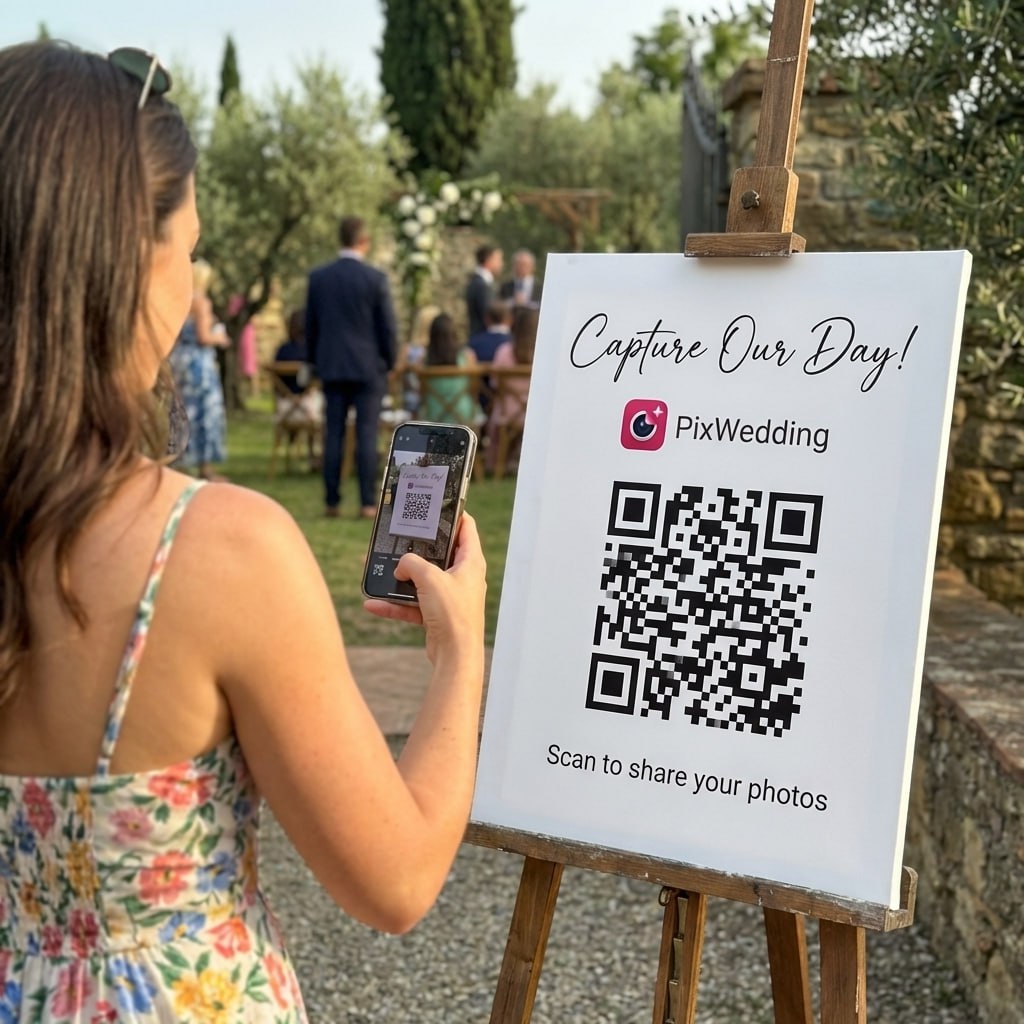
Whatever you decide about the wedding itself, Pix Wedding puts a QR at each table so every photo guests snap lands in one shared album automatically. One less logistical thing competing for your headspace.
From Mom
Scan to join the album
No app, no account
UPLOADING
Saving your moment
THE ALBUM
Emma & Jack
June 21, 2026
647 photos · 95 guests


SCAN TO TRY
pix.wedding/
your-wedding
A Short Self-Quiz: Locate the Real Fear
This is not a scored personality test. It is a way to notice which statements land, so you can stop fighting a vague "I have cold feet" and start naming something specific enough to act on. Read each pair slowly. Notice which one makes your stomach tighten a little.
If this sounds like you...
“The fear shows up the second I imagine the word "marriage," but disappears when I picture eloping quietly next week.”
“I keep picturing myself at 60 and wondering who I will have become inside this one relationship.”
You are likely facing Existential Commitment Anxiety or Fear of Permanence.
If this sounds like you...
“I love my partner, but I picture losing my friend group, my hobbies, or my sense of "me" the moment we are married.”
“I feel guilty wanting alone time, as if wanting it means something is wrong with the relationship.”
You are likely facing Enmeshment Anxiety, the fear of losing your individual identity.
If this sounds like you...
“My parents' marriage was difficult or ended in divorce, and I catch myself waiting for our relationship to follow the same script.”
“Every small disagreement makes me flinch, as if it confirms a pattern from home.”
You are likely facing Divorce Modeling, a learned association rather than a fact about this relationship.
If this sounds like you...
“Combining bank accounts, debt, or spending habits with another person feels like the scariest part of getting married.”
“I avoid talking about money with my partner because the conversation itself feels like the real commitment.”
You are likely facing Financial Merging Anxiety, which is usually the most solvable fear on this list.
If this sounds like you...
“I picture my future narrowing, fewer choices, less spontaneity, once I am legally tied to one person.”
“The word "husband" or "wife" feels heavier than "partner," like a door quietly closing.”
You are likely facing Autonomy Loss, the fear of feeling trapped rather than freely committed.
If two or three groups resonated at once, that is common. Fears rarely arrive one at a time. The glossary below defines each of these terms in plain language so you can talk about them, with yourself or your partner, without needing a psychology degree.
A Plain-Language Glossary of Marriage Fears
These are not clinical diagnoses. They are common, descriptive patterns that therapists and relationship writers use to talk about pre-marriage anxiety. Naming the pattern usually makes it smaller.
Fear of Permanence
The specific unease that comes from a decision being framed as "forever" rather than "for now." It is less about your partner and more about how your brain handles open-ended, irreversible commitments. This fear often eases once you reframe marriage as a choice you renew daily rather than a single locked-in event.
Enmeshment Anxiety (Loss of Identity)
Worry that marriage will dissolve your individual self into a merged "we," leaving less room for your own friendships, hobbies, or solitude. This fear is usually a reaction to an outdated model of marriage, not a description of how most modern couples actually live day to day.
Divorce Modeling
The tendency to expect your own marriage to resemble a difficult or failed marriage you witnessed growing up, most often a parent's. It is a learned association, not a prediction. Naming that you are pattern-matching to someone else's relationship is often the first step to loosening its grip.
Financial Merging Anxiety
Fear centered on combining money, debt, or financial decision-making with another person. This one is often the most solvable of the group, since it responds directly to a concrete conversation and a plan, rather than to reflection alone.
Autonomy Loss ("Feeling Trapped")
The sense that marriage will restrict your freedom to make independent choices, from where you live to how you spend a Saturday. This fear tends to fade when a couple explicitly discusses what independence will still look like after the wedding, instead of assuming it disappears by default.
The "Right Person" Fallacy
The belief that a truly correct decision would come with total certainty, so any doubt must mean you have the wrong person. In practice, most long, stable marriages were not built on total certainty at the start. They were built by two uncertain people who kept choosing each other anyway.
Anticipatory Grief for Single Life
A quieter, often unspoken sadness about closing the chapter of being unattached, even while wanting the relationship. This is not evidence of doubt about your partner. It is a normal response to any major life transition, including ones you are genuinely excited about.
Existential Commitment Anxiety
A more abstract, harder-to-name unease about the idea of binding your future self to a decision your present self is making. It shows up as vague dread rather than a specific complaint. This is usually the fear underneath all the others, and it responds best to naming it directly rather than searching for a logical justification.
What Actual Research Says
You do not need invented statistics to take this seriously. Here is what named, published sources actually say about pre-marriage doubt.
Doubt is not always about the relationship
Psychologist Mark Travers, writing in Forbes, identifies three distinct sources of pre-wedding cold feet: questioning the relationship, questioning yourself, and questioning the idea of marriage altogether. Only one of the three is actually about your partner.
A meaningful share of first marriages end, but the trend is improving
The same Forbes analysis notes that roughly 43 percent of first marriages in the United States end in divorce, while also pointing out that overall divorce rates have been declining since 2000. Fear of that statistic is common. It is also not a prediction about your specific relationship.
Most conflict never fully "resolves," and that is normal
Therapy-focused outlet Growing Self cites Gottman Institute research suggesting that roughly 70 percent of relationship conflict is "perpetual," meaning couples learn to manage it rather than eliminate it entirely. Expecting a conflict-free marriage is the setup, not the fear.
Anxiety and intuition feel different
The same Growing Self piece, drawing on couples therapists, describes anxiety as persistent "noise" full of what-ifs, while intuition tends to feel calmer and more settled. It also references therapist Esther Perel's framing of choosing between a "love story" and a "life story," a useful lens for sorting a fleeting fear from a durable one.
How Modern Marriage Actually Works
Many fears about marriage are based on outdated models. Here is what marriage looks like for couples who are doing it well today.
Individuality is preserved, not sacrificed
Modern couples maintain separate friend groups, hobbies, and even bank accounts. The idea that two become one literally is outdated. Two whole people building a life together is the goal.
Roles are negotiated, not assigned
There is no default "wife role" or "husband role." Couples decide together who handles what based on strengths, preferences, and fairness. Your marriage is whatever you design it to be.
Communication is the foundation, not obedience
Healthy modern marriages are partnerships built on honest dialogue. Conflict is expected and managed, not avoided. The ability to disagree respectfully is a strength, not a flaw.
Growth is ongoing, not optional
The best marriages include personal growth for both partners. Supporting each other's evolution, career changes, new interests, and even changes in identity is part of the deal.
The "exit option" exists, but commitment changes behavior
Knowing you can leave but choosing to stay creates a different dynamic than being trapped. Committed couples tend to invest more deeply in resolving problems rather than avoiding them.
5 Exercises to Work Through Cold Feet With Your Partner
These are not hypothetical suggestions. They are concrete activities used by couples therapists to help engaged couples work through commitment anxiety.
The "Marriage Means" exercise
15 minutes, both partnersEach partner writes down 10 things they believe marriage means. Then compare lists. You will likely discover that your definitions of marriage are different in surprising ways. This exercise reveals assumptions you did not know you had and creates a shared definition you both agree on.
The "Five Years From Now" visualization
10 minutes, individualClose your eyes and picture your life 5 years from now if you get married. What does a Tuesday evening look like? What does a weekend look like? Now picture 5 years from now if you do not get married. Which picture feels more like the life you want? This is not about grand visions. It is about daily reality.
The "Fear vs. Desire" list
20 minutes, individual then shareDraw a line down the middle of a page. On the left, write every fear you have about marriage. On the right, write every reason you want to be married. Be specific. Then share your lists with your partner. This creates a map of your emotional landscape and shows where the work needs to happen.
The "Non-Negotiables" conversation
30 minutes, both partnersEach partner names 3 to 5 things they need in the marriage to feel safe and happy. These might include personal time, financial transparency, regular date nights, or shared decision-making. Agreeing on non-negotiables before the wedding creates a framework for the marriage that feels structured rather than scary.
The "Married Friends Interview" project
1 to 2 hours over a weekTalk to a few married couples you respect. Ask them: What surprised you about marriage? What is harder than expected? What is better? Real stories from real people cut through abstract fear and give you a concrete picture of what married life actually looks like.
If, after working through these exercises and having honest conversations, the fear does not ease and instead feels like persistent dread that follows you through good days as well as hard ones, that is worth bringing to a licensed couples therapist or counselor. That is not a sign you have failed at this. It is what pre-marital counseling exists for.
Whatever You Decide, the Record of This Chapter Still Matters
Working through cold feet about marriage is not about faking certainty for the sake of a wedding date. Some couples talk it through and move forward, some postpone, and some realize marriage is not the right structure for them right now. All three are legitimate outcomes of doing the work honestly.
If you do move forward, the day itself becomes one more chapter in a much longer story, not the whole story. Couples who work through real doubt before the wedding often say the day felt lighter, not heavier, because the hard conversations already happened. Pix Wedding exists for that lighter version of the day: guests scan a QR code at their table, every photo they take lands automatically in one shared album, and you are not the one chasing memory cards or nagging people to send pictures. It is a small, practical thing, but on a day that is emotionally loaded enough already, one less task to manage is one more moment you get to actually be present in.
See how Pix Wedding photo sharing works →Continue reading
However this chapter turns out, your photos should not add stress
Pix Wedding gives every guest a QR code and gathers every photo into one shared album automatically, so nobody, including you, is managing memory cards on a day that already asks a lot of you.
Get Started FreeCold Feet About Marriage vs. Cold Feet About the Wedding: Why It Matters
The distinction between cold feet about marriage and cold feet about the wedding is not just semantic. It changes what you need to do. If your anxiety is about the wedding event, the solution is practical: delegate more, simplify plans, or even elope. If your anxiety is about marriage itself, the solution is emotional and relational: honest conversation, self-reflection, and possibly professional guidance.
Many people conflate the two, which leads to confusion. They think they are scared of marriage when they are actually burned out from months of wedding planning. Separating the two, using a simple test like imagining a quiet elopement, allows you to address the right problem with the right tools instead of generalizing a specific fear into vague dread.
- •Wedding cold feet responds to practical solutions like delegation and simplification
- •Marriage cold feet requires emotional processing and honest conversation
- •Most people experience a mix of both, which is why it feels so confusing
- •The 'imagine eloping' test quickly reveals which type is dominant
- •Both types are normal and neither predicts marital failure on its own
What 'Forever' Actually Means in a Modern Marriage
The word 'forever' is one of the biggest triggers for marriage cold feet. It sounds permanent, unchangeable, and absolute. But the truth is that 'forever' in marriage means choosing your partner one day at a time. It is a continuous decision, not a single irreversible act.
Happily married couples will tell you that their marriage is not one continuous state. It is a series of chapters. There are seasons of closeness and seasons of independence. Seasons of challenge and seasons of ease. The commitment is not to stay the same forever. It is to grow together, adapt together, and keep choosing each other through all of it.
When to Seek Professional Support
Working through cold feet on your own or with your partner resolves it for most people. But if the fear is constant, feels like dread rather than nervousness, or is accompanied by ongoing distress that does not lift even on good days, that pattern is worth bringing to a licensed therapist or counselor rather than working through alone indefinitely.
Pre-marital counseling programs exist specifically for this stage of a relationship, and reaching out is a sign that you are taking the decision seriously, not a sign that something is broken. A therapist can help you separate old patterns, such as a parent's divorce, from the reality of your own relationship.
Explore more free wedding tools
Everything you need to make your wedding day stress-free and unforgettable.
Seating Chart Planner
Plan your reception seating visually.
Guest List Manager
Track RSVPs and dietary needs.
Budget Allocator
Turn your total into a category-by-category plan.
Timeline Builder
Plan your entire wedding day.
Venues by State
Explore venues across all 50 states.
Countdown Timer
Count down the days to your big day.
Bachelorette Party Games
15+ games with rules, supplies, and timing.
Alternative to Wedding Guest Book
15 creative alternatives guests enjoy.
Frequently Asked Questions
Straight answers to the questions people ask most about this topic.
Yes, fundamentally. Cold feet about the wedding is performance anxiety and event stress. Cold feet about marriage is about the permanence of the commitment, the concept of 'forever,' and what marriage means for your identity and freedom. The solutions for each are different, which is why making the distinction matters. A quick test: imagine being married quietly tomorrow with no ceremony. If the fear disappears, it was about the event.
Ask yourself whether your concerns are specific to your partner's values, honesty, or behavior, or whether they are about the general idea of a permanent, legal, lifelong bond. If marriage as a legal institution did not exist and you could still make an informal lifelong commitment to this person, would you still want to? If yes, your fear is likely about the institution, not the relationship.
Based on common patterns described by therapists and relationship writers, the most frequent ones are fear of permanence, loss of individual identity, modeling a parent's divorce, anxiety about merging finances, and a general fear of losing autonomy. Naming which one applies to you, using a glossary like the one on this page, makes the fear far easier to talk about.
Absolutely. This is actually a very common combination. You love your partner, you want to be with them, but the institution of marriage triggers fear. This is about your relationship with the concept of commitment, not your relationship with your partner.
Try the exercises listed in this guide: the 'Marriage Means' writing exercise, the 'Five Years From Now' visualization, the 'Fear vs. Desire' list, the 'Non-Negotiables' conversation, and interviewing married friends. These structured activities bring vague fears into focus and create shared understanding with your partner.
If the fear is constant rather than occasional, feels like dread instead of nervousness, or persists even during genuinely good moments in the relationship, that pattern is worth bringing to a licensed couples therapist or pre-marital counselor. Seeking support at that point is a sign of taking the decision seriously, not a sign of failure.