
Your Ultimate Guide to Guest Media Collation
Guest media collation is the art of pulling every photo and video your guests captured into one organized, searchable archive. This guide covers the full process, from the week before your wedding to the permanent backup you will still have in 20 years.
Start Collecting Guest PhotosGuest media collation, in one sentence
Guest media collation is the structured process of gathering every photo and video your wedding attendees captured across all their devices, organizing the files into a single chronological archive, curating a shareable highlight set, and preserving the full collection in a format that will still be accessible in 20 years.
The term borrows from bookbinding, where loose printed pages are gathered and ordered before stitching into a final volume. Applied to modern events, it means exactly that: pulling scattered camera rolls into one cohesive record of the day.
The four-phase collation process
Guest media collation spans four distinct phases. Each phase has different goals and different people responsible. Work through them in order and nothing falls through the cracks.
Phase 1: Before
4 to 8 weeks out- Choose your album host platform and create the album
- Generate a QR code linked to the guest upload page
- Add the upload link to your wedding website and digital invitations
- Design and order printed QR cards (aim for 100 cards per 120 guests)
- Pre-load 8 to 12 engagement or rehearsal photos so the album looks lived-in
- Write a one-line upload prompt: 'Scan to share your photos and see ours'
Phase 2: During
Day of the wedding- Place QR cards at every table, the entrance, the bar, and the photo booth
- Ask your MC to announce the album link during the welcome speech
- Have a coordinator drop the short link into any WhatsApp or group chat
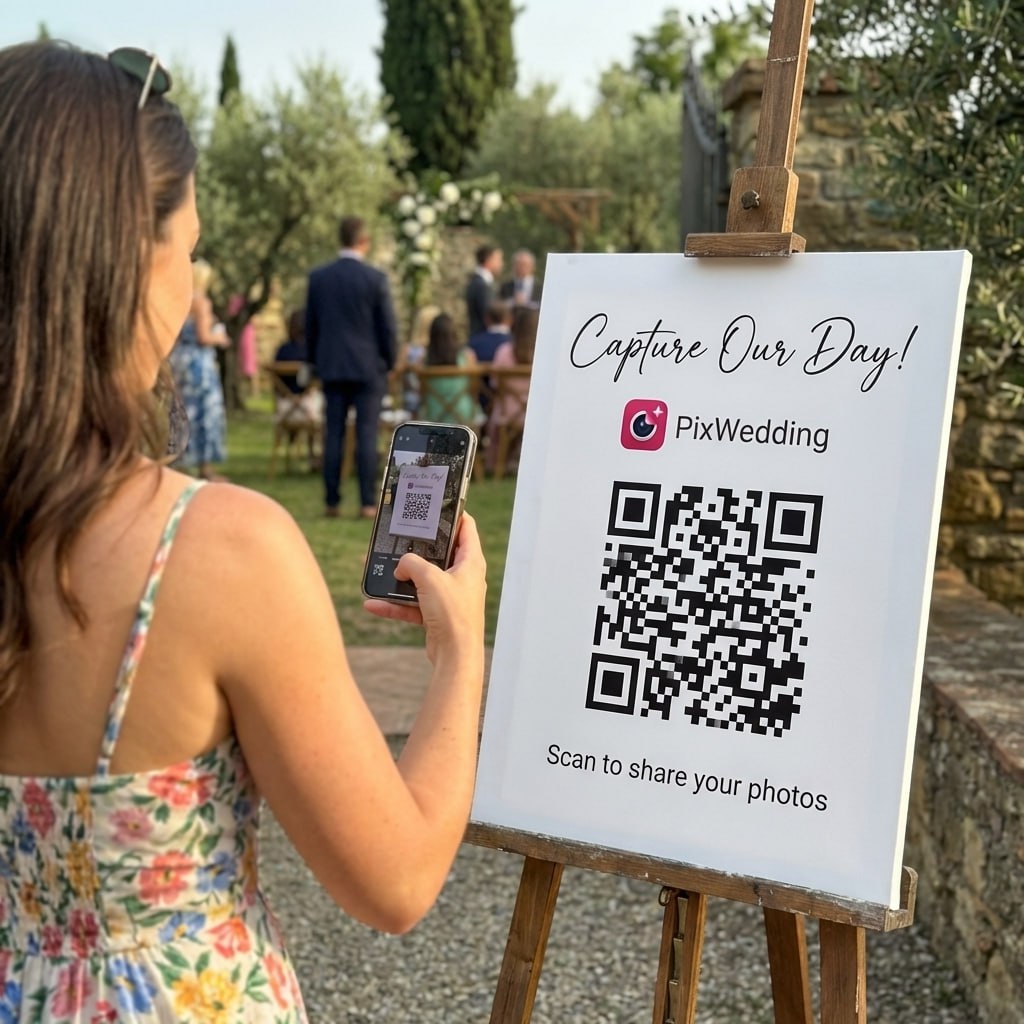
- Place a laminated QR sign near the guest book for direct comparison
- Check the album once during the reception to confirm uploads are landing
- Encourage the wedding party to be first to upload so guests see it is working
Phase 3: After the day
Days 1 to 21- Send a thank-you message to guests that includes the album link
- At day 7, send one gentle reminder to anyone who has not uploaded
- Leave the upload window open for at least 21 days post-wedding
- Download all submitted media as a full-resolution ZIP or folder
- Run a deduplication pass before moving anything to long-term storage
- Request photos directly from known photographers in the guest list
Phase 4: Long-term archive
Month 1 and beyond- Sort the complete set by EXIF timestamp into date-named folders
- Tag key people with a naming convention you will still understand in 10 years
- Build a curated sub-folder of 80 to 120 highlight images for sharing
- Back up to at least two separate cloud services and one external drive
- Print one physical album from the highlight folder before your first anniversary
- Set a calendar reminder to check and migrate the archive every five years
The eight tools every collation setup needs
You do not need all eight at every wedding. Smaller, tech-fluent groups can skip two or three. But knowing what each category does helps you decide which gaps to fill before the day arrives.
Album page host
A web service that creates a private, shareable album page. Guests open it in their phone browser and upload directly. Pix Wedding is built for this. Good hosts keep original resolution and export a full ZIP.
QR code generator
Converts your album URL into a scannable square. Most album hosts generate one automatically. If yours does not, a dedicated generator lets you choose the size, color, and error-correction level before downloading a print-ready PNG.
Video transcoding tool
When guests upload MOV or HEVC files from iPhones, not every browser plays them natively. A transcoding pass through HandBrake or a cloud converter turns everything into MP4 H.264 for universal playback without re-encoding quality loss.
Hashtag tracker
A saved search or third-party tool (like Later or a manual Instagram search) that pulls every public post tagged with your wedding hashtag. Useful as a secondary collection channel, but misses guests who post privately or do not use social media.
USB drop box
A physical card reader at the venue where guests can plug in their phone or a USB drive and copy files directly. Excellent for older guests who do not upload digitally but want to contribute. Requires a coordinator to manage the box during the event.
Printable photo guide
A one-page PDF on each table explaining in three steps how to scan the QR and upload. Keep it to 40 words or fewer. Large font, high-contrast print. This is the single biggest driver of participation from guests over 65.
Post-event reminder system
A scheduled message, sent seven days after the wedding, that includes the album link and a thank-you note. Email, WhatsApp broadcast, or SMS all work. One message only. Automate it the day after the wedding while you are still thinking about it.
Family share extension
After the main album closes, create a second private folder for immediate family only: parents, siblings, the wedding party. This smaller group often has the most emotionally significant candids and deserves a dedicated sub-collection with its own curation pass.
The five-step collation workflow
This is the end-to-end sequence, from opening the album to handing guests a curated keepsake. Each step feeds directly into the next.
Set the album
Create your album page, set privacy to 'anyone with the link can upload and view,' and give it a clear name. Choose a host that keeps original resolution files and lets you download everything as a single export.
Spread the QR
Print the QR code on 100 physical cards. Place them at every table, the entrance, and the bar. Add the link to your wedding website and any pre-event group chats. Three to five contact points per guest is the target.
Pre-load seed photos
Upload 8 to 12 engagement or rehearsal photos before the wedding. A populated album tells guests they are in the right place and lowers the psychological barrier to becoming the first to upload from the reception.
Collect through the event
Have one person check the album twice during the evening to confirm uploads are landing and the link is working. Ask the MC to mention it once. Let guests discover it naturally from the cards rather than interrupting the night.
Curate and gift
After the album closes, dedupe and sort the full set. Build a highlight folder of your best 80 to 120 images and share it back to every guest as a thank-you. Guests who contributed feel recognized; guests who did not often upload late when they see the link again.
Which collection method fits your wedding
There are five broad categories of guest photo collection. The right one depends on your group size, the age range of your guests, and how much post-event curation work you are willing to do.
Web-based album platforms
Browser-first services where guests upload to a private URL without an account. Best for large, mixed-age groups. Original files are preserved, and the organizer gets a single-download export. Pix Wedding falls in this category. Guest effort is minimal: scan, tap, upload.
Cloud storage services
General-purpose folders shared via link. They require guests to sign in for uploads, which cuts participation on event nights. Better suited for post-event sharing with a smaller, tech-fluent group than for real-time collection from 120 wedding guests.
USB and physical collection
A card reader or shared drive at the venue. Zero internet dependency, which is valuable at barn venues with poor signal. The trade-off is that a coordinator must manage the box, transfer files manually, and there is no guest-view layer built in.
Hashtag-only collection
Guests post to Instagram or TikTok with a custom hashtag. The organizer searches the tag and saves the content. The structural problem: this only captures the fraction of guests who post publicly, misses video in full quality, and depends on social platforms you do not control.
Hybrid methods
A combination of web album plus hashtag plus USB backup. Hybrid approaches capture the widest audience and the most media, but they require post-event consolidation work to merge three separate streams into one archive. Worth the effort for large events over 150 people.

Reception
All in one place
Collation. Solved on the day of.
Pix Wedding gathers every guest photo and video into one private album in real time. No post-wedding chase, no spreadsheets, no DMs.

From Mom
Scan to join the album
No app, no account
UPLOADING
Saving your moment
THE ALBUM
Emma & Jack
June 21, 2026
647 photos · 95 guests






SCAN TO TRY
pix.wedding/
your-wedding
Cost and effort by collection method
Five methods, four dimensions. Use this to decide where to put your effort before the wedding, not after.
| Method | Setup time | Cost | Guest effort | Post-event curation effort |
|---|---|---|---|---|
| Web album with QR code | 15 to 30 minutes | Free to ~$30 one-time | Very low, scan and tap | Low, files arrive organized |
| Wedding hashtag only | 5 minutes | Free | Medium, must post publicly | High, manual scrape and save |
| USB drop box at venue | 1 to 2 hours (hardware) | $30 to $80 for hardware | Medium, needs cable or card | Medium, manual file merge |
| Cloud storage shared link | 10 minutes | Free with existing account | High, requires sign-in | Low if guests cooperate |
| Hybrid (web + hashtag + USB) | 2 to 3 hours total | $30 to $80 plus subscriptions | Variable by channel | High, three streams to merge |
Seven collation failures to avoid
1. Relying only on a hashtag
Hashtags only capture guests who post publicly on the platform you are tracking. On a 150-person guest list, that might be 25 to 40 people. You lose the 70-year-olds, the private account holders, and everyone who simply does not post.
2. Sending the album link only to your wedding party
The best candid at any wedding is usually taken by someone you barely planned around, a cousin, a college roommate of your partner, a child with an iPad. Wide distribution of the QR is essential.
3. Choosing a platform that compresses uploads
Some services downscale images to under 2 megapixels to save storage costs. You will not notice until you try to print a 12-by-16 photo and it looks like it was shot in 2008. Confirm original-resolution storage before committing.
4. Forgetting to leave the album open after the event
A meaningful share of uploads arrive in the week after the wedding as guests clear their camera rolls at home. Closing the album at midnight on the wedding day locks out a substantial chunk of your archive.
5. Not seeding the album before the event
An empty album makes the first guest think the link is broken. Pre-load it with rehearsal dinner photos or engagement shots so the very first scanner sees an active, populated page and trusts the system.
6. Using a method that requires a sign-in before uploading
Sign-in walls cut event-night participation by roughly half, based on our user data. Guests at a reception have two glasses of wine in them and a full dance floor; they will not pause to create an account. Remove every barrier you can.
7. Skipping the reminder message at day seven
Guests mean to upload. Life interrupts. A single, warm reminder at the one-week mark typically recovers 20 to 30 percent of guests who intended to share but forgot. Send one. Not two, just one.
Post-event organizing playbook
Once the uploads stop coming in, you have a raw archive. Here is the exact eight-step sequence to turn that pile into a proper, long-lived collection.
- 1
Deduplicate
Sort the full download by file size and file name to catch obvious duplicates. Tools like Gemini Photos (Mac) or dupeGuru handle this automatically. Removing duplicates before you start curating saves hours.
- 2
Sort chronologically
Use EXIF timestamp, not file name. File names from different phones differ wildly (IMG_4821 vs PHOTO_20260515). Every photo editor and Lightroom can sort by capture time; do this before anything else.
- 3
Tag key people
Go through the sorted set and flag photos of the couple, immediate family, and wedding party. A simple tagging system in Apple Photos, Google Photos, or Lightroom lets you pull these faces in seconds later.
- 4
Blur unintended strangers
If a guest photographed a candid moment that includes people in the background who were not aware they were being photographed, a quick blur on faces you cannot identify protects privacy before you share the album publicly.
- 5
Build the highlight reel
Create a sub-folder or album of your best 80 to 120 images. Think of it as the edit you would show someone who asked to see your wedding photos for the first time. This is the set you will print, frame, and share.
- 6
Share back to guests
Send the highlight album link to your full guest list as part of the thank-you message. Guests who uploaded feel appreciated; guests who did not often click through and discover their own faces in other people's shots.
- 7
Archive the full set
Move the complete, unedited archive to cold storage: one external drive, one cloud backup service. Use a clear folder name like "Wedding_2026_GuestMedia_FULL." Add a plain-text file inside explaining what the folder contains.
- 8
Print a physical album
Order one printed album from the highlight reel before your first anniversary. Printed photos are the only format that does not require a device, a login, or a company still existing in 20 years. It is the most future-proof archive format available.
Related guides
More resources on collecting, sharing, and backing up your wedding photos.
Why guest media collation matters more than you think
Your professional photographer will deliver 400 to 800 curated images, usually four to eight weeks after the wedding. Your guests will take somewhere between 800 and 4,000 photos and videos in the same evening, and most of them will live permanently on individual camera rolls unless you actively pull them together.
Guest cameras capture things professionals physically cannot: the first look from the groom's side, Aunt Clara crying in the third row, the cousin who photobombed every table shot. These candids are the texture of the day, not the formal record of it. Collating them is not optional if you want the full picture.
The word 'collation' comes from bookbinding, where loose pages were gathered and ordered before stitching. Applied to media, it means the same thing: pull everything in from wherever it sits, put it in order, and make it useful. Most couples skip this step and end up with a photographer album plus a WhatsApp thread that nobody can find two years later.
- •Guests collectively take 3 to 10 times more photos than a professional at the same event
- •A structured collation process recovers roughly 60 to 80 percent of those images into one place
- •Unstructured approaches, meaning 'just message me your photos,' typically recover under 20 percent
- •A properly archived guest album is searchable, printable, and shareable decades later
The complete post-collation archive strategy
Once you have gathered the photos, the work is not finished. A raw dump of 2,000 images in a folder is not an archive, it is a pile. A real archive has three layers: a working folder with everything in, a curated sub-folder with your best 80 to 120 images, and a cold-storage backup that you never touch except to restore.
For the cold-storage layer, use at least two physical locations and one cloud location. The 3-2-1 rule applies here: three copies, two different media types, one off-site. Google Photos, iCloud, and Backblaze each cover the cloud layer for under $10 a month. Print one physical album from the curated set before the first anniversary. Printed photos survive cloud service shutdowns, which digital-only archives do not.
Explore more free wedding tools
Everything you need to make your wedding day stress-free and unforgettable.
QR Sticker Designer
Design custom print-ready stickers.
Hashtag Generator
Create unique wedding hashtags.
How to Collect Guest Photos
5 methods ranked by participation rate and ease.
Share Wedding Photos with Guests
Compare every sharing platform by ease and participation.
Best Way to Get Guest Photos
The single method with the highest participation rate.
How to Make a Shared Wedding Album
Step-by-step setup for every platform.
Alternative to Disposable Cameras
Better, cheaper options than disposable cameras.
Alternative to Wedding Photo Booth
5 cheaper alternatives to a $1,000+ photo booth rental.
Guest media collation, answered
Straight answers to the questions people ask most about this topic.
Guest media collation is the process of gathering, sorting, and archiving every photo and video that attendees captured at an event. At a wedding, it covers everything from ceremony candids on grandma's phone to reception videos on a teenager's device. The goal is one complete, organized archive rather than dozens of separate camera rolls.
At least three weeks before the wedding. You need time to generate a QR code, print cards, add the link to invitations or the wedding website, and pre-load the album with a few seed photos so it does not look empty when the first guest scans it.
A web-based album page accessed by a QR code is the most reliable method for groups of any size. Guests scan, upload, and view without installing anything. Hashtags work as a backup but miss guests who are not on that social platform. USB drop boxes are good for older guests but require manual digital transfer afterward.
Start with a deduplication pass using a tool like Gemini Photos or a simple by-filesize sort. Then sort chronologically by EXIF timestamp. Tag key people, blur any unintended strangers in background shots, build a 60-to-80-photo highlight sub-folder, and share that back to guests before archiving the full set to cloud cold storage.
Leave it open for at least three weeks post-wedding. Some guests upload at the reception, others get around to it a week later when they finally have Wi-Fi at home. Cutting off access at 48 hours loses a meaningful share of your archive.
Send one gentle reminder message at the seven-day mark with the album link included again. Keep the tone light. A single nudge typically recovers 20 to 30 percent of guests who meant to upload but forgot. Do not send a second reminder, it tips from friendly to nagging.