







pixPix Weddingwedding
Wedding Keepsakes

Why a Digital Wedding Guestbook Is the Must-Have Keepsake of the Modern Wedding

Paper guestbooks collect signatures from roughly a third of your guests. A digital one captures photos, videos, and messages from nearly everyone, including the people who could not be there. Here is the full case for switching.

Start the Digital Guestbook

The honest short answer

Six months after the wedding, the paper guestbook is in a box somewhere. The spine is cracked from being carried to the venue. Twelve guests wrote variations of "Congrats! So happy for you both!" The entries from the people who matter most, the uncle who flew in from Portugal, the college roommate who cried during the vows, are not in there because the pen queue at the guestbook table was too long and they never made it over. A digital guestbook would have 80 percent of your guests contributing, including the ones who could not attend, the ones who hate writing under pressure, and the ones whose contribution is a 30-second video that makes you cry every time you watch it.

This is a narrative case for the digital guestbook, not a feature list. If you want a listicle-style breakdown of the top reasons to choose one, see the sibling article. This page goes deeper: the emotional argument, the honest tradeoffs, and the specific moments where digital wins in ways paper never could.

Digital wedding guestbooks: honest pros and cons

The goal is not to oversell. Here are six real advantages and four real limitations, so you can make the right call for your wedding.

Six genuine advantages

  • Higher participation rate: couples using QR-based digital guestbooks consistently see 65 to 85 percent of guests contribute, compared to 25 to 40 percent for paper.
  • Photos and video included: guests can contribute a candid shot from their camera roll alongside their message, something a lined paper page cannot hold.
  • No pen queue, no performance anxiety: guests contribute privately on their own phone, at the moment that feels right, not under the eyes of a crowd at a table.
  • Reaches guests who did not attend: send the private link to anyone who could not be there and they can contribute from anywhere in the world.
  • Permanent and searchable: you can find the message from a specific person in two seconds rather than leafing through 80 pages of handwriting.
  • Printable later: the digital archive becomes the source file for a premium printed photobook once you choose the best entries, rather than being the only copy with no backup.

Four real limitations

  • Requires a service to host it: unlike a paper book you buy at a stationery shop, a digital guestbook needs a platform. Most are free or under $30, but there is a setup step.
  • The "paper feels real" objection is not nothing: some guests genuinely prefer writing by hand, and a few older family members may feel a paper book is more ceremonially appropriate. The hybrid approach (see below) addresses this.
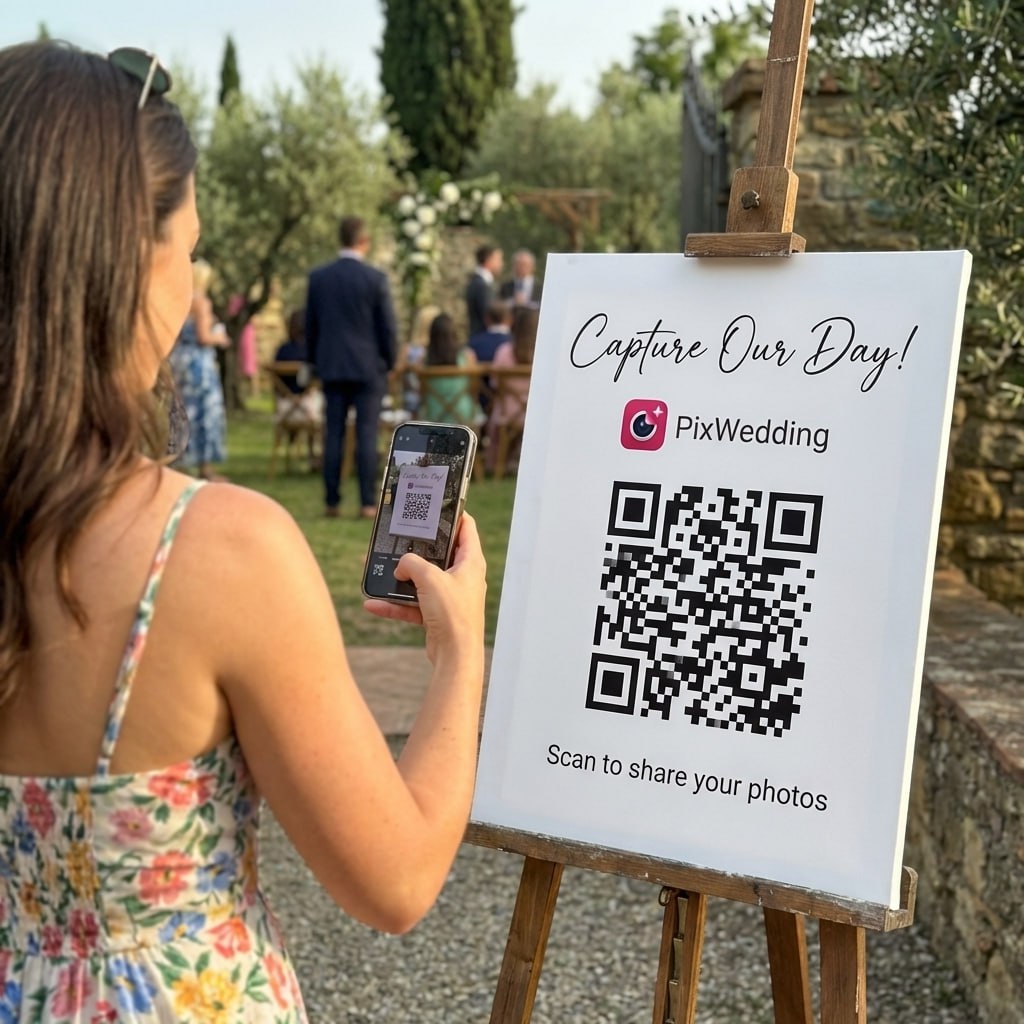
  • QR codes need to be printed well: a postage-stamp-sized QR in dim lighting kills participation. Good execution requires a printed card on every table, not just one sign near the entrance.
  • Long-term hosting depends on the platform: if the service shuts down in 10 years, you need your own downloaded backup. Always export the full archive before trusting any single host forever.

Digital vs paper guestbook: side by side across 8 dimensions

These are the dimensions that actually matter when you are making the call. Not features for features' sake, but the things couples mention when they reflect on what they wish they had done differently.

DimensionDigital guestbookPaper guestbook
CostFree to $30 for most setups$20 to $80 for a quality book
LongevityDigital files survive indefinitely with backupsPaper yellows, bindings crack, ink fades over 20 to 30 years
Guest capture rate65 to 85 percent of guests25 to 40 percent of guests
Photo inclusionYes, unlimited photos and videos alongside messagesPolaroid add-ons possible but bulky and expensive
Accessibility for elderly guestsWorks on any phone; no pen, no small handwriting requiredArthritis, low vision, and tremors make pen writing difficult
Lost-in-the-shuffle riskBacked up to cloud automaticallyFrequently left at venue, mislaid during move, or damaged
Share with no-show familySend a private link; they can contribute from anywhereNot possible
Post-event experienceScroll at any time, share with family, print a photobook laterRead once at the kitchen table, then stored in a drawer

On five of eight dimensions, digital wins outright. On cost and the ceremonial feel question, it is genuinely close. On longevity, the gap widens the further out you project.

Four guests who would never appear in a paper guestbook

The best argument for a digital guestbook is not a statistic. It is the specific people it captures who a paper book never would.

The shy guest who would never write but uploads 12 photos

The cousin who is quiet at every family event, who went to your wedding and genuinely loved it, but who would sooner disappear into the bathroom than stand at a paper guestbook table and perform a meaningful sentiment in front of strangers. She spent the evening with her phone out, capturing candid moments you never posed for. She uploaded all 12 of them from the parking lot on the way to her car. Three of those photos became your favorites from the entire wedding. In a paper world, she contributed nothing. In a digital world, she contributed more than anyone.

The grandparent who did not make it and gets a private link

Your grandmother is 84. The flight was too much. She watched a short clip on her iPad and felt the absence all week. Two days after the wedding, you sent her the private album link. She spent an afternoon going through every photo. She uploaded a scan of the wedding portrait your grandfather kept on his desk, which is now the most-viewed item in your guestbook. She typed a three-paragraph message that she would have never managed under the noise of a reception venue. The paper book closed without her. The digital one has her at the center of it.

The drunk uncle whose hilarious 30-second video becomes the best entry

He would have written "Cheers! Many happy returns!" in the paper book and called it done. Instead, at 11pm on the dance floor, someone handed him a phone, pointed at the QR card, and explained he could record a video message. He recorded a 34-second speech that involved three callbacks to stories from your childhood, a genuine tear at the end, and a toast with whatever was in his glass. You have watched it 40 times. It is funnier every watch. Pen and paper would have gotten you three words. The camera got you the real thing.

The bridesmaid who did not get a chance to write but records a voice memo

She spent the entire reception managing logistics: dress pins, cue cards, the florist who arrived 20 minutes late. By the time the guestbook table was packed away, she had not signed it. She remembered on the drive home. She pulled over, opened the album link on her phone, and recorded a 90-second voice memo that was more honest and more beautiful than anything she would have written in a rush at the table. The voice memo exists because the digital guestbook does not close when the venue does.

What "keepsake" actually means in 2026

The paper guestbook objection usually sounds like this: "but something physical feels more real." That instinct deserves a real answer, not a dismissal.

Physical objects carry a specific kind of emotional weight. The heft of a leather book. The smell of pages. The handwriting of someone you love. None of that is imagined or trivial. Paper guestbooks have genuine ceremonial value, and anyone who dismisses that entirely is missing something.

But "feels more real" is not the same as "is better preserved" or "captures more of the day." The wedding photos from the 1990s that families treasure most are not the paper programs, they are the prints that got scanned and shared and backed up over decades. The keepsakes that survive a generation are the ones that get handled, copied, sent to people, looked at again. Digital files do all of that more easily than objects stored in a box.

In 2026, "digital" does not mean "disposable." It means the opposite. The photos your parents took on film had a finite number of prints. Your digital guestbook archive can be copied to every family member's drive at no cost, printed as a photobook at any resolution, and viewed by the children and grandchildren who were not born yet when you said your vows. The paper book risks yellowing in a box. The digital archive risks nothing except the discipline to keep one backup.

The hybrid truth: the couples who feel best about their wedding keepsake usually do both. A small, beautiful paper guestbook for the guests who want to write, and a QR-based digital guestbook for everyone else. The paper book becomes a physical artifact. The digital archive becomes the complete record. Neither one has to replace the other.

The book your grandkids will actually scroll through.

A leather guestbook on a shelf gets opened once. A digital one gets opened on every anniversary, by everyone.

From Mom

From Mom

9:41

ALBUM

Emma & Jack

June 14, 2026

634 photos · 94 guests

AllMomentsMine
Add photosShare your moments
Album opened todayAnniversary 12 · 3 plays

The accessibility argument no one talks about

Paper guestbooks are quietly inaccessible to a significant portion of the guests you care about most. A digital guestbook removes almost every one of those barriers.

Guests with arthritis or hand tremors

Writing by hand in a crowded, noisy venue is genuinely painful for guests with joint conditions. Uploading a photo or typing a note on a phone takes none of the same physical effort. Your great-aunt who has not been able to hold a pen comfortably for three years can still contribute something meaningful.

Guests with low vision

A phone screen can be zoomed in to whatever size the guest needs. The text input field on a digital guestbook page is not fixed to the small lines printed in a physical book. A guest who wears thick reading glasses and dreads handwriting can type on a screen at any font size their phone allows.

Guests for whom English is a second language

Many guests at multicultural weddings feel embarrassed about their written English and skip the paper guestbook entirely. A phone allows them to type in their first language, use autocorrect in their preferred language, or simply upload a photo that says everything without a word. Inclusion does not require a translation service; it requires removing the pen.

Young children at the wedding

A five-year-old at the guestbook table under adult supervision tends to produce a large scrawl that takes up two pages and upsets the parent who was hoping for something neater. On a digital guestbook, a parent can help the child record a five-second video saying "congratulations" and the result is genuinely charming rather than a page of chaos. The child feels included, the parent is not stressed, and you get an entry that actually reflects the moment.

5 reasons couples regret going paper-only

These come from patterns in how couples talk about their guestbooks after the fact. No invented quotes, just the recurring regrets.

1. The guestbook was left at the venue

Venue staff move fast at the end of the night. The book ends up in a lost-property box, sometimes permanently. At least two or three times a year, couples post in wedding forums asking if anyone knows how to track down a book they left behind. A digital guestbook cannot be accidentally left at a venue.

2. The people who signed it barely knew them

When there is one guestbook and it lives on a single table, the people who sign it tend to be whoever was nearest that table at the right moment. The couple's closest friends, who were on the dance floor until 1am, often never made it over. The paper book ends up full of polite acquaintances and work colleagues, and thin on the people who actually matter.

3. They cannot read half the entries

Wedding venues are noisy, dim, and chaotic. Pens on string produce scratchy results. Guests who have had two glasses of wine produce signatures rather than messages. Many couples open their paper guestbook a month later and find that a quarter of the entries are illegible. Digital text and voice memos do not have a legibility problem.

4. The people they most wanted to hear from did not sign it

The friend who flew in from abroad but had an early morning flight the next day left before the guestbook table was even set up. The grandmother who was seated at a far table never walked over. The college friend who spent the evening looking after her toddler never got a free hand to write. Every couple has a short list of people whose words they most wanted, and those people are disproportionately absent from the paper book.

5. They did not get the guest photos

Guests at weddings take extraordinary pictures. Candid moments from angles the photographer never covered. Reactions during the vows. The moment the cake was cut from three tables away. In a paper-only setup, those photos live on individual phones and slowly get buried under the rest of life. A digital guestbook turns the "can you send me that photo?" conversation into something that happens automatically, because contributing photos is the same gesture as leaving a note.

The hybrid approach: how to run both at once

You do not have to choose between the ceremonial weight of paper and the reach of digital. Many couples run both, and the setup is simpler than it sounds.

What the paper book is for

Keep a single beautiful hardcover book on a dedicated table near the entrance. Staff the table during cocktail hour when the crowd is standing and mingling anyway. Frame it as "for anyone who wants to write something by hand." Do not chase people to sign it. The guests who genuinely want a pen-and-paper moment will seek it out, and those entries will be more meaningful than the coerced ones.

What the digital guestbook is for

Put QR cards on every table, the bar, and the welcome table. The digital guestbook catches everyone who missed the paper table, everyone who wanted to contribute a photo, everyone who recorded a voice note on the drive home, and every family member who watched from afar. It runs in the background without anyone managing it. By the time the paper book closes at midnight, the digital archive may already have 400 contributions.

How they work together afterward

After the wedding, scan the best handwritten entries from the paper book and add them to the digital archive. Now you have a single complete record. The physical book becomes a display artifact, the kind of object you leave on a coffee table for a few years. The digital archive becomes the permanent searchable, shareable, printable record. Both exist. Neither one suffers for the other being there.

Practical tip: tell guests at the top of the digital guestbook page that there is also a paper book at the entrance table. Some guests will do both, and that is the best outcome. The message is "we want to hear from you in whatever way feels right," not "you must choose."

Keep reading

More on digital guestbooks, keepsake alternatives, and how to collect photos from every guest at your wedding.

The science behind why digital guestbooks get more contributions

Behavioral research on social participation consistently finds that people contribute more when the barrier to entry is low and the action feels low-stakes. A lined paper book with a pen attached triggers performance anxiety in a way that uploading a camera roll photo does not. The pen queue at the guestbook table is a social gauntlet: you stand there, strangers watch, you try to think of something meaningful to write, and you inevitably produce something far shorter than you intended.

A QR code on a table card removes almost every one of those friction points. The guest interacts in private, on their own phone, at the moment that feels right to them, which might be during cocktail hour, during a lull between dances, or even the next morning when they are going through their camera roll and find the perfect shot from the night before. The emotional quality of contributions tends to be higher too, because guests choose what to share rather than scrambling for words under pressure.

  • Paper guestbooks average 25 to 40 percent guest participation; digital ones routinely exceed 70 percent
  • Guests who contribute photos also tend to write longer messages because the context of the image removes the blank-page problem
  • The ability to contribute after the event captures guests who arrived late, left early, or could not attend
  • Video and voice messages carry emotional weight that pen-and-ink entries cannot replicate

What to do with a digital guestbook after the wedding

The archive does not have to live only on a screen. Couples who get the most value from digital guestbooks treat the digital version as the master record and then commission physical artifacts from it. A printed photobook using the best 40 to 60 uploads, a canvas print of the most-liked photo, a framed grid of guest selfies from the photo wall, a QR code coaster that links to the full album permanently.

The digital format also makes sharing forward much easier. When your daughter asks to see your wedding photos in 20 years, handing her a USB drive or a link is simpler than finding the box where the paper book lives, hoping the pages have not yellowed, and discovering that three pages are stuck together from a spilled champagne flute at the reception.

Explore more free wedding tools

Everything you need to make your wedding day stress-free and unforgettable.

FAQ

Digital wedding guestbook, answered

Everything you need to know about our free tools and how they help your wedding day.

A digital wedding guestbook is a private online album where guests contribute photos, short videos, voice memos, and written messages using their phone camera, accessed via a QR code or link, with no app download required. The result is a living keepsake the couple can scroll through, share with family, and preserve permanently.

For most modern weddings, yes. Paper guestbooks typically get signed by 25 to 40 percent of guests, often with short one-liners under time pressure. Digital guestbooks reach guests who skip the pen queue, guests who arrive late, guests who did not attend, and guests who want to contribute a photo rather than write a sentence. The content is richer and the participation rate is higher.

They should not have to. Good digital guestbook tools, including the one Pix Wedding offers, work entirely in a phone browser. Guests scan a QR code printed on a card at the venue, which opens a web page where they can upload photos, record short videos, or type a note. No account, no install, no friction.

Older guests have been scanning QR codes at restaurants since 2020 and are more comfortable with the motion than most couples assume. The key is using a service that keeps the landing page dead simple: one upload button, no password prompts, no navigation. If you pre-load a few photos so the page looks alive, older guests feel confident they hit the right spot and tend to contribute more than expected.

Yes, and this is one of the biggest advantages. You can share the private album link with anyone, whether they live overseas, had a last-minute conflict, or could not travel. They can view everything, upload a photo from home, or leave a video message. A paper guestbook cannot do that.

After the event, download the full archive, which should include original-quality photos, videos, and written messages, and back it up to two locations: one cloud service and one local drive or USB. Many couples also order a printed photobook from the highlights once the digital archive is complete. The digital version serves as the master record; the printed book is the coffee table artifact.