
Wedding photographer vs videographer: which one if you have to pick?
Five forced-choice tests. Photographer wins four. Videographer wins one. If budget is the constraint, here is exactly what to do, how to spend, and where to cut without losing the moments that matter.
Cover every moment guests capture tooThe direct answer
If you are forced to pick one, hire the photographer. Photos win the framing test (the one thing that ends up on your wall), the share test (you will send 50 or more photos to family members within the first month and maybe three video clips total), and the longevity test (photos open instantly on any device in 20 years without format conversion, codec problems, or dead links). A photo album does not require a subscription, a specific app, or a specific operating system.
Video wins one test: the voices test. Your dad's speech, your grandmother's laugh, the way your partner's voice broke on the word "always" in the vows. That is on video or it is gone. If you have any budget at all after hiring a photographer, the move is not to skip video entirely. It is to hand a trusted friend with a recent iPhone the specific job of recording the speeches and the first dance. The footage will not be cinematic. But it will have the voice, and that is the only thing video does that photos cannot replace.
The 5 forced-choice tests
When you ask "which one should I hire," you are really asking five separate questions. Each has a different answer. Here they are in order.
The framing test
Photography winsFive years from now, what is on the wall of your home? Almost certainly a photo. The large print above the mantle, the framed shot on the hallway console, the canvas in the bedroom. No couple hangs a freeze-frame from their wedding film on the wall. Still images have a visual weight and permanence that no video still can replicate at print quality. Photography wins this test by a distance.
The share test
Photography winsIn the weeks after the wedding, how many photos will you send to family and friends? Most couples send 50 to 150 individual photos via text, email, and shared galleries. How many video clips will you send? Usually two to five. The share behavior shows what actually gets used. Photos travel easily, get saved to phone galleries, get printed by grandparents, get posted to Instagram. Video gets watched once on Vimeo, shared a few times, and then rarely revisited. Photography wins this test too.
The longevity test
Photography winsOpen a JPEG from 2005 on any device you own right now. It opens. Now try opening an HD video file from 2005 in whatever codec was popular then. Good luck finding a player. Video formats degrade in accessibility over time in a way that photos do not. MP4 will outlast H.264, but the principle remains: video requires active format management across decades. A printed photo requires nothing. Twenty years from now, a printed album opens without a password, a subscription, or a compatible device. Photography wins.
The voices test
Videography winsThis is the one test video wins, and it wins it completely. Your father's voice saying your name during his speech. Your grandmother's laugh when your best man told that story. The way your partner's voice sounded at the exact moment they said "I do." Photos cannot capture any of that. If anyone important to you is elderly, ill, or otherwise unlikely to be present in your life in 20 years, this test carries enormous weight. This is the honest reason to hire a videographer, and it is a real reason.
The rewatch test
Photography winsHow often will you actually rewatch the wedding film? Honestly? Most couples watch the highlight reel on the first anniversary, show it to parents once, and then revisit it sporadically. Most couples flip through their photo gallery several times per year, especially around anniversaries and birthdays. The consumption pattern is not equal. Photos get casually revisited. Video requires intent and a 6-minute commitment. Photography wins the rewatch test in practice, not in theory.
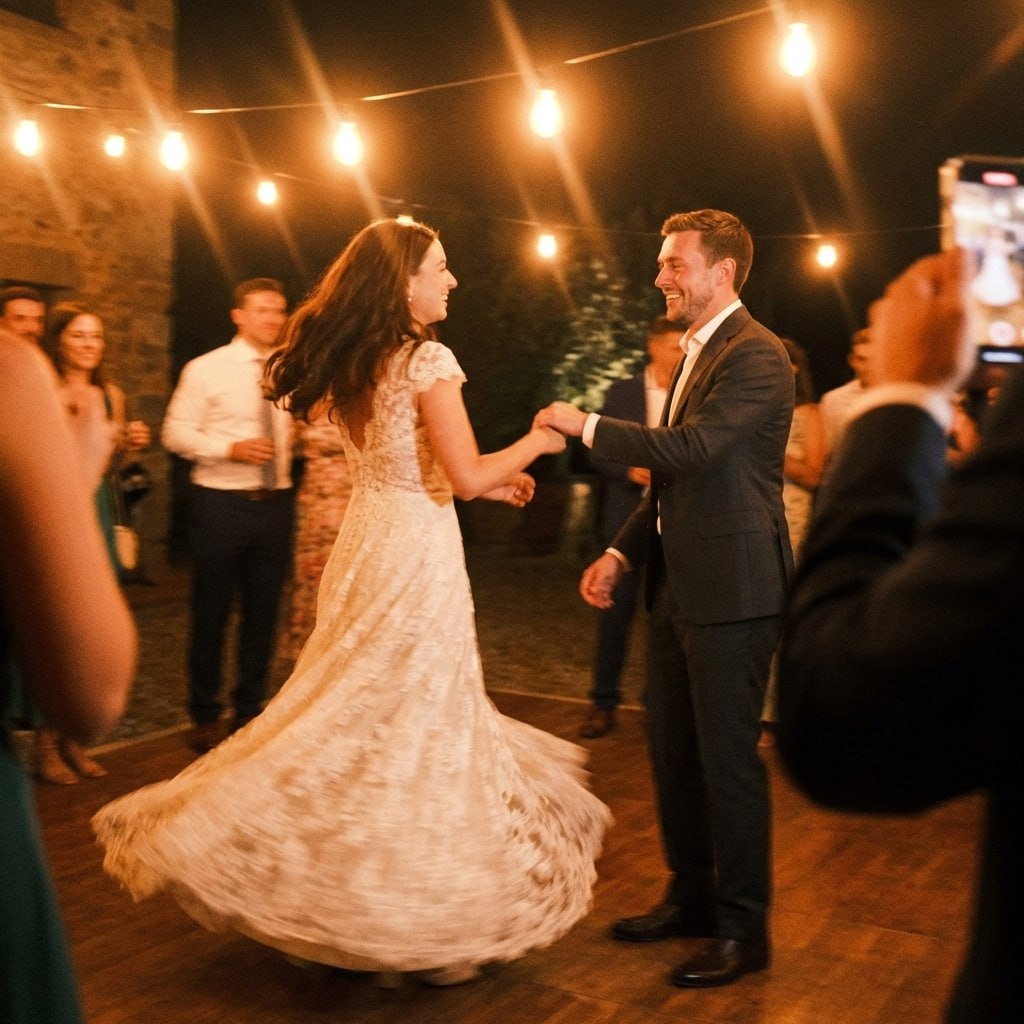
Dance floor
Caught by a cousin
Add the candid coverage neither one will catch
A pro photographer covers your portraits. A videographer covers your speeches. Pix Wedding covers everything else, captured by your guests, in one album.
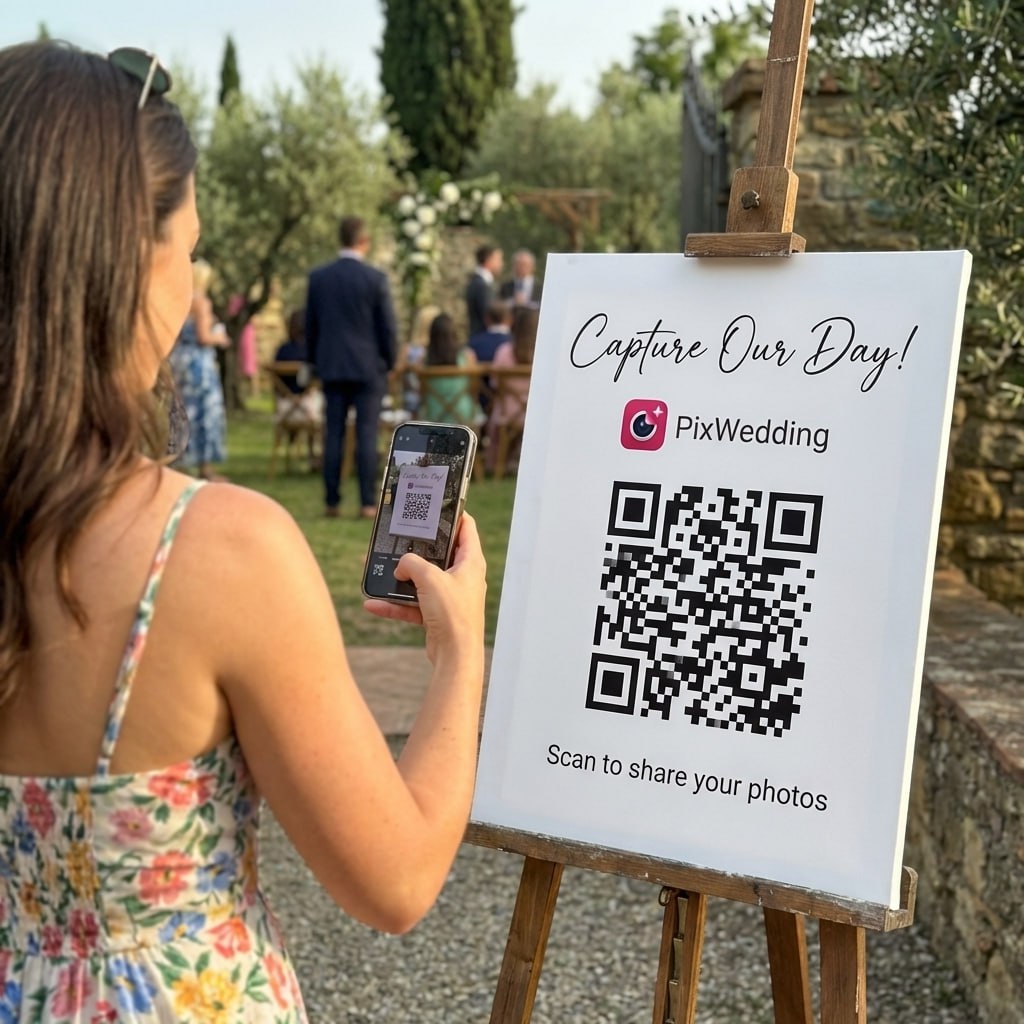
From a guest
Scan to join the album
No app, no account
UPLOADING
Saving your moment
THE ALBUM
Emma & Jack
June 21, 2026
647 photos · 95 guests

SCAN TO TRY
pix.wedding/
your-wedding
What each option actually costs in 2026
Real US price ranges for 2026, based on mid-market professionals in major cities. Budget markets are roughly 30 to 40 percent lower. Destination or high-demand markets run 30 to 60 percent higher.
| Package | Typical 2026 cost (US) | What you actually get | Finished output |
|---|---|---|---|
| Pro photographer (4-hour) | $1,200 to $2,500 | Ceremony + portraits, 200 to 350 edited images | 200-350 edited JPEGs |
| Pro photographer (8-hour) | $2,500 to $4,500 | Getting-ready through first dances, 400 to 600 edited images | 400-600 edited JPEGs |
| Pro photographer (full day) | $4,500 to $8,000 | Getting-ready through late reception, 600 to 900 edited images | 600-900 edited JPEGs |
| Pro videographer (4-hour highlight reel) | $1,500 to $3,000 | Ceremony + key moments, 3 to 8 minute highlight reel | 1 highlight reel (3-8 min) |
| Pro videographer (full day + edit) | $3,500 to $6,500 | Full day documentary + highlight reel, raw ceremony footage | Highlight reel + 45-90 min full film |
| Photo + video combo (single vendor) | $4,000 to $9,000 | Both mediums, but secondary medium quality is usually compromised | Photos + highlight reel (mixed quality) |
| Photo only + friend with iPhone | $1,200 to $4,500 + $0 | Pro photos for everything, iPhone for speeches/first dance | Pro photos + 2-4 raw video clips |
What each medium actually captures: an honest matrix
This is not about which is "better." It is about what each medium is physically capable of capturing. Know this before you decide.
| Photography captures uniquely | Videography captures uniquely |
|---|---|
| Frozen emotion in a face at the exact right moment | Voices: speeches, vows, readings, toasts |
| The framable wall image at print resolution | The way you walked down the aisle, the pace and feeling of it |
| Print-ready quality for albums, cards, gifts | Laughter and the sound of it: the room reacting to the best man's speech |
| The photo your mom keeps in her wallet | The first-dance song playing, the full ambient sound of the room |
| Shareable single images for social, family texts, printing | Your partner's voice at the moment they said "I do" |
| Device-agnostic access for 20+ years without format conversion | Your grandmother's laugh, preserved in her voice |
| The collective gallery: 300 to 600 distinct moments across the whole day | The processional: the faces of guests turning to look at you |
| The single image that becomes "the photo" of your wedding | The sequence of moments, not just peaks: time-as-experience |
Which couple should hire which vendor
The right answer depends on what kind of couple you are and what you will actually do with the media you commission. Be honest with yourselves here.
The couple who would rather flip through a printed book
You imagine sitting with your children in 15 years, showing them a physical album. You want something that does not require a password, a streaming service, or a working link. You plan to print photos, frame portraits, and give grandparents their own prints. You are a photography couple. The video would sit on a drive you would forget about. Hire the photographer and spend the rest on the album printing.
The couple who plans to watch the wedding on every anniversary
You have already thought about sitting on your couch on your tenth anniversary rewatching the film. You love documentary-style storytelling. You want to hear the vows again, not just see them captured in a still. You consume video content naturally and regularly. You are a videography couple. Still hire a photographer for the prints and the album, but videography is genuinely the higher-priority vendor for how you will actually use the media.
The couple who barely looks at their phone gallery
You have 47,000 photos on your phone that you never look at. You do not watch video content voluntarily very often. Your Instagram Stories sit unviewed. This is important information. It means you will almost certainly not rewatch a wedding film with any regularity. Photography forces curation: you will have 400 images that your photographer has already curated down from 2,000 raw files. The signal-to-noise ratio is high. Hire the photographer.
The couple where a parent is elderly or seriously ill
This is the most urgent case for videography, and the one where the voices test outweighs everything else. If your father is in his late seventies, or your mother has a health condition that makes her long-term presence uncertain, the video of her at your wedding is something you cannot recreate. A still photo preserves her face. A video preserves her laugh, her toast, the way she said your name. In this specific situation, if budget only allows one, make a serious case for the videographer, or at minimum ensure someone with a good phone records her speech.
The couple who wants their guests to feel it
You care most about the experience in the room: your guests being present, feeling something, being part of the moment rather than documenting it. You picture giving people a shared gallery link where they can see each other's candid shots. Photography serves this couple better, because the output is shareable, social, and gives guests something tangible to hold. A wedding film is usually private. Shared photos are communal. If community is your value, lean toward photography.
The hybrid option: four strategies if you want both
Most couples land somewhere in the middle: they want some video coverage but cannot justify a full videography budget on top of photography. Here are the four practical strategies, with honest trade-offs.
Pro photo + friend with iPhone for speeches and vows
Cost: your full photography budget plus nothing. Pick the most technically capable person in your guest list, give them specific instructions before the event (steady hands, horizontal orientation, do not zoom, hold the phone at chest height), and assign them the sole job of recording the speeches and the first dance. The footage will not be cinematic. But it will have the audio, and the audio is the point. This strategy captures the only thing video wins that photos cannot replace, at zero additional cost.
The main risk: your designated friend gets caught up in the moment and forgets to record. Assign a backup. Brief both of them in writing the day before.
Pro photo + 4-hour videographer (ceremony and first dance only)
Cost: photography budget plus $1,500 to $2,500. A 4-hour videographer package covering the ceremony through the first dances captures the highest-value video content without the cost of a full-day package. You get professional audio, proper camera stabilization, and a delivered highlight reel. What you give up is reception coverage, which is rarely what couples rewatch anyway.
This is the right strategy if you genuinely want a professional highlight reel with good audio, not just iPhone footage, but cannot stretch to a full-day video package. It is also the most common compromise among couples with $5,000 to $7,000 total media budgets.
Reel-only video package, no full edit
Cost: $800 to $1,800. Some videographers offer a highlight reel-only package, typically 60 to 90 seconds, set to one piece of music, with no full documentary edit. You get a beautiful short film suitable for sharing on Instagram or playing at a first anniversary party. You do not get unedited ceremony footage, the full speeches, or a long-form film.
The trade-off: a 90-second reel does not capture the voices in any meaningful way. Your dad's speech will have three seconds of edited-in audio over B-roll, not the full thing. If the voices test is your reason for hiring a videographer at all, a reel-only package does not solve it. If the reason is a shareable social film, it does.
One vendor doing both photo and video
Cost: $4,000 to $9,000 for the combination. On paper, this looks like the most efficient option. In practice, it is almost always the weakest. Photography and videography require different physical positions, different equipment, and different mental modes during key moments. During the ring exchange, a photographer needs to be low and angled for a ring-on-finger shot. A videographer needs to be back and wide. A single person cannot occupy both positions simultaneously.
The exception is a two-person team from one studio: one shooting, one filming, coordinated. That is a legitimate combo package. A single individual doing both mediums is almost always a compromise you will feel when the gallery arrives. If this is what you can afford, ask specific questions about how they physically manage both mediums during the ceremony before booking.
The honest regret data: who actually wishes they had picked differently
The regret pattern is asymmetric, and consistently so. Couples who hired only a videographer and skipped a photographer frequently report wishing they had better still images. When they ask the videographer for freeze-frames from the video, the results are typically 1080p or 4K video stills: fine for digital, not suitable for print. The framable image of their first look does not exist in the quality they imagined.
Couples who hired only a photographer and skipped a videographer very rarely wish they had done otherwise, with one specific exception: couples where a key person gave a speech and has since passed away. That group consistently expresses that they wish they had the audio. Every other video regret is mild. The voice regret is permanent.
This asymmetry matters for your decision. Skipping a photographer when you hired a videographer produces more frequent and more diverse regrets. Skipping a videographer when you hired a photographer produces regret in one specific, predictable scenario. That scenario is the voices test, and it is worth planning around specifically, even if you cannot justify the full videographer cost.
The practical takeaway: if you are going to hire only one vendor, hire the photographer. Then separately plan who will record the speeches, even if it is just a phone propped on a glass.
Edge cases where video wins outright
The general rule is "photographer first." These are the specific situations where that rule genuinely reverses.
Second marriages with blended families
In second marriages, particularly those creating blended families with children from previous relationships, the video often carries more archival value than the photos. The children in attendance will want to see and hear the moment their family became official. That is a video moment, not a photo moment.
Older grandparents whose voices matter most
If you have grandparents at your wedding who are in their late eighties or nineties, or grandparents with health conditions that make their presence at future family events uncertain, the video of them at your wedding is something their great-grandchildren will watch. This is the clearest case for prioritizing videography. Preserve the voice.
Couples who plan to make the film a shared project
Some couples intend to watch their wedding film together on every anniversary as a ritual. If this is genuinely your plan, and you know yourself well enough to know you will follow through, videography carries more use-value for you than the statistical average. The film has to exist to be watched. Make it.
Deaf couples who sign their vows
For couples where one or both partners communicate in sign language, video preserves the language in a way that photographs cannot. A still photograph of a signed vow captures one frame of a visual language. A video captures the full sentence, the rhythm, the meaning. This is a specific and real reason that video is the primary medium for this couple.
The 6 worst things couples do when deciding between photo and video
- 1
Hiring a videographer because it looks good on Instagram
The couple's highlight reel that went viral belongs to the couple it happened to. Your wedding film will mostly be watched by the 30 to 50 people who attended. If the primary motivation for hiring a videographer is content for social media, that is a $3,000 to $6,000 marketing spend on content that will generate about 400 views and then disappear from the algorithm. Hire the videographer if you want to preserve the day for yourself, not for an audience.
- 2
Hiring a photographer who "also does video"
If a photographer's primary offering is photography and they mention as an add-on that they can also shoot some video, treat that as a red flag, not a bargain. Video added on by a photographer is almost always shaky, poorly framed, and not properly edited. The same is true in reverse. If you want both mediums done well, hire two people who specialize in their respective craft.
- 3
Paying for video and never watching it
Be honest about your consumption habits before you spend the money. If you have never rewatched a home video in your life, the odds that you will build a ritual around your wedding film are low. Ask yourself: when was the last time you watched a video on your phone or computer that was longer than two minutes and was not a TV show or YouTube video you sought out? If the answer is "rarely," photography is the better investment.
- 4
Skipping both and relying entirely on guests
Guest photos are excellent supplemental coverage. They are not a replacement for a professional photographer. Guest photos are inconsistent in quality, rarely cover the formal portraits or the ceremony from a good angle, and depend on your guests being in the right place at the right time. A guest photo gallery adds coverage. A professional photographer delivers consistent coverage of the moments you planned for. You need both, not one instead of the other.
- 5
Splurging on one and going under $1,000 on the other
The logic of "we will spend $6,000 on the photographer and find a cheap videographer at $800" usually produces a great photo gallery and a video you would be embarrassed to show anyone. If budget forces a split, do not split it 85/15. Either commit both budgets at a quality level you are comfortable with, or put the full budget into one medium done well. An $800 videographer at a mid-market wedding usually produces footage that the couple privately describes as unusable.
- 6
Hiring two friends instead of one pro
Two enthusiastic friends with good cameras do not add up to one professional. A professional photographer does not just own a camera; they have shot dozens of ceremonies in varying light conditions, know where to stand during the recessional, and have a system for post-processing that produces consistent results. Friends tend to miss moments because they are also emotionally present at your wedding. They are guests who are trying to take photos, which is a different thing entirely.
Related wedding guides
What the Research and Wedding Professionals Say
Wedding planners, photographers, and videographers who have worked hundreds of weddings consistently observe the same pattern: couples who skipped a videographer rarely regret it. Couples who skipped a photographer almost always do. This asymmetry is not anecdotal. It shows up in post-wedding surveys conducted by venues, planners, and wedding media year after year.
The reason is not that video is less valuable in the abstract. It is that the use cases for wedding photos are broader, more frequent, and more durable than the use cases for wedding video. You open your photos on birthdays, anniversaries, and when showing them to your children. You rewatch your wedding video for the first time on your first anniversary and then with decreasing frequency after that.
Professional wedding photographers also point out that still images carry an emotional compression that video cannot replicate. A single frame of your partner seeing you at the end of the aisle captures a moment in a way that 30 frames per second of the same moment does not. The stillness itself is part of the emotional effect.
- •Post-wedding surveys consistently show photographer regret is rare, videographer-only regret is common
- •Photos are used on birthdays, anniversaries, and for family sharing with much higher frequency than video
- •Still images offer emotional compression that moving images cannot replicate
- •Photos work on every device without format degradation over a 20-year timeline
- •Video files require active management (format conversion, storage) as technology changes
When Budget Forces the Choice: A Framework
The practical framework is simple. If your total vendor budget for visual coverage is under $3,000, spend it on a photographer. A skilled photographer at $2,500 to $3,000 will deliver 400 to 600 edited images that cover every key moment. Give a trusted friend with a recent iPhone the job of recording the speeches and the first dance. That iPhone footage will not be broadcast-quality, but it will capture the voices.
If your budget is $3,000 to $5,000, you have options. A mid-range photographer at $3,500 to $4,000 plus a ceremony-only videographer at $800 to $1,200 gives you professional coverage of both mediums for the moments that matter most. The trade-off is reception coverage, which is usually the least important part of the video anyway.
If your budget is $5,000 or more for visual coverage, hire both. The only budget constraint above $5,000 should be quality, not whether to include video at all.
The Guest Coverage Gap Both Vendors Miss
Even with both a photographer and a videographer, there is a coverage gap. The professional team is focused on the couple, the ceremony, and the formal moments. Nobody is covering the table where your college friends are crying and laughing simultaneously. Nobody is capturing your grandmother dancing at 10pm when she thought nobody was watching. Nobody is getting the moment your nephew decided to put the flower arrangement on his head.
This is the coverage gap that guest photo sharing fills. A private gallery linked from a QR code at each table captures 400 to 800 additional images across the day that no professional team was positioned to take. The combination of a professional photographer, a friend with an iPhone for speeches, and a guest photo gallery covers the day more completely than any single vendor.
Explore more free wedding tools
Everything you need to make your wedding day stress-free and unforgettable.
QR Sticker Designer
Design custom print-ready stickers.
Hashtag Generator
Create unique wedding hashtags.
How to Collect Guest Photos
5 methods ranked by participation rate and ease.
Share Wedding Photos with Guests
Compare every sharing platform by ease and participation.
Best Way to Get Guest Photos
The single method with the highest participation rate.
How to Make a Shared Wedding Album
Step-by-step setup for every platform.
Alternative to Disposable Cameras
Better, cheaper options than disposable cameras.
Alternative to Wedding Photo Booth
5 cheaper alternatives to a $1,000+ photo booth rental.
Photographer vs videographer: common questions
Straight answers to the questions people ask most about this topic.
Photography is more important for most couples. Photos win the framing test (the thing on your wall), the share test (you will send 50+ photos to family, but only 2-3 video clips), and the longevity test (photos open instantly on any device in 20 years). Videography wins the voices test, which is irreplaceable if any key person in your life may not be there in 10 years. If you can only afford one, hire the photographer.
A 4-hour wedding photographer in the US typically costs $1,200 to $2,500 in 2026. An 8-hour package runs $2,500 to $4,500. Full-day coverage including getting-ready and reception runs $4,500 to $8,000 for a skilled professional. Budget photographers exist below $1,200 but quality variance is very high at that price point.
Technically yes. In practice, vendors who offer both almost always produce inferior results on the secondary medium. Photography and videography require different equipment setups, different positioning during key moments, and different post-production skills. The rare exception is a studio that employs separate photographers and videographers who work in coordination. A single person doing both will usually sacrifice one for the other during the ceremony.
Not strictly. The question to ask is: are there voices at my wedding that I would want to have on tape in 20 years? If your father is giving a speech and you want to hear his voice on your 20th anniversary, hire a videographer or make sure someone records it on a phone. If the answer is no, a great photographer covers almost everything else.
A wedding highlight reel is a short edited video, typically 3 to 8 minutes, that captures the emotional peaks of the wedding day: the first look, the vows, the first dance, the speeches, and candid reactions. It is usually set to music and delivered within 6 to 12 weeks. It is the minimum viable product from a videographer and costs less than a full-day documentary edit.
Yes, if you want video at all, a ceremony-only package is often the best value. The ceremony is where the irreplaceable moments happen: the vows, the ring exchange, the kiss, the first looks, the readings, the speeches. A 2-3 hour ceremony package capturing those moments costs significantly less than a full-day package and covers the content most couples actually rewatch.