
The Best Business Event Photo Sharing Platform (2026 Guide)
Your attendees have cameras in their pockets. A great platform turns those cameras into a collective archive without requiring anyone to install a single app, log in, or remember a password.
See How Pix Works for Business EventsThe direct answer
The best business event photo sharing platform is one that attendees can reach in under 10 seconds via QR code or link, with zero installs, while giving your event team full branding control, a GDPR-compliant data path, and a clean export to your own storage after the event. Pix Wedding was built for weddings but the underlying architecture handles corporate conferences, galas, product launches, and all-hands meetings just as cleanly. The core capability is identical: private branded album, no-app upload, original-quality archive, and one-click export. You swap the logo and event name.
Photo collection approaches compared, for corporate events
Every event team tries at least one of these four paths before landing on the right one. Here is what each approach actually delivers, and where each one silently fails.
Dedicated photo sharing platform (browser-based)
Works well for
- No app install for any attendee
- Works on managed corporate devices
- Branded landing page reinforces event identity
- Full-resolution archive with clean export
- Organizer controls access and retention
Where it fails
- Requires setup 48 hours before the event
- Depends on venue Wi-Fi or attendee mobile data
Hashtag-only approach (Instagram, LinkedIn)
Works well for
- Zero setup cost
- Attendees already have the apps
Where it fails
- Photos scatter across public social feeds
- No central archive you control
- Algorithm suppresses event hashtags unless you have reach
- Older or non-social attendees are excluded entirely
- No way to download originals; you get compressed social copies
Official photographer only (no crowd photos)
Works well for
- Consistent professional quality
- Clear consent model
- You control the entire visual output
Where it fails
- One photographer misses most candid moments happening at once around the room
- Day-of delivery is rarely possible; turnaround is 2 to 6 weeks
- A full-day corporate shoot typically runs $2,500 to $4,500
- Attendees who want their own copies are left without a path
Internal SharePoint or Teams folder
Works well for
- Already approved by IT
- No new vendor procurement
Where it fails
- Requires attendees to have a company Microsoft account
- External guests and clients are immediately excluded
- Upload UI in mobile SharePoint is awkward enough to kill participation
- No public-facing branded experience
- Files often inherit corporate retention policies that delete them in 30 days
IT and security checklist: 10 questions to ask any vendor
Send this list to the platform sales rep before you sign. If they cannot answer all ten without escalating to their legal team, that is a signal.
1. SSO / SAML support
Lets corporate IT gate organizer access through your identity provider without creating a parallel account.
2. Data residency options
EU, US, or APAC hosting regions selectable before the event. Required for GDPR-strict clients.
3. GDPR compliance and DPA
Vendor provides a signed Data Processing Agreement on request. Non-negotiable for EU events.
4. Configurable retention policy
Choose 30, 90, or 365-day retention windows rather than inheriting a single default.
5. Export to S3 or cloud storage
Full-resolution ZIP or direct bucket sync to your AWS S3, GCS, or Azure Blob before deletion.
6. Audit log
Timestamped record of who uploaded, who viewed admin settings, and who triggered a bulk delete.
7. Watermarking
Automatic logo overlay on shared previews while keeping originals clean in the archive.
8. Branded login / landing page
Event logo, colors, and copy on the page guests land on. Not a generic platform splash screen.
9. Custom domain
Serve the album at photos.yourcompany.com rather than platform.io/event-123.
10. Access roles
Separate permissions for uploader, viewer, moderator, and admin. Not everyone needs the delete button.
How requirements shift with event size
A 50-person offsite and a 5,000-person annual conference both need photo collection, but the setup time, IT involvement, and branding complexity look very different.
| Factor | 50 attendees (offsite / dinner) | 500 attendees (mid-size conference) | 5,000 attendees (large event / expo) |
|---|---|---|---|
| Setup time | 15 to 20 minutes, one person | 2 to 4 hours, includes QR print collateral | 1 to 2 days; multiple QR placements, load testing |
| Platform cost | Around the cost of a coffee per attendee or less | Roughly equivalent to one catering line item | Enterprise licensing; negotiate annual contract |
| IT effort | None; no approval needed for browser-based tool | Brief security review; confirm data residency | Full vendor review, DPA signing, SSO integration |
| Branding control | Logo and event name on the album page | Custom domain, color-matched UI, welcome message | White-label, multiple sub-albums per session track |
| After-event archive | ZIP download; share with internal Slack channel | S3 sync or Google Drive export; share with marketing | Automated bucket sync; archive by session or day |
GDPR, data ownership, and the questions your legal team will ask
If your event includes EU attendees, a single sentence in the vendor terms can create a compliance problem that delays your event or triggers a data-subject access request six months later. Here are the three questions that surface most often.
Who owns the photos?
In almost all jurisdictions, the photographer (the attendee who pressed the shutter) holds the initial copyright. By uploading to your event album, they grant you a license, the scope of which depends entirely on the platform terms and any consent language you add to the album landing page. Your event team should own the archive copy outright. The platform should not claim a sublicense to use attendee photos in their own marketing without an additional explicit opt-in. Ask for this in writing before procurement.
Right to be forgotten: what happens when an attendee asks you to delete their photo?
Under GDPR Article 17, EU data subjects can request erasure of their personal data when it is no longer needed for the purpose it was collected for, or when they withdraw consent, and a photo of a recognizable person is personal data. The UK ICO's guidance on the right to erasure is a useful plain-language reference if your legal team wants a second source. Your platform needs to support granular deletion by upload ID or by uploader identifier, not just whole-album deletion. Run a test deletion before the event to confirm the workflow takes under 15 minutes. A platform that requires a support ticket to delete a single photo will create bottlenecks when a request comes in.
Where is the data hosted, and does it cross borders?
If your vendor uses AWS us-east-1 as a default and your event is in Frankfurt, every uploaded photo crosses the Atlantic before it reaches storage. For most events this is fine with appropriate safeguards (Standard Contractual Clauses, adequacy decisions). For events covered by stricter sector rules (healthcare, government, financial services), EU data residency is not optional. Ask the vendor which AWS, Azure, or GCP regions they support and whether they can provision your event in a specific region before the event starts.
The same live album, at a business event
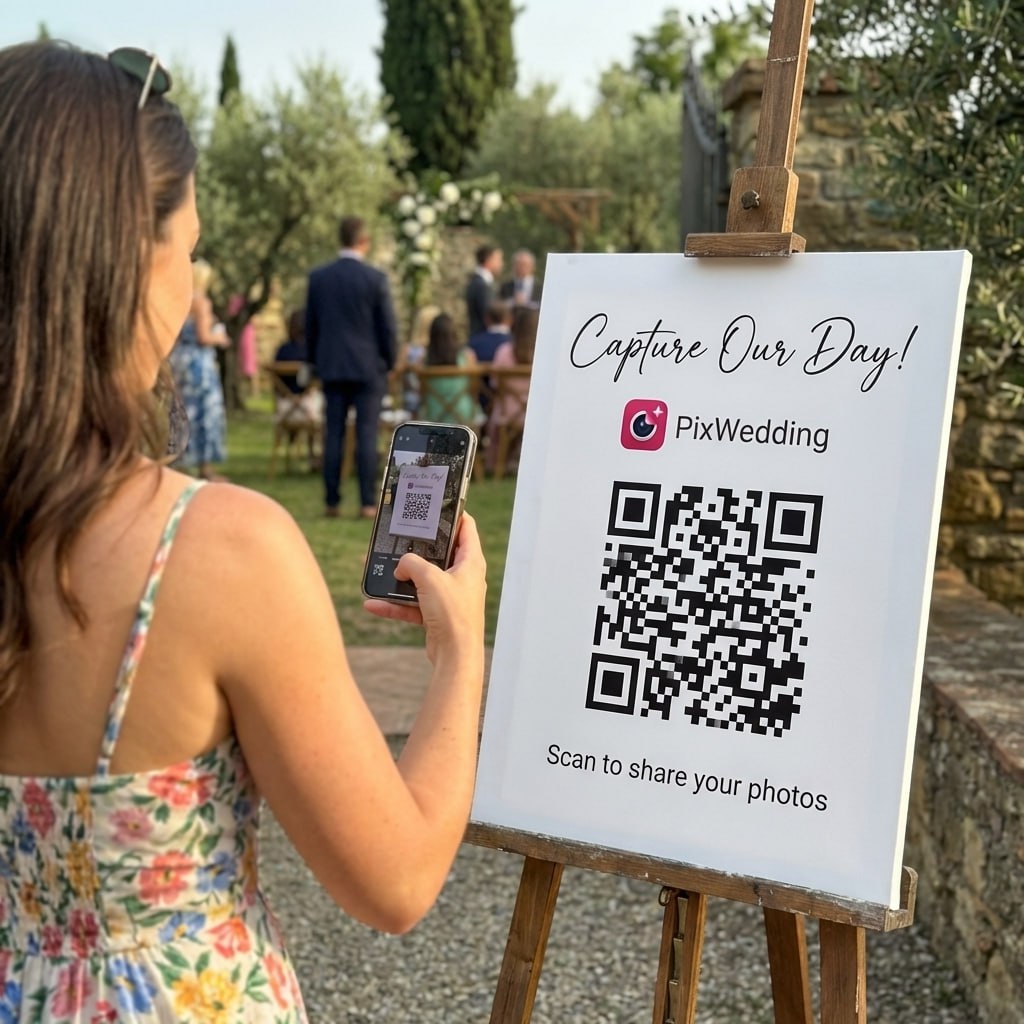
The demo below is a wedding album, but the QR upload and live gallery flow works identically for corporate events.
The real Pix Wedding demo album, exactly what your guests see after scanning the QR code.
How in-app photo sharing boosts attendee engagement
This official EventMobi video shows how conference organizers use in-app photo sharing to lift attendee participation, a useful reference before you finalize the IT and branding checklist above.
Four B2B events, four real outcomes
These scenarios reflect the range of business events that benefit from a no-app photo sharing setup.
Tech conference, 1,200 attendees
A SaaS company running its annual developer conference added a QR code to every badge lanyard and printed a second code on the conference app's offline page. By day two, 847 attendees had uploaded at least one photo. The total archive: 6,400 images. The marketing team used 214 of them in a post-event LinkedIn campaign that reached 380,000 impressions without a single stock photo.
Charity gala, 340 guests
A nonprofit raised $1.2 million at their annual gala. The event team wanted donor photos for the stewardship report but did not want to rely on a hired photographer to capture candid table moments. They placed a QR card at every table setting. 218 guests uploaded 1,100 photos. The development director said the donor-submitted photos were warmer and more genuine than anything from the professional shoot.
Product launch, 85 guests
A consumer hardware company launched a new device at a private press and influencer event. Guests received a QR code that opened a branded album pre-loaded with product shots and embargo-safe press images. The album doubled as the official press kit. Journalists uploaded their own shots and could download the official assets in the same visit. Zero emails asking for the media pack arrived after the event.
Quarterly all-hands, 520 employees
A remote-first company holds quarterly in-person all-hands meetings twice a year. They tried Slack and SharePoint for photo sharing in previous quarters. Participation was under 8 percent. After switching to a QR album page printed on table tents, 61 percent of employees uploaded at least one photo during the event day. The head of people operations called it the highest-participation internal moment they had ever run.

Keynote
Branded album
One platform. Every event. Branded.
Pix Wedding white-labels your corporate event album with your logo, custom domain, and SSO. Attendees scan one QR. Marketing gets every photo.

From Mom
Scan to join the album
No app, no account
UPLOADING
Saving your moment
THE ALBUM
Emma & Jack
June 21, 2026
647 photos · 95 guests






SCAN TO TRY
pix.wedding/
your-wedding
How to think about cost without a pricing matrix
Most event photo platforms price by guest count or by storage volume. A useful mental model: if the platform costs less than one line item on the catering invoice, it is probably the right budget allocation for a corporate event. Plans for events from 50 to 5,000+ guests typically start around the cost of a coffee per attendee, and the per-unit cost drops sharply above 500 guests.
The cost that matters most is not the platform fee
It is the opportunity cost of not having the photos. A post-event LinkedIn campaign built on 3,000 attendee-submitted images will outperform one built on 40 professional shots. The platform fee for most events is a rounding error compared to the marketing value of the archive.
What you are actually buying
You are buying: a branded album page, a QR code that every attendee can scan, a no-friction upload flow, a GDPR-aware data path, and a clean export that your marketing team can use the next morning. The platform fee covers the infrastructure; the value is the archive that lives past the event.
Watch out for storage overages
Some platforms advertise a low base fee but charge per gigabyte above a threshold. A 500-person event where everyone uploads three full-resolution photos can easily hit 15 to 20 GB. Confirm whether the storage ceiling covers your expected upload volume before you sign, or negotiate an unlimited storage add-on.
8 branding and customization features worth asking about
The attendee experience starts the moment they scan the QR code. Generic platform pages with your event name typed in a text field are not the same as a branded album that feels like an extension of your event design.
Custom album cover
Upload a hero image and event logo that appear the moment an attendee scans the QR code. First impressions matter even for internal events.
Vanity URL or custom domain
Point a subdomain like photos.yourconference.com at the album. Attendees see your brand in the address bar, not a third-party domain.
Logo watermark on previews
Every photo shared from the album carries your event logo on the preview image, extending brand reach every time a photo is shared on social.
Color-matched UI
Primary and accent colors match your event brand guide so the album page feels like an extension of your event site, not a separate tool.
Custom welcome message
Set an event-specific greeting that appears above the upload button. Use it to reinforce the photo release consent language or add a sponsor acknowledgment.
Organizer support chat overlay
Some plans embed a live chat widget that reaches your event team, not the platform support queue, so attendee questions get answered by someone who actually knows the agenda.
Branded download page
When you send the post-event download link to attendees, the page they land on shows your branding, not a generic cloud download screen.
White-label admin dashboard
If you are an agency running events for multiple clients, a white-label option lets you present the platform as your own product during client handoffs.
A quick decision framework for your event
Skip the vendor comparison spreadsheet for a minute. These are the branch points that actually decide what you need.
If: Under 100 attendees, all internal, no EU data subjects
Then: A lightweight browser-based album is enough. Skip the DPA conversation, keep setup under 20 minutes.
If: Any EU attendees, regardless of headcount
Then: Require a signed Data Processing Agreement and confirm EU or EEA data residency before you sign anything.
If: External guests, press, or clients attending
Then: Rule out SharePoint or Teams folders. External parties without a company login cannot access them.
If: The photos feed a marketing campaign afterward
Then: Confirm full-resolution export to your own storage, not just in-app viewing or compressed previews.
If: Managed corporate devices with app-install restrictions
Then: Browser-based, no-install upload is not optional. It is the only path that reaches every attendee.
If: Multi-day conference with parallel tracks
Then: Look for sub-albums by session or day, plus a custom domain so each track can be promoted separately.
If: One-off 50-person dinner or offsite
Then: Do not over-engineer it. A single QR code and a same-day export handles the whole job.
If: Recurring quarterly or annual event
Then: Negotiate an annual contract instead of paying per-event; ask about a white-label option if an agency runs it for you.
The data and law behind this guide
Every figure and legal claim above traces back to one of these primary sources. Read them directly before you brief legal or procurement.
GDPR right to erasure
The full legal text on when EU data subjects can require deletion of personal data, including photos of identifiable people.
gdpr-info.eu →ICOUK guidance on right to erasure
Plain-language guidance from the UK Information Commissioner's Office, useful for briefing a non-legal event team.
ico.org.uk →63%Enterprises struggling with device policy enforcement
ElectroIQ's 2026 BYOD security research, cited above for why app-install-free upload matters on managed devices.
electroiq.com →$2.5-4.5kFull-day corporate photographer rate
Strata Booth's 2026 corporate event photography pricing guide, the benchmark used in the comparison table above.
stratabooth.com →Keep reading
Related guides on event photo collection and sharing without app friction.
Why the B2B event market is underserved by photo sharing tools
Most photo sharing apps were designed for consumer use cases: birthdays, vacations, and weddings. The assumption baked into their design is that everyone in the group knows each other, has a personal device, and will happily hand over a phone number or email to sign up. None of those assumptions hold at a 600-person tech conference.
Corporate attendees arrive with managed devices, strict app-install policies, and calendars too full to fiddle with onboarding flows. The event planner who tells 600 engineers to 'just download the app' will receive photos from approximately 30 of them. The planner who drops a QR code on every badge holder and conference desk will hear camera shutters all day.
The gap is a platform that handles enterprise concerns (IT, legal, brand) while keeping the attendee experience as frictionless as a consumer product. That is the bar to clear.
- •63% of enterprises report difficulty enforcing consistent security controls across the personal devices and apps employees bring to work, per ElectroIQ's 2026 BYOD security research
- •No-app browser upload removes the device-management conflict entirely
- •Branded album pages lift perceived event quality and reinforce brand recall after attendees leave
- •A clean ZIP export of full-resolution files is table stakes for any event that produces marketing or press materials afterward
Branding, archive, and the after-event window that most teams miss
The photos collected at a corporate event have a second life: internal newsletters, LinkedIn posts, website case studies, press releases, and next year's event marketing deck. That second life is only possible if you export originals, not compressed thumbnails, before the platform's retention window closes.
Teams that treat the photo album as a day-of activity and then forget about it lose this window. Build the export step into the event debrief checklist, the same way you reconcile the catering invoice and collect name badges. It takes six minutes and the output is potentially thousands of high-resolution images that your marketing team would otherwise pay a photographer to recreate.
Explore more free wedding tools
Everything you need to make your wedding day stress-free and unforgettable.
QR Sticker Designer
Design custom print-ready stickers.
Hashtag Generator
Create unique wedding hashtags.
How to Collect Guest Photos
5 methods ranked by participation rate and ease.
Share Wedding Photos with Guests
Compare every sharing platform by ease and participation.
Best Way to Get Guest Photos
The single method with the highest participation rate.
How to Make a Shared Wedding Album
Step-by-step setup for every platform.
Alternative to Disposable Cameras
Better, cheaper options than disposable cameras.
Alternative to Wedding Photo Booth
5 cheaper alternatives to a $1,000+ photo booth rental.
Business event photo sharing, answered
Straight answers to the questions people ask most about this topic.
No. The right platform opens in any phone or laptop browser via QR code or a short link. Attendees scan, upload from their camera roll or take a live photo, and move on. No account creation, no App Store visit, no Google Play redirect. This matters especially at large conferences where you cannot control what software people have on corporate-managed devices.
Yes, when the core capability is the same: private album page, QR access, no-app upload, branded landing, and clean export. The same infrastructure that handles 200 wedding guests handles 800 conference attendees. You swap the logo, colors, and event name; the mechanics are identical. Pix Wedding for business events uses the same engine with your brand on top.
On a properly structured platform, the event organizer (your company or client) owns the photos. Reputable providers do not claim a license to use attendee-uploaded images for their own marketing without explicit opt-in. Always confirm this in the terms of service before you commit to any platform, especially for events where attendee consent is governed by an NDA or internal policy.
If your event includes EU attendees, the platform must support data residency in the EU or EEA, provide a documented right-to-erasure (right to be forgotten) process, and not transfer personal data to third countries without adequate safeguards. You are the data controller; the platform is the data processor. Ask any vendor for their Data Processing Agreement (DPA) before signing.
A properly scoped platform offers access-role controls: the album is private by default, accessible only via the unique QR code or link that you distribute. Some platforms add a second layer such as an event passcode or domain-restricted access (company email only). The QR code itself is not indexed by search engines and will not surface in a Google Image Search.
On most platforms, photos are deleted after a retention window (30, 90, or 365 days depending on the plan). A good platform lets you export the full archive to your own cloud storage (S3, Google Cloud Storage, Azure Blob) before that window closes. Set a calendar reminder at least 14 days before the retention deadline. Losing 3,000 event photos because you forgot the deadline is a real and avoidable problem.