
The QR Setup That Actually Fills a Wedding Album
One code per table, a table-tent card that says one thing, an MC line timed right, and a single reminder the morning after. That is the whole rig.
Details drawn from real, anonymized weddings on our platform.
Why the setup matters more than the guest list
Every wedding photo album lives or dies on a handful of small decisions made before a single guest arrives: where the codes go, what the card says, whether anyone announces it, and whether anyone reminds people afterward. None of that requires a big budget or a tech-savvy wedding party. It requires doing five specific things correctly, in order, and then leaving the system alone.
Most of what determines whether an album fills up or stays nearly empty is not the venue, the guest count, or how outgoing the crowd is. It is whether the couple treated the QR rig as a five-minute planning task or an afterthought taped to a sign near the gift table. This page is the rig, laid out step by step, drawn from patterns we see across real weddings on our platform.
Nothing below depends on any one couple, any one city, or any one guest count. It is a repeatable setup that works whether the reception has twenty tables or two.
The setup, step by step
Six steps, done once before the reception starts. Nothing here requires monitoring the album during the event.
- 1
Print one QR code per table
Generate a QR code that links straight to the upload page, no login and no app required, and print one for every seated table plus a spare for a standing or lounge area. A code that is not physically in front of a guest gets forgotten.
- 2
Design a table-tent card that says one thing
One instruction in plain language, a QR code sized to scan from an arm's length across a place setting, and nothing else competing for the guest's attention. Cards get skimmed, not read carefully, so simplicity is the whole design brief.
- 3
Place cards during the room reset, not before
Have the venue staff or a member of the wedding party place cards during the final room turnover, after linens and place settings are done, so cards do not get knocked over, covered by a plate, or lost to an earlier furniture rearrangement.
- 4
Give the MC one scripted line
Hand the MC a single written sentence pointing guests to the table card, timed for a natural pause in the evening such as right after the toasts, not buried inside a longer welcome speech guests are only half listening to.
- 5
Let it run itself during the reception
Do not assign anyone to manage a photo station or check upload counts during the event. The entire point of the rig is that it works unattended once it is placed and announced. Managing it during the reception defeats the purpose.
- 6
Send a single morning-after reminder
The next morning, send one short message to the guest list or wedding party group chat: the album is still open, here is the link again. One message, sent once, is the most valuable five minutes in the entire setup.
Designing the table-tent card
The card is doing one job: getting a guest from "notice it exists" to "scan it" in under two seconds of attention. Anything that slows that down, a paragraph of instructions, a hashtag guests have to remember and type later, a URL they are expected to type by hand, works against the whole point of using a QR code in the first place.
Size matters more than most couples expect. A code printed small enough to fit in a corner of a place card often ends up too small to scan comfortably from a seated position across a round table. A standalone card, roughly the size of a folded place card or slightly larger, with the code taking up most of the visible face, scans far more reliably.
Keep the wording to a single sentence. Something close to "Scan to add your photos to our album" does the job. Avoid stacking a QR code, a hashtag, and a written URL on the same card. Guests will default to the path of least effort, and if the card offers three options, most will take none of them.
Scan to add your photos to our album
No app. No account. Just your camera.
One instruction, one code, nothing competing for attention. That is the entire design brief.
Placement: where the cards actually go
Every seated table, no exceptions
A code goes on every table, including the head table and the kids' table if there is one. The goal is that no guest has to leave their seat to find a code.
One extra for standing or lounge areas
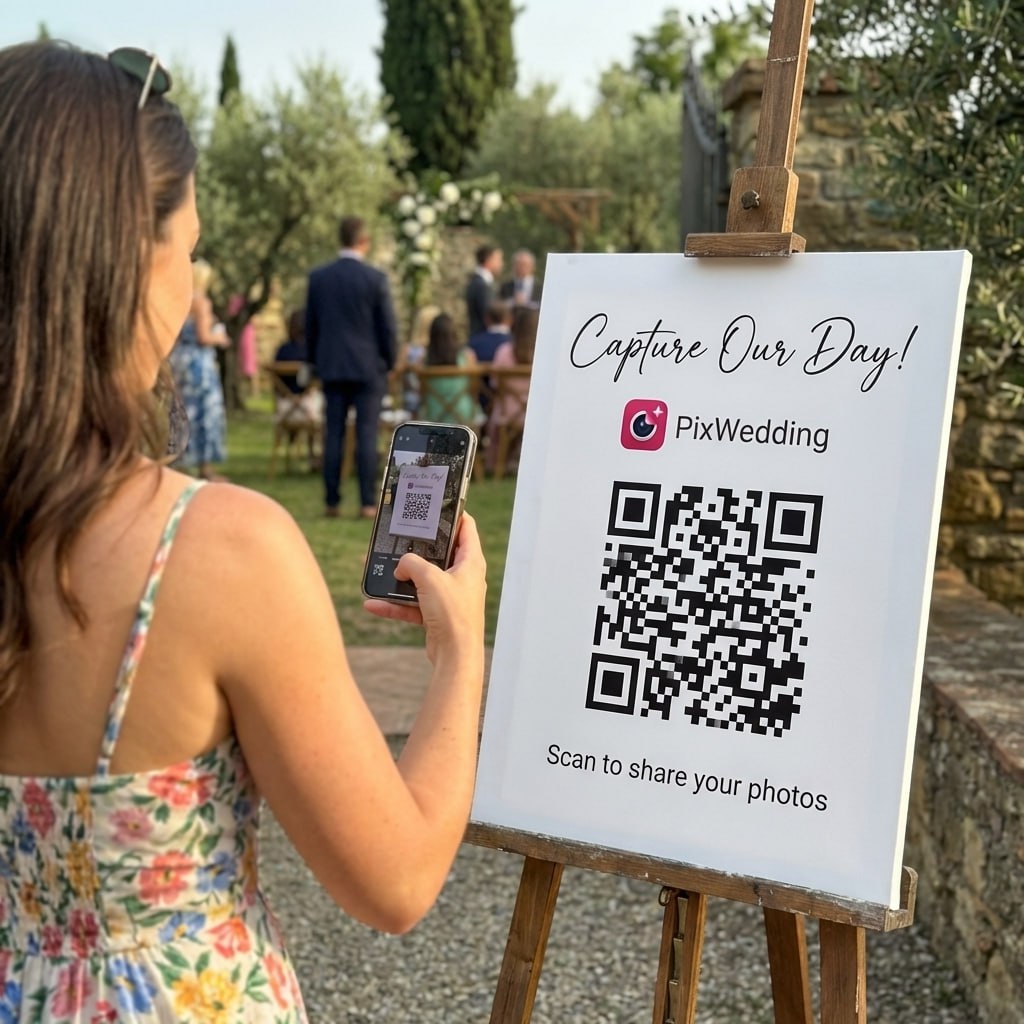
Cocktail hour spaces, a lounge corner, or an outdoor patio area that is not part of the seated plan gets its own sign, not a card, since there is no table surface to prop a card on.
Near the guest book, not instead of it
If there is a guest book or memory table, a small standing sign next to it catches guests who linger there but skipped the dinner tables entirely.
Not at the entrance or gift table
Codes placed only near the entrance get seen once, on the way in, before guests have anything to photograph yet. Save entrance signage for logistics, not the photo album.
The MC line, and when to use it
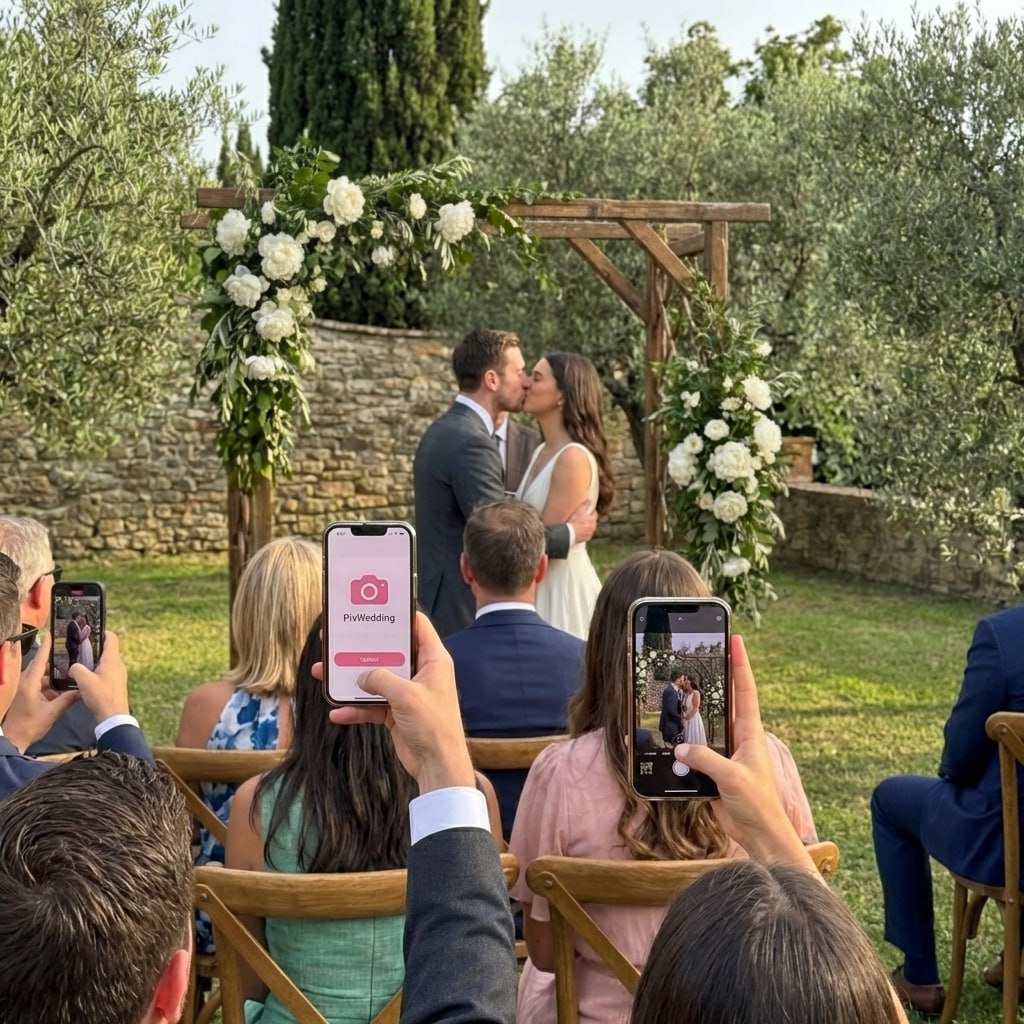
A table card alone catches guests who happen to notice it. An MC announcement catches everyone in the room at once, which is why the two together outperform either alone. The line does not need to be clever. It needs to be short, clear, and timed for a moment when guests are actually listening.
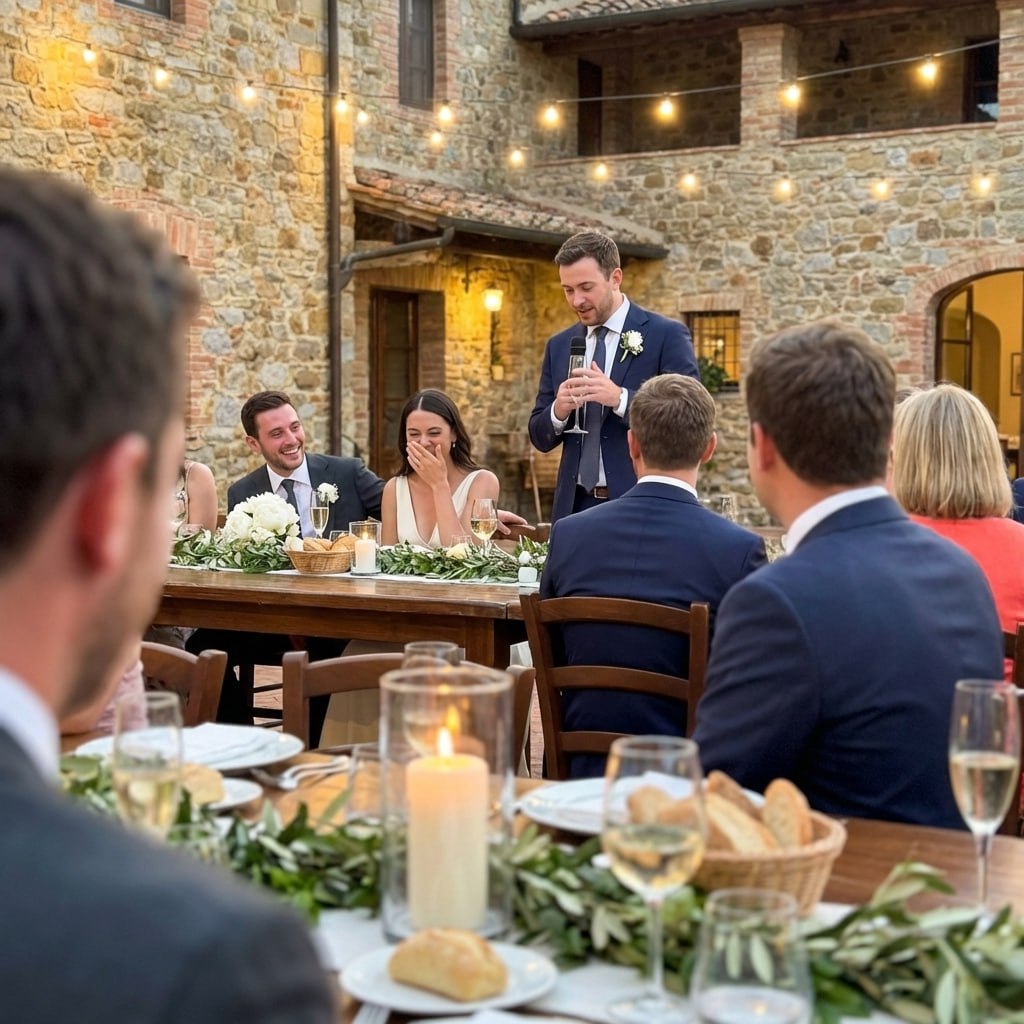
Avoid the welcome speech. Guests are still finding seats, greeting tablemates, and settling in, and an announcement competing with that noise gets lost. The better windows are right after the toasts, when the room is already quiet and attentive, or just before the first dance, when guests are looking for something to do while the dance floor clears.
Example MC script line"Before we get the dance floor going, take a look at the card on your table. Scan the code and add your photos from tonight, we want to see the wedding through your eyes too."
Written down and handed to the MC in the run sheet, not left to memory. A scripted line does not get accidentally skipped when the evening runs long.
The single morning-after reminder
Most of the setup happens before the reception. This last step happens after it, and it is the one couples forget most often, usually because they are exhausted, traveling, or simply not thinking about the album anymore. It is also the single most valuable five minutes in the entire rig.
Most guest uploads do not land during the reception itself. A meaningful share of any album fills in after the wedding day is already over, once guests are home, going through their camera roll, and deciding what is worth sharing. See our guest photo timing data for the full curve. One clear reminder the next morning catches that wave. Skipping it means leaving a real share of the album on guests' phones, unshared.
"Good morning! Thank you again for celebrating with us. Our photo album is still open if you have not added your photos from last night yet, here's the link again: [album link]. We would love to see the day through your camera too."
One message, sent once. A second or third follow-up starts to feel like nagging and produces diminishing returns. Say it clearly the first time and let it stand.
Why placement matters more than coverage
Across real weddings on our platform, the typical album lands close to the median: 149 photos from about 8 unique guest uploaders. Averages get pulled higher by a small number of very large albums, so the median is the more honest number to plan around. Full methodology on our guest photo upload statistics page.
What that number tells the couple planning their own setup is that volume comes from a few enthusiastic guests, not from the whole room. The largest single album on record in our data reached 1,365 photos, and it came from just 3 uploaders, not from a huge guest list. A big album is a small number of people uploading a lot, not a large number of people uploading a little each.
That is the entire logic behind the placement rules above. The QR code needs to be where the eager guests already are, at their own table, in front of their own seat, not tucked away at a single central station they would have to walk to. A handful of enthusiastic uploaders drive most of the album, and the rig above is built around making it as easy as possible for exactly those guests, wherever in the room they happen to be sitting.
Watch: What Real-Time Guest Photo Sharing Looks Like
Source: Kululu - Event Photo Sharing App, "Kululu - Event Photo Sharing with QR code + Live Photo Wall."
Mistakes that quietly empty an album
None of these are dramatic failures. They are small omissions that, together, are the difference between a full album and a nearly empty one.
One central station instead of one per table
A single QR sign near the entrance or gift table requires a guest to notice it, remember it, and walk over. Most never do, even if they would gladly have scanned a code already in front of them.
No MC announcement at all
A table card alone reaches only the guests who happen to look down and read it. Skipping the announcement cuts reach roughly in half for no reason.
Forgetting the outdoor or cocktail space
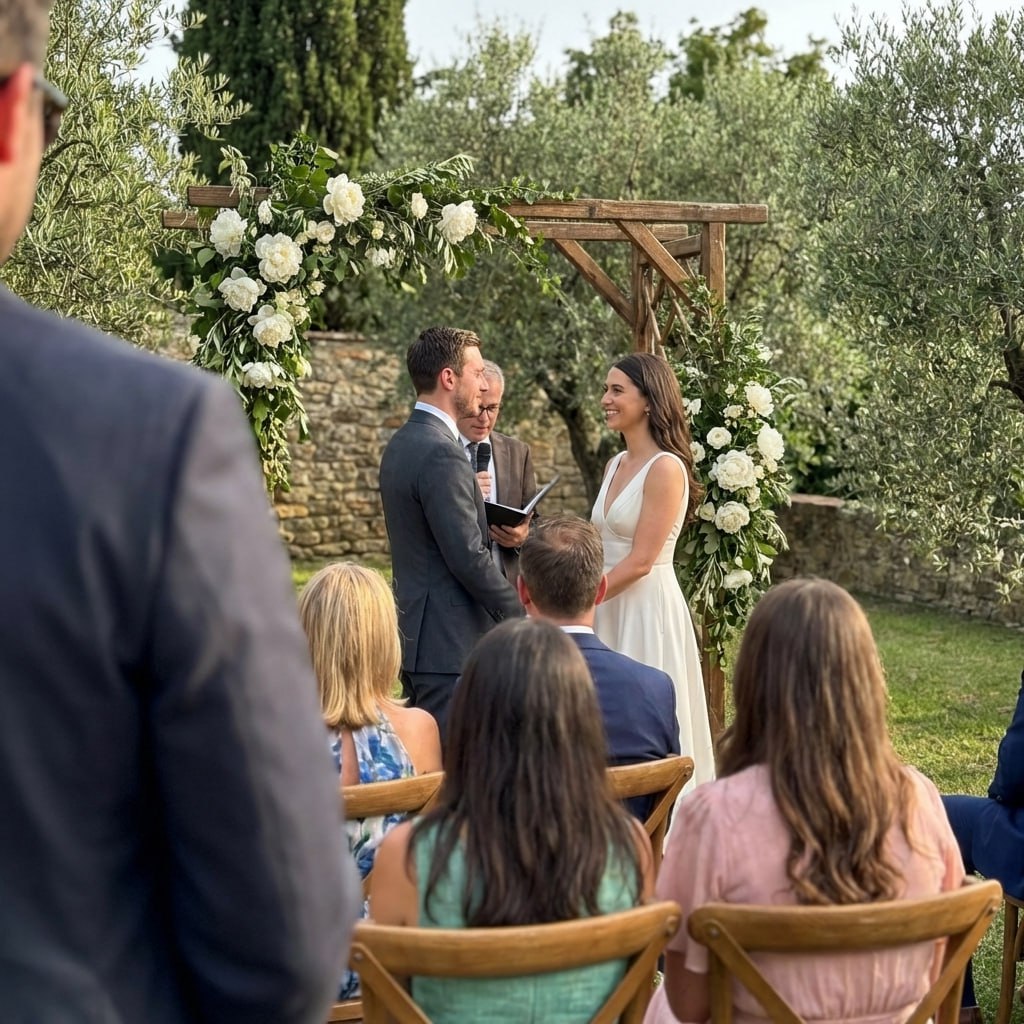
A ceremony lawn, a separate cocktail terrace, or an after-party space that is not part of the seated dinner plan needs its own sign. Treating the reception room as the whole venue misses guests who spend real time elsewhere.
Never sending the morning-after reminder
This is the single most common gap. The couple is exhausted, traveling, or simply forgets, and a meaningful share of the album that would have arrived the next day never gets sent at all.
A code too small to scan from a seat
Squeezed into the corner of a place card, a tiny QR code often fails to scan from arm's length at a round table. Guests give up after one failed attempt far more often than they try twice.
No laminated backup copy
Paper cards get knocked into a wine glass or lost during the room reset. A couple of laminated spares, kept with the wedding-day emergency kit, solve this for the cost of printing two extra cards.
Adapting the rig to different venue layouts
| Venue layout | What changes about the setup |
|---|---|
| Single room, seated reception | The base rig applies as written. One card per table, one MC line, one reminder. |
| Outdoor ceremony, indoor reception | Add a standing sign near the ceremony seating or program table, since the ceremony itself has no tables to place a card on. |
| Cocktail hour in a separate space | A standing sign near the bar or appetizer station covers the gap between arrival and the seated dinner, when guests are most likely to be taking casual photos of each other. |
| Multiple reception rooms | Every room gets its own full set of table cards. Guests do not carry a card from one room to another in their head, so each room needs to be self-sufficient. |
| Destination wedding, smaller local guest count | The rig scales down cleanly. Fewer tables means fewer cards, but the MC line and the morning-after reminder matter just as much on a ten-table wedding as a forty-table one. |
The setup checklist, printable
Copy this into your own wedding-day checklist. Every item takes minutes, not hours, and none of it requires managing anything during the reception.
What this rig does, and what it does not replace
A well-placed QR rig fills an album with candid, wide-angle coverage from the people who were actually sitting at each table, arriving faster than any professional gallery ever will. It does not replace a hired photographer, and it is not meant to. The two serve different needs on different timelines.
What the setup above changes is whether that guest-side coverage exists at all. Without a deliberate rig, most of those photos simply stay on individual phones, seen once by the person who took them and never shared with the couple. The steps on this page are the difference between that outcome and an album guests actually fill.
Related reading on guest photo behavior
The data, the founder's take, and the timing curve this setup is built around.

First dance
You guys!!
Set up the QR rig that actually fills the album
Free to start. One code per table, up in a few minutes, no guest downloads.
From Mom
Scan to join the album
No app, no account
UPLOADING
Saving your moment
THE ALBUM
Emma & Jack
June 21, 2026
647 photos · 95 guests


SCAN TO TRY
pix.wedding/
your-wedding
If you are setting this up for your own wedding
Treat the QR rig like table settings, not like technology. It gets planned in the same pass as escort cards and centerpieces, it gets placed by the same people doing the room reset, and it gets forgotten about once the reception starts. The couples who get a full album are not the ones who work hardest on the night, they are the ones who did the five-minute setup correctly beforehand.
The one thing worth protecting on your own checklist is the morning-after reminder. It is the cheapest step in the whole rig and the easiest one to forget once the wedding is actually over and you are exhausted. Set a phone reminder for the next morning before the wedding even starts.
If you are a planner or venue coordinator running this across multiple weddings
The setup steps here do not change much between an 80-person backyard reception and a 300-person ballroom. What changes is the number of cards you print and whether you need a second code for a separate cocktail space or an outdoor ceremony area. Build a laminated master card template once and just swap the QR code and couple's names per event.
The MC script line is worth standardizing across every wedding you run. A short, consistent line handed to the MC in the run sheet removes the risk of the announcement getting skipped entirely when the evening runs long, which is the single most common way a otherwise well-placed QR rig underperforms.
Explore more free wedding tools
Everything you need to make your wedding day stress-free and unforgettable.
QR Sticker Designer
Design custom print-ready stickers.
Hashtag Generator
Create unique wedding hashtags.
How to Collect Guest Photos
5 methods ranked by participation rate and ease.
Share Wedding Photos with Guests
Compare every sharing platform by ease and participation.
Best Way to Get Guest Photos
The single method with the highest participation rate.
How to Make a Shared Wedding Album
Step-by-step setup for every platform.
Alternative to Disposable Cameras
Better, cheaper options than disposable cameras.
Alternative to Wedding Photo Booth
5 cheaper alternatives to a $1,000+ photo booth rental.
Questions about setting up the QR rig
Straight answers to the questions people ask most about this topic.
One per seated table is the baseline, plus one extra for any area where guests stand rather than sit, such as a lounge corner, cocktail area, or the bar. The goal is that a guest is never more than a glance away from a code, since walking somewhere to find one is the biggest single reason a guest never scans at all.
One instruction, in plain language, is enough. Something like "Scan to add your photos to our album" next to a QR code large enough to scan from across a place setting. Cards that add a hashtag, a URL to type manually, or multiple instructions tend to get skimmed past rather than acted on.
Yes, a single scripted line works better than leaving guests to notice the table cards on their own. The best timing is a natural pause in the evening, such as right after the toasts or just before the first dance, rather than buried inside the welcome speech when guests are still finding their seats.
No. The QR code should link directly to a browser upload page. Requiring an app install is one of the most common reasons a guest abandons the process before uploading a single photo, particularly for guests who are cautious about installing unfamiliar software during someone else's wedding.
Because most guest uploads do not happen during the reception itself. A large share of the album fills in after the wedding day is over, once guests are home and going back through their camera roll. See our guest photo timing data for the full curve. One clear reminder the next morning, sent once and not repeated, catches that wave without feeling like nagging.
It changes reach more than it changes the ceiling. Our platform data shows the typical wedding album lands around the median: 149 photos from about 8 unique guest uploaders. The volume in any album comes from a handful of enthusiastic guests rather than the whole room, and the largest album on record, 1,365 photos, came from just 3 uploaders. Placing a code where those few enthusiastic guests already are, at their table, in their hand, matters more than covering every square foot of the venue.