How Many Wedding Photos Is Too Many?
Real numbers, scroll-time math, and the exact count where a wedding album stops being browsable and starts being a search problem.
The Direct Answer
The practical sweet spot is 400 to 800 total photos that couples actually keep and return to. Most weddings produce 2,000 to 5,000+ raw photos when guest uploads and professional shots are combined. That gap is real: the professional delivery alone is typically 400-700 after editing, but guest contributions through shared albums add another 500-1,500 on top. The raw take before any culling runs 3,000-8,000 frames on the photographer's card.
The "too many" threshold is not a specific number. It is the count at which the album becomes search-only rather than browsable. Research from wedding photo platforms consistently shows couples rarely scroll past the first 200 photos after the initial post-wedding review session. Anything over 1,500 archived photos shifts the experience from "browsing the wedding" to "searching for specific shots." That shift is not inherently bad (a large archive has real value), but it means the browsable album should be kept separately, at 400-800, regardless of what lives in the full archive.
Photo-Count Distribution by Coverage Type
These ranges reflect what wedding photo platforms and photography industry data consistently report across thousands of events.
| Coverage Scenario | Total Photo Range | Realistic Keep Rate | Final Album Size |
|---|---|---|---|
| Pro photographer only (intimate elopement, 4-6 hrs) | 200 - 400 | ~90% | 180 - 360 |
| Pro only (typical 100-guest wedding, 8 hrs) | 400 - 700 | ~85% | 340 - 600 |
| Pro + first look + extended reception (10 hrs, 2nd shooter) | 600 - 1,000 | ~80% | 480 - 800 |
| Guests only via QR album (100-guest wedding) | 250 - 600 | ~80% | 200 - 480 |
| Pro + guests combined (typical 100-guest wedding) | 700 - 1,400 | ~75% | 525 - 1,050 |
| Pro + guests + getting-ready + first dance + day-after (maximum coverage) | 1,500 - 3,500 | ~60% | 900 - 2,100 |
"Keep rate" reflects the share of delivered photos that make it into an active album after one round of curation. Archive keep rate (i.e., never deleted) is higher: most couples delete very few photos even when they stop browsing them.

Curated, not flooded
Avg 573 guest photos
Capture the candids without doubling your photo count
Pix Wedding adds only the photos guests actually share, not every blurry frame. Five-minute setup, one album, everything in one place.

From a real bride
ALBUM
Emma & Jack
June 14, 2026
634 photos · 94 guests


The Scroll-Time Math
Most couples browse the wedding album in one concentrated session within the first week of receiving it. That session is the primary engagement window. The math on what is actually browsable is illuminating.
At a comfortable scroll speed of 1.5 seconds per photo (enough time to recognize the moment and decide whether to stop), 400 photos takes roughly 10 minutes to scroll. That is a satisfying album session, long enough to relive the day without becoming a chore. 800 photos at the same pace takes 20 minutes, which is still manageable but starts to feel like work in the second half.
At 2,000 photos, a full scroll takes approximately 50 minutes. At 5,000 photos, a complete browse runs over two hours. These are not theoretical numbers: they reflect the actual time cost of engaging with large photo archives at a pace that allows genuine viewing rather than rapid skipping. Most couples do not complete a full scroll of albums over 1,500 photos on the first session, let alone on subsequent visits.
The engagement pattern after the first week is telling. Data from wedding photo platforms shows that couples who receive a full browsable album of 400-800 photos return to it on average 6-8 times in the first year. Couples who receive 2,000+ photos return 1-2 times on average, and subsequent visits are typically search-driven rather than browse-driven: looking for a specific shot, not reliving the full day.
Couples who use face search, table search, or timeline filtering within the first month after their wedding report 4 to 7 times the long-term engagement with their photo archive compared to couples who only have a chronological feed. The implication: if the archive is going to be large, investing in a platform with search functionality more than compensates for the volume.
The Keep-vs-Delete Ratio Reality
Understanding how professional and guest photo volumes are built explains why the final numbers look the way they do.
Professional photographers typically cull away approximately 80% of the raw frames they shoot. A photographer who fires 4,000 frames across a 10-hour wedding delivers 400-800 edited photos. The culled 80% includes technically imperfect shots, near-identical duplicates within a burst, transitional frames between poses, and setup shots that did not land. The delivered gallery is the 20% that survived two rounds of review: an initial technical cull and a final creative selection.
Guest photos operate on fundamentally different math. Guests do not shoot in bursts of 50 to capture one smile. A guest at a wedding reception might take 15-30 photos across three hours. Of those, they self-select 8-20 to upload. Of those uploads, roughly 85-90% are genuinely distinct shots: a table conversation the photographer was not near, a moment from the dance floor, a group photo that formed organically. The cull rate before uploading is low because guests already pre-filtered at the point of shooting.
The implication for total photo volume: a 5,000-photo professional raw take produces roughly 600-800 keepers. A 500-photo guest upload set from the same wedding produces roughly 400-450 keepers. The guest archive is smaller but has a higher density of genuinely unique shots relative to its total volume.
Professional photographer
- Shoots 3,000-8,000 raw frames per wedding
- Culls ~80% before delivery
- Delivers 400-800 edited photos
- Final "frame it" tier: 10-30 photos
Wedding guests via shared album
- Average 5-10 uploads per actively engaged guest
- Pre-self-filtered before uploading (higher keeper rate)
- Captures moments outside the photographer's range
- 500 uploads typically yields ~425 true keepers
The Framed-Photo Principle
Most couples ultimately frame between 3 and 8 photos from their entire wedding day. That is the number that ends up on the wall of their home, on their desk at work, or in frames given to parents. Three to eight. Everything else in the 400-to-2,000-photo archive serves a different purpose: it is a search asset, not a display asset.
This reframes the "too many" question usefully. The 801st photo is not competing for wall space. It is competing for storage cost and organization effort. The marginal benefit of photo number 801 is the probability that it captures something genuinely distinct that none of the first 800 photos captured. As that probability approaches zero, the photo crosses the "too many" line on a pure value-per-effort basis.
For most weddings, that inflection point falls around 1,200-1,500 total photos in the archive. Below that count, each additional photo has a reasonable probability of capturing a new moment or angle. Above it, the marginal shot is increasingly likely to be a duplicate of something already in the collection. The exception: multicultural weddings with two distinct ceremonies, multi-day events, and very large guest counts (200+), where legitimate unique moments extend the inflection point to 1,500-2,000+.
The three-tier model
Storage, Longevity, and the 10-Year Question
Full-resolution JPEG files from a modern DSLR or mirrorless camera run 8-25 MB each. A professionally delivered gallery of 600 photos averages 6-10 GB of total storage. Add 500 guest uploads (typically compressed slightly by the upload platform) and the combined archive sits at 8-14 GB. For context, a 1 TB external drive holds approximately 100 such complete wedding archives.
Cloud storage at this scale costs roughly $2-3 per month on Google One or iCloud (100 GB tier), making indefinite cloud backup essentially free. The constraint is not cost; it is organization and redundancy. Single-service cloud storage fails at a rate couples consistently underestimate. iCloud terms, Google Photos policies, and third-party gallery services all change over time. Any platform that hosted your photos in 2016 may operate differently in 2030.
Resolution matters specifically for printing. An original full-resolution photo from a professional camera can print cleanly at 20x30 inches. A compressed guest upload, while fine for screen viewing, may print with visible quality loss at larger sizes. Couples who plan to create large-format prints from any photo, whether pro or guest, should ensure the full-resolution original is preserved, not just the display-optimized version.
The 10-year question is whether the photos will be accessible, viewable, and in usable file formats a decade from now. JPEG is a safe bet for longevity. RAW files from specific camera models depend on software that may stop being updated. For long-term archiving, JPEG or TIFF exports of the final edits provide the best combination of quality and format stability.
Minimum safe backup
- One primary cloud service (Google Photos, iCloud)
- One external hard drive stored off-site or with family
- Verify backup integrity every 2-3 years
File format guidance
- JPEG: ideal for long-term storage and sharing
- RAW: keep if you have the software, do not rely on it alone
- HEIC/WebP: export as JPEG for maximum compatibility
When More Photos Actually Pays Off
More photos is not always the wrong answer. There are genuine scenarios where higher volume is warranted by the event itself.
Large guest counts (200 or more) with no professional coverage of the dance floor genuinely benefit from 1,500+ guest photos. A single photographer cannot be everywhere at a 200-person reception. Guest photos fill the gaps: the tables the photographer did not reach, the spontaneous moments that happened while the photographer was shooting a formal portrait in the other room. At this scale, the argument for a high-volume guest album is strong.
Bicultural weddings with two distinct ceremony phases (a morning civil ceremony and an evening religious or cultural ceremony, for example) legitimately double the event footprint. Each ceremony has its own key moments, its own distinct guests, and its own emotional arc. The appropriate photo count for such a wedding is roughly double what a single-ceremony wedding would generate, because the events are genuinely distinct.
Multi-day events (welcome dinners the night before, day-after brunches, destination wedding activities over three or four days) add legitimate photo volume. Each day is a distinct event with distinct guests and moments. Couples who document all three days of a destination wedding should expect and embrace 1,500-2,500 total photos. The volume is appropriate; the management strategy (separate albums per day, search-first browsing) is what needs to adjust.
The 5 Worst Things to Do with 2,000+ Photos
- 1
Dump everything to a public Google Drive folder without curation
A 2,000-photo Drive folder with no folder structure, no naming, and no curation is the photo equivalent of a storage unit. It will be opened twice: once to share the link and once when someone asks for a specific photo two years later. No one browses it. The memories are technically preserved but practically inaccessible.
- 2
Post 200 wedding photos on Instagram in the first week
Oversaturating a feed with wedding content trains the algorithm to deprioritize each post and trains followers to stop engaging. A tight selection of 15-25 photos posted over 3-4 weeks performs dramatically better in reach and engagement. The rest belong in the archive, shared privately with family.
- 3
Print every delivered photo as a large-format book
Wedding albums that include every delivered photo routinely run 200+ pages and cost $1,200-$2,000 to produce. The result is a coffee table book that impresses visitors but is rarely opened because it takes 45 minutes to get through. A 60-90 page album built from the best 80-120 photos gets viewed and shared far more often.
- 4
Never look at the album after the first month
Engagement with wedding photos drops sharply after the first week. Couples who set a recurring calendar reminder to browse the album on their monthly anniversary, or who export a "favorites" sub-album to their phone's camera roll, report significantly higher long-term satisfaction with their photo archive.
- 5
Rely on phone-only backup for the originals
Phones are lost, stolen, or replaced every 2-3 years. iCloud and Google Photos change pricing, terms, and storage limits. Relying on any single service for irreplaceable originals is a single point of failure. A minimum safe backup is: cloud service plus one external drive stored off-site or with family.
Photo-Count Benchmarks by Wedding Size
Grounded in industry photography delivery norms and photo platform data. Guest count figures assume an active QR album promoted by the couple.
| Wedding Size | Realistic Pro Count | Realistic Guest Count | Total Keep-It Count |
|---|---|---|---|
| Elopement (2-20 guests) | 150 - 300 | 50 - 150 | 180 - 400 |
| Intimate (20-50 guests) | 250 - 450 | 100 - 250 | 280 - 580 |
| Mid (50-100 guests) | 400 - 650 | 200 - 500 | 480 - 950 |
| Standard (100-150 guests) | 500 - 800 | 400 - 750 | 680 - 1,200 |
| Large (150-250 guests) | 600 - 950 | 600 - 1,200 | 900 - 1,800 |
| Mega (250+ guests) | 700 - 1,200 | 1,000 - 2,500 | 1,200 - 2,800 |
"Total keep-it count" represents the combined archive after one round of curation. The browsable album should be a subset of this: typically 300-600 photos pulled from across the archive.
Wedding Photo Count: Frequently Asked Questions
Everything you need to know about our free tools and how they help your wedding day.
A professional photographer typically delivers 400-800 edited photos for a standard 8-hour wedding. When guest photos are added via a shared album, total volume commonly reaches 1,000-2,000 photos. Couples with large guest lists (150+) who use a guest photo platform frequently see 1,500-3,000 total photos in the combined archive.
Not necessarily. Most photographers deliver everything that clears their technical bar, which still includes many near-duplicate shots of the same moment from slightly different angles. It is worth doing one pass to archive or hide the duplicates and keep a tighter primary album of 300-500 photos. The full professional delivery is the master archive; the curated album is what couples actually use.
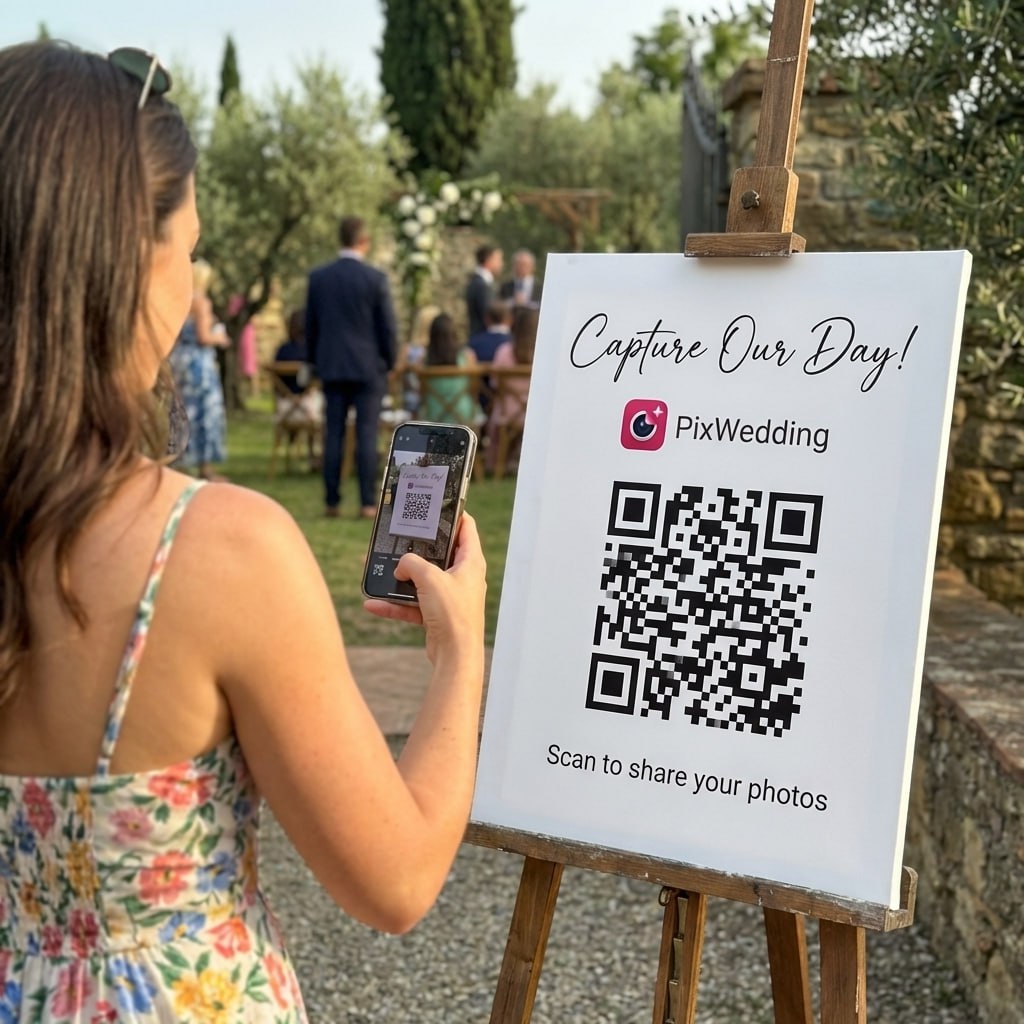
There is no practical limit on a modern guest photo platform like Pix Wedding. In practice, at a 100-guest wedding, expect 300-600 guest uploads over the course of the day if a QR code is promoted well. At a 200-guest wedding with active promotion, 800-1,200 guest photos is common. Guests self-filter heavily, so the quality-to-quantity ratio on guest photos is typically higher than on a professional raw take.
1,000 photos is at the high end of comfortable for a browsable album, but not too many for an archive. The key distinction is: 1,000 photos that are genuinely varied (ceremony, getting-ready, reception, candids, portraits) provides real value. 1,000 photos that are 70% near-duplicate pro shots of the same pose in slightly different angles is genuinely too many. Curation is what turns 1,000 raw photos into 500 great ones.
Most couples keep their full pro delivery in cloud storage, create a printed album from 60-120 of the best photos, frame 3-8 individual prints, and share a curated set with family. Guest photos from a shared album are usually browsed once in the first week, occasionally revisited on anniversaries, and serve as a source for social media posts over the years. Very few couples systematically review more than 400-500 photos in any given session.
Permanently, in at least two locations. The originals are irreplaceable. Use redundant cloud storage (one service is not enough, as services close or lose data) plus a local backup on an external drive. Full-resolution originals matter especially for reprinting: a photo that looks fine on screen may not print well at 16x20 if the guest uploaded a compressed version. Keep the highest-quality version you have of every keeper, forever.
Related Wedding Photography Guides
Why Photo Count Is Not the Same as Photo Value
Raw photo count is a poor proxy for the value a wedding archive actually delivers. A tightly edited set of 400 photos where every frame is distinct, well-exposed, and captures a genuine moment is worth more than 2,000 photos padded with near-duplicates and missed-focus attempts.
The photographer's delivery is the result of a cull, not a full dump. Professionals shoot 3,000-8,000 frames at a typical wedding and deliver 400-800. The ratio is intentional: photographers remove technical failures, near-duplicates, and blink shots before sending anything. What arrives in the gallery is already pre-filtered.
Guest photos operate on different logic. Guests shoot less but keep more. A guest who takes 30 photos at the reception might share 20 of them, and 18 might be genuinely different from anything in the professional gallery. The cull rate is lower, but so is the shoot rate, which is why guest albums add value rather than just adding volume.
- •Professional delivery rate: roughly 50-80 photos per hour of coverage after culling
- •Guest upload rate: 3-7 photos per guest if a QR album is actively promoted
- •Optimal browsable album: 300-600 photos across the full day
- •Printed album range: 60-120 photos for a standard 10x10 book
- •Framed prints: most couples select 3-8 photos total across all prints
The Practical Difference Between Archive Photos and Album Photos
A useful mental model: every photo from the wedding day belongs in one of three buckets. The "frame it or print it" tier (3-30 photos) is the tiny set of genuinely exceptional images. The "album tier" (200-600 photos) is the browsable set couples actually return to. The "archive tier" (everything else) is what sits in cloud storage as a searchable backup.
Most couples conflate all three buckets into one undifferentiated mass, then feel overwhelmed by the volume. Separating them removes the pressure: the archive can be enormous because it will be searched, not browsed. The album should stay manageable because it will be browsed.
The point where "too many" becomes genuinely problematic is when the archive tier bleeds into the album tier, making the browsable collection too long to scroll without losing the thread of the day.
What the Wedding Photography Industry Delivers as Standard
Industry norms for professional photo delivery have settled around 50-70 edited photos per hour of coverage. A standard 8-hour wedding package produces 400-560 delivered photos. A 10-hour package covering getting-ready through the first dances commonly delivers 500-700.
Second shooters add 15-25% more photos, not double. The second shooter captures the same key moments from a different angle and fills in shots the primary shooter was too far away to catch. Couples who specifically want second-shooter coverage should expect 500-900 photos from a 10-hour, two-photographer package.
Photographers who deliver 1,200+ photos from a standard wedding are typically under-culling. While more is often appreciated initially, couples who receive very large professional deliveries frequently report difficulty choosing prints or building albums because there are too many near-identical options for every key moment.
Explore more free wedding tools
Everything you need to make your wedding day stress-free and unforgettable.
QR Sticker Designer
Design custom print-ready stickers.
Hashtag Generator
Create unique wedding hashtags.
How to Collect Guest Photos
5 methods ranked by participation rate and ease.
Get Photos After the Wedding
Message templates to gather guest photos post-wedding.
Share Wedding Photos with Guests
Compare every sharing platform by ease and participation.
Best Way to Get Guest Photos
The single method with the highest participation rate.
How to Make a Shared Wedding Album
Step-by-step setup for every platform.
Alternative to Disposable Cameras
Better, cheaper options than disposable cameras.