
7 Essential Corporate Event Planning Tools You Need in 2026
The complete corporate event tech stack, from registration to ROI tracking, with real budget tiers, integration maps, and stack picks for every event size. No fluff, no affiliate rankings.
See the Events SetupThe direct answer
Every corporate event needs exactly seven tool categories: registration and ticketing, attendee engagement, venue and vendor coordination, photo and video sharing, livestream and hybrid, survey and feedback, and post-event analytics. Most teams are strong in one or two and weak in the rest. The gaps in the middle are where events fail to demonstrate ROI and where attendee experience breaks down. This guide covers all seven with real pricing, integration advice, and a 30-60-90 day plan to upgrade your stack without disrupting the next event already on your calendar.
The 7 tool categories, ranked by implementation priority
Ordered by how much damage the gap causes if you are missing that category entirely. Start at the top.
Event Registration and Ticketing
Handles attendee sign-up, badge data collection, payment processing, waitlists, and confirmation emails. The front door of your event. Without a solid registration layer, every downstream tool works off bad data.
Budget range
Free tier up to 100 registrants on several platforms. Startup budget: $3 to $8 per paid ticket or ~$150/event flat fee. Enterprise custom forms, SSO, and API access: $500 to $2,500/event.
Top criteria when evaluating
- GDPR-compliant data handling with explicit consent capture
- Custom fields for dietary needs, company, job title
- Conditional logic for session-based events
- Automated reminder and confirmation sequences
Named examples
Attendee Engagement Platform
Live Q&A, audience polls, word clouds, networking lounges, and sponsor booths. Keeps attendees involved rather than passive. The single category most correlated with positive post-event NPS scores.
Budget range
Basic Q&A and polls: free for under 200 attendees on tools like Slido free tier. Startup budget: $200 to $600/event for live polls, word clouds, and quizzes. Enterprise networking and gamification: $1,000 to $4,000/event.
Top criteria when evaluating
- Real-time moderation controls
- Anonymous submission option for honest Q&A
- Slide embed or OBS widget for screen sharing
- Export of all questions and poll data post-event
Named examples
Venue and Vendor Coordination
Centralises run-of-show documents, vendor contacts, floor plans, AV specs, and catering orders in a shared workspace. Prevents the classic scenario where the AV team has one version of the schedule and catering has a different one from three weeks ago.
Budget range
General-purpose tools (Notion, Airtable) work at $0 to $20/month. Event-specific coordination tools: $50 to $200/month per planner. Full venue management platforms: $300 to $1,500/month for larger agencies.
Top criteria when evaluating
- Shared real-time document editing
- Permission layers so vendors only see what is relevant to them
- Timeline view with dependency tracking
- File storage for floor plans, contracts, spec sheets
Named examples
Photo and Video Sharing
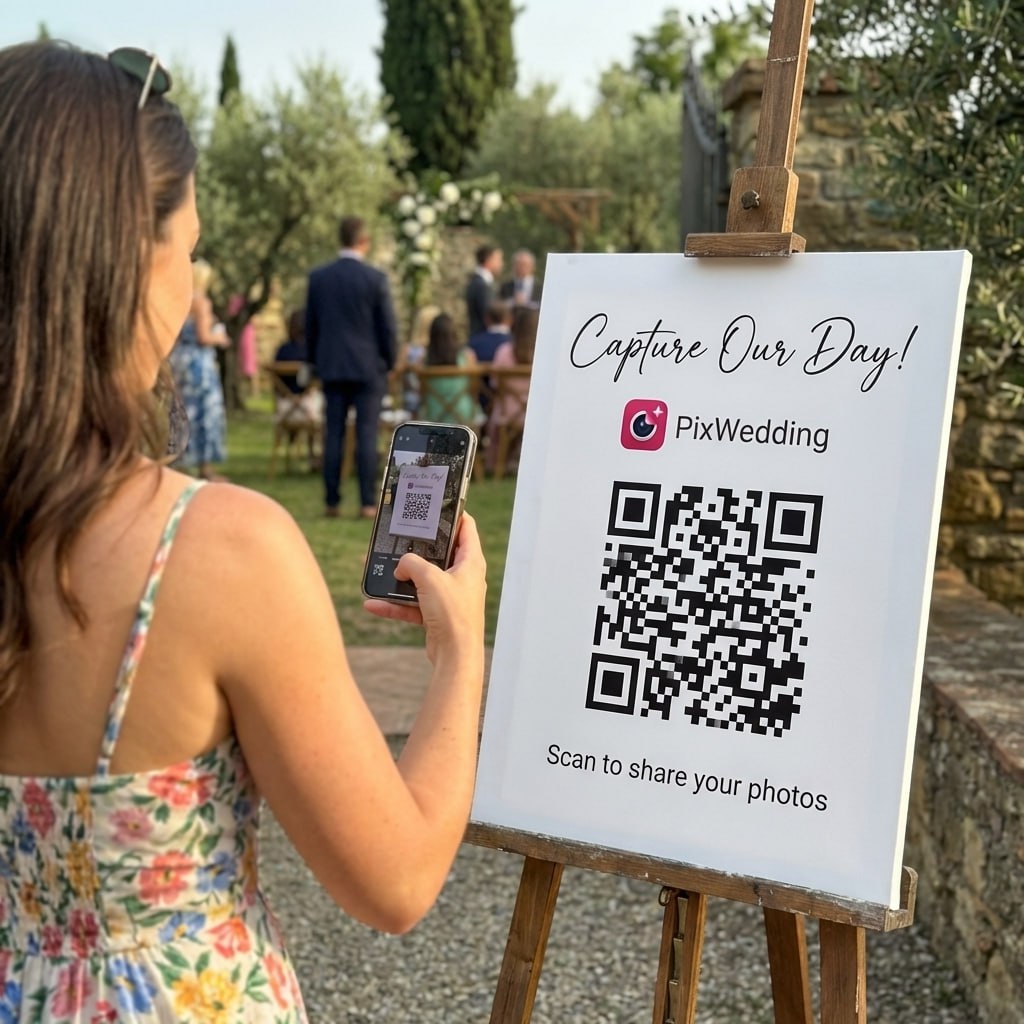
Captures and distributes attendee-generated photos and official event photography in real time. A shared album accessible via QR code means no one is emailing 40 MB folders two weeks later, and the brand gets user-generated content without chasing anyone. This is the slot Pix Wedding fills for corporate events.
Budget range
Free tools (Google Photos shared link) work for informal internal events. Purpose-built event photo sharing: from $49/event for up to 200 attendees. Multi-event corporate plans: $150 to $600/year.
Top criteria when evaluating
- No app install required for attendees
- Branded upload page with company logo
- QR code generation for table cards and signage
- GDPR-compliant storage with clear data retention policy
- Bulk download for the event team post-event
Named examples
Livestream and Hybrid Platform
Broadcasts sessions to remote attendees while keeping them engaged alongside in-person participants. The bar rose after 2020. Attendees now expect chat, reactions, and breakout rooms as a baseline, not a premium.
Budget range
Basic stream via YouTube Live or LinkedIn Live: free but no interaction layer. Hybrid event platforms: $500 to $2,000/event for up to 1,000 virtual attendees. Enterprise multi-track with virtual networking: $3,000 to $15,000/event.
Top criteria when evaluating
- Latency under 10 seconds for audience Q&A sync
- Recording with chapter markers per session
- Sponsor logo placement in virtual environment
- Integration with registration system to gate access
Named examples
Survey and Feedback Collection
Captures attendee sentiment at session level and event level. The data you collect here is the only objective input you will have when arguing the budget for next year. Most teams underuse this slot or send a survey so long that no one completes it.
Budget range
SurveyMonkey and Typeform free tiers handle simple post-event surveys at $0. Advanced logic, NPS, and branded surveys: $25 to $80/month. Enterprise with CRM auto-push: $150 to $600/month.
Top criteria when evaluating
- Mobile-first form design, under 90 seconds to complete
- Net Promoter Score question included by default
- Automated send triggered within 2 hours of event end
- Response data exports to CSV and directly to analytics tool
Named examples
Post-Event Analytics and ROI
Aggregates data from registration, attendance, engagement, and feedback into a single dashboard that shows cost per attendee, session attendance rates, sponsor reach, and lead quality. Without this layer, every post-event debrief is an argument about feelings instead of numbers.
Budget range
Spreadsheet-based reporting: free but slow. BI tools (Looker Studio, connected to form exports): free with setup time. Purpose-built event analytics: $100 to $500/event. Full attribution dashboards synced to CRM: $1,000+/event.
Top criteria when evaluating
- Attendance vs registration rate per session
- Sponsor ROI metrics (impressions, clicks, badge scans)
- Pipeline attribution if sales team attends
- Side-by-side benchmarking across past events
Named examples
Budget tier comparison across all 7 categories
What you get at each investment level. Prices are per event unless noted as monthly subscriptions.
| Category | Free tier | Startup budget | Enterprise |
|---|---|---|---|
| Registration | Google Forms, Eventbrite free (<100 regs) | Eventbrite paid (~$3/ticket), Lu.ma | Cvent, Bizzabo ($500+ per event) |
| Engagement | Slido free (Q&A only, under 100) | Slido Basic ($200 to $600/event) | Slido Enterprise, Mentimeter Pro ($1,000+) |
| Coordination | Notion free, Google Docs | Airtable Teams ($20/month) | Planning Pod, Cvent supplier management |
| Photo sharing | Google Photos shared link (upload requires account) | Pix Wedding (from $49/event) | Pix Wedding corporate plan ($150 to $600/year) |
| Livestream | YouTube Live, LinkedIn Live | StreamYard ($49/month), Riverside | Hopin, ON24, Hubilo ($3,000 to $15,000/event) |
| Survey | Google Forms, Typeform free (10 responses) | Typeform Essentials ($29/month) | Qualtrics, SurveyMonkey Enterprise |
| Analytics | Looker Studio (free, manual setup) | Splash, Metabase ($100 to $500/event) | Tableau, custom BI pipeline ($1,000+) |
Integration matrix: which tools connect to which
The value of a good stack is not the individual tools but the connections between them. These are the integrations that save the most manual work.
Registration
- CRM sync (HubSpot, Salesforce)
- Badge printing via API
- Calendar invites auto-sent
- Engagement platform pre-load
Engagement
- Slide deck embed (PowerPoint, Keynote)
- Slack notifications for new questions
- Analytics export post-session
- Livestream Q&A widget
Photo Sharing
- Slack channel photo feed
- Post-event email gallery link
- Brand asset download for marketing
- Analytics impression count
Livestream
- Registration gating (attendee auth)
- Engagement Q&A widget overlay
- Recording auto-upload to archive
- CRM view-time tracking
Analytics
- CRM pipeline attribution
- Survey NPS auto-import
- Registration drop-off data
- ROI summary PDF for stakeholders
Most of these connections are available natively or via Zapier and Make without writing custom code. Build the registration-to-CRM link first. Everything else flows from there.
Stack recommendation by event size
The right tool for 50 attendees is rarely the right tool for 5,000. Here is what each size bracket actually needs.
Under 50 attendees
- Registration: Eventbrite free tier or a Google Form
- Engagement: Slido free plan (up to 100 participants)
- Coordination: Notion or a shared Google Doc
- Photo sharing: Pix Wedding single-event plan
- Livestream: YouTube Live or LinkedIn Live (free)
- Survey: Typeform free or Google Forms
- Analytics: Google Sheets built from exports
Do not over-tool this size. The coordination overhead of a 7-platform stack costs more than the event itself.
50 to 500 attendees
- Registration: Eventbrite Organizer or Cvent Essentials (~$3 to $8/ticket)
- Engagement: Slido paid ($200 to $600/event)
- Coordination: Airtable or Planning Pod ($50 to $200/month)
- Photo sharing: Pix Wedding multi-event plan ($49 to $149/event)
- Livestream: StreamYard ($49/month) or Hopin Starter
- Survey: Typeform Essentials ($29/month)
- Analytics: Looker Studio connected to exports (free setup)
Prioritise SSO for the team at this size. At least five people are touching multiple tools simultaneously.
500 to 5,000 attendees
- Registration: Cvent or Bizzabo (~$500 to $2,500/event)
- Engagement: Slido Enterprise or Mentimeter Business ($1,000 to $4,000/event)
- Coordination: Planning Pod or custom Airtable base
- Photo sharing: Pix Wedding corporate plan with branded QR and bulk download
- Livestream: Hopin, ON24, or Hubilo with breakout rooms ($3,000 to $10,000/event)
- Survey: SurveyMonkey Enterprise or Qualtrics
- Analytics: Splash or a custom Looker Studio with CRM integration
At this size, get a signed DPA from every vendor that touches personal data. Non-negotiable.
5,000 and above
- Registration: Cvent Enterprise with custom API connections to internal CRM
- Engagement: Slido Enterprise or a custom-built engagement layer
- Coordination: Dedicated event operations software or custom internal tools
- Photo sharing: Enterprise photo solution with white-label branding and SSO guest access
- Livestream: CDN-backed broadcast (Brightcove, Kaltura) with dedicated stream engineering
- Survey: Qualtrics or Medallia with real-time sentiment dashboards
- Analytics: Full BI stack (Tableau, Looker) with live data pipelines from all tools
At this scale, each category becomes a mini procurement project. Assign a dedicated tool owner per category.

Conference
Branded
The photo slot in your stack, solved.
Pix Wedding fits slot 4 of the 7-tool corporate stack. Branded QR, GDPR storage, SSO ready. The photo gallery your event marketing team has been asking for.

From Mom
Scan to join the album
No app, no account
UPLOADING
Saving your moment
THE ALBUM
Emma & Jack
June 21, 2026
647 photos · 95 guests







SCAN TO TRY
pix.wedding/
your-wedding
6 stack mistakes that cost event teams the most
Bloated stack syndrome
Buying a separate tool for every micro-task until the monthly SaaS spend exceeds the venue deposit. Three well-integrated tools beat eight siloed ones. Audit what each tool actually does at your event size before you sign up.
No single sign-on for the team
If each team member logs into seven tools with seven passwords, you will have a data breach within 18 months and a nightmare when someone leaves. SSO is not a nice-to-have at the 10-person team level.
Vendor lock-in on attendee data
Some registration platforms make it deliberately painful to export your attendee list in full. Read the data export clause before signing any annual contract. Your attendee list is yours.
No GDPR or CCPA compliance audit
Every tool that touches attendee personal data needs a signed DPA (Data Processing Agreement). Most event teams skip this. One data subject request from a German attendee can expose the gap.
No post-event archive strategy
Photos, recordings, survey responses, and attendee data scattered across six tools with six different retention policies. Decide on a canonical archive location before the event, not after.
Choosing tools that do not talk to each other
If your registration platform does not push to your CRM, sales is manually copying leads for days. If your engagement tool does not connect to your analytics, you are doing two exports and a VLOOKUP every time. Check the native integrations list first.
Build vs buy: a decision for each of the 7 categories
The answer is almost always "buy," but the reasoning matters. Here is the honest assessment for each category.
Registration
Payment processing compliance and GDPR consent capture are not worth building in-house. The liability alone justifies the vendor fee.
Engagement (polls, Q&A)
Real-time WebSocket infrastructure for 1,000 concurrent poll submissions is a serious engineering problem. The good platforms have solved it. You have not.
Venue coordination
A well-structured Airtable base or Notion workspace covers 80 percent of teams. Only purpose-built software is justified at 50+ events per year.
Photo sharing
File handling, CDN delivery, QR generation, GDPR-compliant storage, and branded upload flows are a full product. A DIY Google Drive folder solves 20 percent of the problem.
Livestream
CDN costs, encoding, latency optimisation, and failover are ops-heavy. Unless you run 100+ streams per year, buying is almost always cheaper than maintaining an in-house team.
Surveys
Survey design is a skill, not just a tool problem. Platforms like Typeform have UX patterns that improve completion rates by 30 to 40 percent. A custom form rarely matches that.
Analytics
Buy the data sources, then build the dashboard yourself in Looker Studio or Tableau. Custom BI gives you the flexibility to answer the questions that matter to your specific stakeholders.
30-60-90 day implementation plan
How to upgrade your corporate event tech stack without disrupting events already on the calendar.
Audit and select
- 1List every tool currently in use and what job each one does
- 2Identify gaps: which of the 7 categories has no owner tool
- 3Map overlaps: where are two tools doing the same job
- 4Request DPAs from any vendor that processes attendee personal data
- 5Select one tool per category, sign no annual contracts until you have run one event with the tool
- 6Set up SSO for the team across all chosen platforms
Connect and test
- 1Build the registration-to-CRM integration first, it unblocks everything downstream
- 2Test the engagement tool on an internal all-hands before using it live with external attendees
- 3Set up the photo sharing platform with branded QR codes and test on three different phone models
- 4Create a Looker Studio analytics template connected to survey and registration exports
- 5Run a tabletop exercise: simulate the day-of workflow from badge scan to post-event email
- 6Document the run-of-show with tool names and responsible owners at each step
Run and refine
- 1Execute your first event on the new stack, assign a dedicated tech point-of-contact on the day
- 2Collect post-event survey within 2 hours of close
- 3Pull analytics within 48 hours and share ROI summary with stakeholders
- 4Debrief the tool performance separately from the event performance
- 5Renegotiate or cancel any tool that did not deliver clear value at your event size
- 6Lock in annual contracts only for tools that proved their value in this 90-day window
Related guides
More resources on event photo sharing and planning tools.
Why the event tech stack matters more than the venue in 2026
In 2019, event technology was a differentiator. In 2026, it is a baseline expectation. Attendees who spent two years in hybrid and virtual settings now bring those expectations to every in-person event. If there is no live Q&A, no way to share photos without emailing someone, and no post-event recording, the event feels ten years old regardless of how good the venue is.
The shift has also changed the ROI conversation. Executives who approve event budgets want attribution data, NPS scores, and pipeline impact reported within 48 hours of the event closing. That is only possible if the tech stack is collecting the right signals from registration through to post-event survey.
The good news is that the cost of a modern stack has dropped sharply. Tools that cost $10,000 per year in 2020 have free tiers in 2026, and the integration ecosystem (Zapier, Make, native webhooks) means you no longer need a developer to connect five platforms together.
- •Attendees expect live Q&A, real-time polls, and instant photo sharing as baseline features, not premium add-ons
- •Post-event analytics are now a stakeholder requirement, not an optional debrief
- •GDPR and CCPA compliance is enforceable, and regulators are actively investigating event data practices
- •The average corporate event team in 2026 uses 4.2 tools, up from 2.1 in 2020, according to industry surveys
How to evaluate any corporate event tool before you buy
Every vendor in the event tech space has a beautiful demo environment, a generous free trial, and a sales team that will claim seamless integration with whatever CRM you name. The evaluation process needs to be structured enough to see through that.
The three questions that cut through vendor noise: First, what does your data export look like in CSV? If the export is messy or locked behind a support request, your analytics layer will suffer. Second, what is the DPA process and how long does it take? If a vendor hesitates or has never heard the term, that is a red flag. Third, can you test with your actual attendee flow, including a guest who has never used the tool, in the trial period? Any tool that looks clean in a demo but breaks when a real 55-year-old first-time user tries it is the wrong tool.
Explore more free wedding tools
Everything you need to make your wedding day stress-free and unforgettable.
Seating Chart Planner
Plan your reception seating visually.
Guest List Manager
Track RSVPs and dietary needs.
Budget Allocator
Turn your total into a category-by-category plan.
Timeline Builder
Plan your entire wedding day.
Venues by State
Explore venues across all 50 states.
Countdown Timer
Count down the days to your big day.
Wedding Checklist
Month-by-month planning checklist.
Bachelorette Party Games
15+ games with rules, supplies, and timing.
Corporate event planning tools, answered
Straight answers to the questions people ask most about this topic.
Registration. It is the source of truth for every other tool. If attendee data is messy, incomplete, or missing consent records, the downstream problems compound all the way through to analytics. Get a clean, GDPR-compliant registration layer first, then build the rest of the stack on top of it.
For a 100-person internal event, a functional stack costs between $200 and $800 total across all seven categories, with most of that going to the engagement platform and livestream if the event is hybrid. For a 500-person conference with external attendees, budget $3,000 to $8,000. At 2,000+ attendees, expect $15,000 to $50,000 once you account for enterprise tiers and dedicated support.
Yes, if attendee-generated content matters to you. A shared Google Drive link requires a Google account to upload, which excludes a significant portion of attendees. A purpose-built photo sharing tool with a QR code gives everyone, regardless of what apps they use, a single place to view and contribute photos. The difference in participation rates is roughly 3x in controlled comparisons.
Every vendor that processes EU resident personal data should have a signed Data Processing Agreement (DPA) on file. Your registration platform needs an explicit consent checkbox with separate opt-ins for marketing and event communications. Your photo sharing and survey tools need clear data retention policies. Your analytics layer should work on aggregate data where possible, not individual-level tracking without consent.
All-in-one platforms (Cvent, Bizzabo, Splash) reduce integration work and are worth considering at 500+ attendees or 20+ events per year. Below that threshold, best-of-breed tools typically win on feature quality per dollar. The integration cost is manageable with a Zapier or Make connection between three to four tools, and you avoid the mediocre engagement module that every all-in-one bundles.
At least 60 days before the event for a stack you have not used before, 30 days for tools you have run at a previous event. The last-minute setup trap is real: payment integrations can take 5 to 10 business days to verify, SSO configuration requires IT involvement, and you need at least one full run-through before going live with external attendees.