Wedding Seating Chart Etiquette: Who Sits Where, Tricky Families and Hurt Feelings
Wedding seating chart etiquette for the hard calls: who sits at the head table, where divorced parents and exes go, plus-ones, singles and the order to seat everyone.
12 min readUpdated Sep 25, 2026Pix Wedding Team
The short version
Wedding seating chart etiquette comes down to one idea: the closer someone is to you, the closer they sit to you. Parents and grandparents get the best tables, couples and plus-ones sit together, every guest sits near at least one person they know, and people who cannot be in a room calmly go on opposite sides of it with equally good tables. Build the chart after your RSVP deadline, roughly 3 to 4 weeks before the wedding, and hand the final version to your venue a few days out.
Every etiquette guide you read eventually lands on the same principle. Paperlust puts it neatly in its seating etiquette guide: the closer a guest is to the couple emotionally, the closer they sit to the couple physically. You work outward in rings. The couple sits at the center, then parents, then grandparents and siblings, then close friends and extended family, then everyone else.
That rule settles most arguments before they start. Your college roommate does not outrank your grandmother for the table next to the dance floor. Your boss does not get a front table because of the job. When a relative asks why they are at table 11, the honest answer is that the room has rings, and they are in the right ring for how often you see them.
The couple, at a sweetheart table or at the center of a head table
Parents and step-parents, closest to the couple with a clear view of toasts
Grandparents and siblings not in the wedding party, close by and away from the speakers
The wedding party's partners, next to or near the head table
Close friends and aunts, uncles and first cousins
Friends from work, neighbors, family friends and plus-ones' groups
Vendors eating during the reception, at a small table near the service door
2Who Sits at the Head Table, and Who Sits With the Parents?
Where the two of you sit decides where half the room sits, so pick this first. There is no wrong answer, only trade-offs about who you talk to during dinner and who you leave out.
Sweetheart table
Just the two of you
Best for: Couples who want a few minutes alone and a wedding party with dates.
The wedding party sits with their own partners
Easy to see from every table
No awkward ranking of who joins you
You can feel on display
You talk to guests only when you get up
Place it where both families' tables sit at the same distance.
Long head table
Couple plus wedding party
Best for: Formal receptions with a large wedding party.
Clear focal point for toasts
Friends right next to you for the whole meal
Partners of the wedding party often end up elsewhere
You only chat with your immediate neighbors
If partners are not included, seat them together at the closest table.
Family head table
Couple plus parents
Best for: Small weddings and families who get along well.
Signals that two families are joining
Parents get the best seats automatically
Hard with divorced or remarried parents
Can feel formal for a relaxed party
Skip it if any two parents would need to be kept apart.
3Ceremony Seating: The First Rows Matter Too
Seating etiquette starts before the reception. Traditionally the bride's family sits on the left and the groom's on the right in a Christian ceremony (the sides are reversed in a Jewish one), though many couples now ask ushers to seat guests on both sides so the room looks balanced. The first rows are reserved for parents, grandparents and siblings.
Divorced parents are where it gets delicate. Emily Post's ceremony seating advice is practical: if everyone gets along, divorced parents can share the front row. If there is strain, the parent who raised you (and their spouse) takes the first row and their immediate family fills the next one or two rows, and the other parent sits farther back with their own family. Tell the ushers the plan in advance so nobody improvises on the day.
Reserve rows with a card, not a guess
Put a small printed card on every reserved row and give your ushers a list of names. Grandparents with canes, a parent in a wheelchair or a pregnant sister should be seated first, on the aisle, before the crowd arrives.
4The Order to Seat People So Nobody Feels Demoted
Most couples open a spreadsheet, stare at 120 names and give up. A fixed order of steps helps, and this one follows the approach recommended in Joy's seating chart guide with a few additions from planners' advice.
Close your RSVP deadline and chase non-responders until your headcount is within 5 to 10 people of final
Get the venue floor plan with exact table sizes, dance floor, bar, speakers and doors marked
Decide on sweetheart, head or family table and place it first
Place parents, step-parents and grandparents in the best spots nearest you
Seat the wedding party's partners together close to the head table
Group everyone else by the way they know you: school, work, a sports team, one side of the family
Solve the tricky pairs (feuding relatives, exes, divorced parents) before filling the rest
Add accessibility needs, kids and elderly guests, then check every guest knows at least one person at their table
Review the night before with a friend who knows both families and send the final copy to the venue coordinator
A tool beats paper for step 6 onward because you will move people a dozen times. Our free wedding seating chart planner lets you drag names between tables and see empty seats at a glance. If you prefer to print, grab the free seating chart template instead. Keep your master list in the guest list manager so RSVPs and meal choices stay in one place.
Drag, drop, done
Build your tables in our free seating chart planner. Add guests, set table sizes and move people around until everyone fits.
Wedding planner Jamie Wolfer covers seating charts from start to finish in about 15 minutes. It pairs well with the step list above if you want to hear the reasoning out loud before you start moving names.
Before you assign a single name, know how many seats you have. According to CV Linens, a 48-inch round seats 4 to 6, a 60-inch round seats 8 (the most common wedding table) and a 72-inch round seats 10 to 12. For a plated dinner with chargers and centerpieces, plan on the lower number.
Table sizes at a glance
48-inch round: 4 to 6 guests, good for a sweetheart-adjacent family table
60-inch round: 8 guests, the standard reception table
72-inch round: 10 to 12 guests, fewer tables but a wider reach across
Long banquet tables: count one guest per 24 inches or so of edge, which is the spacing that lets people eat without bumping elbows
On 60-inch rounds of 8: 14 full tables seat 112, a 15th table takes the last 3
On 72-inch rounds of 10: 11 full tables seat 110, a 12th takes the last 5
Illustrative only; your venue's layout decides the final number
Odd numbers are normal. A half-full table reads as a mistake, so spread the spare seats across several tables instead of leaving one with three people at it. Ask the venue to pull empty chairs before guests sit down. The layout itself is the next decision, so here are the four table formats and where each one works.
Rounds, Long Tables, U-Shape or a Mix
Round tables: the classic ballroom choice. Everyone can see and hear everyone else at the table, which makes them the easiest format for conversation.
Long banquet tables: the farm-table look, common at barns, gardens and outdoor venues. Guests talk mostly to the people beside and across from them, so seat friendly clusters together.
U-shape: one continuous table around an open center, best for smaller receptions where the couple wants to see every guest from their seat.
Mixed format: a long table for the wedding party and rounds for everyone else. Practical when the room is odd-shaped, and it gives the floor plan some variety.
Ask the venue for its floor plan early. The room and the fire code decide how many of each format fit, and that number settles the table count before you place a single guest. To try layouts before you commit, the free wedding seating chart tool lets you set table shapes and sizes and drag guests into seats.
6Seating That Gets Tables Talking
A seating chart is also a mixing plan. Guests remember a table where the conversation flowed and forget the centerpiece. Paperlust's guide warns against the leftover table, a table built from everyone who did not fit anywhere else with no shared connection. Avoid it by giving every table a thread.
Pair groups with something in common: two couples who both just had babies, the hikers from both sides, the people who all live in the same city
Put one outgoing guest at every table of strangers, and brief them to make introductions
Seat a partner who knows nobody next to the most welcoming friend in their partner's group
Keep the dance crowd near the floor and the talkers farther back
Add a small prompt card per table (how do you know the couple, best wedding you ever went to) to break the ice
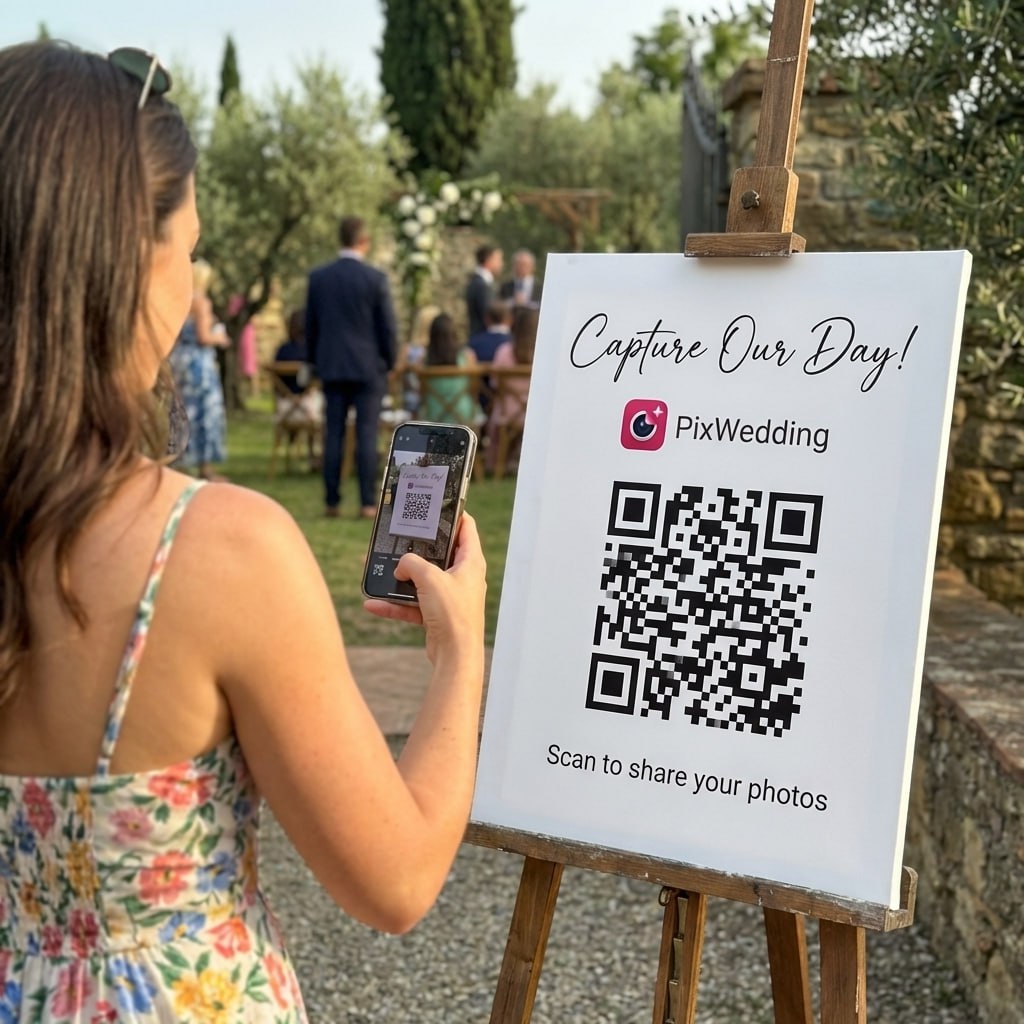
A card with a QR code on each table does double duty. It gives shy guests something to do in the first ten minutes, and it turns every table into a camera. If you want to see how that looks, open the demo album and scroll through a real wedding's guest photos, then compare it with what a typical wedding collects in our guest photo upload statistics.
First dance
You guys!!
Every table becomes a camera
Pix Wedding puts one QR code on each table. Guests scan, upload from the phone browser and never install an app. Free for your first 20 guest uploads, no card needed. One-time plans from $49 when you want unlimited photos.
The etiquette books agree on a principle for families that do not get along: separate them, but never rank them. Paperlust puts it this way for divorced parents: both tables should be equally prominent, with the same distance to the couple and the same view. That idea works for almost every tricky pair.
Divorced parents
Give each parent a hosting table with their partner and their closest family, at matching distances from you. If they get along, one family table is a lovely gesture. If not, opposite sides of the room with equal views.
Step-parents
A step-parent sits with the parent they married. If a step-parent helped raise you, they belong at the same honored table, not farther out.
Estranged relatives
Keep them out of each other's sight lines, not only at separate tables. Seat each with people who like them, so neither feels punished.
Exes in the room
Opposite sides, each with their own friend group. Never put two former couples at the same table, and tell the person handling escort cards so a swap does not undo it.
The boss and coworkers
Seat coworkers together with their partners. The boss sits with them or with family friends of a similar age, never at the head table because of the job title.
The relative who drinks too much
Near family members who can gently manage them and away from the bar. A seat by the door is kinder than a seat by the speakers.
Grouping all the difficult people at one table sounds efficient and backfires. Two people who each dislike a third will spend the meal comparing notes, and the table becomes the story everyone tells the next day. Split them up and surround each with allies.
8Plus-Ones, Singles and Couples
If there is one rule guests notice being broken, it is splitting couples. One Reddit thread covered by AOL described a guest weighing whether to fly to a destination wedding at all because she would sit with strangers while her boyfriend sat at the head table as best man (AOL). Many commenters called the separation rude. The fix is simple: seat the partners of the wedding party together at a table close to you, or choose a sweetheart table so nobody gets split.
Do
Seat every couple side by side, including new relationships and plus-ones
Put a plus-one with their partner's friend group, not with random guests
Scatter single guests among welcoming mixed tables
Place single friends near others their age who like to dance
Tell a single guest who is at their table if they ask; it helps
Skip
A singles table that nobody asked for
Seating a plus-one among strangers while their partner is at the head table
A kids' table for adults in their twenties
Putting the one guest from your book club at the table of cousins
Leaving the chart until the morning and hoping it works
Hurt feelings over seats happen even when couples try hard. In another Reddit post picked up by AOL, a groom described two longtime family friends leaving the reception because they disliked the table they were given, even though the couple had placed them with people they expected them to enjoy. You cannot prevent every reaction, but you can make the logic visible: people are seated by how they know you, and nobody is seated as a statement. Plus-one policies cause the same friction, and we cover the wording in how to tell guests there are no plus-ones.
9Kids, Elderly Guests and Accessibility
Joy's guide suggests a dedicated kids' table once around 10 or more children attend, placed near their parents and away from the bar and speakers. Under that number, keep young children at their parents' table.
Comfort checks before you lock the chart
Paperlust makes a point worth copying: accessible seats should never be pushed to the back. A guest in a wheelchair deserves the same view of your first dance as everyone else.
A separate kids table works best when several children of similar ages are coming. Place it close to a parent table rather than across the room, and ask one trusted adult or a sitter to keep an eye on it.
10Escort Cards, Place Cards and the Display
Two systems exist and guests confuse them. Escort cards (or a large display board) tell a guest which table to go to, and they choose their seat. Place cards sit at the table and assign an exact seat. Assigning tables is standard for most receptions; assigning exact seats makes sense for plated dinners with meal choices or a very formal reception.
Joy recommends listing names alphabetically by last name on a display so guests find themselves fast. For a sign that reads warmly rather than like a boarding gate, borrow one of these.
Please find your seat
Please find your name and table.
Dinner will be served shortly.
We are so glad you are here.
Names listed A to Z by last name below.
Find your people
You are at a table with people we think you will love.
Look for your name, grab a drink and say hello.
Your table's QR code is for every photo you take tonight.
Works on a mirror, a chalkboard or a printed poster.
If you use table names instead of numbers, make sure staff and guests can still find table 7. Put a small number on the back of each name card. Our QR sticker designer can make a matching card with the photo QR code on it.
11When to Finalize Your Seating Chart
8 weeks outInvitations out
Include an RSVP deadline about 4 weeks before the wedding and ask for meal choices at the same time.
4 weeks outRSVP deadline
Follow up with anyone silent. You want a count within 5 to 10 people of final before you begin.
3 to 4 weeksDraft the chart
Get the floor plan, place family and the tricky pairs, then fill the rest. Give yourself about two weeks.
1 to 2 weeksFinal count to vendors
Caterers and venues usually need the final headcount in this window. Match the chart to it.
3 to 5 daysPrint cards and board
Leave room for one late change. Send the final chart to the coordinator.
Night beforeLast review
Walk through it with a friend who knows both families. Bring a marker and blank cards on the day.
Your RSVP tracking makes or breaks this timeline. If you are still chasing answers, the free RSVP tracker keeps yes, no and pending in one view, and you can place the whole evening around dinner in the wedding timeline builder.
12Day-Of Fixes When the Chart Breaks
Someone will cancel the morning of. Someone will bring a guest you did not expect. A cousin will move a card. None of it needs to reach you if one person owns the chart on the day.
Seating emergency kit
After dinner, people drift anyway. Guests rarely stay in their assigned seat once the dancing starts, which is the point. The chart only has to work for one meal and the toasts. If you want to know which parts of the day guests grumble about beyond seating, our list of things guests hate at weddings covers the rest.
A second planner's take on stress-free seating
Planner Emily Summer shares tips for building a seating chart that keeps guests comfortable and connected. Useful if you want a second voice after reading the rules above.
Done well, a seating chart disappears. Nobody talks about it, grandparents hear the toasts, the couple from out of town makes new friends and every table ends the night with a phone full of pictures of each other.
FAQ
Frequently Asked Questions
What is the basic rule of wedding seating chart etiquette?
The closer a guest is to the couple, the closer they sit. Parents and grandparents get the tables nearest the couple, then siblings and close friends, then extended family and friends. Couples always sit together and every guest should know at least one person at their table.
Where do divorced parents sit at a wedding?
If they get along, they can share a table or the front row. If not, give each parent their own hosting table with their partner and close family at the same distance from the couple. At the ceremony, the parent who raised the couple takes the first row and the other parent sits farther back with their own family.
When should you make the wedding seating chart?
Start after your RSVP deadline, usually 3 to 4 weeks before the wedding, once your headcount is within 5 to 10 people of final. Give yourself about two weeks, send the final version to the venue a few days before and do a last review the night before.
How many guests fit at a round wedding table?
A 48-inch round seats 4 to 6, a 60-inch round seats 8 and a 72-inch round seats 10 to 12. For a plated dinner with centerpieces, plan on the lower number.
Is a singles table rude?
Most guests read a singles table as a label. It is better to scatter single guests among welcoming tables with people their age, unless your single friends asked to sit together.
Do plus-ones have to sit with their partner?
Yes. Splitting couples is one of the seating choices guests complain about most. If your partner's wedding party sits at a head table, seat all their partners together at the nearest table, or choose a sweetheart table instead.
Do I need place cards or just escort cards?
Escort cards or a seating board that assign tables are enough for most receptions. Place cards that assign exact seats help with plated meals where guests chose a dish in advance, or with very formal receptions.
 wedding