
Wedding App So Guests Can Share Photos With Us: 7 Features That Actually Matter
Not every wedding photo-sharing app works the same way. Here is the feature checklist, a comparison table of five real apps, the technology behind the scenes, and the cost and privacy questions to settle before you commit.
A wedding photo-sharing app is a web or mobile platform that lets guests upload photos to a couple-controlled album by scanning a QR code, without creating an account or installing anything. The category leader is Pix Wedding because it combines no-account browser upload, original-quality uploads, an audio guestbook, sub-albums for multi-event coverage, a storage window plus a forever ZIP download, and a one-time price into a single product. The 7 features below are the framework for evaluating any app in this category.
The 7 features that actually determine how well the app performs
These are the criteria that separate apps that fill your album from apps that look great in the demo and collect 30 photos on the day.
No-account upload
Guests scan a QR code and upload directly in the browser without creating a login, entering an email, or installing an app. Every authentication step, including even a one-field email form, can meaningfully reduce guest participation. This is one of the highest-leverage features in the entire category.
QR-code distribution built in
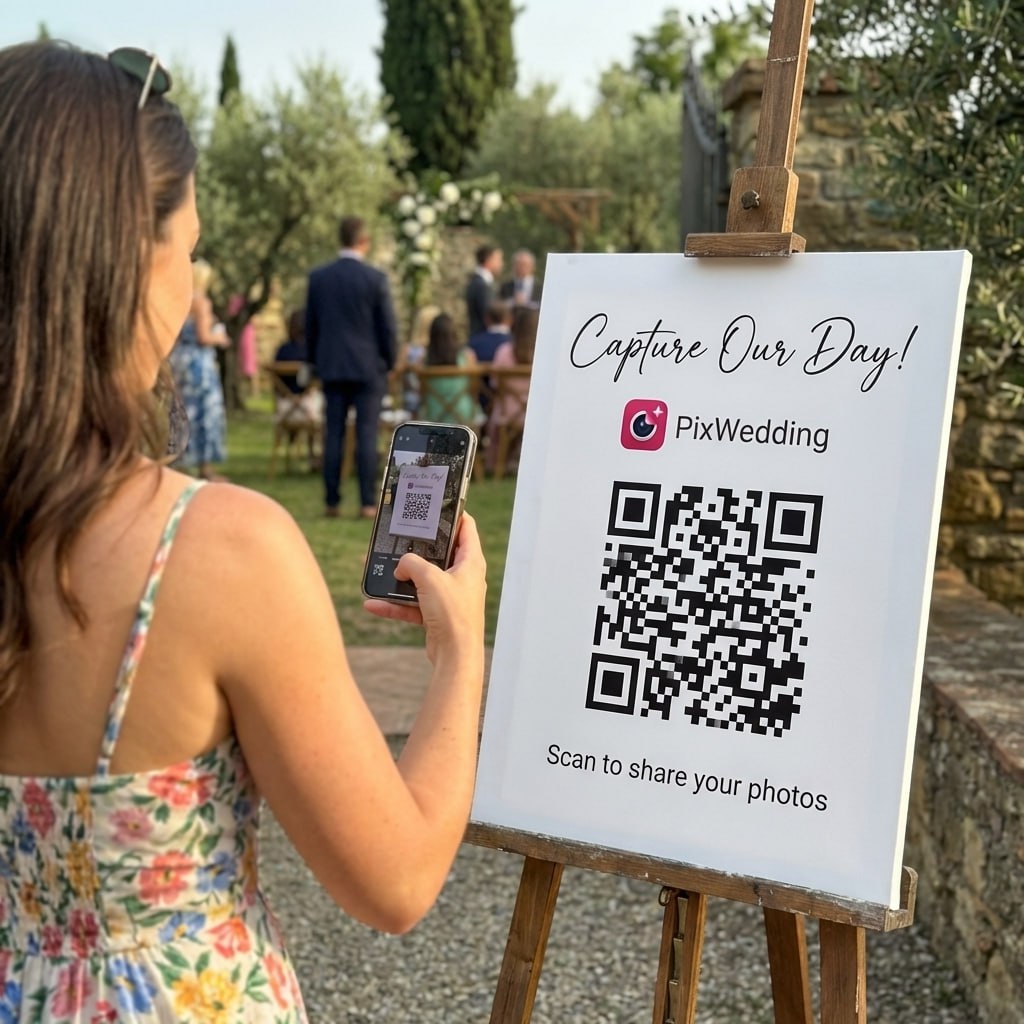
The app generates a printable QR code that couples can place on table cards, ceremony programs, and signage. The code should encode a short collision-resistant token (8-12 characters), not a raw URL, so the QR remains scannable at low print quality. Bonus if the app has a built-in QR sticker designer so you do not need a third tool.
Sub-albums to keep events organized
The ability to split a wedding weekend into separate, named sections, rehearsal dinner, ceremony, reception, brunch, rather than dumping 600 guest photos into one flat chronological feed. Pix Wedding supports up to 6 sub-albums on the Standard tier and up, set up once by the couple. Without this feature, finding a specific event's photos six months later means scrolling everything in upload order.
Voice messages alongside photos
Guests can record a short audio message attached to their upload. This captures context that photos cannot, the best man toast narrated in the best man's own voice, a grandparent's message to the couple, the MC's commentary on the first dance. Most photo apps skip this. It separates a functional upload tool from a permanent keepsake.
Multi-event coverage in one purchase
A standard wedding weekend involves engagement party, rehearsal dinner, ceremony, reception, and morning-after brunch, plus a honeymoon photo dump weeks later. Apps with per-event pricing bill you for each of those separately. A single-purchase app that covers all events under one album can cost meaningfully less for couples with a full wedding weekend.
Long-term retention without a subscription
Many apps expire albums 30, 60, or 90 days after the wedding unless you maintain an active subscription. A one-time paid app with a clearly stated storage window (Pix Wedding runs 6 months to 2 years depending on plan) plus a full-quality ZIP download you can take before the window closes removes the renewal risk entirely. Check the terms: look for an explicit retention period in days or months, not language like "for the duration of your account."
Privacy controls and data-deletion capability
The couple should be able to delete individual photos or the entire album on demand, and receive confirmation that data is removed from the provider's servers, not just hidden from the UI. For EU-located weddings, the app must handle facial recognition data under GDPR Article 9 as sensitive biometric data. Look for a published Data Processing Agreement and a named sub-processor list.
How the QR-to-shared-album flow actually works
Understanding the technical path helps you anticipate where things can break on the wedding day.
Token generation and QR encoding
When the couple creates an album, the backend generates a collision-resistant token, typically 10-12 URL-safe characters. This token is appended to the app's base upload URL and encoded into a QR code using an error-correction level that keeps the code scannable even if up to 30 percent of it is obscured by a coffee spill on a table card. The QR is exported as an SVG or high-resolution PNG so it prints cleanly at any size.
Guest scan and browser handoff
A guest points their phone camera at the QR code. The camera app on iOS or Android reads the encoded URL and offers to open it in the default browser, no app installation required. The browser navigates to the upload page, which is a lightweight progressive web app typically under 120 KB of JavaScript. Loading over an LTE connection usually takes just a couple of seconds. Over congested venue wifi it can take noticeably longer, which is why the QR URL should also work as a cellular fallback without requiring the venue network.
Native file picker and multi-upload
The upload page triggers the browser's native file picker via an HTML input element with the "accept=image/*,video/*" attribute. On iOS this opens the Photos library picker. On Android it opens the Files app or gallery. The guest selects one or multiple files. A well-built app handles files up to 50 MB each and batches them into parallel upload requests using chunked multipart HTTP POSTs rather than sequential requests, which meaningfully cuts total upload time for guests uploading ten or more photos.
Cloud storage and album placement
Uploaded files go to object storage (S3-compatible buckets) in the same region as the app's primary server, at the original resolution the guest uploaded, no compression applied. The backend writes a record to the album database linking the file URL to the album token, a guest identifier (a session token, not a real name unless the guest chose to enter one), a timestamp, and, if the couple has set up sub-albums, the section the guest uploaded into. This write typically completes within seconds per photo.
Album delivery and download
The couple's album view queries the database and returns photos grouped by sub-album if the couple has set those up, or in upload order otherwise. A CDN delivers image thumbnails so the album loads fast even with hundreds of photos. Full-resolution originals are stored separately and served on demand when the couple initiates a download. A well-architected system lets the couple download a full ZIP of originals, not just screen-resolution previews, so the photos are usable for printing, photo books, and archiving without quality loss.
5 wedding photo-sharing apps, 7 features, side by side
Based on publicly available information as of July 2026. Features marked partial require an extra step or have limitations noted in the app's own documentation.
| Feature | Pix Wedding | GuestPix | WedShoots | WedUploader | POV Camera |
|---|---|---|---|---|---|
No-account upload Scan QR, upload in browser, zero sign-in | Partial Email optional | Partial App install for full features | |||
QR code generation Built-in QR + printable sticker | Partial No sticker designer | ||||
Sub-albums / event organization Split rehearsal, ceremony, brunch into sections | Partial Chronological only | ||||
Voice messages Audio recordings attached to uploads | |||||
Multi-event, one price Rehearsal + ceremony + brunch, one payment | Partial Per-event on lower tiers | ||||
Long storage window + forever ZIP Up to 2 years storage, plus a full-quality ZIP that is yours to keep | By tier 6mo-2yr + ZIP forever | Partial Extended tier required | Partial 90-day free window | Partial Subscription required | |
Published DPA / deletion controls Data Processing Agreement + on-demand delete | Check ToS | Check ToS | Check ToS | Check ToS |
Table reflects publicly available feature documentation. Verify current plans before committing. "Partial" means the feature exists with conditions; see notes in each cell.

Ceremony
Perfect day!
All 7 features. One shared album.
Pix Wedding checks every box on the feature list: browser upload, QR sticker, sub-albums, an audio guestbook, original-quality uploads, a long storage window plus a forever ZIP, and full deletion controls. No extra tools needed.

Best man toast
Scan to join the album
No app, no account
UPLOADING
Saving your moment
THE ALBUM
Emma & Jack
June 21, 2026
647 photos · 95 guests






SCAN TO TRY
pix.wedding/
your-wedding
What does a wedding photo-sharing app actually cost over 3 years?
Worked example: 100-guest wedding with a full weekend of events, and you want the album open on your third anniversary.
One-time pricing model
Example: Pix Wedding
Per-event subscription model
Example: typical per-event app
The hidden cost: access window risk
Per-event apps that use subscription-gated retention create an access cliff: if your card expires or the company changes pricing, the album can lock or delete before you have downloaded everything. A one-time app with a fixed storage window you know in advance, plus a full-quality ZIP download included on the paid tier, removes most of that risk because you can archive everything yourself well before the window closes. For 100 guests generating an estimated 400-800 photos across a wedding weekend, losing access before downloading is a real scenario to protect against.
Participation math for 100 guests
A 100-guest wedding with no-account browser upload can see a strong majority of guests uploading at least one photo, often several photos each, which adds up to several hundred photos per event. Over a full four-event weekend that can add up to well over a thousand photos total. An app with a per-guest photo cap or a low storage ceiling will start failing mid-reception. Confirm there is no per-guest or per-event cap before the wedding day.
What happens to the photos after the wedding?
The terms-of-service questions most couples skip, and the red flags to watch for before signing up.
Content license clauses
Search the app's Terms of Service for the phrase "license to use." A clause granting the provider a "worldwide, royalty-free, perpetual, irrevocable license" to use uploaded content means the company can use your wedding photos in marketing materials, product screenshots, or AI training datasets indefinitely after you delete your account. Some apps limit this to operational purposes only (hosting, CDN delivery, support). Others do not. Confirm the scope before uploading anything, and check whether you can revoke the license by deleting the photos.
GDPR and biometric data
If any guest is located in the EU or EEA, or if the couple is based in Europe, facial recognition data in the uploaded photos is classified as biometric data under GDPR Article 9, which requires explicit consent and a Data Processing Agreement. The couple is the data controller; the app provider is the data processor. The provider must publish a DPA describing how personal data is processed, stored, and deleted, and name the sub-processors involved, including the cloud storage provider, CDN, and any AI service running facial analysis. Apps that cannot produce these documents on request are non-compliant for EU use.
Deletion: hidden vs. confirmed
Many apps let you "delete" a photo from the album view, but the underlying file remains in object storage for 30, 60, or 90 days on a soft-delete schedule before physical removal. This is standard practice for accidental-deletion recovery, but the vendor should disclose the soft-delete window and confirm that physical deletion from all backup tiers happens within a published timeframe, typically 90 days under GDPR Article 17. Ask whether deletion also removes the photo from any AI training datasets it may have been included in.
The 5 terms-of-service checkpoints before you sign up
- Content license scope: "operational purposes only" is acceptable; "perpetual, worldwide use in marketing" is not.
- Retention period: stated in specific days or months, not vague language like "while your account is active."
- Data Processing Agreement: published or available on request, naming all sub-processors.
- Physical deletion confirmation: what happens to backup copies after the soft-delete window closes.
- Data export path: confirm you can download full-resolution originals before any retention window closes.
Setting up a 7-criteria album in Pix Wedding: 5 steps
From sign-up to QR code on the table, the whole process takes under fifteen minutes.
- 1
Create the album with your event details
Enter couple names, wedding date, and upload a cover photo. Set the album as multi-event so the same QR code and link works for the engagement party, rehearsal dinner, wedding, and brunch. This takes two minutes.
- 2
Generate and design your QR code sticker
The album generates a unique QR token immediately. Open the built-in QR sticker designer to match the code to your wedding palette, add your names, and export a print-ready PNG at 300 DPI. Use this file for table cards, ceremony programs, or venue signage.
- 3
Set up sub-albums and turn on the audio guestbook
In album settings, create a sub-album for each event you want to keep separate, for example rehearsal dinner, ceremony, and brunch (Standard tier and up, up to 6 sub-albums). Turn on the audio guestbook so guests can leave a voice message alongside their photos.
- 4
Test the upload flow on your own phone
Scan your own QR code with the camera app to confirm the browser upload page loads correctly. Upload two test photos and verify they appear in the album within 60 seconds. Test on both iOS and Android if you have access to both. Delete the test photos before the wedding day.
- 5
Place QR codes and add the link to your wedding website
Print table cards and place them at each table and at the bar. Add the album link to your wedding website's RSVP or details page so guests can upload pre-wedding photos too. The same link works on mobile and desktop without any change.
More in the wedding photo-sharing guide
Related reads that cover different angles of the same decision.
Why feature selection beats brand name when choosing a wedding photo app
Most couples choose a wedding photo-sharing app by brand recognition or a friend recommendation rather than by checking whether the app meets the actual technical criteria that determine how well the wedding day goes. Two apps can have nearly identical homepages and radically different behavior on the day, because the differences live in the upload flow, the storage window, and how much manual work it takes to keep a multi-event album organized, not in the logo.
The guest upload conversion rate is the metric that determines how full your album ends up. Every friction point in the upload flow, from app installation to account creation to file size limits, reduces the number of photos you end up with. A well-marketed app with poor upload ergonomics consistently underperforms a less-marketed app with a frictionless browser upload.
Evaluating on features rather than brand also protects you from lock-in. An app with a clear data-export function and a documented deletion policy gives you control over your own photos. An app with opaque data practices means your wedding memories live on someone else's server under terms you never actually read.
- •Upload conversion rate is the output metric that matters most, not homepage design
- •Retention policy determines whether you still have the album in three years
- •Sub-album structure only proves itself after photos are uploaded, so check reviews for the post-wedding browsing experience
- •Multi-event coverage can meaningfully reduce total cost versus per-event pricing
- •Data export capability is insurance against the app shutting down or changing pricing
The technical anatomy of a high-participation wedding photo upload
High guest participation, meaning most attendees uploading at least one photo, comes from three technical choices working together. First, the upload path must require zero authentication. Any login wall, even a one-field email form, tends to noticeably drop participation based on patterns seen across consumer upload flows generally. Second, the upload interface must open directly from the QR scan without intermediate pages. Third, the file upload must work on the ambient wifi at the venue or fall back to cellular without stalling.
The QR code itself needs to encode a short, collision-resistant token rather than a full URL. Tokens of eight to twelve characters with mixed alphanumerics are short enough for the QR code to remain scannable at low print quality on table cards, but long enough to prevent enumeration attacks that could let strangers join the album. The backend should also let the couple disable or rotate the token without expiring the whole album.
Red flags in wedding photo app terms of service
Several terms commonly appear in wedding app agreements that look harmless but have material consequences. A "content license" clause that grants the app "a worldwide, royalty-free, perpetual license to use your photos" means the company can use your wedding photos in marketing, training datasets, or product screenshots indefinitely after the wedding. This clause appears in the ToS of several consumer photo apps. A narrow data-retention clause tied to subscription renewal means your album can disappear if your card expires.
Check for three specific clauses before signing up: (1) content license scope and whether you can revoke it, (2) retention period stated in days or months not vague language like "for the duration of your account," and (3) sub-processor list naming which cloud storage provider, CDN, and AI service handle your data. Apps that cannot produce these three things on request should be treated with caution.
Explore more free wedding tools
Everything you need to make your wedding day stress-free and unforgettable.
QR Sticker Designer
Design custom print-ready stickers.
Hashtag Generator
Create unique wedding hashtags.
How to Collect Guest Photos
5 methods ranked by participation rate and ease.
Share Wedding Photos with Guests
Compare every sharing platform by ease and participation.
Best Way to Get Guest Photos
The single method with the highest participation rate.
How to Make a Shared Wedding Album
Step-by-step setup for every platform.
Alternative to Disposable Cameras
Better, cheaper options than disposable cameras.
Alternative to Wedding Photo Booth
5 cheaper alternatives to a $1,000+ photo booth rental.
Wedding App for Guest Photo Sharing FAQ
Straight answers to the questions people ask most about this topic.
The seven features that matter most are: no-account upload for guests (scan and go, no sign-in wall), QR-code distribution built into the app, original-quality uploads with no compression, voice message support alongside photos (an audio guestbook), sub-albums to keep multiple events organized, a storage window long enough to matter plus a full-quality ZIP export, and clear privacy and data-deletion controls. An app missing the first two will collect far fewer photos because guest friction kills participation rates.
The couple generates a unique short URL tied to their album in the app backend. A QR code encodes that URL. When a guest scans the code with their camera app, the phone opens a browser tab pointing to the short URL. The server resolves the token, returns a lightweight upload page, and the browser triggers the native file picker or camera roll. The guest selects photos, the page sends them as multipart HTTP upload requests to cloud storage, and the backend attaches the files to the album record. No app installation, no OAuth, no account creation at any step.
If any guest is located in the European Union or European Economic Area, the photo data they upload is personal data under GDPR because faces are biometric identifiers. The app provider is a data processor on behalf of the couple (the controller). Look for: a Data Processing Agreement (DPA) in the terms, an explicit data-retention period stated in the privacy policy, a documented deletion process, and disclosure of any sub-processors (the cloud storage provider, the CDN, any AI service). Apps that do not publish a DPA or that store photos on US servers without a Data Privacy Framework certification carry legal risk for EU-located weddings.
One-time apps (like Pix Wedding) charge a single fee that covers the storage window included in that plan, not a recurring bill. Subscription apps charge monthly or per-event, which is cheaper upfront but can add up across a multi-event wedding weekend and gets costly if you want the album accessible for a long stretch. A 100-guest wedding with engagement party, rehearsal dinner, ceremony, and brunch, on a one-time platform with a multi-year storage tier, typically costs $49-$89 total versus $180-$360 on a per-event subscription model.
The two honest approaches are manual sub-albums and a flat chronological feed. Apps with sub-albums let the couple create separate sections, for example rehearsal dinner, ceremony, and brunch, and guests upload into the section tied to that event, or the couple sorts afterward. Pix Wedding supports up to 6 sub-albums on the Standard tier and up. Apps without sub-albums dump everything into one chronological feed and you scroll to find what you need. Be skeptical of any app claiming fully automatic AI sorting by moment with no manual step; that is not how the category actually works today, and it is worth confirming with a live demo before you buy.
This varies widely and is one of the most important terms to check. Some apps delete photos 30, 60, or 90 days after the wedding date unless you pay for extended retention. Others keep the paid-tier storage window open for a year or more. Apps with free tiers almost always have a shorter window. Before committing, check: the exact storage period in the pricing FAQ, whether the album becomes read-only (no new uploads, no downloads) or fully deleted after the window closes, and whether you can export a full-quality zip before that happens. Pix Wedding gives you 6 months of storage on Starter, 1 year on Standard, and up to 2 years on Pro, all counted from the event date, plus a full-quality ZIP download included on every paid tier that is yours to keep for good.