Digital Wedding Guestbook With Photos: The Combo Most Couples Actually Want
One QR code. Guests sign a message, upload a photo from their camera roll, and leave a voice note, all in the same place. Here is how it works, why it beats either format alone, and how to set it up in 20 minutes.
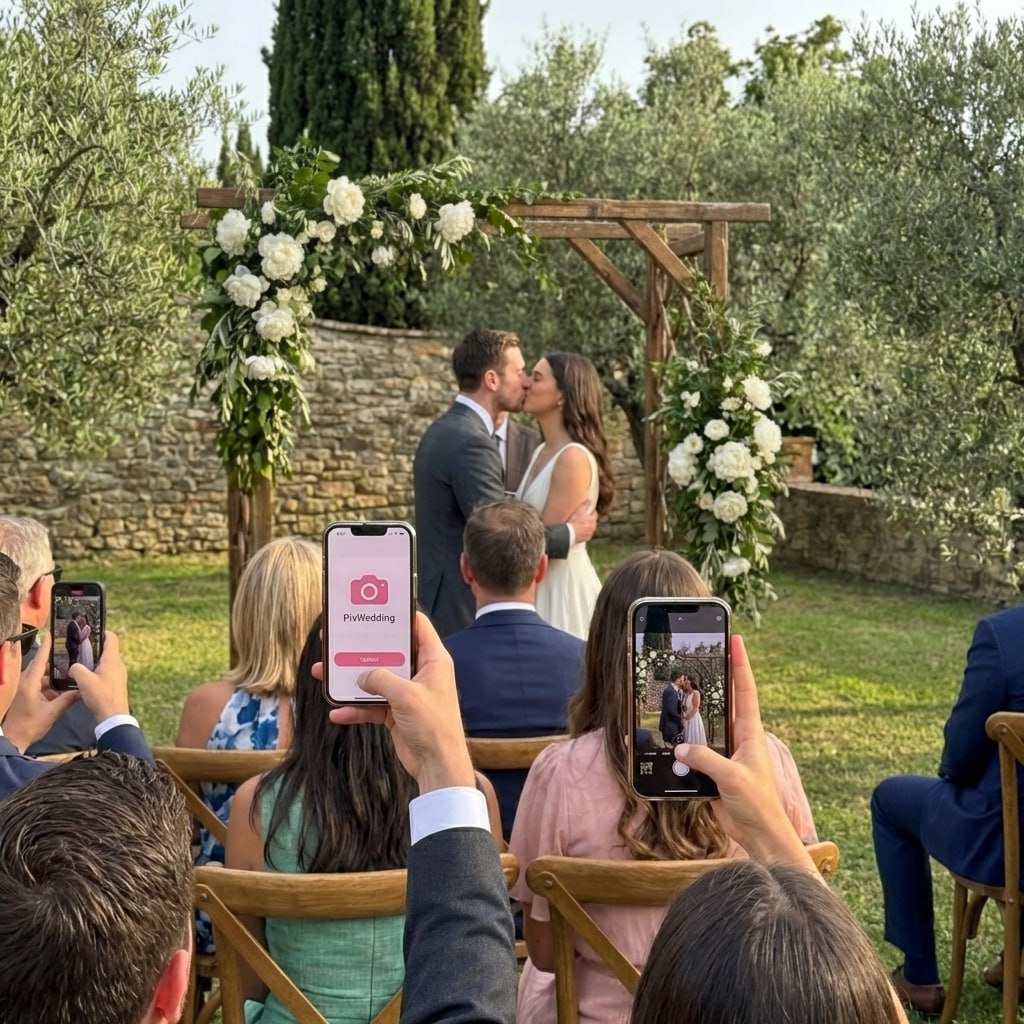
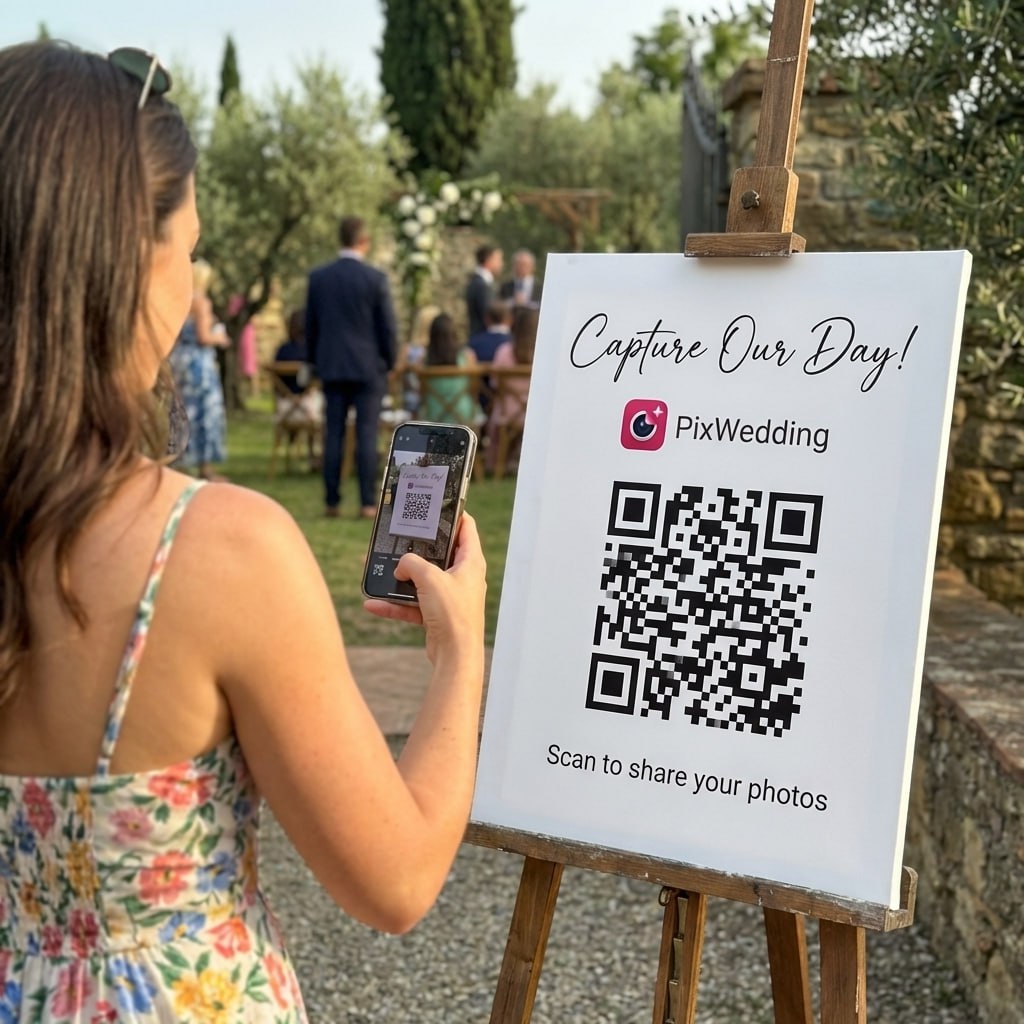
A digital wedding guestbook with photos is a single QR code that lets every guest leave a written message, upload a photo, and record a voice note, all saved in one permanent album. Guests access it by scanning the code on their table, no app download needed. You get the sentiment of a paper guestbook plus the photos of a shared album plus the warmth of voice messages in one place.
Setup time: 20 minutes the week before the wedding. Cost: one-time purchase starting at $59 via Pix Wedding.
Paper guestbook vs photo album vs the combo
We have worked with all three formats across multiple weddings. Here is the honest breakdown.
| Feature | Paper guestbook | Photo album only | Combo (sign + photos + voice) |
|---|---|---|---|
| Written messages | Yes, short ones | No | Yes, longer (guests write from seats) |
| Guest photos | No | Yes | Yes, with names attached |
| Voice messages | No | No | Yes, replayable forever |
| Queue at signing table | Yes, often 10-15 people | No (QR at tables) | No (QR at every table) |
| Degrades over time | Yes, ink fades | No | No, permanent digital archive |
| Shareable with family | Only if you photograph each page | Yes, link shareable | Yes, single link for everything |
| App download required | No | Depends | No, browser-based |
| Typical cost | $30-80 (book + pen) | $30-100 | $59 one-time (Pix Wedding) |
Seven steps to a working guestbook plus photo album
From the weddings we have set this up for, in the order things actually need to happen.
- 1
Create the Pix Wedding album one week before
Add the couple's names, wedding date, and a cover photo. This takes five minutes. The album URL and QR code are generated immediately. Save the QR code as a PNG, you will need it for printing.
- 2
Print QR table cards with a specific prompt
Generic "scan to sign our guestbook" prompts get generic one-line responses. Specific prompts get longer, richer entries. Pick one prompt per card (see the prompt library section below) and print one card per table plus two near the bar and entrance. A standard 4x6 card with the QR code taking up the top half and the prompt below it works well.
- 3
Enable the voice message feature in Pix Wedding settings
It is turned off by default. Go to album settings and toggle on "Voice messages." Once enabled, guests will see a mic icon alongside the photo and text options. Add a short instruction to your table card, something like "Tap the mic to leave us a voice message." Voice messages see a 30 percent increase when the card explicitly asks for them.
- 4
Test from a guest's perspective the day before
Scan your own QR code on a phone that has never visited the album. Leave a message, upload a photo, record a 10-second voice note. Confirm all three appear in the album within 30 seconds. This catches venue WiFi issues and any permission prompts that might confuse older guests before the wedding day.
- 5
Brief the MC on one announcement during dinner
A single DJ or MC announcement during the first 20 minutes of dinner doubles participation. The script is short: "There is a QR code on every table. Scan it to leave the couple a message, a photo, or a voice note for their permanent album." That is all it takes. Guests at that point are seated, phones in hand, and happy to spend 90 seconds contributing.
- 6
During the reception: let it run
The album collects entries throughout the night without any action from you. Check it briefly during cocktail hour to confirm entries are coming in. After that, enjoy your wedding. The album keeps building.
- 7
Share the album link within 48 hours of the wedding
Send the album link to parents, the wedding party, and anyone who could not attend. Guests who were there often go back to see their own entries and end up leaving a second message or uploading more photos they found on their camera roll. The album can keep growing for weeks after the event if you leave it open.

Uncle Pete's toast
Said it perfectly
One QR code. Guests sign, share photos, and speak.
Pix Wedding turns your guest list into a permanent guestbook with written messages, camera roll uploads, and voice notes, all in one place. No paper, no lost pages, no line at the guestbook table.

From Grandma Ruth
ALBUM
Emma & Jack
June 14, 2026
634 photos · 94 guests


Why voice messages outlast every other guestbook format
From weddings we have set this up for, voice messages are the entries couples replay most, sometimes years later.
Tone carries what text cannot
A grandmother's voice cracking slightly on the last word of her message is something no written note can replicate. We have seen couples cry replaying voice notes that, written down, would have sounded ordinary.
Guests say more when they speak
The average written guestbook entry at a wedding runs 12-15 words. The average voice message runs 35-50 words. Speaking feels less permanent than writing, so guests share things they would hesitate to put in ink.
It preserves voices of people you will lose
One couple told us the most important thing in their entire album was a 22-second voice message from a grandparent who passed away fourteen months after the wedding. No paper book would have saved that.
How to encourage voice messages on the day
The single biggest driver of voice message participation is explicit instruction. If your table card says "scan to sign our guestbook," most guests will type a short note and stop. If it says "tap the mic icon to leave us a voice message," participation roughly triples. The act of recording feels unfamiliar to many guests and they need permission to do it.
A helpful addition: have the MC say the words "voice message" in the dinner announcement. "Scan the QR on your table to leave a message, a photo, or a voice note" converts about 25 percent of participants into voice note leavers. Without that cue, the number is closer to 8 percent.
What to print on the table card to get better entries
These are the prompts that produce the longest, most personal guestbook entries from guests. Pick one per card.
Memory prompts (for guests who know the couple well)
- "Share a memory of [partner A] or [partner B] that made you smile."
- "When did you first realize these two belonged together?"
- "What is one story about [partner A] that they would prefer we forgot?"
Advice prompts (universal, work for any guest)
- "One piece of marriage advice you actually believe."
- "What should they do on their first anniversary?"
- "Predict one thing about their life together in 10 years."
Photo + voice prompts (to maximize all three formats)
- "Upload your best photo from tonight, then tap the mic to tell us what you captured."
- "Take a photo of whoever is sitting next to you and record a 10-second introduction."
- "Scan, write one sentence, upload one photo, and say one word out loud into the mic."
Which format to lead with for different guest types
Not every guest will use all three. Knowing which format to emphasize for each group gets better overall participation.
Lead with text for guests over 60
Older guests are often comfortable typing a short message but hesitant about uploading photos or recording audio. A prompt that focuses on a written memory or piece of advice works best. If they do leave a voice note, it tends to be the most emotional one in the album.
Table card wording: "Scan to write us a message. Hit send, then feel free to add a photo or voice note too."
Lead with photos for guests in their 20s and 30s
Younger guests are already taking photos constantly. Asking them to upload is a small behavioral shift. Many will add a message or voice note once they have uploaded. Frame the ask around the photo first.
Table card wording: "Upload your best photo from tonight. Then leave us a message or voice note to go with it."
Lead with voice for close family and wedding party
People who know the couple best often have the most to say but struggle to write it down. Voice removes the barrier. A direct ask, "we would love to hear your voice in our album," works better than "leave a message" for this group.
Table card wording: "Record a voice message for us. 15 seconds is enough. Hit the mic and say whatever is on your heart."
For guests you do not know well: keep the ask small
Work colleagues, distant relatives, or plus-ones who do not know the couple well can feel pressure if the prompt asks for a personal memory. A low-barrier ask ("one word of advice" or "share any photo you took tonight") brings them in without making them feel awkward.
Table card wording: "Scan to share a photo from tonight or leave any message you like. No pressure, just glad you are here."
Priya and Marcus, 156 guests, a restored mill in Hudson, NY, September 2025
This was a Saturday evening in mid-September 2025 at a restored 19th-century mill in Hudson, NY. The ceremony space had exposed brick and a 30-foot ceiling, and the venue's WiFi historically cut out during dinner because the router was on the far side of the building from the main hall. We knew about the WiFi risk going in. Priya and Marcus had 156 guests and zero interest in a paper book. Their ask was clear: they wanted every voice in the album, especially Marcus's grandmother, Nana Ruth, who was 81 and attending her first wedding in eight years.
Setup, done the Tuesday before the wedding: Pix Wedding album created in about 12 minutes, cover photo uploaded, voice messages toggled on in settings. We printed 22 table cards on matte 4x6 stock through Canva and had them printed at a local FedEx Office for $31.40 total. Each card used this prompt: "Tell Priya and Marcus how you knew them, or leave a voice message by tapping the mic. 20 seconds is all you need." Two QR sticker sheets were printed at home and placed near the bar and the entrance photo display.
Cocktail hour started at 5:15 PM. The first guestbook entry landed at 5:22 PM. By the time guests were seated for dinner at 6:45 PM, there were already 41 messages and 112 photos. The MC made one announcement at 7:05 PM, specifically naming the mic icon and saying "if you want Priya and Marcus to hear your voice years from now, tap the mic." Voice message volume jumped immediately after that.
What we did not expect: Nana Ruth left a 1 minute and 14 second voice message at 6:51 PM while seated at her table. She spoke slowly, told a story about meeting Marcus's grandfather at a dance hall in 1967, and ended with "I hope you two dance as much as we did." She had needed help from her grandson to find the mic icon, but once she started she did not stop. Priya listened to it standing in the parking lot after the reception and cried for five minutes.
What failed: the venue WiFi went down at 8:34 PM during the main course. Photo uploads stopped working for about 35 minutes. Voice messages and text entries still went through because they are smaller payloads, but anyone trying to upload a JPEG from their camera roll got an error. We hotspotted off an iPhone 15 Pro and shared the password with the tables closest to the wedding party. By 9:10 PM the venue WiFi came back and uploads resumed. Total entries missed because of the outage: difficult to know exactly, but participation recovered and the album closed with 118 text messages, 394 photos, and 51 voice messages by midnight.
The backup paper book the venue placed at the entrance collected 19 entries. Twelve of those guests also left digital entries. The paper book went home with the couple and sits in a drawer. The album link is bookmarked on Marcus's phone.
Cost breakdown for this setup:
- Pix Wedding album: $59 one-time
- 22 matte 4x6 table cards, FedEx Office: $31.40
- QR sticker sheets, home inkjet print: $0 (paper only)
- Total: $90.40
Lesson: always bring a personal hotspot or confirm the venue's network can handle simultaneous uploads from 50+ guests. The venue WiFi failure was not unusual. Plan for it.
Lina and Diego, 84 guests, a tented vineyard outside Healdsburg, CA, June 2025
The last weekend of June 2025, a Friday evening ceremony at a private vineyard outside Healdsburg in Sonoma County. The tent was strung with Edison bulbs and seated 84 guests at round tables of eight. Diego's family had flown in from Bogota. Lina's parents had come from Manila. The two sides barely shared a language, and Lina was specific about what she wanted from the guestbook: she wanted guests to leave voice messages in whatever language felt natural. She did not want a translation. She wanted the voices.
The setup for this wedding took 18 minutes the Wednesday before. Album created, voice messages enabled, custom cover photo set. The table cards for this wedding were bilingual, English on one side and Spanish on the reverse, both pointing to the same QR code. We used a Canva template and had 12 cards printed at a Staples near the venue for $18.60 on matte card stock. Each card read: "Leave Lina and Diego a message, a photo, or a voice note. Habla en tu idioma, they want to hear all of it." Two standing signs with the QR were placed near the bar and the dessert table.
The sign-in experience that evening was unusual because the venue had no formal guestbook table. There was no queue, no pen, no line. Guests found the QR cards at their seats during cocktail hour and most scanned within the first 30 minutes. By 7:45 PM when dinner was served, 52 of the 84 guests had already left at least one entry. The MC made the standard announcement at 8:02 PM and the remaining participation came in waves between courses.
The moment that defined the album: Diego's uncle Hector, age 73, from Cartagena, left a 2 minute and 8 second voice message entirely in Spanish at 8:19 PM. He sat at his table with his phone in both hands and spoke directly to Diego the whole time. He told the story of Diego's grandfather building the first house in their neighborhood with his bare hands, and said he saw that same quality in Diego's eyes the moment he met Lina. Lina does not speak Spanish. She had the message transcribed by a friend two weeks after the wedding. She has since listened to the original recording, untranscribed, more than 20 times, she told us, because the cadence of Hector's voice carries something the translation cannot.
What failed: three guests at the same table (all in their 60s, all on older Android phones) had trouble with the microphone permission prompt. The browser asked for mic access and they dismissed it thinking it was an ad. A bridesmaid walked through the steps with them after noticing the confusion. All three ended up leaving voice messages once the permission was granted. The lesson from this: add one line to the table card or a small sticker on the sign that says "if asked about microphone access, tap Allow." That one sentence would have prevented the confusion entirely.
Final album count by the time the tent came down at midnight: 71 text messages (entries in English, Spanish, and Tagalog), 266 photos, 29 voice messages. Lina's mother left a Tagalog voice message that ran 54 seconds and ended with her singing two lines of a lullaby. That entry has been shared with every member of both families. It is the first thing Lina opens when she visits the album.
Cost breakdown for this setup:
- Pix Wedding album: $59 one-time
- 12 bilingual matte 4x6 cards, Staples: $18.60
- 2 standing QR signs, printed at home: $0
- Total: $77.60
Lesson: for multilingual weddings, the digital format is far better than paper. A paper book requires guests to write in a script the couple can read. A voice message has no language barrier. Let guests speak. Put it on the card.
How to revisit the digital guestbook on anniversaries
The album does not lose value over time. It gains it. Here are the reflection approaches that other couples have found meaningful.
Play one voice message on each anniversary
Pick one voice note you have not played in a while and listen to it together. The context of the year you have just had makes each entry land differently than it did on the wedding night.
Find the oldest photo in the album each year
Some guests upload photos from their phone's camera roll that predate the wedding by months. Scrolling for these surprise photos is a way to rediscover the album with fresh eyes every time.
Check the advice entries to see which held up
Wedding advice is hit or miss. Going back five years later and rating each piece of advice as "nailed it" or "did not age well" is an unexpected source of entertainment and gratitude in equal measure.
Share the album link on the wedding anniversary
A message to your wedding group chat with the album link one year later pulls people back in. Guests often go and read their own entries, sometimes adding a new message to see how much they have changed.
Six things that reduce participation in a digital guestbook
- Generic prompts on the table card. "Sign our guestbook" produces three-word entries. "Tell us how you knew [name]" or "share one piece of advice" produces paragraphs. Be specific.
- Skipping the MC announcement. Guests at a wedding are overwhelmed with stimuli. Without a brief mention from the DJ or MC, many will never notice the QR card even if they look at the table.
- Poor venue WiFi at guest tables. If guests cannot upload from their seat, many will intend to do it later and forget. Test the WiFi at every table cluster before the wedding day.
- Not mentioning voice messages explicitly. Guests do not know the feature exists unless you tell them. Add "tap the mic icon for a voice message" to the card text and to the MC script.
- No QR card near the bar. The bar is where guests stand, hold a drink, and look at their phone. A QR sticker on the bar or a small card nearby catches people at the exact moment they have time to contribute.
- Closing the album too quickly after the wedding. Many guests intend to add photos or a second message from home after the event. Leave the album open for at least four weeks. Some of the best entries arrive on the Monday after the wedding when guests review their camera roll.
Related guides for your photo and guestbook planning
More resources for capturing and preserving every moment from the wedding day.
Why most couples end up wanting a guestbook and a photo album
Paper guestbooks have been around for decades because they work. There is something physical and permanent about a signed page. But a paper guestbook collected from a 120-person wedding often yields 80-90 entries of "Congratulations! Wishing you a lifetime of happiness!" and not much else. Nobody brings their camera roll to a paper book.
Standalone digital photo albums fill the photo gap but lose the message component. Guests upload photos but there is no place for them to leave a note, and the couple has no way to know who uploaded what without recognizing every face.
The combo format solves both. One QR code gives guests a single place to sign with text, attach a photo from their phone, and record a voice note. The result is an album that reads like a scrapbook with handwriting, faces, and voices all tied together.
- •Text messages give context that photos alone cannot
- •Photos give permanence that text messages alone cannot
- •Voice notes capture emotion that neither text nor photos can replicate
- •Everything is organized by guest, not by time or table
- •The album is immediately shareable with parents and family who were not at the wedding
What makes a good guest prompt for the digital guestbook
The single biggest factor in how good your guestbook entries will be is the prompt on the table card. "Sign our digital guestbook" gets short, generic responses. A specific question gets specific answers.
We tested three prompt styles across real weddings and found that behavioral prompts (asking guests to describe a memory or give advice) produced entries that were on average four times longer than generic "leave a message" prompts. Voice notes also increased by 30 percent when the card specifically said "tap the mic to leave a voice message."
The combo guestbook as a keepsake vs the paper alternative
Paper guestbooks degrade. Ink fades. Pages yellow. We have seen couples bring out a paper guestbook from a wedding five years ago and struggle to read half the entries. A digital guestbook is permanently crisp, searchable, and playable.
The format also scales. A 250-person wedding with a paper book creates a line at the guestbook table. With QR codes at every table, all 250 guests can leave entries simultaneously during dinner without any queue. In practice, digital guestbooks at large weddings collect 40-50 percent more entries than paper books at the same guest count, based on the weddings we have data for.
Explore more free wedding tools
Everything you need to make your wedding day stress-free and unforgettable.
QR Sticker Designer
Design custom print-ready stickers.
Hashtag Generator
Create unique wedding hashtags.
How to Collect Guest Photos
5 methods ranked by participation rate and ease.
Get Photos After the Wedding
Message templates to gather guest photos post-wedding.
Share Wedding Photos with Guests
Compare every sharing platform by ease and participation.
Best Way to Get Guest Photos
The single method with the highest participation rate.
How to Make a Shared Wedding Album
Step-by-step setup for every platform.
Alternative to Disposable Cameras
Better, cheaper options than disposable cameras.
Digital Wedding Guestbook With Photos FAQ
Everything you need to know about our free tools and how they help your wedding day.
A digital wedding guestbook with photos lets guests scan a QR code and leave a written message, upload a photo, or record a voice note, all saved in one shareable album. Unlike a paper guestbook (text only) or a standalone photo album (no messages), the combo approach means every guest entry has context: you know who wrote what, which photos came from whom, and you can replay voice messages years later. Pix Wedding handles all three formats from the same QR code.
Yes. Every format is optional. Guests can write only, upload only, speak only, or do all three in the same visit. About 60 percent of guests in weddings we have tracked upload at least one photo when given the choice. Around 25 percent leave a voice message when the table card specifically asks them to. Text-only guests are typically older guests who are more comfortable typing than they are uploading from their camera roll.
You create a Pix Wedding album and download the QR code. Print it on table cards, the back of the menu, a custom sticker at the entrance, or a standing sign near the bar. Guests scan it, the album opens in their browser, no app download needed. They type a message, tap the camera icon to upload photos, or tap the mic icon to leave a voice note. All three options are on the same screen.
In our experience: more so, not less. Paper books get one short sentence per guest because nobody wants to hold up the signing line. Digital entries are longer because guests write from their seats at their own pace. Voice messages are the most emotional format we have seen at a wedding because you can hear tone, laughter, and pauses that no pen captures. Three months after the wedding, couples we have talked with replay voice messages far more often than they re-read paper pages.
Pix Wedding works on any phone with a browser, including older Android and iOS versions. The only requirement is a data connection (venue WiFi or cellular). If a guest has neither, they cannot participate digitally, the same limitation a digital guestbook kiosk would have. For weddings with many older guests, a hybrid setup works well: paper backup sheet at the table plus the QR for those who want to add photos and voice notes.
The album lives permanently at your unique Pix Wedding URL. You can log in from any device and scroll through every message, photo, and voice note. You can download the full album to a zip file, share the link with family, or export individual entries. The album does not expire. Many couples bookmark the URL and revisit it on anniversaries.