







pixPix Weddingwedding
Guest Video Uploads

Can Guests Upload Videos to a Wedding Photo App?

Yes, but it depends entirely on the app. The good ones accept photos and full-length 4K video through the same QR code with no extra steps. The bad ones cap clips at 30 seconds, charge extra for video on paid tiers, silently transcode your 4K footage to 720p, or refuse video uploads altogether. The difference is not obvious until your guests are already at the venue.

Pix Wedding accepts unlimited full-length 4K video alongside photos from any guest phone via the same QR code, with no separate app install or signup required. This page breaks down which platforms actually support video, what the hidden caps are, the technical reasons behind them, and what your guests can realistically upload from an iPhone or Android.

Set Up Your Wedding Photo and Video Album Free
Quick answer

Video Upload Works When...

Two conditions determine whether your guests can actually deliver video to your album.

Video Upload Works When...

The platform explicitly lists video support with no length cap

Guests can upload without installing a native app

The upload flow accepts both photos and videos in one selection

HEVC (H.265) codec is accepted, not just H.264

File size limits are above 500MB per clip

The platform does not silently transcode to a lower resolution

Video Upload Fails When...

The platform caps clips at 30 seconds or less

A native app download is required before guests can upload

File size limit is 100MB or below

The platform shows a success screen but silently rejects HEVC files

Video upload is locked behind a paid plan the couple did not buy

The album link expires within 24 to 48 hours of the wedding

Platform comparison

Platform Video Feature Matrix

Eight platforms, eight features. Every cell reflects the actual behavior on the free or default tier as of 2026.

FeaturePix WeddingGoogle Photos SharedWedShootsShoeboxApple iCloud SharedJoy AppThe Knot SiteDisposable Camera Apps
Video supported?YesYesYes (paid)NoYesLimitedNoNo
Max length per clipUnlimitedUnlimited2 min (free: 30s)N/AUnlimited30 secondsN/AN/A
Max file sizeNo cap~10GB500MBN/ANo cap100MBN/AN/A
4K resolution?YesYes (with storage)No (1080p max)N/AYesNoN/AN/A
Live Photos?Yes (as MP4)YesStill onlyStill onlyYes (native)Still onlyN/AN/A
Codec restrictionsNoneNoneH.264 onlyN/ANoneH.264 onlyN/AN/A
Compresses on upload?NoOptionalYesN/ANoYesN/AN/A
Cost for videoIncludedCounts against quotaPaid plan onlyN/ACounts against quotaPaid plan onlyN/AN/A

N/A indicates the platform does not offer a guest photo/video sharing feature in the traditional sense. Green = favorable, red = restrictive, gray = neutral or context-dependent.

The real reason

Why Apps Cap or Reject Video

Four cost and engineering factors drive the restrictions you run into at the worst possible moment.

Storage Costs Scale Fast

A 100-guest wedding can generate 3 to 6 gigabytes of video. Scale that across thousands of weddings and cloud storage bills become the dominant cost. Many platforms cap video to keep per-wedding storage predictable.

Transcoding Is Expensive

To play a video in a browser or app reliably, most platforms transcode it to a streaming format. That process uses compute resources for every clip. Platforms that reject long videos or high-res files are often cutting transcoding costs, not storage.

Bandwidth During Upload

A 500MB video clip uploaded by a guest on venue WiFi can saturate a shared connection. Platforms that serve global guest bases have to handle this load. Capping file size is a blunt way to control bandwidth spikes at high-traffic hours.

Browsing UX Breaks Down

Albums with 30-minute speech recordings mixed in with photos become hard to browse. Some platforms use this as justification for a 30-second cap, though the real driver is usually cost. A better solution is a dedicated video section within the album.

Device differences

iPhone vs Android Video Upload Friction

The platform you choose interacts differently with iOS and Android defaults. Here is what actually happens.

iPhone Upload Friction

HEVC codec default

iPhone 12 and later shoots video in HEVC (H.265) by default. Platforms that only accept H.264 will silently fail these uploads. The guest sees a success screen; the video never arrives.

HEIC photo format

Photos shoot in HEIC by default. Some platforms convert on the fly; others store raw HEIC files that do not render in most browsers. The safe platforms convert to JPEG at upload time.

Live Photos

Live Photos are two files: a JPEG still and a short MOV. Platforms that only accept single files drop the MOV component, delivering a frozen still. The motion is lost silently.

File sizes

A 1-minute 4K video from iPhone 14 or later is roughly 400MB. Platforms with 100MB caps reject these entirely. HEVC compression helps but still produces 150-250MB per minute at high quality.

Android Upload Friction

Codec varies by manufacturer

Samsung, Google Pixel, and OnePlus devices each have different default video codecs. A platform that tested only against Samsung phones may fail on Pixel uploads. The inconsistency is unpredictable and rarely documented.

File size varies dramatically

A 1-minute 4K video from a Samsung Galaxy S24 can be anywhere from 200MB to 600MB depending on settings. Budget Android phones often produce smaller files at lower bitrates. The range makes file size caps an unreliable filter.

No Live Photos equivalent

Android does not have Live Photos in the iOS sense. Motion Photos on Samsung exist but are stored differently. Most platforms ignore the motion component entirely regardless of the format.

Browser upload compatibility

Web-based upload flows (no app required) perform more reliably on Android Chrome than on older Android WebView. Guests on Android phones more than 3 years old may need to be told to open the upload link in Chrome specifically.

The Live Photos Problem

When a guest shoots a Live Photo on an iPhone, what they are actually saving is two separate files: a full-resolution JPEG still and a short MOV video clip, usually 1.5 to 3 seconds long, that plays before and after the still frame. Together, they create the "living photo" experience. Separately, they are just a static image and an orphaned video clip.

Most upload platforms accept the JPEG component and silently discard the MOV. The guest uploads what they think is a Live Photo. You receive a frozen still. Neither party is told this happened. The motion component, which often captures the exact second of a laugh or a look that did not survive in the still, is gone.

Pix Wedding handles Live Photos as paired files. The JPEG is stored as the album photo. The MOV component is preserved as a linked MP4, accessible alongside the still in the album viewer. When you look at a Live Photo in your album, you get both the frozen still and the motion clip without having to do anything differently on the upload side.

Test this before your wedding: upload a Live Photo to your platform of choice and confirm that the motion plays in the album viewer. If it arrives as a still, you know what is being lost.

What to collect

The 5 Guest Video Types That Matter Most

Ranked by how often couples wish they had them and how exclusively guest video captures them.

1
Most Requested

Ceremony Aisle Moments

Guests in aisle seats capture the walk-down from angles the official photographer cannot reach. These short clips account for roughly 20% of post-wedding "I wish I had that" requests. A guest 3 rows back on the left side catches the expression on the groom's face that no camera on a tripod ever sees.

Example: 45-second clip of the bride entering, shot from the third pew at eye level.

2
High Value

First Dance and Parent Dances

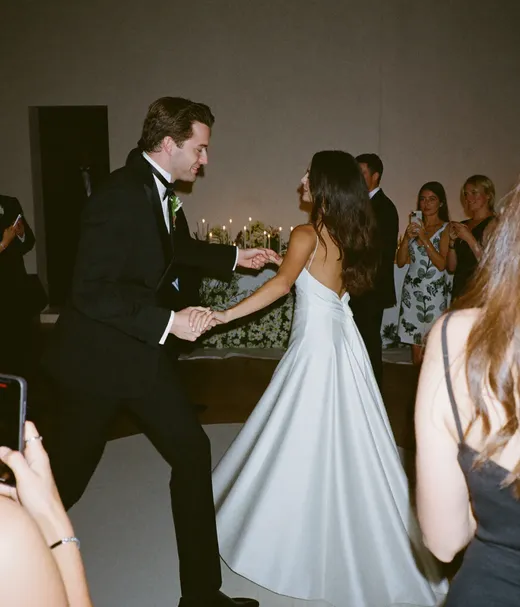
These are the moments guests film most reliably. They are stationary, well-lit by the DJ setup, and emotionally charged. The professional video covers the couple. Guest video covers the audience reaction: the parents watching, siblings quietly crying, friends leaning into each other.

Example: 3-minute first dance clip showing the full room from a table near the back.

3
Irreplaceable

Spontaneous Reactions and Candid Laughs

The ring bearer trying to eat the ring pillow. The best man dropping his notes and ad-libbing. Grandma dancing unexpectedly. These moments are not scheduled and the photographer is rarely pointing the lens that way. A guest nearby who hits record gets the only documentation that moment ever happened.

Example: 8-second clip of a flower girl spinning until she falls over, caught by an aunt at table 6.

4
Audio-Critical

Speeches and Toasts

Professional video covers speeches from a fixed camera position with good audio. Guest video captures the same speech from inside the crowd: the laughter building, the speaker's face, the table reactions. A guest with a phone close to the microphone sometimes delivers the cleaner audio track. More importantly, a guest filming from the side records the speaker AND the couple's reaction simultaneously.

Example: 6-minute best man speech filmed from the front-left table, showing both the speaker and the couple.

5
Energy Capture

Dance Floor Energy Clips

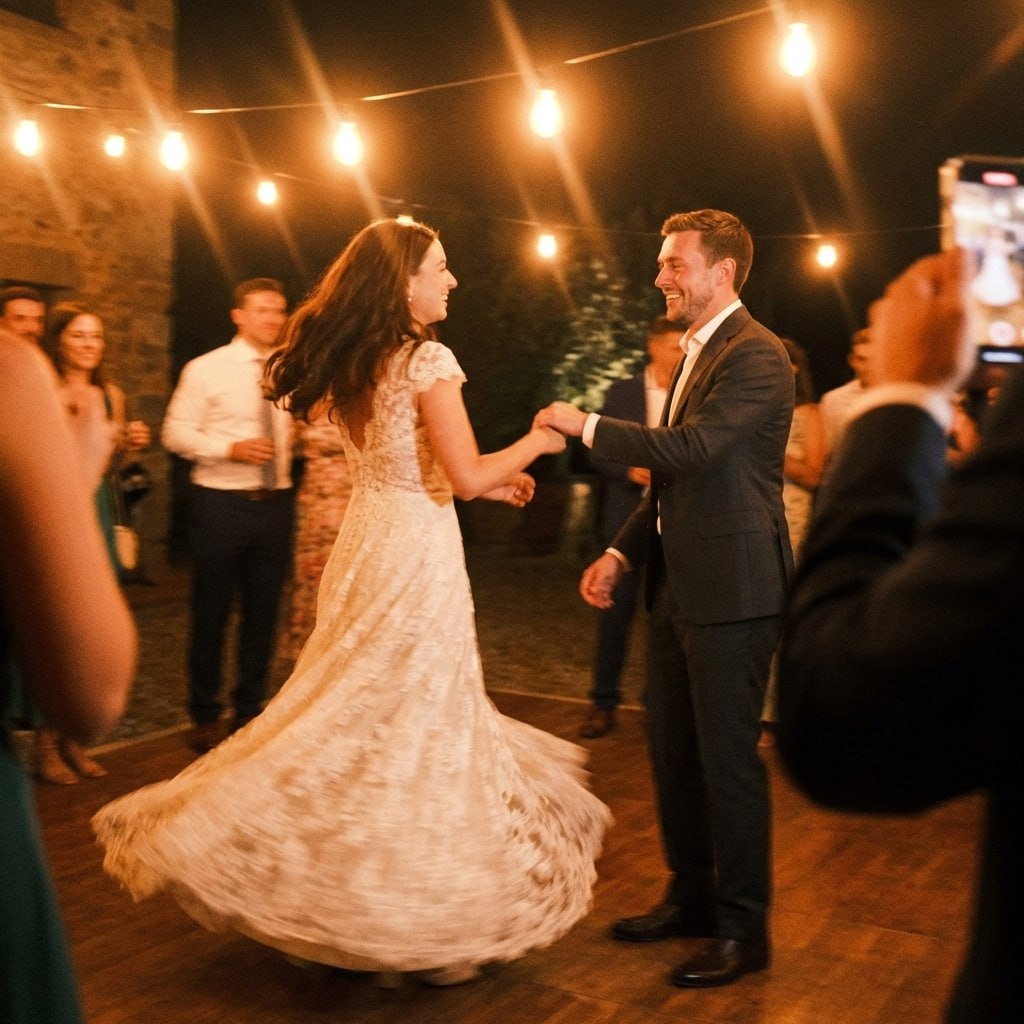
The dance floor after 10pm is where professional coverage often ends and guest documentation takes over. These clips are chaotic, dark, and loud, but they are the ones couples watch most in the years after the wedding because they capture the feeling of the night more than any posed photograph. A 90-second clip of your college friends completely losing it to a song is something no photographer produces on purpose.

Example: 90-second dance floor clip, shaky, noisy, and irreplaceable.

Data

What a Real Wedding Generates

Typical upload volumes from a 100-guest wedding using a platform with video enabled.

150 to 400video clips

From 100 guests

Not every guest films but roughly 40-60% of guests at an active wedding will capture at least one video clip.

~12 secaverage clip length

Per video

Most guest clips are short reactions. Dance floor clips and speech recordings skew the average upward to 20-30 seconds.

3 to 6 GBtotal video

Per 100-guest wedding

Smaller than most people expect. The equivalent 2,500 photos from the same event are typically 20 to 25 GB total.

~25 GBphoto files

For comparison

2,500 full-resolution JPEG and HEIC files from 100 guests dwarf the video volume. Video is the smaller data set despite the per-file size.

Watch out for

Caps That Silently Kill Your Video Collection

Six restrictions that are not always visible in pricing pages but show up when guests try to upload on the day.

30-second clip caps

Excludes every meaningful moment. A 30-second limit cuts off toasts, dances, and ceremony clips mid-scene. Apps that advertise "video support" often mean this.

100MB file size limits

A 4K clip from a modern iPhone runs 300-500MB per minute. A 100MB cap allows roughly 12 seconds of 4K or 30 seconds of 1080p. Anything longer is silently rejected.

No 4K acceptance

Apps that cap incoming video at 1080p are compressing your guests' best footage before you even see it. The guest shot 4K. You receive 1080p. The platform keeps the gap quiet.

Codec rejection (HEVC)

iPhones shooting in HEVC (H.265) produce half the file size of H.264 at equal quality. Many platforms only accept H.264, silently failing uploads from iPhone 12 and newer. Guests see the upload complete, but the file never arrives.

Native app install required

Platforms that require guests to install an app before uploading lose 40-60% of potential video contributors. Guests who would happily tap a browser upload link will not install an app for a one-time event.

24-hour or 7-day album expiry

Some platforms auto-delete uploaded content after a short window. Guests who upload immediately are fine. Guests who planned to upload Tuesday find an expired link. The clips are gone.

Fallbacks

Workarounds When Your App Blocks Video

Three approaches couples use when their primary platform does not support video, plus honest downsides for each.

Shared Google Drive Folder

How it works: Create a shared folder, share the link at the wedding, instruct guests to upload directly.

Downsides

Requires guests to have a Google account or log in

No organized photo gallery view, just raw files

Guests must know how to navigate Drive on mobile

No easy way to see who uploaded what

Permission settings frequently cause confusion ("request access" loops)

AirDrop Chain (iPhone-only)

How it works: Have a bridesmaid or groomsman walk around collecting video via AirDrop to a central phone.

Downsides

Works only between Apple devices, excludes all Android guests

Requires physical proximity and a willing point person

The central phone fills up fast and someone has to manage the transfers

Files arrive unnamed and unattributed

Bridesmaids and groomsmen are busy during the event

USB Drive Station at the Venue

How it works: Set up a laptop or hub near the exit with a USB drive and instructions for copying files.

Downsides

Requires guests to know how to transfer files from their phone to a drive

Modern iPhones default to HEIC and HEVC which Windows PCs often cannot read without codecs

Needs someone to manage the station all evening

Guests leaving at different times means the station needs to be staffed for hours

High chance of the drive being left behind, unplugged, or full

Real outcomes

Two Weddings, Two Outcomes

The platform choice made a concrete difference in what these couples kept.

What was lost

A Father's Toast, Capped at 30 Seconds

Emma and Daniel chose a photo-sharing app that was well reviewed and easy to set up. What they did not check before the wedding was the 30-second video cap on the free tier. During the reception, Emma's father gave an unscripted 9-minute toast. Three of Daniel's cousins filmed it from different angles. All three uploads failed silently at the 30-second mark. The guests saw a success screen. The full recordings never arrived. Their official videographer had been positioned at the back of the room and did not catch the close-angle of Emma's father looking directly at her during the key part of the speech. The moment exists in one 30-second clip, which cuts off mid-sentence.

The cap was listed in the platform's FAQ. It was not mentioned during setup or in the email confirmation.

What was kept

Six Hours of Dance Floor Footage

Marcus and Priya set up their Pix Wedding album with video enabled and updated their QR sign to say "Photos and videos welcome." Their reception ran until 1am. Their official videographer stopped filming at 11pm. Between 11pm and 1am, 34 guests uploaded a combined 6 hours and 18 minutes of dance floor clips. The next morning, Marcus opened the album and watched 90 minutes of footage his professional team had not covered. The clips were shaky, loud, and occasionally blurry. They were also the most watched files in the album in the months that followed, according to view counts.

The single change that made this possible: "Photos and videos welcome" on the QR sign, plus a platform with no clip length cap.

Copy-ready script

What to Tell Guests About Video Uploads

Three lines you can put on your QR sign, wedding website, or program. Use any of them as-is or adapt to your voice.

For the QR Code Card or Table Tent

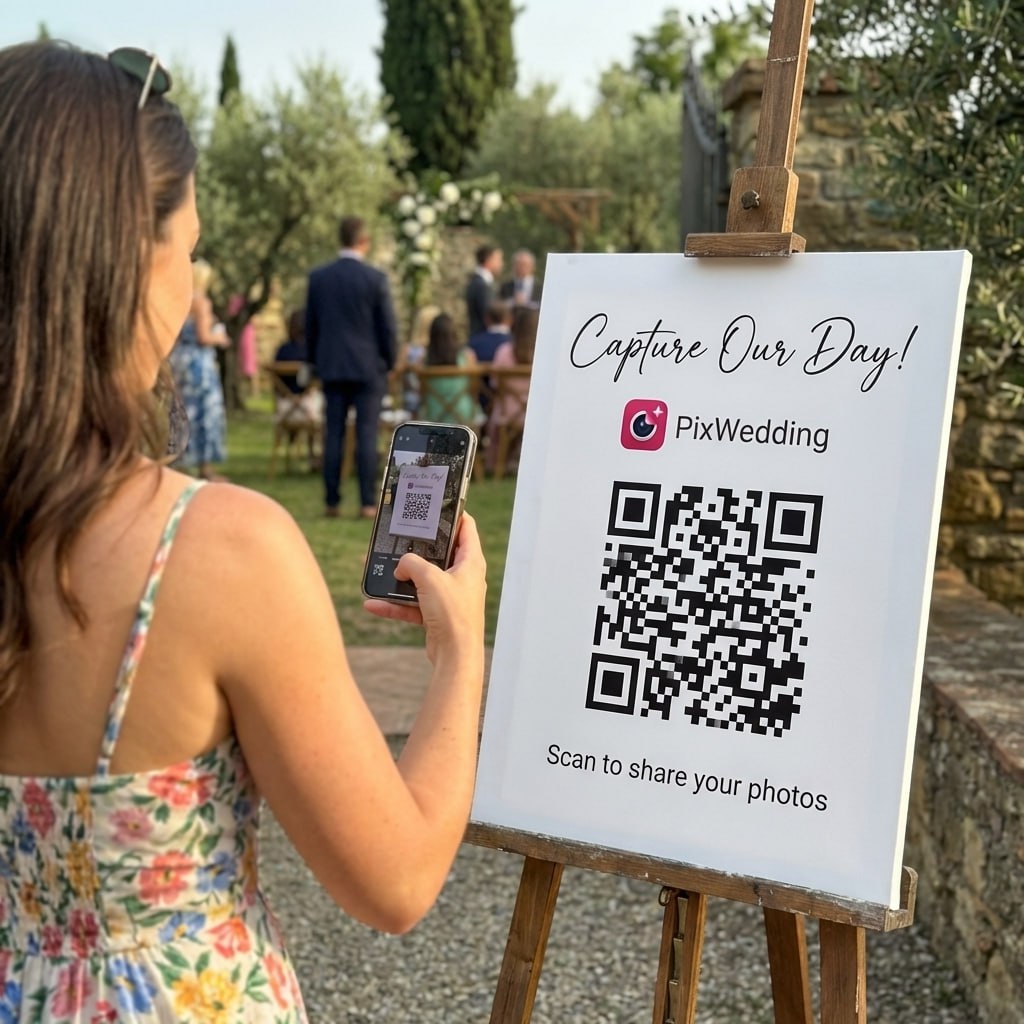
"Scan to share your photos and videos with us. Any length, any format. It takes under a minute and no app download is needed."

The phrase "any length" is doing real work here. Guests who filmed a 4-minute speech assume apps do not want it. Saying "any length" explicitly tells them it is welcome.

For the Wedding Website

"We would love your photos and videos from the day. Candid clips, reaction moments, dance floor footage, the boring parts: all of it. Scan the QR code at your table or use this link to upload directly. No app needed, videos are welcome at any length."

Including "the boring parts" gives guests permission to upload everything, not just the highlight-reel shots they think you want.

For a Post-Wedding Message

"If you have any video clips from the ceremony or the reception, please upload them before you clear your camera roll. Videos are welcome at any length. Here is the link: [link]. We are especially hoping someone caught [specific moment]."

Mentioning a specific moment ("we are especially hoping someone caught...") triggers guests to actually scroll through their camera roll looking for it. Generic asks get generic responses.

Related Guides

Collect Photos and Full-Length Videos in One Album

Pix Wedding accepts unlimited 4K video alongside photos via one QR code. No app install for guests, no clip length cap, no silent transcoding. Your guests film it, you keep it.

From Mom

From Mom

9:41

ALBUM

Emma & Jack

June 14, 2026

634 photos · 94 guests

AllMomentsMine
Add photosShare your moments
Table 4 just uploadedSarah B. · +12 new photos

Why Video Matters More Than Most Couples Realize

Professional wedding photographers deliver exceptional images, but they cannot be in two places at once and they rarely capture audio. A guest standing next to your grandmother during the ceremony may catch a 15-second clip of her reaction that no photographer would have. Your uncle at the bar may record the best man speech from a perspective that shows the whole room laughing. These are not files a professional produces. They come only from guests.

The most common post-wedding regret couples report is not about photo quality. It is about missing moments. A dad's spontaneous toast that happened while the photographer was outside. The flower girl spinning on the dance floor when no one official was watching. Candid reactions during the vow reading. Guest video captures all of this at zero cost if the upload platform supports it properly.

The technical barrier is lower than it used to be. Modern smartphones shoot broadcast-quality video by default. Guests are already recording. The only question is whether your sharing platform makes it easy to collect those clips or lets them disappear when guests clear their camera rolls three months later.

  • Guest video captures reactions and angles that photographers physically cannot
  • Most guests are already recording on their phones without being asked
  • Clips disappear when guests clear storage, usually within 30-90 days of the wedding
  • A platform that accepts both photos and videos in one flow doubles your content recovery rate

The Technical Reality of Guest Video Uploads

Video upload is harder to support than photo upload, which is why many platforms restrict it. A single 4K video clip from a modern iPhone can be 400 to 800 megabytes. Processing and storing thousands of those files requires infrastructure that a photo-only platform does not need to build. Transcoding to a streamable format adds compute cost on top of storage cost. This is why platforms either charge extra for video, compress it aggressively, or refuse it.

When a platform says it "supports video," the fine print matters. A 30-second cap effectively excludes most meaningful wedding moments. A 100MB file size cap rejects any 4K clip longer than about 8 seconds. Silent transcoding to 720p delivers blurry footage back to couples who expected HD. The only way to know what a platform actually does is to test it with a real clip before your wedding day.

Pix Wedding built video support into the original upload flow rather than bolting it on later. Guest uploads go through a pipeline that preserves original codec, resolution, and duration. No background compression, no length caps, no file size rejections for standard device video.

  • Test your platform with an actual video file before the wedding, not just a photo
  • Ask specifically about transcoding: does the platform re-encode video after upload?
  • Check whether the length cap applies per clip or per guest total
  • Verify that 4K files are accepted, not silently downsampled to 1080p

How to Maximize Guest Video Collection on Your Wedding Day

The biggest lever is signage language. Most QR code signs say "Share your photos." Changing that to "Share your photos and videos" is a single edit that meaningfully increases the number of guests who upload clips. Guests default to assuming apps only want photos. If you want video, you have to say so explicitly.

Positioning matters for video in a way it does not always for photos. Guests who are standing near the dance floor, seated close to the ceremony aisle, or positioned near the cake table are the ones most likely to capture compelling video. If you can give those guests a direct, personal prompt during the event ("I noticed you were right at the aisle during the walk, please upload that clip"), the conversion rate is dramatically higher than a general announcement.

After the wedding, video clips are the ones most likely to be deleted first when guests run out of storage. A recovery message sent within 48 hours that specifically says "if you have any video clips from the ceremony or dances, please upload them before you clear your camera roll" will surface files that would otherwise be lost within the month.

Explore more free wedding tools

Everything you need to make your wedding day stress-free and unforgettable.

Answers to what couples ask most about video support in wedding photo apps

Common Questions About Guest Video Uploads at Weddings

Everything you need to know about our free tools and how they help your wedding day.

With Pix Wedding, yes. One QR code handles photos and full-length videos from any guest phone. Guests do not need a separate link, a different app, or extra steps. They scan, select their photos and videos together, and upload in a single flow. Many other apps require a separate video upload path or simply reject videos at the QR entry point.

The most common cap is 30 seconds per clip, which is enough for a quick reaction but not for a speech, a full first dance, or a ceremony walk. Some apps allow up to 2 minutes on paid tiers. Pix Wedding imposes no per-clip length cap, so guests can upload a 12-minute ceremony reel or a 3-second laugh clip without any difference in the upload process.

Most apps transcode incoming video to 1080p or lower to reduce storage costs. This is done automatically and couples are rarely told about it. Pix Wedding preserves original resolution, so a guest who shot 4K on a recent iPhone or Android delivers the same 4K file to your album without any silent downgrade.

A Live Photo is actually two files: a JPEG still and a short MOV video component. Most upload platforms only accept the JPEG and silently discard the MOV, so the Live Photo arrives as a frozen still with no motion. Pix Wedding handles Live Photos as paired files. The still is stored as your album photo, and the motion component is preserved as a linked MP4 so you can view both.

A wedding with 100 guests typically yields 150 to 400 video clips averaging about 12 seconds each. At modern iPhone and Android compression, that works out to roughly 3 to 6 gigabytes of video. By comparison, 2,500 photo files from the same wedding typically total around 25 gigabytes. So video is actually the smaller data set by volume, just individually larger per file than a single photo.

Adjust the headline from "Share your photos" to "Share your photos and videos." That single word change has a measurable effect. You can also add a line like: "Videos welcome, any length." Guests assume apps only want photos unless you explicitly say otherwise. Telling them upfront that videos are welcome increases the number of guests who bother to upload their clips.