






Fraud Blocker
pixPix Weddingwedding
Format Comparison

Shared Photo Album for Wedding: Album App vs iCloud vs Google Photos

"Shared album" means three different things depending on which app you pick. Here is what each format actually lets your guests do, and which one fits your wedding.

Create Your Shared Album Free
The Short Answer

A shared photo album is any single place where more than one person can add photos, rather than one person's gallery that others just browse. For a wedding, that mostly comes down to four formats: a dedicated wedding album app (link or QR code, no account needed), iCloud Shared Albums (Apple ID required to contribute), a Google Photos shared album (Google Account required to contribute), or a plain cloud folder link (Drive, Dropbox, WeTransfer, no gallery view at all).

This guide compares the formats themselves, not individual apps within a format. If you are choosing between specific guest-upload apps, see our app comparison guide instead; if you just need step-by-step instructions for collecting photos on the day, see how to collect photos from wedding guests.

Side by Side

Every Shared Album Format, Compared

FormatWho can add photosAccount neededPrivacyCross-platform
Dedicated wedding album app (Pix Wedding)Any guest with a phone camera, via QR code or linkNo account or app downloadPrivate link only, not indexed or searchableYes, iPhone and Android
iCloud Shared AlbumsGuests you invite by Apple ID (up to 100 participants)Apple ID required to add photosInvite-only, or a view-only public web linkNo, Android guests can only view a public link
Google Photos shared albumGuests you invite or send the link toGoogle Account required to add photosInvite-only, or a public link the owner controlsYes, iPhone and Android
Plain cloud folder link (Drive, Dropbox)Anyone with edit access to the folder linkUsually an account to uploadAs private as the folder permission settingYes, but no gallery view, just a file list

One format, every guest, no app to download.

Skip the Apple ID and the Google Account sign-in prompts. Send guests a QR code or link and their photos land in one private album automatically.

From Mom

From Mom

Point your camera

Scan to join the album

No app, no account

9:41

UPLOADING

Saving your moment

9:41

THE ALBUM

Emma & Jack

June 21, 2026

647 photos · 95 guests

AllMomentsMine
Guest photo 1
Guest photo 2
Guest photo 4
Guest photo 5
Guest photo 6
Guest photo 7
Guest photo 8
Guest photo 9
Guest photo 10
Add photosShare your moments

SCAN TO TRY

pix.wedding/
your-wedding

Who Can Actually Contribute

How Each Format Lets Guests Add Photos

QR Code or Link (Album App)

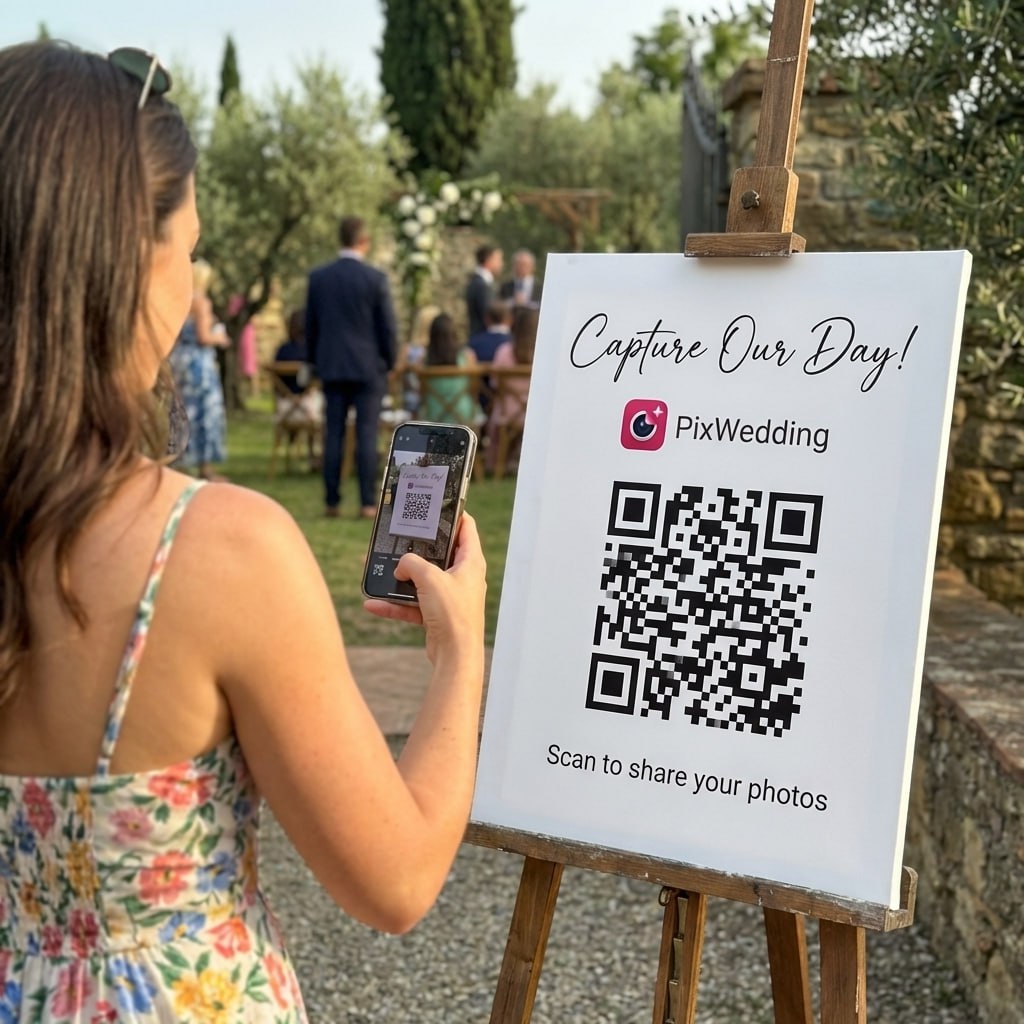
A guest opens their camera, scans a code, and their upload page opens in the browser. No account, no app store, no password. This is the lowest-friction way to collect photos from a full guest list.

Apple ID (iCloud Shared Albums)

To add a photo, a guest needs to be signed into iCloud on an Apple device and accept your invite. Guests on Android can be given a view-only public link, but they cannot contribute their own shots.

Google Account (Google Photos)

Contributing requires a Google Account, whether that is an invite by email or an "anyone with the link" setting the owner turns on. Viewing the album does not require an account, but adding photos does.

Folder Permission (Cloud Link)

A Drive or Dropbox folder set to "anyone with the link can edit" still generally requires the guest to sign into an account before the upload goes through, since anonymous editing was removed from standard folder sharing.

In One Sentence

Shared Album Terms, Defined

Contributor

Anyone who can add their own photos to the album, not just browse what is already there.

View-only link

A link that lets someone open and download photos, but not upload any of their own.

Public website (iCloud)

An optional toggle on an iCloud Shared Album that publishes a browser-viewable, view-only copy with no Apple ID required to open it.

Invite-only album

An album only the specific people the owner added, by email, phone number, or account, can open at all.

Storage quota

The total space allowed on an account, shared across every service tied to that account, not a pool reserved just for the wedding album.

Format 1

iCloud Shared Albums

Built into the Photos app on every iPhone, iPad, and Mac. The owner creates an album and invites people by name, email, or phone number. According to Apple's official Shared Album limits page and Apple's Shared Albums guide, the current limits are:

  • Up to 100 participants (subscribers) can be invited to a single shared album.
  • A shared album can hold up to 5,000 photos and videos in total.
  • Any one contributor can add up to 1,000 photos and videos per hour, and 10,000 per day, across all of their shared albums combined.
  • An album owner can create up to 200 shared albums and subscribe to 200 more.
  • Turning on the "Public Website" option lets anyone view the album in a browser without an Apple ID, but that link is view-only, it does not let them add photos.

Pros

  • Free and pre-installed: no download for anyone already on an iPhone.
  • Full resolution stays in Photos: no compression like a text or email attachment.
  • Familiar interface: guests who use iCloud regularly need no instructions.

Cons

  • Android guests are locked out: they can only view a public link, never add their own photos.
  • Apple ID required to contribute: a real barrier for guests who share a family Apple ID or are signed out.
  • 5,000-item cap: a large wedding with photo booth bursts can approach that limit.
Format 2

Google Photos Shared Album

Available on iPhone and Android through the Google Photos app or the web. Per Google Photos Help, here is how it actually works:

  • To add photos to a shared album, a collaborator needs a Google Account, whether they were invited by search, by contact, or by a link.
  • People without a Google Account can still open a shared album link to view it, if the owner has link sharing turned on.
  • A shared album holds up to 20,000 photos and videos, the same cap Google applies to private albums.
  • Storage counts against the account owner's Google plan, and the free tier is 15GB shared across Gmail, Drive, and Photos.

Pros

  • Works across iPhone and Android: no guest is excluded by device.
  • Higher item cap: 20,000 photos and videos per album.
  • Free tier for most guests: nearly every Android user already has a Google Account.

Cons

  • Google Account required to contribute: a real sign-in wall mid-reception.
  • Storage counts against the owner's plan: the free tier is 15GB shared across Gmail, Drive, and Photos.
  • No built-in QR code: sharing means sending a link and hoping guests find it later.
Format 3

Plain Cloud Folder Link

A Google Drive, Dropbox, or similar folder that guests upload into. It is not really an "album" at all, just a shared storage location. Per Google's own documentation on Drive sharing and Dropbox's plan page:

  • Standard Google Drive folder sharing still requires the uploader to sign into a Google Account, even with "anyone with the link can edit" turned on, since anonymous editing was removed from default sharing.
  • A folder link has no gallery view built for photos specifically, guests see a flat list of files, no captions, no per-guest attribution, no comments.
  • Free storage runs out fast with wedding-day video: Dropbox Basic starts at 2GB free, and Google's free tier is the same 15GB shared across the whole account.
  • A folder link set to "anyone can edit" does not expire on its own, and it is easy to forget it is still open months after the wedding.

A cloud folder link is best used for what it is: a storage bucket, not a guest-facing experience. Many couples use one after the wedding to receive the photographer's final delivery, not to collect live guest contributions during the event.

Decision Framework

Which Format Actually Fits Your Wedding

If Your guest list is mostly iPhones and you want a free, no-new-app option

iCloud Shared Albums works, but plan on Android guests being view-only through the public link, not contributors.

If Your guests are a real mix of iPhone and Android and most already have Gmail

Google Photos crosses platforms, but every single contributor has to be signed into a Google Account before they can add one photo, which is friction mid-reception.

If You want zero friction for every guest regardless of phone or app

A dedicated album app with a QR code removes the login wall entirely: scan, upload, done.

If You only need somewhere to store the photographer's delivered files after the wedding

A plain cloud folder link is enough. You are not collecting live guest contributions, you just need storage.

If You expect a lot of photo booth bursts or short video clips

Google Photos and most dedicated album apps scale past iCloud's 5,000-item album cap more comfortably.

If Privacy is the top priority and you do not want the link forwarded around

iCloud Shared Albums and most dedicated album apps default to invite-only or unlisted-link access; a Drive or Dropbox folder is easier to accidentally leave open to editing.

If You want the album to still exist in five years without re-uploading it yourself

Pick a format that is not dependent on one guest's personal cloud account staying active and paid, and download your own backup copy regardless of which format you choose.

Whichever Format You Pick

Organize the Album by Wedding Event

Getting Ready

Bridesmaids, groomsmen, and close family capture the morning preparations, hair and makeup, toasts, and last-minute adjustments before the ceremony.

Ceremony

Guest angles of the aisle walk, the vows, and the recessional often cover spots your photographer cannot reach from the front of the room.

Cocktail Hour

Mingling, venue details, and group selfies. This is usually when the most candid, unposed photos happen.

Reception

Toasts, first dance, cake cutting, and table conversations. The reception is where a shared album typically fills up fastest.

After-Party

Late-night dancing and goodbyes, often after your professional photographer has already left for the night.

Longevity

Make the Format You Chose Permanent

No shared album format, including a dedicated app, is a guaranteed permanent home for your photos on its own. Whatever you picked, treat the album as the collection step and take these steps afterward.

  1. 1

    Download a copy to your own device

    Whichever format you used, export or download the full-resolution files to a laptop or phone, do not rely on the album staying online forever.

  2. 2

    Duplicate it to a second location

    Copy the downloaded files to a second cloud account or an external drive. One copy is not a backup, it is a single point of failure.

  3. 3

    Decide who curates, in writing

    Agree with your partner on who goes through the full album, removes duplicates and blurry shots, and builds a shorter highlights set.

  4. 4

    Print the photos that matter most

    A printed photo book or a set of prints cannot be deleted by an expired free-tier storage cap or an accidentally revoked share link.

Avoid These

Common Mistakes When Choosing a Format

Assuming "shared album" means the same thing everywhere.

iCloud, Google Photos, and a plain folder link all use the word "shared" differently. One is built for collaborative photo contribution, the other is a flat file store with no gallery.

Picking iCloud Shared Albums for a mixed-device guest list.

Android guests can view a public website link if you turn it on, but they cannot add their own photos to an iCloud Shared Album.

Not checking storage headroom before the wedding.

A free Google or iCloud account that is already near its cap will quietly reject uploads on the one day you cannot afford that.

Leaving a Drive or Dropbox folder set to "anyone can edit."

That setting does not expire on its own, and forwarded links tend to outlive the wedding by months.

Forgetting the account requirement kills participation.

The moment a guest hits a Google or Apple sign-in prompt mid-reception, a real share of them will simply give up rather than add the photo.

Treating the shared album as the backup.

None of these formats is a substitute for actually exporting a copy of the files you own.

Skipping a plan for after the wedding.

A format that worked well during the event still needs someone to decide who curates it and where the final files live long-term.

Related Album Guides

Why the format matters more than the app name

Every option on this page can technically hold your wedding photos. The differences that actually affect your wedding are contributor limits, whether a guest needs an account before they can add anything, who can see the album, and whether the format survives past the honeymoon without anyone actively maintaining it.

A "shared album" that requires a Google Account or an Apple ID to contribute is not equally shared across a real guest list. Grandparents, out-of-town guests, and anyone who avoids creating new accounts will end up as viewers only, not contributors, no matter how good the app is. That is the gap a QR-code or link-based album app is built to close.

  • iCloud Shared Albums: free, Apple-only for contributors, 5,000 photos and 100 participants per album
  • Google Photos: cross-platform, but every contributor needs a Google Account, 20,000 items per album
  • Plain cloud folder: flexible storage, but no gallery view and usually still needs an account to upload
  • Dedicated album app: built specifically for one-time event collection, no account required to contribute

After the wedding: turning any format into a permanent keepsake

Whichever format collects the photos, the same rule applies afterward: download your own copy. Give it a week after the wedding so late uploads land, then export the full album at full resolution to your own device rather than trusting any single cloud account to keep it online indefinitely.

From there, duplicate the files to a second location, whether that is a different cloud account or an external drive, decide who is responsible for curating the best shots, and consider printing a physical photo book from the highlights. A printed copy is the one format on this page that cannot be revoked by an expired storage plan or a link nobody remembers turning off.

Explore more free wedding tools

Everything you need to make your wedding day stress-free and unforgettable.

Common Questions

Shared Album Format FAQ

Everything you need to know about our free tools and how they help your wedding day.

It depends on the format. A collaborative album, like iCloud Shared Albums, Google Photos, or a dedicated wedding album app, lets multiple people add their own photos to one place. A simple "shared link" to a personal gallery or a cloud folder is closer to view-only, one person's photos that others can browse or download, not a place everyone contributes to equally.

It comes down to your guest list's devices. iCloud Shared Albums is built into every iPhone and is free, but Android guests can only view a public link, not add photos. Google Photos works across iPhone and Android, but every contributor needs a Google Account to add anything. A dedicated wedding album app avoids both account requirements by using a QR code or link that opens directly in the browser.

With iCloud Shared Albums, guests need an Apple ID. With Google Photos, guests need a Google Account. With most cloud folder links (Google Drive, Dropbox), guests typically need to sign into an account to upload as well. A dedicated wedding album app like Pix Wedding is built to skip that step entirely, guests scan a QR code and upload from the browser with no account.

iCloud Shared Albums caps out at 5,000 photos and videos per album, with a per-contributor limit of 1,000 uploads per hour and 10,000 per day. Google Photos shared albums hold up to 20,000 items, the same cap as a private album. Dedicated album apps vary by plan, Pix Wedding has no photo limit on paid plans.

It depends on the sharing setting you choose, not the format itself. iCloud Shared Albums and Google Photos are invite-only by default, with an optional public link you can turn on. A Drive or Dropbox folder is only as private as its permission setting, and "anyone with the link can edit" does not expire automatically, so it is worth checking who still has access after the wedding.

Any of these formats can last indefinitely, but each one depends on someone keeping an account active, whether that is the couple's iCloud storage, a Google Account, or a cloud folder subscription. The safest approach regardless of format is to download a full-resolution copy of the album to your own device shortly after the wedding, rather than relying on any single service to keep it online forever.

Shared Photo Album for Wedding: App vs iCloud vs Google Photos (2026)