
How to Share Photos Without Losing Quality
To share photos without losing quality, use AirDrop (Apple-only, no compression), Google Drive, Dropbox, or WeTransfer (all cross-platform, all lossless). Do not use WhatsApp, SMS/MMS, iMessage, or iCloud Shared Albums -- these all compress photos, permanently destroying detail.
WhatsApp shrinks a typical 5 MB photo to about 80-100 KB -- roughly 95% of the data gone. SMS/MMS is even more destructive, with most carriers capping attachments at 1-3 MB. For sharing with a whole group at full resolution, a dedicated album platform is the only practical option at scale.
Why Your Photos Look Blurry After Sharing
Most platforms compress photos before sending. Here is exactly what each app does to your images and why.
Carrier caps MMS at 1-3 MB. A 10 MB photo becomes 0.5-1 MB. Quality loss is immediately visible.
Resizes to ~1600px longest edge, re-encodes as JPEG. A 5 MB photo arrives as ~80-100 KB. About 95% of data is lost.
Send the photo as a "document" instead of media. Bypasses compression entirely. Recipient can download the original file.
Apple compresses images before sending even on Wi-Fi, though less aggressively than SMS. Still not original quality.
Shared Albums resize to a maximum 2048px longest edge. Not suitable for archiving or printing.
Resamples to 16 MP maximum, applies lossy compression. A 16 MB RAW-equivalent JPEG becomes roughly 1 MB.
Both platforms heavily compress uploads for display on their networks. Never use these for archiving originals.
Transfers the original file over a local connection. Pixel-perfect copy, full EXIF data preserved.
Stores and serves the original uploaded file. No re-encoding. Download is identical to what you uploaded.
Lossless file storage. Originals are preserved exactly. Desktop sync downloads pixel-perfect copies.
Transfer service that sends the original file. No account needed for the sender. Up to 2 GB free, link active for 7 days.
Why do apps compress at all?
Bandwidth and storage cost money. Sending a 10 MB photo instead of a 100 KB one costs roughly 100x more in server costs and uses 100x more of the recipient's cellular data. Platforms compress to reduce their infrastructure costs. Your image quality is what pays for that saving.
Every Method Compared
Full-quality, cross-platform, effort level, and file size limits for every common sharing method.
| Method | Keeps Full Quality? | Max File Size | Cross-Platform? | Effort | Notes |
|---|---|---|---|---|---|
AirDrop | No limit | Low | Apple only, close range | ||
Google Drive | 5 TB per file | Low | Free up to 15 GB, requires Google account | ||
Dropbox | 50 MB (free) / unlimited (paid) | Low | Free tier is 2 GB storage total | ||
WeTransfer | 2 GB (free) | Very low | No account needed, link expires in 7 days | ||
Google Photos (Original) | No limit per file | Medium | Must set to "Original quality" in settings | ||
iCloud Shared Album | 50 MB per photo | Low | Compresses to 2048px on longest edge | ||
Email | 20-25 MB | Medium | Impractical for more than 3-4 photos | ||
WhatsApp | Resizes to ~1600px | Very low | Compresses to 80-100 KB regardless of original size | ||
SMS / MMS | 1-3 MB carrier limit | Very low | Heavy compression, worst quality loss of any method | ||
Pix Wedding | Full resolution | Very low | Built for group sharing, no app required, QR code access |
How to Use the Best Full-Quality Methods
Exact steps for each full-quality method, including a lesser-known trick for WhatsApp users.
AirDrop (Apple to Apple)
- 1On the sending device, open the Photos app and select the photos
- 2Tap the share button (box with arrow pointing up)
- 3Tap AirDrop, then select the recipient's name
- 4The recipient accepts the transfer on their device
- 5Photos arrive in the recipient's Photos app at original resolution
Both devices must have AirDrop enabled. Go to Control Center, long-press the connectivity panel, and tap AirDrop to turn it on.
Google Drive (cross-platform)
- 1Open drive.google.com or the Google Drive app
- 2Create a new folder for the photos
- 3Upload photos using the + button, select the files from your device
- 4Right-click (or long-press) the folder and tap "Share"
- 5Enter the recipient's email or set the folder to "Anyone with the link"
- 6Recipients can download originals at any time from the shared link
Google Drive stores and serves the original uploaded file. No re-encoding happens. Recipients download exactly what you uploaded.
WeTransfer (no account needed)
- 1Go to wetransfer.com on any device or browser
- 2Click "Add your files" and select the photos you want to send
- 3Enter the recipient's email address (or create a link)
- 4Add your own email and an optional message
- 5Click Transfer and wait for the upload to complete
- 6The recipient gets an email with a download link, valid for 7 days
Free tier allows up to 2 GB per transfer. No account required for sender or recipient. Files are downloaded as the original.
WhatsApp as a Document
- 1Open WhatsApp and go to the chat
- 2Tap the paperclip icon (or + on iOS) to open the attachment menu
- 3Select "Document" instead of "Photos & Videos"
- 4Browse to your Photos folder and select the image file
- 5Send as normal. The recipient downloads the document to get the original file.
This bypasses WhatsApp's compression completely. The photo will not preview inline like a media message, but downloads as the original full-resolution file.

Just married
Full resolution!
Share Every Wedding Photo at Full Resolution
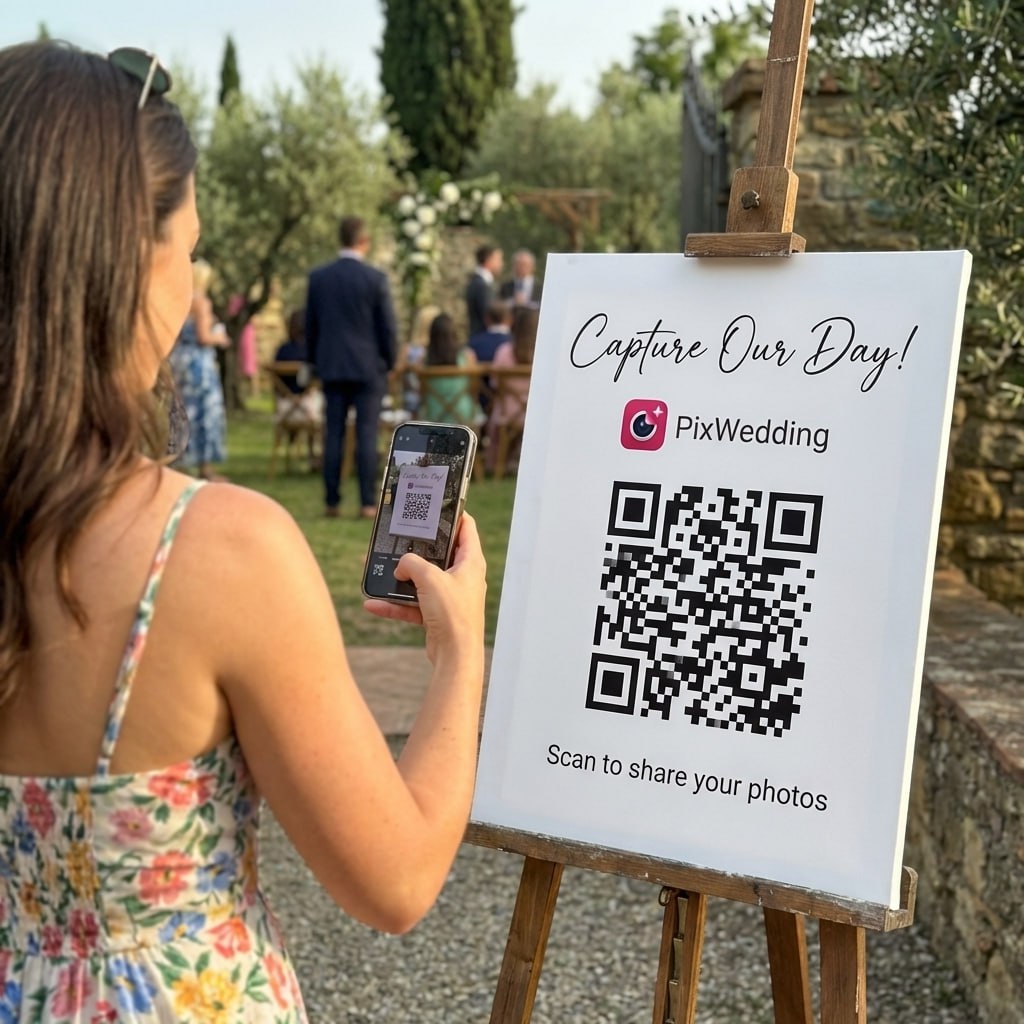
Pix Wedding stores and serves your photos exactly as they were shot. Guests scan a QR code, upload from their phones, and everyone downloads originals. No compression. No app required.

The whole crew
Scan to join the album
No app, no account
UPLOADING
Saving your moment
THE ALBUM
Emma & Jack
June 21, 2026
647 photos · 95 guests







SCAN TO TRY
pix.wedding/
your-wedding
Settings to Change Right Now on Each Platform
Most platforms default to compressed storage or transfers. These settings changes take under 30 seconds each.
Profile picture > Photos settings > Backup > Backup quality: select "Original quality"
Full-resolution originals stored, count against Google One storage
Settings > Chats > Media auto-download. For truly full quality, send photos as Documents, not as media.
Sending as Document bypasses all compression
Settings > Photos > Transfer to Mac or PC: select "Keep Originals." This also affects what AirDrop and cable-transfer share.
HEIC originals transferred instead of converted JPEG copies
For full-quality sharing, use iCloud Drive (Files app) instead of iCloud Shared Photo Library or Shared Albums. Upload the photo file to Drive and share the folder.
Originals shared rather than 2048px-capped Shared Album copies
No settings change needed. Google Drive stores and serves originals by default. Just make sure you are not uploading via Google Photos, which has its own separate compression setting.
Files stored and downloaded exactly as uploaded
No settings change needed. Dropbox is lossless by default. Camera Uploads (automatic phone backup) uses the original file.
All uploads are losslessly stored originals
How to Share Full-Resolution Photos with a Whole Group
One-to-one methods break down fast. Here is what actually works when you have 50 to 300 photos from 100+ people.
Why Common Group Methods Fail
- WhatsApp group chats: compress every photo to ~100 KB
- Shared iCloud Albums: caps at 2048px per photo
- Facebook groups: heavy compression, private by default
- Google Photos shared albums: requires everyone to have a Google account
- Email chains: 25 MB limit per message, impractical beyond 5 photos
- Dropbox shared folders: requires everyone to create an account
What Actually Works at Scale
- A shared album platform that stores originals, not display copies
- QR code or link entry so guests join without downloading an app
- Guests can upload from their own cameras and phones
- Everyone can download anyone's photos at full resolution
- Works on Android, iPhone, and desktop without friction
- Pix Wedding does all of this with a single QR code at the venue
The Wedding Scenario: 150 Guests, 1,200 Photos
Consider a wedding with 150 guests. If even half of them take 15 photos each, you have 1,125 photos spread across 75 different phones. Collecting those photos without compression requires a platform where:
- 1Guests do not need to install anything: App installs kill participation rates. Browser-based QR code access gets 80-95% of guests to upload vs under 15% for hashtag-based collection.
- 2Photos upload at original resolution: If the platform compresses on upload, you cannot recover the originals later. Compression is a one-way trip.
- 3Downloads are the original files: Some platforms store originals but serve compressed previews for download. Always verify that the download function gives you the actual uploaded file.
- 4The album stays accessible after the event: A WeTransfer link expires in 7 days. A dedicated event album stays live for months so late arrivals can still browse and download.
6 Mistakes That Silently Destroy Your Photo Quality
These mistakes are easy to make because the quality loss is not always obvious until you try to print or zoom in.
Screenshotting instead of downloading
Screenshots capture what is displayed on screen at screen resolution (usually 1x or 2x density), not the original photo. A screenshot of a compressed WhatsApp photo is doubly degraded. Always use the download function to get the actual file.
Trusting Google Photos "High quality" (now Storage Saver)
Storage Saver was renamed from "High quality" in 2021. Many users still believe it preserves originals because the old name sounded reassuring. It does not. A 16 MB shot can be compressed down to 1 MB. Check your backup setting and switch to "Original quality."
Using iCloud Shared Albums for archiving
iCloud Shared Albums limit photos to a 2048px maximum on the longest edge. If your iPhone shot a 4032x3024 image, sharing it via a Shared Album cuts the resolution roughly in half. Use iCloud Drive (not Shared Albums) to share originals, or use Google Drive.
Sending lots of photos via email
Gmail caps attachments at 25 MB per message, Outlook at 20 MB. A modern JPEG from a smartphone runs 4-8 MB, so you can send 3-5 photos per email at best. For batches of 20-300 photos (such as a full event), email is completely impractical.
Posting to Facebook or Instagram to "store" photos
Social networks re-encode every upload to optimize for screen display and fast loading. Facebook compresses photos to a maximum 2048x2048 pixels. Instagram is even more aggressive. These are not archives. They are display copies.
Not checking the settings on sharing apps
Apps like Google Photos default to compressed storage. WhatsApp defaults to compressing photos. Some apps have updated their defaults over time. Always check the settings on any platform you use for long-term photo storage.
Photo Sharing Cheat Sheet
Match your situation to the right method in under 10 seconds.
Sending to one person, both on Apple devices
Zero compression, instant, no account needed
Sending to one person cross-platform (iPhone to Android)
No account required for WeTransfer. Free up to 2 GB.
Sending via WhatsApp and must use WhatsApp
Tap the paperclip, choose Document, browse to the photo file
Backing up your own photos to the cloud
Must switch Google Photos setting from Storage Saver to Original quality
Sharing a batch of 20+ photos with friends or family
Lossless, cross-platform, free tier covers hundreds of photos
Sharing all photos from a wedding or event with 50+ guests
Guests upload from their phones, all downloads are originals, no app required
You just texted someone a photo
Re-send via AirDrop, Google Drive, or WeTransfer using the original file from your Photos app
Why "Full Resolution" Matters More Than You Think
A modern smartphone camera captures images with 12-50 megapixels, typically producing files between 4 MB and 25 MB each. When you send that photo through WhatsApp, it arrives on the other end as a 80-100 KB JPEG resized to 1600 pixels. Roughly 95% of the original data is gone forever.
This matters whenever you plan to print the photo, crop it, edit it professionally, or display it on a large screen. A heavily compressed photo that looks acceptable on a phone screen falls apart the moment you try to print it at 8x10 inches or zoom in on a face in the crowd. Quality lost in transmission cannot be recovered: the pixels are gone.
The compression applied by messaging apps is not a technical necessity. It is a deliberate cost-saving choice. Transferring and storing uncompressed images at scale is expensive. Platforms pass that cost on to your photo quality. The only way to avoid it is to use a service where the business model does not depend on shrinking your files.
- •Print quality: a compressed 100 KB photo prints at roughly 2x3 inches before showing pixelation
- •Cropping: compression destroys detail in background faces and distant subjects
- •Professional editing: compressed JPEGs lose highlight and shadow detail that editors need
- •Screen display: compression is visible on 4K monitors and modern Retina displays at full zoom
- •Long-term archiving: compressed photos cannot be "restored" to original quality later
The Right Method for Every Situation
No single method is best for every sharing scenario. AirDrop is ideal for quickly passing a photo to someone standing next to you, but useless if they are on Android or across the country. Google Drive is excellent for asynchronous, cross-platform sharing but requires the recipient to have a Google account. The table in the section above maps each method to its real-world strengths.
For wedding and event photo sharing specifically, the challenge is different from one-to-one sharing. You have 50 to 300 guests, each with a phone full of photos they want to contribute, and you want all of those photos in one place at original quality. No amount of AirDropping solves that. A dedicated photo-sharing platform with a QR code entry point is the only practical solution at that scale.
The key question to ask before choosing a method is: does this platform store and serve the original file, or does it re-encode on upload? Google Drive and Dropbox store originals. Google Photos in Storage Saver mode does not. WhatsApp does not. Facebook does not. Instagram does not. If the platform is primarily a social network or a messaging app, assume it compresses.
Frequently Asked Questions
Everything you need to know about our free tools and how they help your wedding day.
Most messaging apps compress photos before sending to reduce bandwidth and storage costs. WhatsApp resizes images to roughly 1600 pixels on the longest edge and re-encodes them as JPEG at a reduced quality level, shrinking a 5 MB photo down to around 80-100 KB. SMS/MMS is even worse: carriers cap MMS attachments at 1-3 MB, so your phone compresses the photo heavily before it even leaves. The result is permanently lost detail that cannot be recovered at the other end.
For one-to-one sharing between Apple devices, AirDrop transfers the original file with zero compression. For cross-platform or longer-distance sharing, Google Drive (with "Original quality" selected), Dropbox, and WeTransfer all transfer files losslessly. For sharing full-resolution photos with a whole group, a dedicated photo-sharing platform like Pix Wedding lets everyone upload and download originals without compression, and guests can join via QR code with no app download required.
No. AirDrop transfers files directly over Wi-Fi Direct or Bluetooth between Apple devices without compression. The photo you send arrives byte-for-byte identical to the original, including EXIF metadata. The only caveat is that AirDrop only works between Apple devices in close physical proximity, so it is not useful for sharing with Android users or people who are not nearby.
Open the Google Photos app, tap your profile picture, then "Photos settings," then "Backup." Under "Backup quality," select "Original quality" instead of "Storage saver." Storage saver (formerly called High quality) compresses photos to a maximum of 16 megapixels and applies lossy JPEG compression, shrinking a 16 MB photo to roughly 1 MB. Original quality stores the file exactly as shot but counts against your Google One storage quota.
Create a shared album on a platform that stores originals: Google Drive folder, Dropbox shared folder, iCloud Shared Photo Library, or a purpose-built app like Pix Wedding. Avoid WhatsApp group chats, Facebook albums, and Instagram DMs for this purpose as all three compress uploads. For wedding or event photo sharing specifically, Pix Wedding lets guests scan a QR code, upload their own shots, and download anyone else's originals at full resolution, all in a browser with no app required.
Yes, significantly. SMS/MMS photo quality is capped by carrier infrastructure. Most US carriers limit MMS attachments to 1-3 MB, which means a 12 MP iPhone photo (typically 4-8 MB) must be compressed 50-90% before sending. Apple-to-Apple messages sent over data (blue bubbles, iMessage) compress less aggressively but still reduce quality. Only AirDrop and dedicated file-transfer tools send the original, uncompressed file.