
Collaborative Photo Album: Every Option Compared (2026)
A collaborative photo album lets multiple people upload pictures to one shared place. Here is exactly what each platform allows, what it limits, and which one to use depending on your situation.
Try Pix -- No App NeededWhat is a Collaborative Photo Album?
A collaborative photo album is a shared digital album where multiple people can add their own photos, not just view someone else's. The owner creates the album and invites others -- via link, QR code, or email -- and each contributor uploads from their own device. The result is a single album that captures the event from every angle and every person who was there.
This is the key distinction: a shared album is one person's photos that others can see. A collaborative album is everyone's photos in one place. For weddings, family reunions, group trips, and team events, the collaborative model captures far more moments because 50 phones beat 1 photographer every time.
Platform Comparison: Collaborative Photo Albums (2026)
Every major option side by side. The three columns that matter most for events: whether contributors need an account, whether photos stay full resolution, and the item cap.
| Platform | Who Can Contribute | Account Needed | Full Resolution | Item Cap | Best For |
|---|---|---|---|---|---|
Google Photos | Anyone with a Google account | Yes (Google) | Yes (eats 15 GB quota) | 20,000 items | Cross-platform groups, everyday sharing |
Apple iCloud Shared Albums | Apple ID holders only | Yes (Apple ID) | No -- compressed to 2048px | 5,000 items | Apple-only families and friends |
Pix Wedding (QR album) | Anyone with the QR code or link | No account needed | Yes -- full res | Unlimited | Weddings, events, large groups |
Dropbox Shared Folder | Anyone with Dropbox account | Yes (Dropbox) | Yes -- full res | 2 GB free (account limit) | Teams, photographers, pro use |
Amazon Photos Family Vault | Up to 5 invited members (Prime required) | Yes + Prime ($139/yr) | Yes -- full res (photos) | Unlimited photos, 5 GB video | Small Prime families, long-term archives |
Tinybeans / 23snaps | Invited family members | Yes (app + account) | Compressed on free plan | Plan-dependent | Baby/child milestones, close family |
Data compiled from official support docs and platform announcements as of June 2026. Storage quotas and limits are subject to change.
Per-Platform Pros and Cons
Google Photos Shared Albums
Pros
- Free with any Google account
- 20,000 item capacity -- plenty for large events
- Cross-platform: Android and iPhone both supported
- Smart search by face, date, location
- Contributors can add up to 50 items per batch, multiple times
- No app install required -- browser upload works
Cons
- Every contributor must have and be signed into a Google account
- Original quality uploads count against each contributor's 15 GB free quota
- No password protection on albums
- Public link mode disables contributor upload -- view only
- Privacy concerns: Google uses images for AI training (opt out available)
Apple iCloud Shared Albums
Pros
- Seamless experience for all-Apple families
- Does not count against iCloud storage quota
- Up to 100 invited contributors
- Comments and likes on individual photos
- Notifications when new photos are added
- 5,000 items per album -- generous for family use
Cons
- Photos compressed to 2048px on the long edge -- not print-quality
- Android users and non-Apple users cannot upload
- Requires Apple ID for every contributor
- Metadata (GPS, camera settings) may be stripped
- No web upload for contributors -- must use Apple device
- 5,000 item cap can fill up at large events
Pix Wedding QR Album
Best for WeddingsPros
- No app download or account required for guests
- Works on any device -- Android, iPhone, anything with a browser
- Full resolution photos preserved
- Unlimited contributors via QR code or link
- Guests upload in seconds -- scan, tap, done
- Owner downloads the complete album after the event
- Purpose-built for high-contribution group events
Cons
- Designed for events, not long-term family library management
- AI selfie search on Pro ($89), without Google Photos-style whole-library search
- Less useful for small private families who prefer native apps
Dropbox Shared Folder
Pros
- Full resolution file preservation -- exact originals
- Cross-platform: app and browser upload
- Folder-based organization familiar to most professionals
- Good for post-event delivery to a photographer or team
Cons
- Contributors must have Dropbox accounts
- Free tier only 2 GB -- fills up fast with RAW photos
- No gallery or visual browsing -- folders of files
- Not built for consumer event sharing or weddings
- Shared folder storage counts against owner's quota
Amazon Photos Family Vault
Pros
- Unlimited full-resolution photo storage for Prime members
- Up to 5 family members can contribute to a shared vault
- Each member also gets their own private unlimited photo storage
- Good for long-term family archiving if already Amazon Prime subscribers
Cons
- Requires Amazon Prime ($139/year) to contribute and store photos
- Hard limit of 5 invited contributors -- not scalable for events
- Only 5 GB video storage (not unlimited)
- Family Vault does not support album-specific sharing -- it is one big vault
- Less polished gallery experience than Google Photos or iCloud

The big day
From your guests
Collect Photos From Everyone at Your Wedding
Pix lets every guest upload from their phone the moment it happens -- no app, no account, just scan and share. Full resolution, every shot.

From grandma
Scan to join the album
No app, no account
UPLOADING
Saving your moment
THE ALBUM
Emma & Jack
June 21, 2026
647 photos · 95 guests






SCAN TO TRY
pix.wedding/
your-wedding
Best Collaborative Album for Each Use Case
Not every situation calls for the same tool. Here is what to reach for based on who you are gathering photos with.
Wedding or Large Event
Best pick: Pix QR Album
Guests span every age group and device type. Any friction -- app install, account sign-in, unfamiliar interface -- means fewer contributions. A QR code removes all of it. Guests scan, upload, done. You end up with hundreds of photos from angles your photographer never saw.
Close Family (All iPhone)
Best pick: Apple iCloud Shared Albums
If your whole family is on iPhone and you want a native, always-on album that shows up in the Photos app automatically, iCloud Shared Albums is the zero-setup choice. The compression is fine for screen viewing. Just do not print posters from it.
Group Trip or Vacation
Best pick: Google Photos
A group of friends on a trip are usually tech-comfortable and already have Google accounts. The 20,000 item cap, cross-platform support, and face/location search make it the best for multi-day trips where you want to browse memories later.
Team or Corporate Event
Best pick: Pix QR Album or Dropbox
For conference photos or company events with a defined guest list, Pix handles casual candid sharing well. For professional photography handoff (RAW files to a marketing team), Dropbox is the standard.
Baby Milestone Sharing
Best pick: Tinybeans
Tinybeans is purpose-built for sharing baby and toddler milestones with grandparents and close family. It has timeline-based browsing, private invite-only access, and sends weekly digest emails to family members who prefer not to use an app.
Mixed Android and iPhone Household
Best pick: Google Photos or Pix
iCloud is off the table the moment one person in the group uses Android. Google Photos handles mixed devices cleanly. For event use where you do not want sign-in friction, Pix is the cross-platform answer.
Quick Decision Guide: Which Collaborative Album to Use
Answer these three questions and you have your answer in under a minute.
Will contributors be strangers or casual guests (wedding, party, reunion)?
Use Pix. Requiring an account at a wedding is the single biggest reason photo collection fails.
Does everyone in the group already use iPhone and have an Apple ID?
iCloud Shared Albums. Native, free, no extra setup. Just remember photos are compressed -- do not use it for professional printing.
Is this a mixed Android/iPhone group of friends or family?
Google Photos if they all have Google accounts. Pix if you want zero sign-in friction.
Do you need full-resolution files for printing large format (60 x 90 cm prints, canvases, albums)?
Avoid iCloud Shared Albums (2048px cap). Use Pix, Google Photos in Original quality mode, Dropbox, or Amazon Photos with Prime.
Is this long-term family archiving (years, not a single event)?
Google Photos or Amazon Photos (Prime). Both offer robust storage, search, and longevity. iCloud also works if the whole family stays Apple forever.
Are you handing off professional RAW files between photographers and editors?
Dropbox. It is the professional standard for a reason: full fidelity, folder structure, version history, and everyone already has it.
Common Mistakes When Setting Up a Collaborative Album
Choosing the platform your guests are NOT on
Setting up an Apple Shared Album when half your guests use Android means those guests simply cannot contribute. Always pick the platform based on your least-tech-savvy contributor, not the most.
Sharing the link too late
Sending the album link to guests after the event -- when phones are away and the moment has passed -- slashes participation by 70% or more. Share the QR code or link during the event, on the table, on a sign at the door.
Using a platform that compresses photos when you plan to print
iCloud Shared Albums cap photos at 2048px. A 90 cm wide print needs around 3000-3600px minimum. If printing is in your plans, verify the platform preserves originals before you commit.
Forgetting to set album permissions before sharing the link
In Google Photos, a public link makes the album view-only. You must explicitly enable collaboration before sharing, or guests arrive at a read-only album and assume they cannot contribute.
Hitting the item cap mid-event
iCloud Shared Albums have a 5,000 item limit. A 150-person wedding where guests each upload 50 photos can hit that cap. Know your platform's limit before the day and pick accordingly.
Not telling guests the album exists
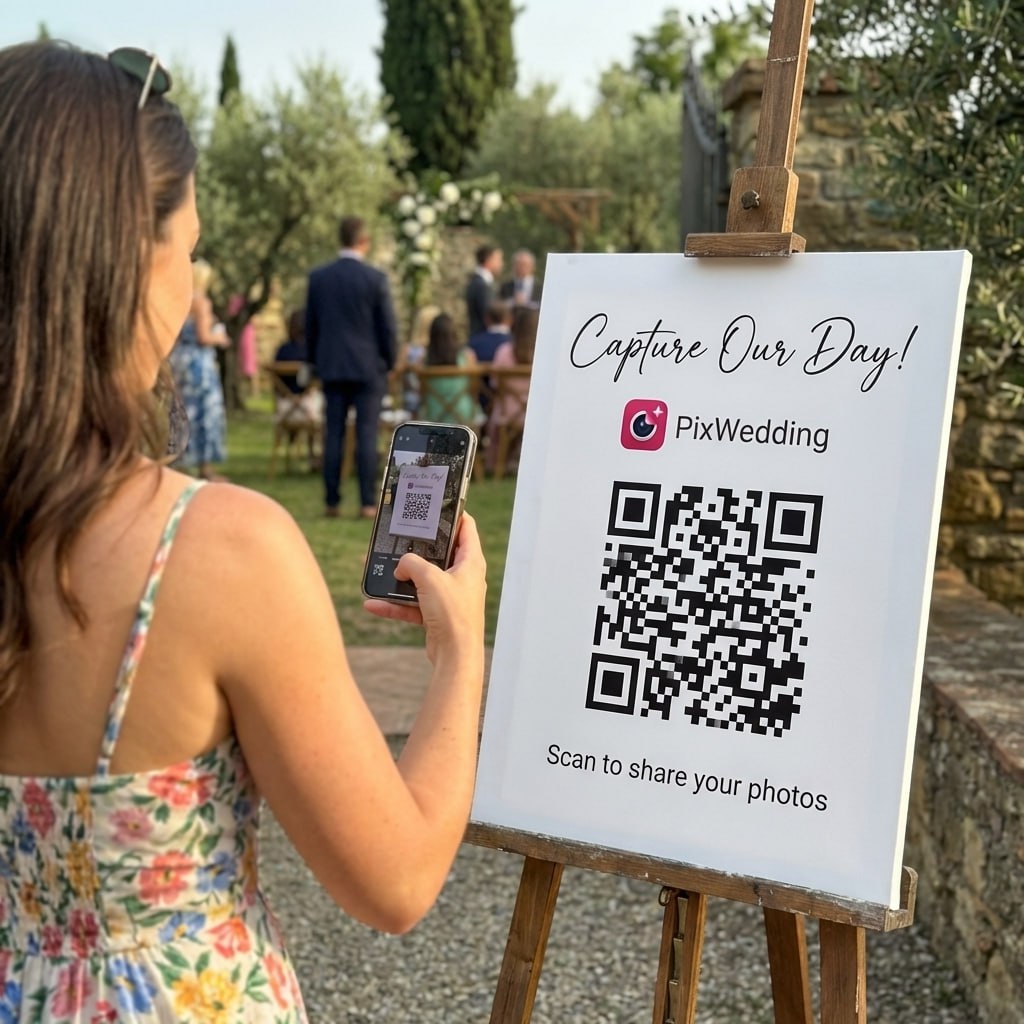
Even the best collaborative album collects zero photos if guests do not know about it. Put the QR code on the table, mention it in the ceremony program, have the MC announce it. Visibility drives participation.
Related Guides
How to Set Up a Collaborative Photo Album in Under 5 Minutes
The fastest path is a QR code album. Create your album at pix.wedding, name it, and download the QR code. Print it on table cards, stickers, or a sign at the venue. Guests scan it with their phone camera -- no app install, no account -- and photos go straight into your album at full resolution. Setup time is about two minutes. This is why QR albums have become the default at weddings and corporate events.
The second fastest path is a Google Photos shared album. Open Google Photos, tap Library, then Shared Albums, then the plus icon. Name the album, toggle on "Collaborate," and share the link. Anyone with a Google account can contribute. The catch: guests without a Google account can only view, not upload. For events with older guests or a mix of Android and iPhone users, expect a meaningful percentage to drop off at the sign-in step.
For family albums with a small, tech-comfortable group, Apple iCloud Shared Albums work well. Open the Photos app on iPhone or iPad, tap the plus icon in the Albums tab, choose New Shared Album, name it, and invite contributors by their Apple ID email. Everyone gets a notification to join. The 5,000 item limit is generous for family use and the experience is polished if everyone is on Apple.
- •QR code album (Pix): 2 minutes, no guest accounts needed, full resolution
- •Google Photos: 3 minutes, contributors need Google accounts, 20,000 item cap
- •iCloud Shared Albums: 5 minutes, Apple users only, photos compressed to 2048px
- •Dropbox shared folder: 10 minutes, contributors need Dropbox accounts, best for teams
- •Amazon Photos Family Vault: 5 minutes, Prime required, up to 6 members total
Which Collaborative Photo Album Should You Choose?
The right platform depends on two factors: who your contributors are and what you need the photos for afterward. If contributors are strangers or casual guests (wedding, conference, reunion), the lowest-friction option wins because every extra step cuts the number of people who actually contribute. If contributors are a close family or team who already share an ecosystem (all Apple, all Google), the native option for that ecosystem is fine.
For printing: only use platforms that preserve full resolution. That means Pix, Dropbox, or Amazon Photos with Prime. iCloud Shared Albums at 2048px max will look fine on screen but blur at large print sizes.
For long-term family archiving: Google Photos or Amazon Photos are the strongest because of storage longevity, search by face and date, and broad device support. iCloud is great if the whole family is Apple-only.
For one-time events (weddings, birthday parties, reunions): a QR album is the clear winner. No account setup for guests, instant contribution, high participation rates. After the event you download everything and store it wherever you like.
First dance
You guys!!
One album everyone can actually add to.
No app installs, no account sign-ups, no permission requests. Guests scan a QR code and their photos appear in your shared album in real time.
From Mom
Scan to join the album
No app, no account
UPLOADING
Saving your moment
THE ALBUM
Emma & Jack
June 21, 2026
647 photos · 95 guests
SCAN TO TRY
pix.wedding/
your-wedding
Collaborative Photo Album: Frequently Asked Questions
Everything you need to know about our free tools and how they help your wedding day.
A collaborative photo album is a shared digital album that multiple people can add photos to, not just the owner. Anyone who is invited (or has a link or QR code) can upload their own pictures, so the final album contains contributions from the whole group. This is different from a standard shared album, where only the creator can add content and others can only view it.
No. To contribute photos to a Google Photos shared album, every contributor must have a Google account and be signed in. Viewers can see an album via a public link without an account, but uploading requires sign-in. This is a common friction point at events where guests use a mix of devices and do not want to create accounts.
Yes. Apple iCloud Shared Albums reduce photos to 2048 pixels on the longest edge before sharing. Panoramic photos can be up to 5400 pixels wide. The original full-resolution file stays on the contributor's device but what is stored in the shared album is a compressed version. This makes them unsuitable for printing large format photos from a wedding or event.
A Google Photos shared album can hold up to 20,000 items (photos and videos combined). Each contributor can add up to 50 items per contribution, though contributors can add multiple times. Photos stored in Original quality count against each contributor's 15 GB free Google storage quota.
A QR code album like Pix is the easiest option for weddings with mixed devices. Guests scan a QR code on their phone camera and upload directly from their browser -- no app download, no account creation, no sign-in. This removes every friction point that causes guests to skip contributing. Both Android and iPhone users can upload in seconds.
It depends on the platform. Pix and Dropbox preserve full resolution. Google Photos preserves full resolution only in Original quality mode, which counts against storage quotas. Apple iCloud Shared Albums always compress to 2048px on the long edge. Amazon Photos (with Prime) stores full-resolution photos. For wedding or professional event use where you may want to print photos, full-resolution preservation matters significantly.