
How to Make an Anniversary Slideshow
A step-by-step guide for 25th, 50th, and golden anniversary celebrations. Covers sourcing photos across the decades, era-matched song picks, tool comparisons, and the mistakes that sink most slideshows.
Quick Answer
To make an anniversary slideshow: (1) collect photos from family across every decade the couple has been married, (2) organize them into chronological chapters with decade title cards, (3) choose 2 to 3 songs matched to the era of the photos, (4) build in Canva, iMovie, or Animoto at 4 to 5 seconds per photo, and (5) export as 1080p MP4 and test on the party TV before the event. For a 50th anniversary, aim for 80 to 120 photos over 8 to 10 minutes.
6 Steps to an Anniversary Slideshow That Works
Most anniversary slideshows fail because of photo sourcing, not editing skill. Follow these steps in order.
- 01
Source photos from every decade
Reach out to family and friends 6 to 8 weeks before the party. Assign each relative a decade to "own." Scan old prints using Google PhotoScan or a flatbed scanner at 600 dpi. Ask the couple's siblings and old friends for photos the couple has never seen.
- 02
Sort and curate ruthlessly
Create one folder per decade. Target 10 to 20 photos per chapter. Eliminate duplicates, blurry shots, and photos where the couple is barely visible. Keep the strongest 10 from each era rather than including everything you collected.
- 03
Pick 2 to 3 songs matched to the era
Open with the song that was popular when the couple met or married. Transition to something from a middle decade for the family chapter. Close with a modern love song or the couple's current favorite. Crossfade between tracks rather than hard-cutting.
- 04
Build in your chosen tool
Import photos in chronological order. Add decade title cards or year captions at each chapter break. Use one transition style throughout (dissolve or simple cut) rather than mixing multiple effects. Set photo duration to 4 to 5 seconds per image.
- 05
Watch it start to finish before the party
View it on the screen or TV you will use. Check audio levels (music should be audible but not overpowering), timing at transitions, and that captions are readable from the back of the room. Bring a backup on a USB drive.
- 06
Share the photo collection after the event
The party will generate new photos too. Collect them from guests and combine everything into a shared album so the couple can relive both the anniversary slideshow and the celebration itself.
Sourcing Photos Across the Decades
The biggest challenge for a 50th anniversary slideshow is not editing; it is finding enough good photos from the mid-1970s. Here is the playbook.
The "Decade Owner" Strategy
Instead of sending one generic "send us your photos" message that gets ignored, assign each family member or close friend a specific decade to own. One sibling gets the 1970s. A different sibling gets the 1980s. A family friend covers the 1990s.
People respond to specific asks, not open-ended ones. "Can you look through your albums for any photos of Mom and Dad from the 1980s, especially the Christmas ones from Grandma's house?" gets results. "Send us any photos you have" gets a thumbs-up and nothing more.
Sample message to send relatives
"Hi [Name], we are putting together a surprise slideshow for [couple]'s 50th anniversary on [date]. We would love any photos you have of them from the [decade], especially anything from before [milestone year]. Even a phone photo of an old print is great. Can you send anything my way by [3 weeks before event]?"
How to Digitize Old Prints
Most photos from the 1970s and 1980s exist only as physical prints. Here are five ways to get them into your slideshow, ranked by quality and effort.
| Method | Quality | Cost | Best for |
|---|---|---|---|
| Google PhotoScan (free app) | Good | Free | Small collections, under 50 prints |
| Home flatbed scanner at 600 dpi | Excellent | Scanner purchase or borrowing cost; check the current model price | Medium collections, 50 to 200 prints |
| ScanMyPhotos mail-in scanning | Good to excellent | $0.20/scan at 300 dpi; $0.50 at 600 dpi; $25 minimum, extras apply | Large print collections, 200+ photos |
| Library or local scanning service | Good | Ask the local provider for its rate | One-off or occasional scanning needs |
| Crowdsource digitals from family | Varies | Free | Pulling digital files relatives already have on their phones |
Scanning tip: Try 600 dpi if you plan to crop or zoom. A 4x6-inch print scanned at 600 dpi produces 2400x3600 pixels: multiply each dimension in inches by 600. The extra pixels leave more room to crop, though they cannot restore detail missing from the print.
Where the Best Photos Are Hiding
The couple's own photo albums
Ask to borrow them for a weekend. Handle with care.
Siblings and in-laws
They were at family events the couple no longer remembers.
Old social media accounts
Look for older uploads that never made it into the family album.
Church or event directories
Annual church directories from the 1980s and 1990s often have family photos.
Old friends who moved away
Reach out through the couple's phone contacts.
Newspaper or newsletter archives
Local papers sometimes covered weddings and achievements worth digitizing.
Grandchildren's phones
Kids take candid shots at family events that never get organized but are gold.
The couple's workplace
Colleagues keep event photos. HR sometimes has anniversary or retirement archives.
Watch the tutorial
Mobile Fun demonstrates scanning printed photos with Google PhotoScan on Android, a useful way to bring older family pictures into your slideshow.
Golden anniversary
50 years!
Let Family Send Photos Directly Into One Shared Album
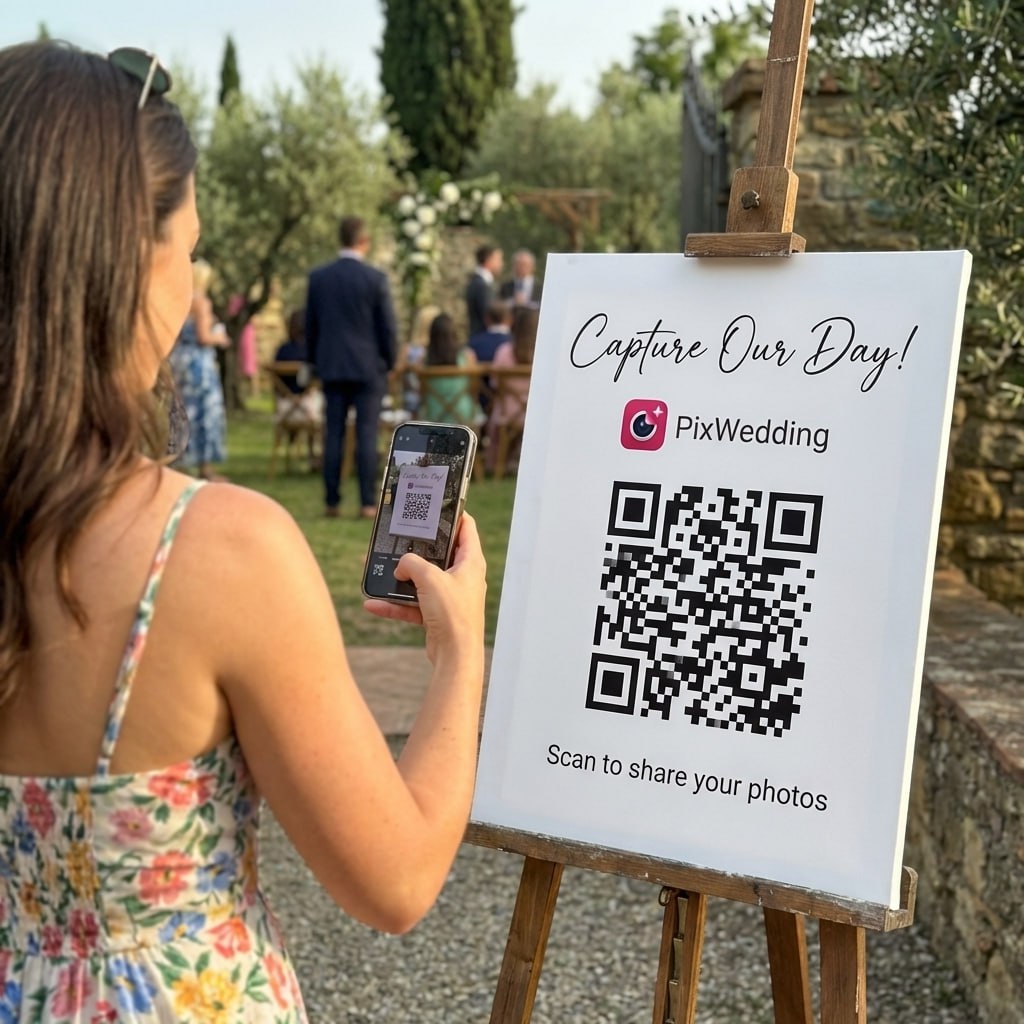
Pix Wedding creates a private QR link your relatives can scan to upload decades of family photos. No app download. No group chat chaos. Every photo lands in one place before the party.
From the kids
Scan to join the album
No app, no account
UPLOADING
Saving your moment
THE ALBUM
Emma & Jack
June 21, 2026
647 photos · 95 guests

SCAN TO TRY
pix.wedding/
your-wedding
Songs That Match the Year They Married
A song from the year of the wedding pulls the room straight back to that decade. Use one for the opening chapter, then move to newer songs as the photos move forward.
1960s couple
Married around 1964- "Stand by Me" by Ben E. King (1961)
- "Can't Help Falling in Love" by Elvis Presley (1961)
- "My Girl" by The Temptations (1964)
- "What a Wonderful World" by Louis Armstrong (1967)
1970s couple
Married around 1974- "Always and Forever" by Heatwave (1977)
- "Still" by The Commodores (1979)
- "You Are So Beautiful" by Joe Cocker (1974)
- "Ain't No Mountain High Enough" by Marvin Gaye & Tammi Terrell (1967)
1980s couple
Married around 1984- "Endless Love" by Diana Ross & Lionel Richie (1981)
- "Through the Years" by Kenny Rogers (1981)
- "Up Where We Belong" by Joe Cocker & Jennifer Warnes (1982)
- "I Just Called to Say I Love You" by Stevie Wonder (1984)
1990s couple
Married around 1994- "At Last" by Etta James (1960, fits any era)
- "Amazed" by Lonestar (1999)
- "From This Moment On" by Shania Twain (1998)
- "(Everything I Do) I Do It for You" by Bryan Adams (1991)
2000s couple
Married around 2004- "Bless the Broken Road" by Rascal Flatts (2004)
- "Make You Feel My Love" by Adele (2008)
- "Better Together" by Jack Johnson (2005)
- "Collide" by Howie Day (2004)
Check music permissions before posting the finished video online.
Anniversary Slideshow Tool Comparison
Canva, Animoto, iMovie, CapCut, Movavi, and Clideo each suit different situations. Here is how they compare for a family anniversary project.
| Tool | Best for | Free tier / price | Music | Platform | Verdict |
|---|---|---|---|---|---|
| Canva | Browser-based ease | Free; Pro $144/year (USD) | Built-in licensed tracks | Web / mobile | Best for beginners with no video editing experience |
| Animoto | Party-ready pacing | Free creation; paid sharing/downloads, see current price | 50 tracks on Free; paid libraries vary | Web | Best polished output with minimal effort |
| iMovie | Long-form control | Free | iTunes / import your own | Mac / iPhone / iPad | Best for Mac users who want full control over timing |
| CapCut | Speed and mobile | Free tools; paid price shown at checkout | Built-in + import | iOS / Android / Web | Best for a quick social share version; less ideal for TV playback |
| Movavi | Advanced effects | Paid subscription or lifetime license; see current USD price | Import your own | Mac / Windows | Best for desktop users who want color grading and transitions |
| Clideo | No install needed | Free tier; Pro $12/month or $108/year (USD) | Import your own | Web | Good fallback for one-off projects with no software to install |
Recommendation for most families
Start in Canva if you want a browser editor, and test an export with your chosen assets first. On a Mac, iMovie is a free option for controlling timing and cuts. Animoto requires a paid plan for sharing and downloading, so check its current price before you start.
What to avoid
Check the canvas shape and export settings before editing. For TV playback, start with a horizontal 16:9 project and try a 1080p MP4 export on the venue screen. A tool designed around vertical clips may need different settings.
Check the costs before you start
Prices checked September 2026. USD prices below exclude any applicable tax. Scanning delivery and shipping options add to the total.
How Many Photos and How Long?
The right number of photos depends on which anniversary you are celebrating and how you will show it.
10th Anniversary
Wedding day, honeymoon, early home life
Keep it tight. The couple is still young and has plenty more chapters ahead.
25th Anniversary (Silver)
Wedding era, children, careers, family milestones
Four to five chapters works well. Do not rush the early years.
40th Anniversary (Ruby)
Five to six decades with empty-nest and grandchildren chapter
Include video clips if available. The 2000s and 2010s will have digital video.
50th Anniversary (Golden)
Five to six chapters. Start in the 1970s. End with grandchildren.
This is the flagship occasion. Invest the most effort here in sourcing and quality.
Digital share (any)
Greatest hits version for sharing online
Make a separate shorter export for family group chats. People watch 3 minutes on a phone, not 10.
6 Common Anniversary Slideshow Mistakes (and How to Fix Them)
These are the problems that make slideshows fall flat at parties. All of them are preventable with a little planning.
Using one song for the entire slideshow
A single track over 8 minutes becomes numbing. Use 2 to 3 songs crossfaded at chapter breaks to signal a new era and re-engage viewers.
Including too many photos
More photos rarely means better slideshow. A tightly curated 70-photo show will outperform a 200-photo dump every time. Cut anything that does not clearly show the couple together or mark a key moment.
Skipping year or chapter labels
Guests cannot follow a 50-year story without signposts. Add a simple text card at each decade break: "The 1980s" or "Bringing home the kids (1987-1993)." It costs 30 seconds to add and pays off in comprehension.
Using every transition effect available
Zoom-in, flip, spin, and bounce transitions fight for attention and cheapen the mood. Pick one style (dissolve or hard cut) and use it throughout. Reserve a single special transition for the closing credits slide.
Waiting until the week before to collect photos
Relatives need time to dig out old albums or get prints scanned. Start collecting 6 to 8 weeks before the party. Send follow-up messages 3 weeks out. You will always get the best photos from the people who needed the most lead time.
No backup plan for the event
Streaming from a laptop that loses wifi, or a USB drive that the venue TV cannot read, are real scenarios. Export at 1080p MP4, bring it on a USB drive, have it in cloud storage, and test the TV connection the day before.
Related Guides
First dance
You guys!!
Ask the family for photos with one link.
Relatives scan a QR code or tap a link and upload from their phones, no app and no account. Start with 20 free guest uploads, no card.
From Mom
Scan to join the album
No app, no account
UPLOADING
Saving your moment
THE ALBUM
Emma & Jack
June 21, 2026
647 photos · 95 guests
SCAN TO TRY
pix.wedding/
your-wedding
Why Anniversary Slideshows Hit Different Than Other Tribute Videos
A graduation slideshow covers 18 years. A retirement slideshow covers a career. An anniversary slideshow for a 50th spans five complete decades of shared life, which is a genuinely different editorial challenge. You are not just making a highlight reel; you are narrating a relationship across eras where the couple's faces, clothes, hairstyles, and world changed completely.
That temporal depth is both the opportunity and the difficulty. Done well, a 50th anniversary slideshow moves through the excitement of early marriage in the 1970s, the chaos of young children in the 1980s, the family settling in during the 1990s, the empty-nest years of the 2000s, and the grandparent chapter of the 2010s and 2020s. Each era should feel distinct. That means matching music to the decade, varying photo density by life stage, and using year captions or chapter titles to orient viewers.
The most common mistake is treating the whole slideshow as one uniform thing: all photos at the same speed, one song playing throughout, no sense of chapter or era. Audiences disengage because there is nothing to follow narratively. Structure the slideshow like a short documentary with acts, and the same photos become something people watch twice.
- •Structure around life chapters, not just chronology
- •Match music era to the decade shown on screen
- •Use year overlays or title cards to orient viewers
- •Vary photo density: fewer photos for older eras, more for recent years
- •Include one video clip per major chapter if available
Slideshow Length and Photo Count: The Numbers That Work
Most anniversary slideshow guides skip the math. Here it is: at a comfortable viewing pace of one photo every 4 to 5 seconds, a 6-minute slideshow holds 72 to 90 photos. That is the right size for most 25th anniversary celebrations. A 50th anniversary can justify 100 to 120 photos over 8 to 10 minutes, but only if the pacing is tight and the music does not drag.
For a party setting where guests are eating and talking, keep the slideshow under 8 minutes. For a seated viewing event where the slideshow is the main activity, up to 12 minutes works. For a digital video shared in a family group chat after the event, cut it to 3 to 4 minutes since people watch on phones with much shorter attention spans.
Photo density should not be uniform across the timeline. Early years (wedding day, honeymoon, first apartment) tend to have fewer surviving photos. Give those eras more time per photo so they breathe. Recent decades where everyone has a smartphone may have hundreds of candidates, so curate aggressively for that chapter and keep the pace moving.
- •25th anniversary: 50 to 80 photos, 4 to 6 minutes
- •50th anniversary: 80 to 120 photos, 7 to 10 minutes
- •Party backdrop: cap at 8 minutes, 4 to 5 seconds per photo
- •Digital share: cut to 3 to 4 minutes for phone viewing
- •Video clips: 10 to 20 seconds each, max 2 to 3 total
Songs mentioned in the FAQ: Still by The Commodores, Endless Love (From "The Endless Love" Soundtrack) by Lionel Richie & Diana Ross, Through the Years by Kenny Rogers, Always and Forever by Heatwave, Can't Help Falling In Love by Elvis Presley, Stand By Me by Ben E. King. Check music permissions before posting your finished video online.
Anniversary Slideshow FAQ
Everything you need to know about our free tools and how they help your wedding day.
For a 25th anniversary slideshow, aim for 50 to 80 photos shown over 4 to 6 minutes. A 50th anniversary often warrants 80 to 120 photos over 7 to 10 minutes. Plan roughly one photo every 4 to 5 seconds so viewers can absorb each image without the slideshow dragging. Less is more: a tightly edited 60-photo show will land harder than a 200-photo dump.
For a couple married in the 1970s, songs from that era resonate most: "Still" by the Commodores, "Endless Love" by Diana Ross and Lionel Richie, "Through the Years" by Kenny Rogers, or "Always and Forever" by Heatwave. For opening with nostalgia, "Can't Help Falling in Love" by Elvis works across all decades. For the closing credits, "Stand by Me" by Ben E. King never fails. Pick 2 to 3 songs total and crossfade them rather than switching abruptly.
Canva offers a browser-based free tier; check your chosen assets and export settings before building the whole slideshow. iMovie is free on Apple devices. CapCut has free tools and paid features. Animoto allows free creation, but sharing and downloads require a paid plan.
Send a group message or family email 6 to 8 weeks before the event asking relatives to dig out old prints or digital albums from specific decades. Give each person a decade to "own" (e.g., ask one aunt for the 1980s, another for the 1990s). For physical prints, Google PhotoScan is a free app that reduces glare when shooting prints with a phone camera. A flatbed scanner at 600 dpi gives better quality if you have access to one. Mail-in scanning is priced by quantity, resolution and extras. ScanMyPhotos lists $0.20 per photo at 300 dpi or $0.50 at 600 dpi, with a $25 minimum scanning fee; shipping and delivery options cost extra.
For a party setting where guests are eating or socializing, 5 to 8 minutes is the sweet spot. Go longer than 10 minutes and you will lose the room. For a 50th anniversary where family has gathered specifically to celebrate, 7 to 10 minutes works if the music and pacing stay tight. For a video shared digitally after the event, 3 to 5 minutes holds attention better because people watch on phones.
Yes, and one or two short video clips (10 to 20 seconds each) can dramatically lift the emotional impact. Home video of the original wedding ceremony, a birthday party, or a family vacation cuts through in a way still photos cannot. Keep clips short and use them as punctuation rather than main content. iMovie, Movavi, and CapCut all handle mixed photo-video timelines without extra steps.