
How Many Photos for a Slideshow?
The short answer: plan on 10-12 photos per minute, which means a 5-minute slideshow needs roughly 50-60 photos at 5-6 seconds each. Below you will find the full formula, a duration-by-pacing table, and by-occasion counts for weddings, graduations, birthdays, anniversaries, retirements, and more.
TL;DR Answer
- Rule of thumb: 10-12 photos per minute (5-6 sec each)
- 3-min slideshow: 30-36 photos
- 5-min slideshow: 50-60 photos
- 10-min slideshow: 100-120 photos
- Collect 2-3x more raw photos than your final target
The 5-Step Slideshow Photo Formula
Every great slideshow starts with a number, not a feeling. Here is the exact formula used by professional event videographers to arrive at the right photo count before they start editing.
Pick your target duration
Decide how long the slideshow should run. Most events: 4-8 minutes. Reception loops: 8-12 minutes. Ceremony slots: 3-5 minutes.
Choose seconds per photo
Use 4-5 sec for high-energy events, 5-6 sec for standard, 6-7.5 sec for reflective occasions. When in doubt, use 5.
Calculate: (duration in seconds) divided by (sec per photo)
Example: 5 minutes = 300 seconds. 300 / 5 sec = 60 photos. That is your target. Aim to curate 20% more than the target so you have editing room.
Check the timeline after adding transitions
Transitions may overlap clips or add time, depending on the editor. If 59 transitions between 60 photos each add 1.5 seconds, they add 88.5 seconds. Read the final timeline duration before exporting.
Collect 2-3x more than you need before editing
You will discard most of what you gather. If you need 60 finished photos, start with at least 120-180 raw candidates so you have genuine editorial choice.
Photos Needed by Duration and Seconds Per Slide
Find your target slideshow length in the left column, then follow the row across to your chosen seconds-per-photo setting to get your exact photo count. The highlighted column (5 sec) is the recommended default for most events.
| Duration | 3 sec / photo | 4 sec / photo | 5 sec / photo | 6 sec / photo |
|---|---|---|---|---|
| 1 min | 20 photos | 15 photos | 12 photos | 10 photos |
| 2 min | 40 photos | 30 photos | 24 photos | 20 photos |
| 3 min | 60 photos | 45 photos | 36 photos | 30 photos |
| 4 min | 80 photos | 60 photos | 48 photos | 40 photos |
| 5 min | 100 photos | 75 photos | 60 photos | 50 photos |
| 6 min | 120 photos | 90 photos | 72 photos | 60 photos |
| 8 min | 160 photos | 120 photos | 96 photos | 80 photos |
| 10 min | 200 photos | 150 photos | 120 photos | 100 photos |
| 12 min | 240 photos | 180 photos | 144 photos | 120 photos |
| 15 min | 300 photos | 225 photos | 180 photos | 150 photos |
These counts are duration divided by seconds per photo. Transition handling varies by editor; check the finished timeline rather than adding a fixed percentage.
Watch how to time photos with music
Kevin Stratvert demonstrates arranging pictures, adjusting clips and adding music and transitions so you can test your chosen pace in an editor.
Recommended Photo Count by Occasion
Different events call for different pacing. A high-energy graduation show runs faster than a funeral tribute. Use these ranges as your starting target, then adjust based on how many quality photos you can gather.
| Occasion | Length | Photo Count | Pacing | Notes |
|---|---|---|---|---|
Wedding (ceremony entrance) | 3-5 min | 30-50 photos | 5-6 sec each | Tightly curated childhood-to-now arc, one song |
Wedding (reception loop) | 8-12 min | 80-150 photos | 5-6 sec each | Plays on repeat; stop at 8 min so late arrivals see most of it |
Funeral / Memorial | 5-8 min | 50-80 photos | 6-7 sec each | Slower pace for reflection; include all life eras |
Graduation | 5-10 min | 60-100 photos | 4-6 sec each | School years, milestones, candid friendships; upbeat pace |
Birthday (milestone 40+/50+) | 4-8 min | 40-80 photos | 5-6 sec each | Decade-by-decade arc works well; keep humorous moments |
Anniversary (25th / 50th) | 4-8 min | 40-80 photos | 5-6 sec each | Two timelines (hers + his) merging works beautifully |
Retirement | 5-8 min | 50-80 photos | 5-7 sec each | Career arc plus team/coworker candids; colleagues contribute well |
Sports banquet / end of season | 3-6 min | 30-60 photos | 3-5 sec each | High energy, upbeat music; action shots beat portraits here |
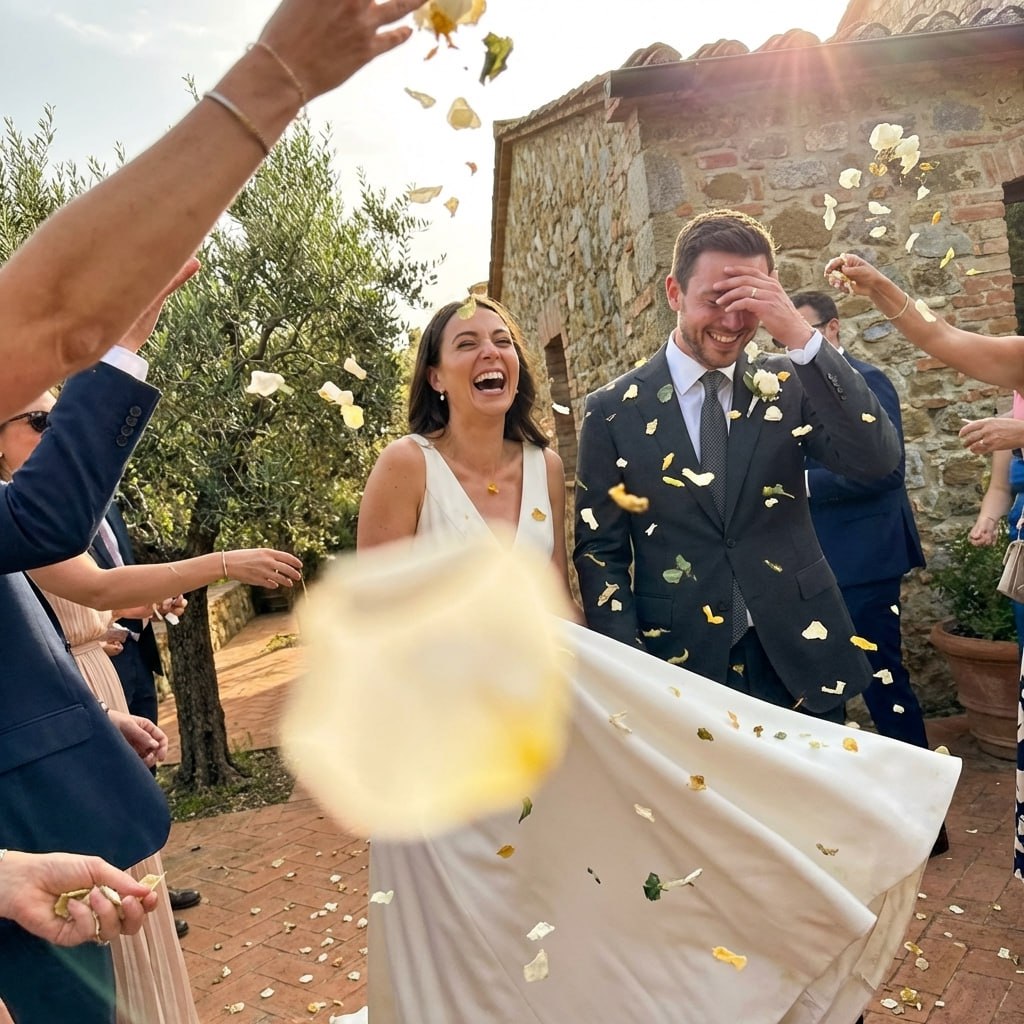
Reception candids
From Aunt Karen!
The Hardest Part Is Collecting Enough Photos
You know the count. Now you need the photos. A Pix Wedding QR album lets every guest upload their candid shots in one tap, straight to your shared album, no app download needed.
From the whole crew
Scan to join the album
No app, no account
UPLOADING
Saving your moment
THE ALBUM
Emma & Jack
June 21, 2026
647 photos · 95 guests

SCAN TO TRY
pix.wedding/
your-wedding
The photos, and the slideshow itself, in one place
Pix Wedding does not just collect the raw material for your slideshow, it can run the show too. A live slideshow plays guest uploads on a TV or projector in real time, photo missions nudge guests toward the shot types you are missing, and AI selfie search finds every photo a specific person appears in when you are editing down to your final count.
Every plan, including free
Free tier collects 20 guest uploads with no cardQR code to browser upload
Guests scan one code and the upload page opens in their phone browser. No app to install, no account to create, any phone and any OS.
Original quality photos and videos
Files land at full resolution with no compression, so the album is usable for printing later.
Unlimited guests on paid plans
The price never changes with headcount, whether 40 people show up or 400.
Starter, $49 one-time
3 months of uploads, 6 months of storageFilm roll mode
Give each guest a set number of shots, from 1 to 100, and keep the album hidden until your reveal time. The disposable camera feeling, without the plastic cameras.
Full album ZIP download
Download every original file in one archive and keep your own backup.
QR code templates
Ready-made QR designs for table cards and signs, so the code does not look like a parking ticket.
Standard, $59 one-time
6 months of uploads, 1 year of storageLive slideshow
Guest photos appear on the projector or TV during the reception, as a single photo or a collage.
Audio guestbook
Guests leave a voice message next to their photo, which beats a book of rushed handwriting.
Photo missions and leaderboard
Set shot challenges for guests and show the leaderboard on the slideshow, so people keep shooting all night.
Up to 6 sub-albums and a photographer link
Split the ceremony, reception and after-party, and give your photographer their own upload link into a dedicated sub-album.
Pro, $89 one-time
1 year of uploads, 2 years of storageAI selfie search
A guest takes a selfie and gets every photo they appear in, including the ones other guests took.
Multiple admins
Hand moderation to a sibling or the planner instead of doing it all yourself.
Priority support and a custom domain
Faster answers before the day, plus your own domain on the album link.
6 Slideshow Mistakes That Ruin the Moment
Most bad slideshows fail in predictable ways. Knowing the mistakes in advance means you can sidestep them before you start editing.
Too many similar photos
Three nearly identical shots from the same pose drain energy. Keep one winner per moment and cut the rest, no matter how hard it is.
Pacing that is too fast
Under 3 seconds per photo, viewers cannot register faces or context. The slideshow starts feeling like a blur rather than a tribute.
Pacing that is too slow
Over 8 seconds on a simple portrait, attention wanders. Reserve long holds for complex group shots or the absolute peak moments.
Only collecting from one person
The official photographer's gallery misses most of what happened in the room. Cousins, coworkers, and neighbors hold the candid shots on their own phones and never share them unless asked.
Skipping chronological order
Jumping between time periods without visual anchors disorients viewers. Even a simple title card between eras helps the audience track the story.
Low-resolution source files
Small scans can look pixelated on a projector. Check pixel dimensions against your display, or use original digital files when available. Preview the result at full screen.
How to Collect Enough Photos Fast
The math says you need 60-100 photos. The reality is that most people have five or ten good photos sitting on their phone from the event and no way to share them unless someone makes it dead easy. Here is the fastest modern approach.
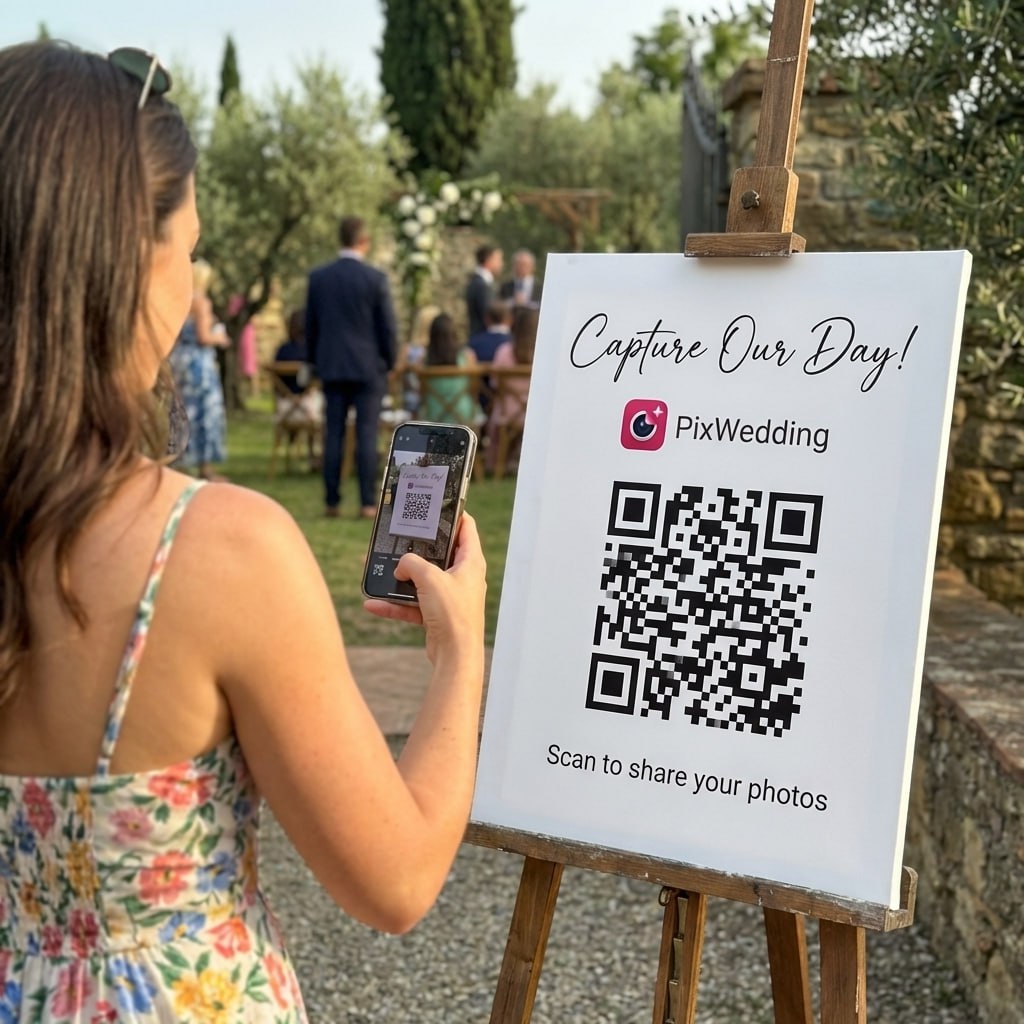
QR Album at the Event
Print a QR code on a sign, table card, or back of the program. Guests scan, tap Upload, and photos go directly to your shared album. This method brings in noticeably more photos than texting or emailing a link later, because people contribute while the moment is still fresh. On Pix Wedding, the same album on Standard ($59) or Pro ($89) can run a live slideshow on a TV or projector during the event, so guests see their own shots appear on screen and keep reaching for their phones.
Ask the Right People Directly
Identify 5-8 people who tend to take a lot of photos -- the social butterfly cousin, the friend who always has their camera out, the parent who documents everything. Send them a personal message with the album link. Personal requests convert far better than a mass group message that gets lost in a busy thread. On paid Pix plans you can also set photo missions ("get a shot with the head table", "find the flower girl mid-dance") with a leaderboard, which is a good way to steer casual guests toward the specific shot types your slideshow is short on.
Old Photos: Digitize Early
For events involving life retrospectives (funerals, milestone birthdays, retirements), physical prints are often the richest source. Start digitizing 4-6 weeks out. Borrow an album from parents or grandparents, scan at a resolution suitable for your display, and upload to the shared album. Give family members a deadline: photos by two weeks before the event.
Set a Hard Cutoff Date
Without a deadline, stragglers keep trickling in while you are trying to edit. Set a "last day to submit" that is 5-7 days before you need the finished slideshow. Communicate it clearly. After the cutoff, you edit what you have. Chasing late submissions after the fact delays the whole project.
Practical collection timeline for a wedding or milestone event:
- 8+ weeks out: decide on your target photo count using the formula above
- 6 weeks out: set up the shared QR album and print the QR code for signage
- 4 weeks out: borrow physical albums from family; begin scanning
- 2 weeks out: send personal requests to the 5-8 key photo contributors
- Day of event: place QR signs at venue entry, tables, and photo spots
- 1 week after: send one reminder to anyone who has not uploaded yet
- 2 weeks after: close the album for new submissions; start editing
Editing Down: How to Pick Your Best 60 Photos from 200
Once you have collected your raw photos, the real work is the edit. Most people keep too many. The golden rule is to keep the best 10-15% of what you gather. Here is a fast triage process that professional slideshow makers use.
First pass: flag the obvious winners
Go through every photo quickly and flag any that give you an immediate emotional reaction. Do not overthink. This pass should take about 30 minutes for 200 photos. You are looking for clear eyes, genuine expressions, and photos that tell a story without needing a caption.
Second pass: cut duplicates ruthlessly
Group near-identical shots and keep the single best one. If you have six shots from the same moment, keep one. This step usually removes a large chunk of your "flagged" pile. If your album is on Pix Wedding, AI selfie search can pull every photo one specific person appears in, which speeds up this pass a lot when you are trying to make sure everyone important is represented.
Third pass: check for chronological balance
Lay the remaining photos out in order. Are some decades or life phases over-represented? Do you have 40 childhood photos but only 5 from the last ten years? Balance the eras so no period dominates.
Fourth pass: check for variety in shot type
You want a mix of portraits (close-ups of faces), wide shots (groups, locations), and detail shots (the cake, the flowers, the hands). A slideshow of only head-on portraits gets monotonous. Aim for roughly 50% portraits, 30% group/wide, 20% detail.
Final gate: hit your target number exactly
If your formula says 60 photos for 5 minutes at 5 sec each, trim or add until you hit 60. Running over means your slideshow runs long. Running under means awkward padding. Precision here saves headaches in the editing software.
Slideshow Numbers at a Glance
Related Slideshow Guides
More answers to questions about slideshows, photo gathering, and memory-making.
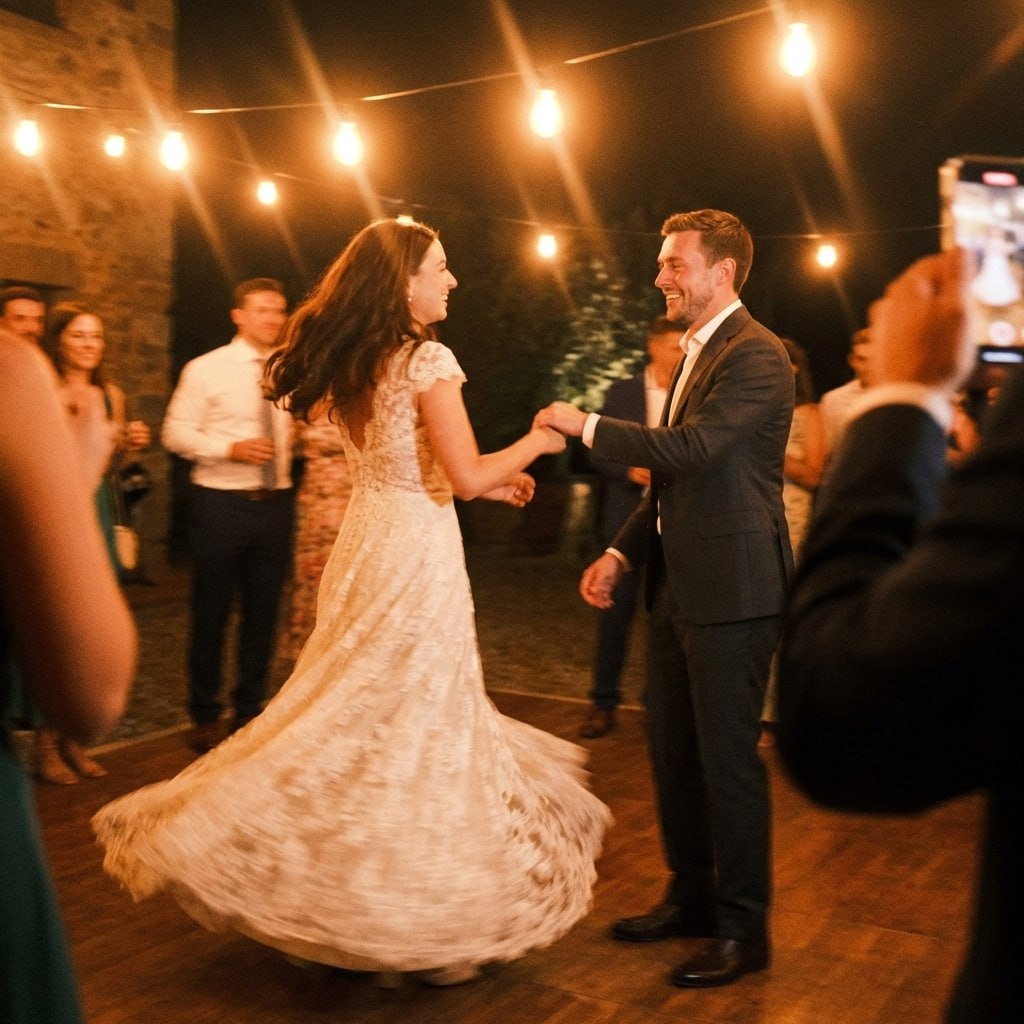
First dance
You guys!!
Get the photos before you build the slideshow.
Guests scan one QR code and upload from their phone browser, no app and no account. Start with 20 free guest uploads, no card.
From Mom
Scan to join the album
No app, no account
UPLOADING
Saving your moment
THE ALBUM
Emma & Jack
June 21, 2026
647 photos · 95 guests
SCAN TO TRY
pix.wedding/
your-wedding
Why the 10-12 Photos Per Minute Rule Works
Use 10-12 photos per minute (5-6 seconds each) as a starting rule of thumb. Preview the result with someone who knows the people pictured, then slow down group shots or speed up simple portraits as needed.
You can time photo changes to the music. At 120 beats per minute, each beat lasts half a second; in 4/4 time, four bars last eight seconds. Listen for a clear musical change instead of assuming every phrase has the same length.
For slideshows played on a loop at a reception or lobby display, the calculus changes slightly. Try a cycle around 8 minutes so late arrivals can see a substantial portion. At five seconds per photo, 96 photos take eight minutes before any separately added transition time.
- •Suggested event pace: 10-12 photos per minute (5-6 sec each)
- •Reflective mood (funerals, anniversaries): 8-10 photos per minute (6-7.5 sec each)
- •High-energy celebrations: 12-15 photos per minute (4-5 sec each)
- •Suggested reception loop: preview an 8-minute cut first
- •Aim for 3-5 seconds on simple portraits, 6-8 seconds on complex group shots
Common Slideshow Mistakes That Ruin the Experience
The most common mistake is starting with too many raw files and never editing down. People pull every phone photo from the last ten years and end up with 400 candidates. The slideshow ends up running 20 minutes with three nearly-identical shots of the same moment in a row. Audiences disengage fast when they sense repetition.
The second mistake is ignoring chronological flow. A slideshow that jumps randomly between decades is disorienting. Even if you mix eras for creative effect, anchor each section with a clear visual or musical shift so viewers know time has moved.
A third underrated mistake: collecting photos from only one or two people. The bride sees hundreds of phone photos from her photographer and bridal party but misses the candid shots her grandmother's neighbor took during cocktail hour. A QR-based shared album solves this by letting every person at the event contribute from their phone browser.
- •Too many photos: edit to the best 10-15% of what you have
- •Skipping chronological flow: anchor each era with a visual or musical beat
- •Relying on one source: collect from everyone, not just the official photographer
- •Identical aspect ratios throughout: mix portrait and landscape for visual rhythm
- •No music sync: time transitions to phrase boundaries, not random intervals
- •Scan prints at a resolution that produces enough pixels for your screen
Frequently Asked Questions About Slideshow Photo Counts
Everything you need to know about our free tools and how they help your wedding day.
The sweet spot is 10-12 photos per minute, which works out to 5-6 seconds per photo. This pace is slow enough for viewers to absorb each image but fast enough to maintain energy. For a reflective mood (funerals, anniversaries) drop to 8-10 photos per minute. For upbeat celebrations (graduations, birthdays) you can push to 12-15 per minute.
As a planning recommendation, start with 3-8 minutes. Wedding ceremony slideshows typically run 4-6 minutes; reception slideshows 8-12 minutes played on loop. Funeral tributes work best at 5-8 minutes. Graduation and birthday shows hit a sweet spot at 5-10 minutes. Preview longer cuts with your audience in mind, especially when the event format calls for a longer tribute.
Absolutely. A slideshow packed with 200 photos at 3 seconds each runs 10 minutes and can feel long for a seated audience. The bigger risk is repetition: similar poses, same background, same era. Edit ruthlessly. Keep the best 10-15% of your raw photos. A tight 60-photo slideshow that tells a clear story can be easier to follow than 150 repetitive photos.
Weddings (reception loop): 80-150 photos over 8-12 minutes. Weddings (ceremony entrance): 30-50 photos over 3-5 minutes. Funerals and memorials: 50-80 photos over 5-8 minutes. Graduations: 60-100 photos over 5-10 minutes. Birthdays and anniversaries: 40-80 photos over 4-8 minutes. Retirements: 50-80 photos over 5-8 minutes.
For most events, 4-6 seconds per photo hits the right balance. Simple portraits: 3-4 seconds. Group shots with multiple people to identify: 5-7 seconds. Milestone moments you want viewers to linger on: 6-8 seconds. If your slideshow software lets you set per-photo timing rather than a fixed interval, use it for the standout images.
The easiest method in 2026 is a shared photo album with a QR code. Print the QR code on a card or sign at the event (or mail it beforehand), and anyone can upload directly from their phone without downloading an app. Pix Wedding creates a dedicated QR album link instantly. This works especially well for weddings and milestone birthday parties where guests all have candid shots you would never see otherwise.