
How Many Photos for a Funeral Slideshow?
A clear, compassionate answer so you can focus on what matters most during a difficult time.
Gather family photosStart with 60 to 80 photos for a 5 to 8 minute slideshow.
At 5 to 6 seconds per photo, 60 photos fill 5 to 6 minutes, and 80 photos fill about 6.5 to 8 minutes. Confirm the available slot with the service coordinator. If you are working with a single song (3 to 4 minutes), aim for 30 to 48 photos. At 6 seconds each, 100 to 120 photos fill a 10 to 12 minute tribute.
The most common mistake families make is either gathering too few photos and stretching each slide awkwardly, or collecting hundreds of images and letting the slideshow run past 15 minutes while the room quietly disconnects. The tables below will help you land in the right range for your specific service.
Photo Count by Slideshow Length
The complete reference table
Use this table to find your target photo count based on how long the slideshow will run and how quickly you want slides to advance. A slower pace (5-6 seconds per photo) is more respectful and gives viewers time to recognize faces. A faster pace (3-4 seconds) works better for vibrant, celebratory slideshows at a celebration of life.
| Slideshow Length | 3 sec / photo | 4 sec / photo | 5 sec / photo | 6 sec / photo | 7 sec / photo |
|---|---|---|---|---|---|
| 2 minutes | 40 | 30 | 24 | 20 | 17 |
| 3 minutes | 60 | 45 | 36 | 30 | 26 |
| 4 minutes | 80 | 60 | 48 | 40 | 34 |
| 5 minutes | 100 | 75 | 60 | 50 | 43 |
| 6 minutes | 120 | 90 | 72 | 60 | 51 |
| 7 minutes | 140 | 105 | 84 | 70 | 60 |
| 8 minutes | 160 | 120 | 96 | 80 | 69 |
| 10 minutes | 200 | 150 | 120 | 100 | 86 |
| 12 minutes | 240 | 180 | 144 | 120 | 103 |
The pink column uses our suggested starting pace of 5 seconds per photo. Counts include photo time only and do not account for title/name slides or transition time.
Photo Count by Song Length
If you are matching the slideshow to specific songs
Many families build the slideshow around one or two meaningful songs rather than a set running time. Here is how many photos you need to fill common song lengths at two possible pacing speeds. These counts reserve 10 seconds for title and closing cards, then round down to whole photos.
| Song / Duration | 4 sec / photo | 5 sec / photo | Typical feel |
|---|---|---|---|
| Short pop or hymn (2:30) | 35 | 28 | Quick tribute, single moment |
| Standard song (3:30) | 50 | 40 | Single-song service tribute |
| Longer song (4:00) | 57 | 46 | Comfortable single-song slideshow |
| Two songs combined (7:00) | 102 | 82 | Full-length tribute |
| Three songs combined (10:30) | 155 | 124 | Extended celebration of life |
| Four songs combined (14:00) | 207 | 166 | Rarely recommended; breaks into chapters |
Family gathering
Memories shared
Need more photos? Let family share directly to you.
Once you know your target count, the work is gathering that many photos from people across the family. A shared QR album lets relatives upload from their phone in seconds, no app required.
From the family
Scan to join the album
No app, no account
UPLOADING
Saving your moment
THE ALBUM
Emma & Jack
June 21, 2026
647 photos · 95 guests

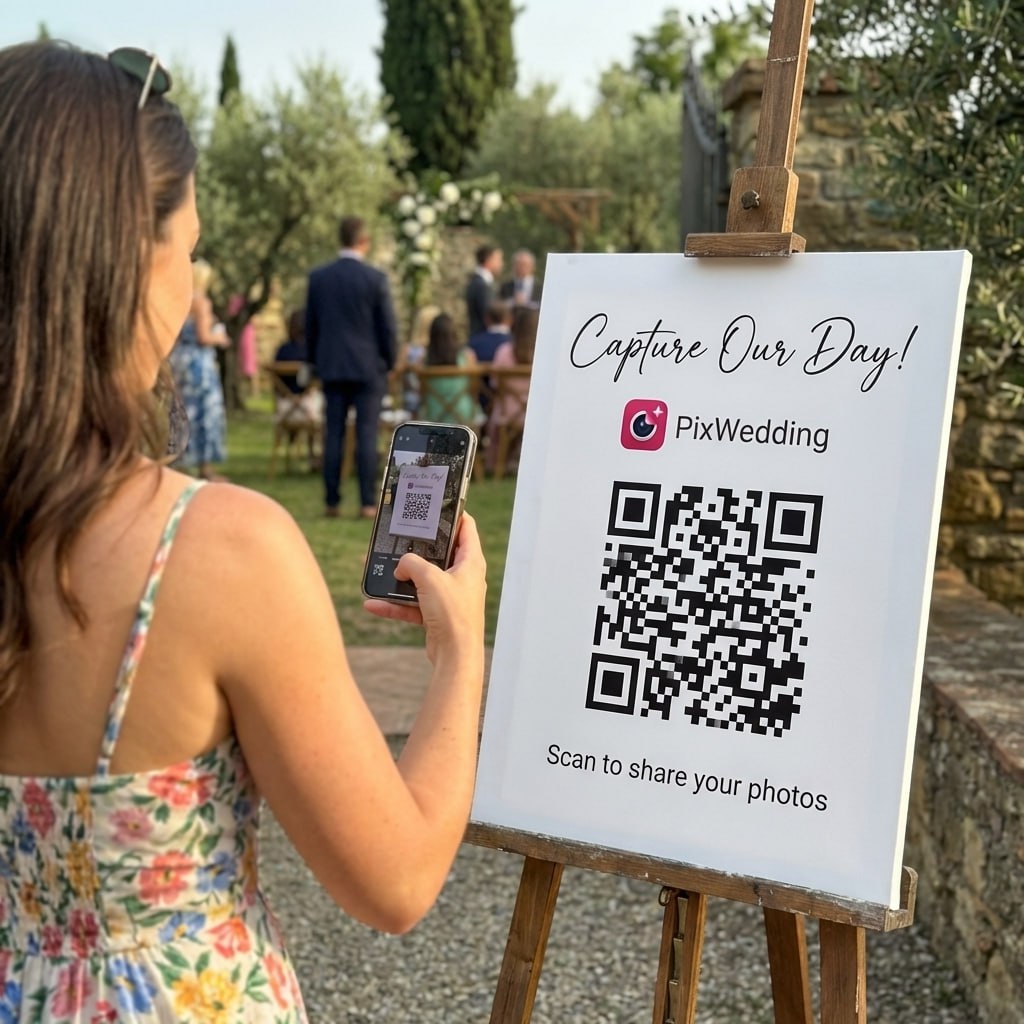

SCAN TO TRY
pix.wedding/
your-wedding
Give relatives one place to send photos
Share a memorial album link with family, then choose the photos you want in the tribute. Relatives can upload in their browser without an app or guest account. The free album includes 20 guest uploads, with no card required.
Set up memorial photo sharingFor printed photographs, Google PhotoScan combines several captures to reduce glare. Preview each scan before adding it.
How to Choose Your Target Count
A decision framework for the organizer
The right photo count depends on three things: how long the program allows for the slideshow, how many photos you can realistically gather, and the pacing that suits the tone of the service. Work through these questions in order.
How much time does the program allow?
Ask the funeral director or service coordinator for an exact slot. Ask whether 5 to 8 minutes fits the program. If no one has specified, plan for 5 to 6 minutes to be safe. A slideshow that overruns a service creates stress for everyone.
How many songs do you want to use?
One song keeps things simple and emotionally cohesive. Two songs work well if the person had distinct phases of life you want to honor separately. Three or more songs should only be used for a dedicated celebration of life event where the slideshow IS the centerpiece, not one part of a service.
How many photos do you currently have?
Take stock before committing to a length. If you have 35 well-curated photos, a single-song tribute will be more dignified than padding to 80 with duplicates or blurry shots. If you have 200 good photos, you can afford to be selective and build a richer timeline.
Who else can contribute photos?
Siblings, adult children, old friends, former colleagues, and neighbors often hold photos the immediate family has never seen. Reaching out even 24 to 48 hours before the service via a shared album can bring in photos you have not seen.
What tone should the pacing reflect?
A reflective, quiet service calls for 5 to 6 seconds per photo with slow transitions. A celebratory tribute for someone who lived with energy and humor can move at 4 seconds per photo without feeling rushed. Match the pacing to the music tempo and the mood you want.
What Mix of Photos to Include
How to balance portraits, mementos, places, and eras
A slideshow that is all portraits becomes monotonous. One that jumps between eras with no thread feels disjointed. This example divides a 75-photo slideshow into five groups; adjust the mix for your family.
Childhood and youth
15 photosSchool portraits, family holidays, early friendships. These often provoke the warmest reactions.
Young adult and milestones
15 photosGraduation, wedding, first home, early career. Photos that mark the shape of a life.
Family and relationships
25 photosParents, siblings, children, grandchildren, close friends. The people who defined their world.
Later years and recent favorites
15 photosRecent gatherings, holidays, quiet moments. These feel most immediate to those in the room.
Places, passions, and mementos
5 photosA beloved garden, a fishing spot, a handwritten letter, a well-worn tool. Objects that carry a person.
A note on ordering within eras
Within each era, a mix of portrait-style photos and candid shots works best. Avoid running five consecutive formal portraits in a row; pair each posed photo with a candid from the same period. Open with one strong recent portrait so people immediately see the person they are there to honor, then settle into the chronological journey, and close with another warm, recent image.
Common Mistakes to Avoid
What quietly undermines even a loving tribute
Too many photos from one era
If 60 of your 80 photos are from the last 10 years because that is what was easiest to find, the slideshow ignores most of a life. Make the effort to seek out older photos even if it means scanning prints or calling relatives who might have albums.
Using every photo you collected
Families often collect 150 photos and include all of them to avoid leaving anyone out. The result is a 12-minute slideshow that loses the room before the end. Edit ruthlessly. Showing 75 strong photos is more honoring than showing 150 including the blurry, poorly lit, or duplicative ones.
All formal portraits, no candids
Formal portraits are important but a slideshow made entirely of posed photos feels like a photo ID collection. Candid moments, laughing at a barbecue, working in the yard, asleep in a chair, show the person in everyday life.
Very low resolution or heavily filtered photos
Small screenshots can look blurred on a large projector screen. If you can get the original file from the person who took the photo, always use that. A blurry projection on a big screen is more distracting than a gap in the timeline.
No opening title or closing card
A title slide with the person's name and dates, and a final "Thank you for being here" card, frame the tribute and give the room a moment to settle in and out. These take 5 seconds each and cost nothing but make the slideshow feel complete.
Running too long without telling the service coordinator
If your slideshow runs 10 minutes but the service only allowed 6, the coordinator will either cut it mid-song or let it run and throw off every element that follows. Always confirm the exact slot, measure your finished slideshow against it, and communicate with whoever is running the service.
How to Gather Enough Photos Quickly
Practical steps when time is short and family is scattered
If the service is only a few days away, divide the photo search among relatives. Here is the fastest path from "I don't have enough photos" to a complete collection.
Start with one message to the whole family
Send a single group text or email with a specific request: "I need photos from before 1990. Please send anything you have by tonight." Specific time constraints and era requests get faster responses than open-ended "do you have any photos?"
Set up a shared QR album immediately
A shared photo album with a QR code link means relatives can contribute from their phone without emailing large files, without anyone needing an app, and without you having to chase individual attachments across a dozen text threads.
Reach out to non-family sources
Long-time friends, former colleagues, neighbors, members of clubs or faith communities, and former classmates often have photos the family has never seen. A quick post in a neighborhood group or alumni network can surface remarkable images within hours.
Scan what you find at home
A phone scanning app can digitize printed photos. Check each scan for glare and missing edges. Go through old albums, shoeboxes, and wallets before assuming you are out of material.
Check their phone camera roll
Ask whoever is authorized to manage the device whether family photos can be shared. Do not bypass account or device access controls.
When you genuinely cannot find enough photos
For older relatives or family members who avoided cameras, you may have only 25 to 35 usable photos. At 6 seconds each, those fill 2.5 to 3.5 minutes before title cards. You can slow the pacing to 6 seconds per photo, include a few photos of meaningful places or objects, and add a title and closing card. A shorter, genuine tribute is far better than a padded one filled with blurry or irrelevant images.
Timing the Slideshow to the Music
Getting the photos and the songs to end together
Few things feel worse in a slideshow than a song fading out on a black screen while 20 more photos remain, or the music looping awkwardly because the photos ran out first. Here is how to sync them cleanly.
Pick the songs first
Note the exact runtime of each song in minutes and seconds. This is your target length. Everything else is adjusted to fit it, not the other way around.
Do the math before selecting photos
Divide total song time in seconds by your seconds-per-photo. That is your photo count. Select exactly that many photos before you open the slideshow software.
Account for title and closing cards
A title card at the start and a closing card at the end each take about 5 seconds. Subtract 10 seconds from total song time before calculating your photo count.
Preview the finished slideshow
Always watch the complete finished slideshow from beginning to end before the service, ideally on the same screen or projector that will be used. Colors shift on different displays and timing can feel different at full size.
Build a memorial slideshow in Canva
Watch & Learn Tutorials walks through a funeral slideshow in Canva. Use your chosen photo count, then preview the full tribute before the service.
Related Memorial Guides
Keep collecting memories after the service
Leave the link with relatives who need more time to find old photographs. Save copies of the collection for the family before its storage window ends.
See the memorial photo albumFamily memories
Shared with love
Bring the family photos together
Start with 20 guest uploads free, no card required. Send relatives one link and choose the images for your tribute.
From the family
Scan to join the album
No app, no account
UPLOADING
Saving your moment
THE ALBUM
Emma & Jack
June 21, 2026
647 photos · 95 guests
SCAN TO TRY
pix.wedding/
your-wedding
Why Photo Count Matters More Than You Think
The number of photos in a memorial slideshow is not just a logistical detail. It shapes the entire emotional arc of the tribute. Too few photos and the slideshow feels rushed, like a summary rather than a life. Too many and viewers stop truly seeing each image; the faces blur together and the room goes numb.
The right count gives each photo room to land. At 60 to 80 photos for a 5 to 8 minute slideshow, there is enough variety to take a complete journey through a life while still letting each moment register with the people in the room.
Knowing the target number also makes the photo-gathering task concrete. Instead of asking family members to "send what they have," you can say "I need about 80 photos and I currently have 45. Can you look through your albums for the 1960s and 1970s?" A specific target turns a vague request into an actionable one.
How to Handle Photos You Find After the Slideshow
One of the most common experiences after a memorial service is family members coming forward with photos they did not know existed, or prints they found in a drawer weeks later. A shared digital album keeps these contributions alive even after the service is over.
Setting up a QR code album before the service means guests can continue adding photos during the reception and in the days that follow. The result is a living archive that grows into something far richer than the slideshow itself, a collection the family can download and keep. Save a local copy before the album storage window ends.
The photos that arrive late often turn out to be the most treasured: the candid shot a neighbor took at a birthday party in 1978, the work photo a colleague contributes at the reception. Building a channel for those contributions is one of the most practical things an organizer can do.
Funeral Slideshow: Frequently Asked Questions
Everything you need to know about our free tools and how they help your wedding day.
We recommend 60 to 80 photos at 5 to 6 seconds each. Sixty photos at 5 seconds fill 5 minutes; 80 at 6 seconds fill 8 minutes. Reserve extra time for title cards and video clips, or reduce the photo count to fit the service slot.
We recommend asking the service coordinator for a 5 to 8 minute slot. A single-song tribute (one song at 3-4 minutes) works well for simpler services. A full tribute can run 10 to 12 minutes if the program allows. Anything over 12 minutes tends to lose the room, no matter how meaningful the photos.
Start with five to six seconds per photo and preview the result. At 4 seconds, viewers can take in a portrait comfortably. Complex group photos or photos with captions benefit from 5-6 seconds. Give captioned images extra reading time and shorten the selection if the tribute exceeds your slot.
This is more common than most families expect, especially for older relatives or family members who disliked cameras. Options include: scanning printed photos with a phone, asking cousins and distant relatives via a shared QR album, including photos of meaningful places and objects (the garden, a favorite chair, a handwritten recipe), and slowing the timing to 5-6 seconds per slide to stretch what you have.
Chronological order is almost always best. Start with childhood photos, move through school years and early adulthood, then family milestones, career highlights, later years, and finally recent favorites. This arc lets viewers experience a whole life as a journey. You can open with one strong recent portrait and close with another, bookending the chronological middle.
Yes, short video clips can be powerful. Keep each clip to 10-20 seconds and use them sparingly, no more than 3-5 clips in a full-length slideshow. Make sure the audio level is balanced with your background music. Clips of the person laughing, speaking, or doing something they loved add a dimension that photos alone cannot.