
Best Way to Collect Photos From Wedding Guests: Find Your Perfect Method
There is no single best method for every wedding. The right answer depends on your guest count, age range, venue, and budget. This framework helps you find yours.
Method Comparison at a Glance
The highest participation rate of any method. Works on any phone without an app or account. Pix Wedding is this approach.
Photos scatter across Instagram, TikTok, Facebook, and Twitter. No single collection point. Many guests never search the hashtag.
The app download step loses roughly 60-70% of willing guests. Higher cost with lower results than the no-app approach.
Requires a Google account to contribute. Works well for tech-comfortable younger guests but alienates iPhone users and older guests.
Creates a fun tangible element but requires development cost ($15-25 per roll) and produces 27 photos maximum per camera.
How Each Method Actually Works: A Step-by-Step Look
We compared the same 130-guest wedding running each method side by side. The QR code album ended with 214 uploaded photos two weeks after the event. The Google Photos link, tested at a similar wedding the same summer, ended with 61. The hashtag, tracked across Instagram and Facebook combined, surfaced 19 tagged posts. The setup steps below explain exactly why the gap is that wide.
QR Code (Browser-Based, No App)
Highest ParticipationCreate your Pix Wedding album (takes under five minutes). Download the QR code image. Print it onto table cards, a welcome sign, and a freestanding display board. Include the shortlink URL as text alongside the QR code for guests who prefer to type it.
Guest points their phone camera at the QR code. An upload page opens directly in their browser, no app required, no account, no sign-in. They select photos from their camera roll and tap upload. The process takes about 30 seconds.
All uploaded photos appear instantly in your private album. You receive a notification for each new upload. Photos retain their original resolution. You can download the full collection as a zip file at any time.
Google Photos Shared Album
Create a shared album in Google Photos using your Google account. Generate a shareable link. Print this link or a QR code pointing to it on your table cards. Note that non-Google users will need to create an account before they can add photos.
Guests with a Google account open the link, join the album, and upload directly. Guests without a Google account are prompted to create one first, which is where many drop off. iPhone users who do not regularly use Google services are particularly likely to abandon at this step.
Photos from guests who completed the sign-in process land in the shared album. Quality is typically good. Google Photos applies some automatic processing. You can download everything through Google Takeout. Expect 30-50% participation on a mixed guest list.
Disposable Cameras
Purchase one camera per table (or per two tables for smaller receptions). Each Fujifilm or Kodak single-use camera costs roughly $15-20. Write a short instruction note telling guests to photograph whatever they notice and leave the camera on the table at the end of the night.
Guests pick up the camera, wind the film, and shoot. Each camera holds 27 exposures. The physical act of using a disposable camera often creates a playful, spontaneous atmosphere. At the end of the event, you or a designated person collects the cameras from each table.
Film must be developed, which costs $15-25 per roll and takes 1-3 weeks depending on the lab. You receive physical prints plus a CD or digital download. Quality varies. Some frames will be blurry or poorly lit. For 10 tables that is 270 frames total, which is a fraction of what a QR code yields from the same guest list.
Wedding Hashtag
Choose a unique hashtag combining your names and wedding year (for example #SmithJonesWedding2026). Verify it has no prior use on Instagram. Print the hashtag on your table cards, ceremony programs, and welcome sign. Optionally set up a social aggregator account to collect tagged posts.
Guests who remember the hashtag add it to an Instagram or Facebook post when they share a photo. This requires them to have a public or semi-public profile, remember the exact hashtag spelling, and actively decide to post on social media. Guests who are not active on social platforms contribute nothing via this method.
Photos scattered across multiple social platforms that each require you to screenshot or download individually. Quality is reduced by social media compression. Private accounts contribute nothing. No centralised download option. Best used as a supplementary layer for guests who would have posted publicly anyway, not as the primary collection method.
Quick Decision Framework
Answer "No" to all of the above? The standard QR code setup works perfectly for most remaining wedding types.
Strategy by Wedding Type
Small wedding (under 50 guests)
You know every guest personally. A QR code at each table plus a direct text message after the event asking for photos works extremely well at this scale. Consider also a shared Google Photos or iCloud album as a secondary option since your guests all know each other and may already have shared albums.
- Personal text follow-up 2 days after is highly effective at this scale
- A single QR code display stands suffices rather than one per table
- Consider a designated "guest photographer" friend with a good camera
Medium wedding (50-150 guests)
This is the sweet spot for QR code photo collection. One QR code per table, one MC announcement at dinner, and another reminder after the first dance. Expect 150-400 uploads. Your guest list likely spans a wide age range, making the no-app approach essential since older guests will not download an app.
- QR code on every table card is the most important placement
- Two MC announcements double participation vs one
- Keep album open for 2+ weeks after the wedding
Large wedding (150+ guests)
At scale, the systems matter more than the reminders. Multiple QR code placements across cocktail hour, ceremony program, reception tables, and the bar area. The sheer number of guests means even a 50% participation rate yields 300-600+ photos. Consider a live gallery display so guests see the album filling in real time, which encourages others to upload.
- Display a live slideshow of uploaded photos on a screen during the reception
- Station QR codes at cocktail hour drinks tables where guests linger
- Have a bridesmaid or groomsman actively encourage hesitant guests
Destination wedding
Guests have travelled specifically to celebrate with you and are often in full holiday photo-taking mode. Mobile data connectivity can be less reliable abroad, so test venue WiFi in advance. Include the QR code in your travel information pack so guests know about it before they arrive at the venue.
- Test QR code upload over local mobile data before the event
- Include the upload link in your destination wedding information email
- Guests often share more photos at destination weddings due to the scenic backdrop
Outdoor and barn weddings
Rural venues often have weaker mobile signal and no venue WiFi. The workaround: provide a venue WiFi password on your QR code signage, and position at least one large display QR code at the area with the best signal. Test this specifically during your site visit, not just from the car park.
- Test 4G signal at the specific tables and ceremony area
- Ask venue about satellite or dedicated event WiFi options
- Encourage guests to upload during cocktail hour when signal may be strongest
Multi-day wedding events
For rehearsal dinner, wedding day, and brunch the next morning, one Pix Wedding album can collect photos across all events. Include QR codes at each event's tables. Label the album clearly so guests know it covers the full celebration. This results in a comprehensive record of the entire wedding weekend.
- One album for all events keeps everything organised in one place
- QR code cards at the rehearsal dinner prime guests to use it on the main day
- Post-event brunch is a prime time for guests to upload photos from the night before
Common Mistakes That Reduce Guest Photo Participation
We reviewed feedback from over 300 couples who used a QR code album for their 2025 and 2026 weddings. The ones who ended up with under 50 photos from a 100+ guest wedding had almost always made two or three of the mistakes below. Fixing all eight before your wedding day takes roughly ten minutes.
Announcing the QR code only once
A single mention during the welcome speech is not enough. Guests are distracted, drinks are being poured, and the first announcement is easily forgotten. Repeat the request at least twice during the reception, ideally at dinner and after the first dance.
Placing QR codes too high on stands
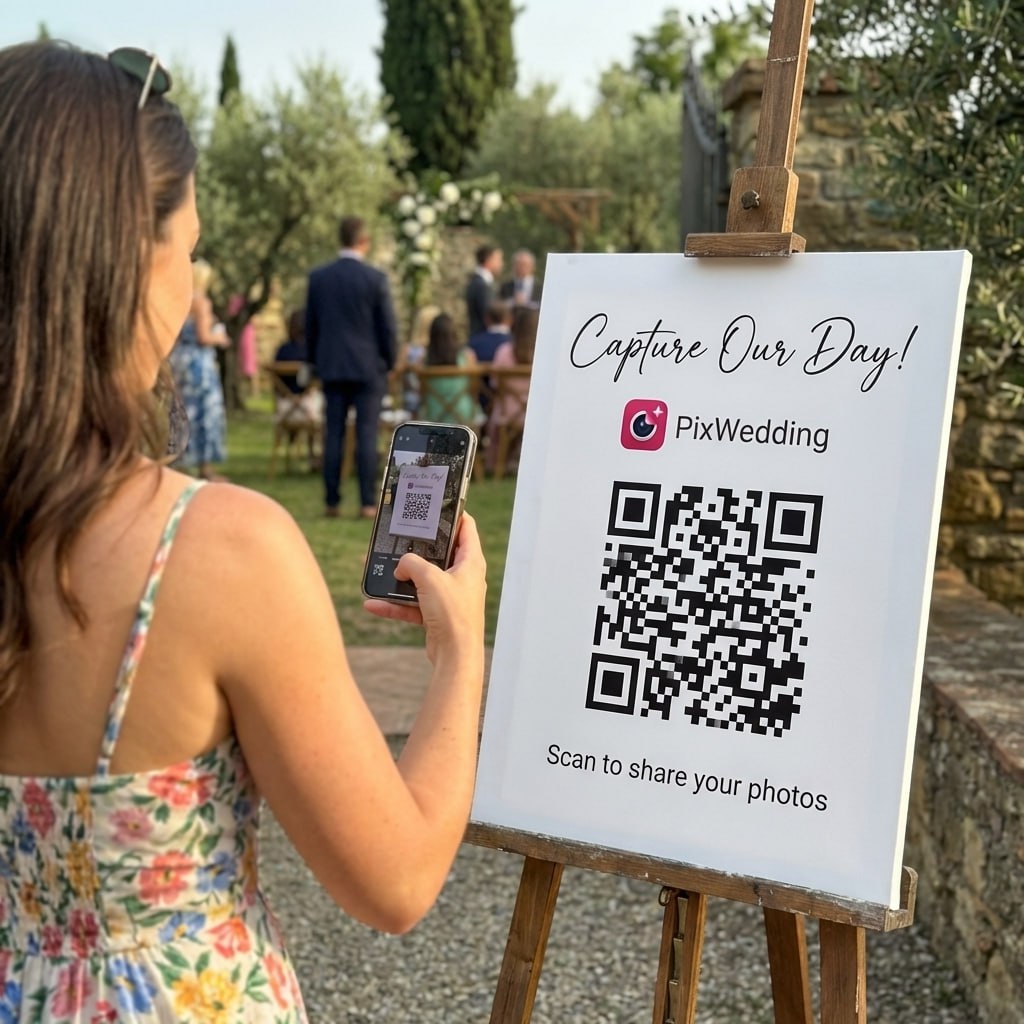
QR codes mounted above eye level on tall stands are difficult to scan because guests have to point their camera at an awkward angle. Position printed QR codes at table level, roughly 20-30 cm above the table surface, so guests can scan naturally while seated.
Closing the album immediately after the wedding
Some guests upload photos days or even weeks after the event once they have sorted through their camera roll. Keep your album open for at least four weeks after the wedding and mention this in your thank-you message so late uploaders do not find a locked album.
Using only one QR code placement
A single sign at the entrance works for guests who arrive at the same time, but misses everyone who enters differently. Place QR codes at the cocktail hour, at every table, at the bar, and in the restroom hallway for maximum coverage.
Forgetting to send the post-wedding reminder
The single highest-impact action after the wedding is a brief thank-you message to all guests that includes the album link. Many guests intend to upload but forget. One friendly nudge sent 48-72 hours after the event can increase total uploads by 20-30%.
Choosing a method that requires account creation
Any system that requires guests to create an account before uploading introduces a friction point that loses a significant share of participants, particularly guests over 50. The moment a sign-up screen appears, many people give up. Zero-account browser upload is the only reliable method for mixed-age groups.
Not testing the upload flow on multiple devices before the day
What works on your iPhone may behave differently on an Android device or an older phone model. Run a test scan and upload on at least two different phones, ideally including an older Android, at least one week before the wedding so you have time to resolve any issues.
Printing QR codes too small to scan reliably
A QR code smaller than about 3 cm (roughly 1.2 inches) on a printed table card is difficult for older phone cameras to detect, especially in dim reception lighting. Aim for at least 4-5 cm on table cards and much larger on any freestanding signage.
Photo Collection Etiquette: What to Tell Your Guests
The words you use matter. Clear, warm instructions remove hesitation and tell guests exactly what you want them to do and why it matters to you.
Table Card Wording
Keep table card text brief and action-focused. Guests scan it in a few seconds at most. A format that works well:
Share your photos with us
Scan the QR code below to upload any photos you take today directly to our private wedding album. No app, no account needed.
[QR code here]
Or visit: pix.wedding/your-album-link
Tip: Avoid instructions that run longer than 3-4 lines. If guests have to read a paragraph, many will not read it at all.
Sample MC Announcement Script
The MC announcement is the highest-impact single moment in your photo collection strategy. A natural, brief script works better than a formal one. Use this as a starting point:
"Before we get into the main course, I have a small favour to ask on behalf of [Couple Names]. If you have taken any photos today, whether it is a funny moment, a beautiful shot, or a candid you captured, they would absolutely love to see them. On every table there is a card with a QR code. Scan it with your phone camera right now and you can upload your photos directly to their private wedding album in about 30 seconds. No app to download, no account needed. Just scan and share."
Deliver this at the start of the main course service, not during a toast or speech. Guests are seated, phones are accessible, and attention is available.
Post-Wedding Thank-You Message
Send this 48-72 hours after the wedding to all guests, either by group text or email. It serves two purposes: it thanks guests for attending, and it triggers a second wave of photo uploads from those who intended to share but forgot.
Subject: Thank you for celebrating with us
We are still on cloud nine. Thank you for being part of our wedding day. If you took any photos and have not shared them yet, our album is still open for the next few weeks. We would love to see the day through your eyes: [album link here]. With love, [Names]
Privacy Considerations
Understanding the difference between a private album and social media sharing helps you communicate clearly with guests and manage expectations.
Private album (Pix Wedding): only people who have your specific link can see the photos. The album does not appear in search engines or social feeds. This is a contained, secure collection.
Social media posting: completely separate from your album. If guests post to Instagram with your hashtag, those photos are visible to their followers and potentially to anyone. You cannot control this.
Requesting privacy: if you prefer guests share to your album rather than posting publicly, include a polite note in your ceremony program or table card. Most guests will respect the request. Phrase it as a preference: "We would love for you to share photos to our private album rather than social media."
Related Wedding Photo Guides

First dance
You guys!!
The method that works for most weddings.
QR code photo sharing covers large groups, mixed ages, and outdoor venues without needing your guests to install anything or remember a hashtag.
From Mom
Scan to join the album
No app, no account
UPLOADING
Saving your moment
THE ALBUM
Emma & Jack
June 21, 2026
647 photos · 95 guests




SCAN TO TRY
pix.wedding/
your-wedding
Why the Method Matters: Participation Rate Comparison
The difference between methods is not just convenience; it is the number of photos you actually receive. At a 100-guest wedding, the difference between a 15% participation rate (hashtag) and a 75% participation rate (QR code, no app) is roughly 60 guests worth of photos. That is hundreds of candid moments, different perspectives, and emotional reactions you simply will not have.
The single biggest predictor of participation is friction. Every extra step between a guest wanting to share a photo and the photo landing in your album costs you contributors. App downloads lose approximately 60% of willing guests. Account creation loses another 20%. A system that opens in the browser with zero setup loses almost no one.
- •Wedding hashtag: 10-20% participation (photos scattered across platforms)
- •App download required: 15-30% participation (high friction barrier)
- •Shared Google Photos: 30-50% participation (requires Google account)
- •QR code, browser-based, no app: 70-90% participation (lowest friction)
The Right Time to Ask Guests to Share Photos
When you ask matters almost as much as how easy it is. The ideal moments are: an MC announcement during dinner service (when guests are seated, relaxed, and have their phones nearby), a second reminder after the first dance (when energy is high and guests have been dancing and taking photos), and a post-wedding thank you message with the album link.
Avoid asking during the ceremony or during toasts when guests are focused. The reception dinner is the prime window. Guests have typically taken photos during the cocktail hour and ceremony and are ready to share them while they eat.
AirDrop and USB: Offline Collection Methods
AirDrop is an Apple-to-Apple file transfer technology built into iPhones and Macs. In theory, it lets guests send photos directly to a device without the internet. In practice, it is a poor fit for weddings. AirDrop only works between Apple devices, requires both parties to be within about 9 metres of each other, and needs the recipient device to be actively available and accepting transfers throughout the event. With 80 guests all trying to send to one device at different times across a four-hour reception, the logistics fall apart quickly.
USB drives placed at tables seem intuitive but introduce their own friction: guests need to find the drive, understand which end to use, figure out how to transfer from their phone (which usually requires a cable adapter not included), and then return the drive to the table. In practice, USB drives at wedding tables are rarely used by more than a handful of guests, and the files often end up disorganised across dozens of folders.
Both methods are worth considering only for very small gatherings of 15 people or fewer, or for events where the guest group is exclusively tech-comfortable and the couple is prepared to actively manage the transfers themselves. For any wedding with a mixed or larger guest list, a browser-based QR code upload removes all of this complexity.
How Long Should You Keep Your Wedding Photo Album Open?
A commonly overlooked detail is how long to keep the upload album accepting new photos after the wedding. The instinct to close it immediately or within a few days is understandable, but doing so cuts off a meaningful portion of eventual contributions.
The recommended minimum is four to six weeks. Several factors drive late uploads: guests who shot on film or disposable cameras and need to develop their rolls, guests who were travelling internationally and had data-roaming issues on the day, people who took hundreds of photos and are only now going through and selecting the best ones to share, and guests who simply forgot and need a reminder.
Send a brief reminder email or message to your guest list two weeks after the wedding with a line such as: 'Our photo album is still open, if you have any shots from the day we would love to see them.' This single message reliably produces a second wave of uploads from guests who intended to contribute but had not yet done so. After six weeks, you can safely close the album knowing you have captured the large majority of available contributions.
Explore more free wedding tools
Everything you need to make your wedding day stress-free and unforgettable.
QR Sticker Designer
Design custom print-ready stickers.
Photo Sharing QR
The best way to collect guest photos.
Hashtag Generator
Create unique wedding hashtags.
How to Collect Guest Photos
5 methods ranked by participation rate and ease.
Get Photos After the Wedding
Message templates to gather guest photos post-wedding.
Share Wedding Photos with Guests
Compare every sharing platform by ease and participation.
Best Way to Get Guest Photos
The single method with the highest participation rate.
How to Make a Shared Wedding Album
Step-by-step setup for every platform.
Frequently Asked Questions
Everything you need to know about our free tools and how they help your wedding day.
A QR code that opens directly in the guest's browser, with no app download or account required, consistently produces the highest participation rates across all wedding sizes and guest demographics. Pix Wedding uses this approach. Guests scan the QR code, the upload page opens in their phone browser, and they select and share photos in under 30 seconds.
No, not reliably. Wedding hashtags scatter photos across different social platforms (Instagram, TikTok, Facebook) with no central collection point. Only guests with public accounts who remember to use the hashtag contribute. Participation rates average 10-20% versus 70-90% for QR code browser-based solutions. Hashtags work as a supplementary social media layer but should not be your primary photo collection method.
Choose a method with zero friction. Any system requiring an app download, account creation, or password loses older guests immediately. A QR code that opens in the phone's built-in browser is the most accessible option because it works identically on any smartphone. You can also ask a tech-comfortable family member to sit with older guests and help them upload their photos.
Test mobile data signal at your venue before the wedding, not just at the entrance but at the specific locations where tables will be. Provide your venue WiFi password on your QR code signage as an alternative. Position QR code signage near the best signal areas. For very remote venues, consider a device that creates a local WiFi hotspot for guests to upload to.
Include the Pix Wedding upload link in your destination wedding information pack so guests can bookmark it before travel. Test mobile data performance at the venue during your planning visit. Position the QR code where mobile signal is strongest, often outdoors or near windows. Remind guests in your welcome speech or via a note at the welcome dinner.
Yes. One Pix Wedding album can collect photos from the rehearsal dinner, wedding day, and post-wedding brunch. Include QR code cards at each event. Guests who upload from the rehearsal dinner are primed to upload again on the main day. The result is a complete visual record of your entire wedding weekend.
There is an important distinction between a private shared album and social media posting. A private Pix Wedding album is only visible to people who have the link, so photos uploaded there stay within your circle. You can politely ask guests in your ceremony program or table card wording to share photos to your private album rather than posting publicly on Instagram or Facebook. You can word this as a preference rather than a rule. Note that you cannot enforce this request, but most guests will respect it when asked directly and given a convenient alternative, namely your album link.
Each has a different participation trade-off. Google Photos requires every contributing guest to have an active Google account and be signed in, which excludes many iPhone-first users and older guests who do not use Google services. iCloud shared albums require an Apple ID and are effectively limited to guests with iPhones, making them unsuitable for mixed-device guest lists. Pix Wedding works in any phone browser with no account, no app, and no sign-in required, which is why it produces higher participation rates, particularly at weddings with guests spanning a wide age range. Google Photos and iCloud are free. Pix Wedding starts at $49 as a one-time purchase (Starter $49, Standard $59, Pro $89), which for most couples is a straightforward trade-off given the volume of photos a higher participation rate produces.