
Marathon Spectator Photo Ideas: 12 Tips to Get Every Shot
The best marathon spectator photos come from knowing where to stand, when to start bursting, and how to capture the recognition moment when your runner spots your face in the crowd. And the real trick? Pooling everyone's shots into one shared gallery so the runner gets every angle from every mile, not just what one person managed to capture.
Quick Answer
The top marathon spectator photo ideas: position yourself at miles 1-2 for the first shot, use burst mode for every pass, find a hill for natural chin-up portraits, shout the runner's name to get the recognition moment, and get to the finish line 20 minutes early. For sharing, create one shared gallery before the race, distribute the link to your whole cheering squad, and everyone uploads their shots -- so the runner gets the complete story, not just what one phone captured.
12 Marathon Spectator Photo Ideas (With How-To for Each)
These are not generic tips. Each idea below comes with the specific setup, timing, and positioning that actually produces a keeper frame.
The Approach Shot
Start bursting when the runner is 50 feet away, not 5. The approach frames show anticipation and determination before they register your face.
The Recognition Moment
Shout their name as they enter your frame. The instant they spot you -- head turn, eyes wide, smile breaking -- is the single best frame of the day.
The Finish-Line Leap
Position yourself at the barrier to the side of center. Start bursting when they hit 30 feet out. Arms raised and chip crossing the pad is the hero shot.
The Reunion Hug
Keep shooting after the finish. The post-race hug is often the most emotional frame of the entire day. Do not put the phone down when they cross.
The Cheer Video
Record 15-30 seconds of your whole squad yelling. Pan slowly. The runner loves watching this back more than any still photo.
The Hill Top
Find a hill on the course and wait at the top. Runners lift their chins when they crest -- you get a natural portrait without them looking down at their feet.
The Sign Interaction
Hold your sign at shoulder height and shoot horizontally so both the runner and the sign appear in the same frame. This context makes the photo a keepsake.
The Mile Marker Frame
Stand near a mile marker or landmark so the background gives geographic context. "Mile 20, still smiling" is a far better caption than a featureless road.
Burst Mode Everything
Hold the shutter for 3-4 seconds per pass. Delete 90% later. You only need one sharp frame but you will not know which one until you review at home.
The Squad Shot
Get a photo of your whole cheering group before the runner arrives. The runner loves seeing the team that showed up for them, even in the shots they are not in.
The Watch Shot
If the runner checks their watch or Garmin as they pass, capture it. That split-second of focus and data-checking tells the whole athletic story in one frame.
The High-Five Hand-Off
Stage a high-five and start bursting 2 seconds before they reach you. The moment of contact -- hands meeting, runner grinning mid-stride -- is pure race-day gold.
Best Spots on the Course for Spectator Photography
Where you stand determines more than any camera setting. Use this as your pre-race planning reference.
| Location | Crowd | Light | Best Shot | Pro Tip |
|---|---|---|---|---|
| Miles 1-2 | Thick | Good (usually morning) | Energy shot, nervous smiles, early determination | Arrive 30 min early for barrier spot |
| Mile 10 (half-race) | Moderate | Bright midday | Settled pace, real expression starting to show | Great for recognizable, unobstructed face shots |
| Mile 18-20 (the wall) | Sparse | Variable | Raw determination, the defining frames | Loudest cheering here matters most -- make it count |
| Any course hill | Thin | Open sky | Dramatic silhouettes, chin-up stride | Top of hill is better than the bottom |
| Finish line | Very thick | Usually great | Chip crossing, arms up, finish-line leap | Arrive 20 min early, take barrier left or right of center |
| Post-finish chute | Controlled | Good | Foil blanket, medal, reunion hug | The medal-placement moment is always emotional |
Pro move: split your cheering squad so each person covers a different spot. One at mile 2, one at mile 18, two at the finish. You get the complete race story instead of a single location.
Finish line
You did it!
Pool Every Spectator's Shots Into One Gallery
Create a shared race-day gallery before the event, share the link with your whole cheering squad, and the runner gets every angle from every mile -- in one place, free.
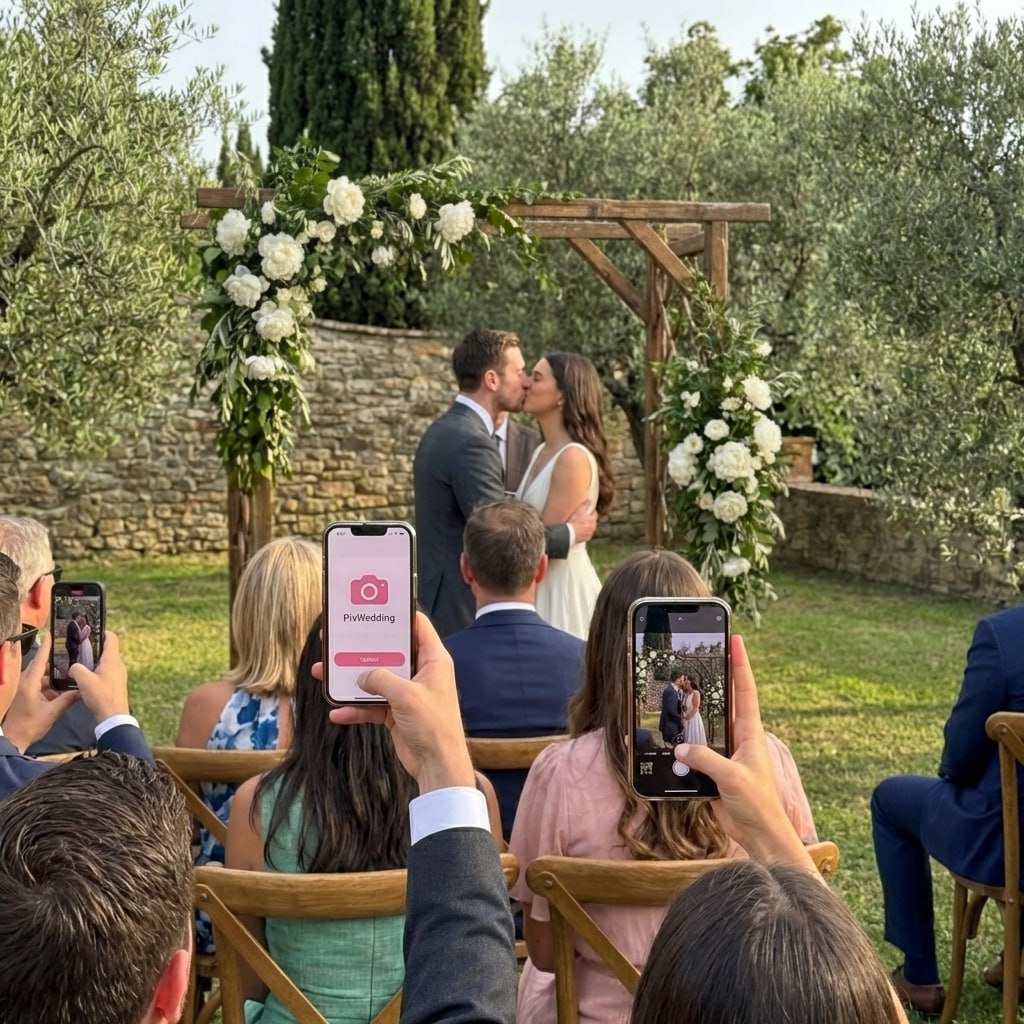
From the squad
Scan to join the album
No app, no account
UPLOADING
Saving your moment
THE ALBUM
Emma & Jack
June 21, 2026
647 photos · 95 guests

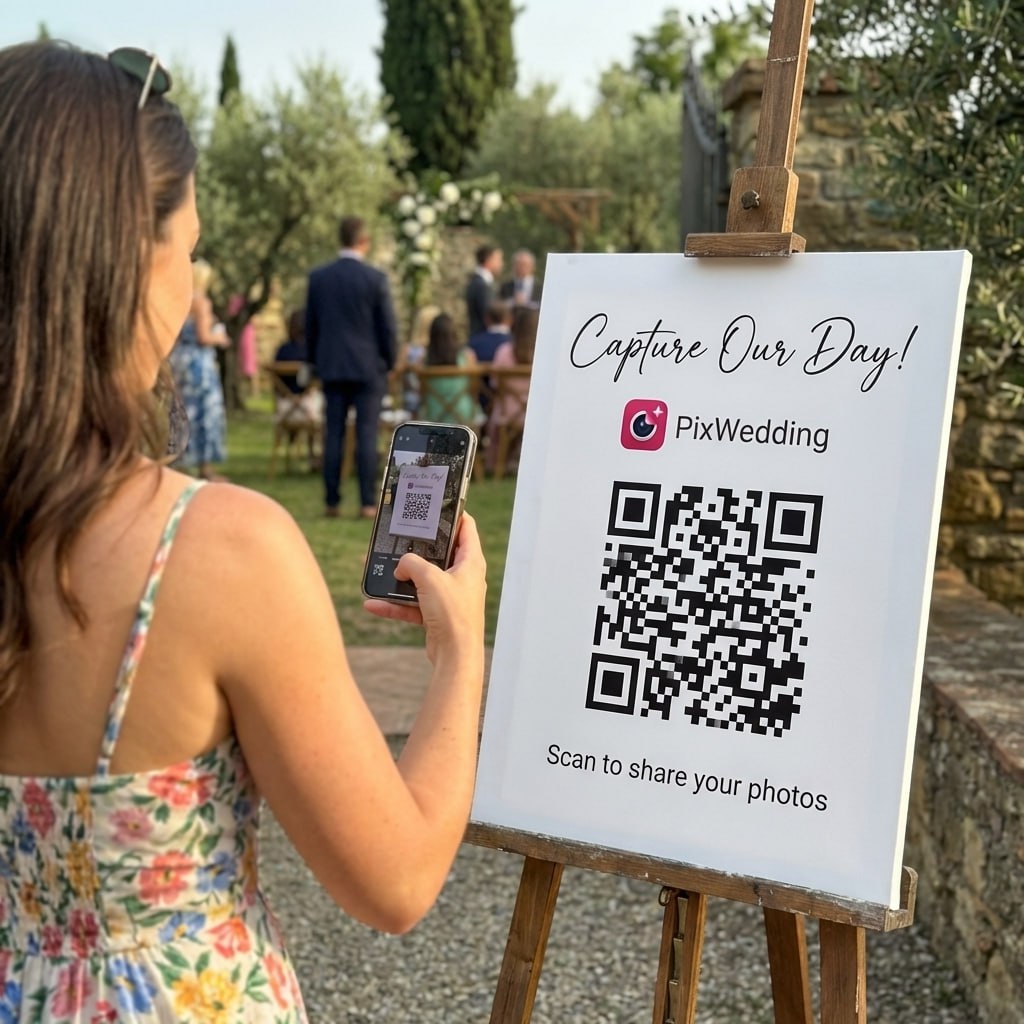
SCAN TO TRY
pix.wedding/
your-wedding
Phone Settings to Enable Before Race Morning
These six settings are the difference between blurry, dark frames and the photos you will actually print. Set them up the night before so you are not fumbling in the crowd.
Burst Mode
Hold the shutter button (iOS) or press volume-down held (Android). Fire for 3-4 seconds per pass.
Disable Live Photos
Live Photos eat storage and give blurry motion layers. Turn off before you leave home -- Settings > Camera.
Turn Off Flash
Outdoor race photography needs no flash, and it causes runners to flinch mid-stride. Auto-flash off.
2x or 3x Optical Zoom
Use optical zoom only. Digital pinch-zoom degrades sharpness on a moving subject instantly.
Action / Sport Mode
iPhone 15 Action Button, Pixel 8 Sports Scene -- enable if your phone has it. Increases shutter speed automatically.
Lock Exposure + Focus
Tap and hold on a runner in the frame to lock AE/AF before the subject arrives. Re-lock if the lighting changes.
Cheering Sign Ideas That Look Great in Photos
A great sign doubles as a photo prop. The runner sees it mid-race and you capture both the sign and their reaction. Here is what actually works.
Signs That Work
- 01"Run like [rival sports team] is chasing you" -- works for every city, always gets a grin
- 02"Worst parade ever" -- dry humor lands mid-race when brains are tired
- 03Their name in huge letters with one word underneath -- e.g. "SARAH. GO." Simple, screenshottable
- 04An inside joke only they will get -- the double-take they do when they read it is the photo moment
- 05"You trained for this mile" with the mile number -- personal, motivational, and true
- 06A photo of them on the sign -- print their training selfie on a poster board. Mind-bending and hilarious
Sign Photo Technique
- AHold the sign at shoulder height, not overhead -- keeps your face visible and sign readable in the same frame
- BUse rigid foam-core board (not floppy poster board) so the sign stays flat in wind and photographs cleanly
- CBlack text on neon yellow is the most readable in motion photography -- higher contrast than any other combination
- DAvoid glitter: it reflects unpredictably and creates lens flare in outdoor shots
- EHave a second person photograph the runner reading your sign -- you cannot hold a sign and shoot at the same time without blur
Real Examples: When Spectator Photos Win
These two stories show exactly why unofficial spectator shots matter more than official race photos.
Claire and the Mile 20 Shot
Claire was running her first marathon and her family drove four hours to cheer. Her sister positioned herself at mile 20 -- known as "the wall" -- and started bursting 50 feet out. The frame she got: Claire looking directly at the camera, jaw set, tears on her cheeks, and a fist pump beginning. It is now printed as a large canvas in her apartment. The official race photographer's shot, taken at the finish, cost $45 and sits unseen in a digital library.
The Six-Person Squad That Got Every Mile
For a big-city marathon, Marcus's team of six split up across the course: miles 2, 10, 18, 23, and the finish (two people there). They all used the same shared gallery link. By the time Marcus got his medal, 340 photos and six videos were already uploaded. He reviewed the whole race from start to finish on the train home. His favorite frame: mile 18, looking utterly broken but still moving. He never would have seen that shot if it lived only in someone else's camera roll.
How to Share Your Spectator Photos With the Runner
The biggest waste in race-day spectator photography is photos that never reach the runner. Here is the five-step process that fixes this completely.
Create the gallery before race morning
Set up a shared race-day gallery at pix.wedding/race-day-photo-sharing. Takes two minutes. Give it the runner's name and race date.
Share the link with your whole squad
Drop the gallery link in the group chat the night before the race. Everyone on the cheering team has it ready to upload from their phone.
Everyone uploads as they shoot
Each squad member uploads their shots to the same gallery throughout the race -- mile 8 photos, finish-line bursts, reunion hugs, all in one place.
Share the link with the runner at the finish
Once they have their medal and foil blanket, hand them the gallery link. They get every angle, every cheering-squad shot, every mile -- in one tap.
Download and keep the best
The runner downloads their favourites in full resolution. No hunting through six different text threads. The whole race story is already assembled.
Video Tips: Capturing the Runner on the Move
Stills are great, but video captures things that photos cannot: the sound of the crowd, your team screaming their name, the exact moment they spotted you. A 20-second clip is often the first thing the runner watches back.
Shoot Landscape Always
Horizontal video is usable on every platform and screen. Vertical video from a race looks like a selfie by accident. Rotate your phone before the runner arrives.
Start 10 Seconds Early
Runners arrive slightly before you expect. Hit record 10 seconds before your estimated pass time or you will capture only the back of the bib.
Pan Slowly as They Pass
Follow the runner smoothly left to right rather than staying still and watching them blur through the frame in two seconds. Keep them centered.
Shout Their Name On Camera
The head-turn when they spot you is the best video frame you will ever get. Yell their name the moment they enter the frame so the reaction is recorded.
Keep Clips Under 30 Seconds
Short clips upload faster, share more easily, and the runner actually watches them. A 30-second clip from mile 18 beats a 4-minute continuous recording every time.
Upload to the Shared Gallery Immediately
Upload your video clips directly to the shared race-day gallery from your phone. The runner can watch them on the train home rather than waiting for you to AirDrop a week later.
The 7 Spectator Photo Mistakes That Kill the Shot
Most bad race photos come from a handful of predictable errors. Here is what to avoid and why.
Waiting until they are 5 feet away to start bursting
Start your burst at 50 feet. The approach frames are often better than the close-up.
Standing dead-center at the finish line
Position left or right of center. You get a diagonal angle, see the runner's face, and avoid other spectators' heads.
Using digital zoom instead of optical zoom
Pinch-zoom is pixel interpolation. Use the 2x or 3x physical lens only.
Putting the phone down after they cross the finish
The reunion hug and medal photo happen in the next 90 seconds. Keep shooting.
Having everyone stand together in the same spot
Split your squad across different mile markers so you get the whole race story.
Letting photos live in one person's camera roll
Set up a shared gallery before the race so everyone uploads their shots as they go.
Leaving Live Photos on
Live Photos slow the buffer and give blurry motion frames. Turn off before the race.
Related Race Day Guides
Why Spectator Photos Matter More Than Official Race Photos
Official marathon photographers are good at their job, but they are positioned at fixed points -- usually the start, the finish, and one or two branded mile markers. They shoot thousands of runners and their images go into a paid library the runner has to search through by bib number days later.
Spectator photos are different. They are taken by people who know the runner, who are screaming their name, who captured the exact moment their eyes lit up seeing a familiar face. That emotional context does not exist in a stock finish-line image from a race photographer.
The problem is that spectator photos are scattered. Six people in your cheering squad all took pictures at mile 10, but they live in six different camera rolls. The runner never sees most of them. Pooling those shots into a shared gallery solves this immediately and gives the runner a complete visual story of their day.
- •Official race photos cost $30-60 each -- spectator shots are free
- •Personal photos capture emotional moments (spotting a sign, high-fiving a friend) that race photographers miss
- •Cheering-squad shots show the full course story, not just start and finish
- •Shared galleries let the runner relive every mile, not just the last 200 meters
Gear Checklist for Race-Day Spectator Photography
You do not need a DSLR. Modern phones shoot sports-capable burst sequences that will capture even a fast runner clearly, as long as you know which settings to flip on before race morning.
Physical preparation matters as much as camera settings. A fully charged phone, a portable battery pack, and comfortable shoes for moving between spots are the non-negotiables. If you plan to photograph at multiple mile markers, map your route the night before using the official course map.
- •Fully charged phone (bring a battery pack for events longer than 2 hours)
- •Burst mode enabled before you leave home
- •Race app or live-tracking app downloaded and set up
- •Printed or screenshot course map showing spectator zones
- •Bright, simple cheering sign on rigid board
- •Comfortable footwear if moving between spots
- •A shared gallery link ready to distribute to your whole squad
- •Portable phone mount or grip for steadier shots in crowds
Marathon Spectator Photo FAQ
Everything you need to know about our free tools and how they help your wedding day.
Miles 1-2 are the sweet spot for your first shot: runners are still fresh, the pack has thinned slightly, and the energy is high. Miles 10-13 (mid-race) show real determination on their faces. The finish line is a must, but get there 15-20 minutes early to claim a front spot at the barrier. If the course has a hill, plant yourself at the top -- that is where runners lift their chins and look straight at the crowd, which makes for a dramatic, natural portrait.
Turn on burst mode (hold the shutter or use volume-down on iPhone). Set exposure manually: bright outdoor race days need a slightly underexposed tap so the runner does not blow out. Turn off Live Photos on iPhone -- they eat storage and the motion frames are usually blurry. Use 2x or 3x optical zoom instead of pinching in digitally. If your phone has a Sport or Action mode (Pixel 8, iPhone 15 Action Button), activate it. Shoot in HEIC or JPEG rather than ProRAW for faster buffer clearing between bursts.
Track the runner via the race app or live results and start watching when they hit the 0.2-mile mark. Stand at the finish-line barrier to the right or left of center rather than dead-on -- the angle is more dramatic and you avoid the back of other spectators' heads. Start bursting when they are about 30 feet out. The best frames are usually just before the chip pad: they are looking up, arms often raised, mouth open in relief or joy. Capture three to five seconds of burst and you will have at least one keeper.
The easiest method is a shared race-day gallery where every spectator uploads their shots in one place. Create a gallery on Pix Wedding's race-day photo sharing page before the event, share the link with your whole cheering squad, and everyone drops their photos in after the race. The runner gets every angle -- from mile 8 to the finish -- in a single download, rather than hunting through texts and group chats for days afterward.
Short text (five words max) in high-contrast colors -- black on neon yellow is the most readable in motion photography. Hold it at shoulder height so it appears in the frame above your hands without covering your face. Funny or personal messages land best: inside jokes, the runner's nickname, or a phrase tied to their training ("You trained for this mile"). Avoid glitter, which reflects unpredictably in photos, and poster board that flops in wind. A rigid foam-core board stays flat and legible in every shot.
Shoot landscape (horizontal) so the video is usable on any screen. Start recording 10 seconds before you expect them to pass -- runners always arrive slightly sooner than you think. Pan smoothly from left to right as they go by rather than standing still and letting them zip through the frame in two seconds. Shout their name right as they enter your frame: the head-turn reaction when they spot you is the shot every runner loves to watch back. Keep clips to 15-30 seconds for easy sharing and upload.