
How Do Race Organizers Share Photos With Runners?
Most events run two tracks in parallel: a bib-tagged pro photography service for official finisher shots, and a free QR gallery for candid and spectator photos. Here is how the full operations workflow fits together, and how to decide which system your race actually needs.
The Short Answer
Large marathons contract a dedicated race photography company -- MarathonFoto, Pic2Go, Jolyy, or FinisherPix -- that uses automated bib-recognition software to sort every image by the number on each runner's bib, then emails each runner a personalized gallery link within 24-72 hours of the finish. Runners can browse their shots and purchase downloads or prints.
Alongside or instead of that pro layer, smart organizers also run a free shared gallery accessed by a QR code printed on every bib, on finish-line banners, and distributed in the results email. This gallery collects photos from every spectator, pacer, and volunteer with a smartphone, covering all the candid moments no paid photographer can reach. Small races (under 500 runners) often skip the pro vendor entirely and run the QR gallery alone -- it costs nothing and often produces more total photos per runner than the commercial service.
The Official Bib-Tagged Photography Ecosystem
The commercial race photography market is dominated by a handful of specialists. Each brings different strengths in terms of coverage geography, technology, and pricing model. Here is how they compare.
| Vendor | Best For | Bib Tagging | Turnaround | Model |
|---|---|---|---|---|
| MarathonFoto | Large US marathons and half-marathons with established commercial photo sales | Yes, automated OCR + manual review | 24-72 hours | Pay-per-photo with bundled download packages |
| Pic2Go | International events, triathlon series, obstacle races | Yes, advanced AI bib recognition | 12-48 hours | Per-event fee or revenue share |
| Jolyy | European races, cycling events, multi-sport | Yes, facial + bib recognition | 6-24 hours | SaaS per-event pricing |
| FinisherPix | Triathlons, iron-distance events, running expos | Yes, multi-sport bib and race-number variants | 24-48 hours | Per-photo and package bundles |
| Free QR Gallery (e.g. Pix) | Any race size, spectator + candid coverage, community 5Ks | No (crowd-sourced upload by bib or name) | Immediate (live during race) | Free for basic use |
Vendor information is for general comparison. Confirm current pricing and coverage directly with each vendor before contracting.
Race Size Decision Tree: What Setup Do You Need?
The right photo-sharing system depends primarily on participant count, whether photo sales are part of your revenue model, and how much volunteer bandwidth you have. Use this as a starting point.
Skip the pro vendor. Print the gallery QR on bibs and one finish-line banner. One volunteer with a DSLR at the finish chute is enough.
A community gallery covers candid shots. If budget allows, hire one pro photographer for 2 hours at the finish. Bib-tag their shots manually in Lightroom.
At this scale a pro vendor pays for itself through photo sales. Run the community QR gallery in parallel for spectator coverage. Embed both in results page.
Contract a dedicated vendor (MarathonFoto, Pic2Go, Jolyy). Run a community gallery for the volunteer and spectator layer. Integrate both into your event app and results platform.

Finish line moment
Mile 26.2!
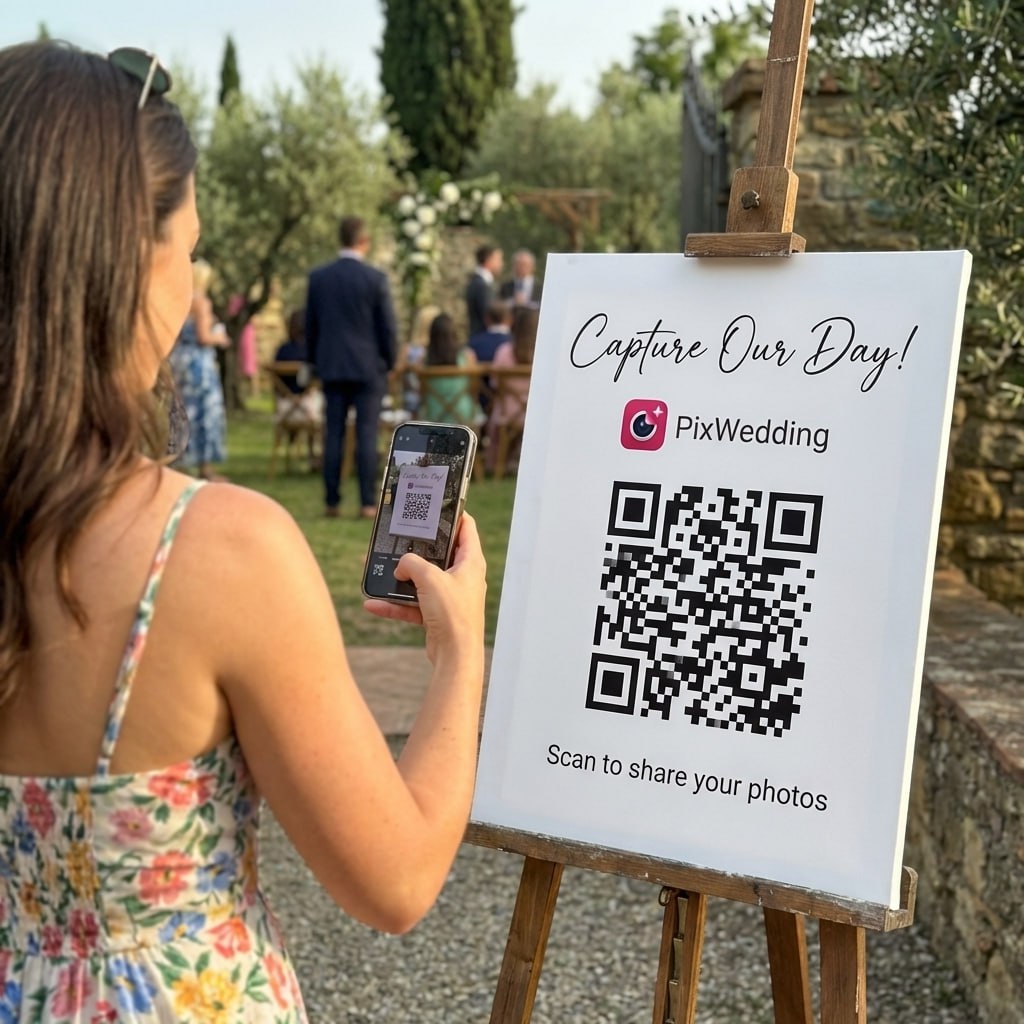
Set Up Your Race Gallery in 2 Minutes
Generate a QR code, print it on your bibs and banners, and let every runner and spectator contribute photos from the moment the gun goes off.
Race day
Scan to join the album
No app, no account
UPLOADING
Saving your moment
THE ALBUM
Emma & Jack
June 21, 2026
647 photos · 95 guests



SCAN TO TRY
pix.wedding/
your-wedding
The Full Organizer Workflow: Pre-Race to Post-Race
Photo sharing is not a day-of afterthought. The setup decisions made weeks before the race determine whether runners actually find and share their photos. Here is the complete operational timeline.
Pre-Race Setup (4-6 Weeks Out)
- Decide on vendor track, community track, or hybrid
- Contract pro photography vendor if using one
- Generate gallery QR code and test it on multiple phones
- Add QR code to bib design file before printing
- Design finish-line banner with QR code at scan height (120-160 cm)
- Brief timing company to include gallery link in results output
- Prepare gallery link for race app and confirmation emails
Race Morning (Day-Of Logistics)
- Verify finish-line banner QR codes are scannable from three meters
- Brief medal-table volunteers on verbal QR prompt script
- Confirm pro photographer arrival and camera positions
- Post QR code signs at spectator hotspots: mile 1, halfway, mile 20, finish
- Push gallery link to race app and social channels at gun time
- Have a volunteer at packet pickup scanning QR to confirm it works
During the Race (Live Gallery Management)
- Monitor community gallery for inappropriate uploads (most platforms auto-moderate)
- Reshare notable uploads to your social channels in real time
- Capture finish-line atmosphere shots for your own gallery use
- Confirm pro photographer is shooting through the final finisher wave
- Have a volunteer post the gallery link in runner Facebook groups and Slack channels
Post-Race Distribution (Day 1-3)
- Embed gallery link in the results page immediately after timing closes
- Send results+gallery combined notification within two hours of finish
- Send 24-hour teaser email if using pro vendor (include 3-5 sample shots)
- Post to social channels tagging your sponsor photographers
- Send 48-hour reminder to community gallery contributors asking for uploads
- Deliver full pro gallery link to runners at 48-72 hours
Long-Tail Engagement (Week 1-4)
- Day 7: discount reminder email for pro photo purchases
- Day 14: spotlight best community gallery photos in social post
- Day 30: final purchase reminder before archive
- Save best photos for next year's race marketing assets
- Survey runners on photo experience to improve next cycle
Where to Place the QR Code: A Placement Guide
The QR code on your race bib is the highest-reach placement you have, but it is not the only one. Each location reaches runners and spectators at a different moment in the race-day experience.
| Placement | Audience | Scan Timing | Notes | Priority |
|---|---|---|---|---|
| Race Bib (below bib number) | Every registered runner | Before, during, after race | Highest-reach placement. Runners always have it on their body. | |
| Finish-Line Arch / Banner | All finishers + spectators | At and just after finish | Place at 120-160 cm height. Scan distance up to 3 m. High-intent moment. | |
| Medal Distribution Table | All finishers | Immediately post-finish | Volunteer verbal prompt dramatically increases scan rate. | |
| Race Results Page / Email | All registered runners | 1-24 hours after race | Highest digital reach. Link form works better than QR image here. | |
| Mile Markers (20, 13.1 for marathons) | Runners + spectators at those points | During race | Best at spectator-heavy spots. Hard to scan while running. | |
| Water Station Signage | Runners walking through aid | During race | Participants slow down here; scan rate is higher than mid-course. | |
| Race App (push notification) | App-registered runners | Gun time + post-race | Reaches tech-savvy segment. Send at gun time and at finish. | |
| Packet Pickup Area | Early packet pickup runners | 1-2 days before race | Good for pre-race awareness. Low-stakes environment for scanning. | |
| Post-Race Food / Recovery Area | All finishers gathering | Within 30 min of finish | Runners are resting and on their phones. Print on food tent signage. |
Volunteer Briefing: Scripts and Placement Guide
The gallery QR is passive. Volunteer verbal prompts at the right moment are what actually drive scan rates. A 90-second photo briefing in your pre-race volunteer meeting, combined with a printed script card, can double gallery visits. Here is what each role should say and where to position them.
Finish-Line Volunteers
Script
"Great job finishing! Scan the QR code on your bib -- or the banner right there -- to see your race photos and add your own."
Point at the banner. Demonstrate on your own phone if needed. Have a printed backup card with the gallery URL in case QR is not scanning.
Medal Table Volunteers
Script
"Here is your medal! Your race photos are live -- scan the code on the back of your bib to find them."
Medal handoff is the natural pause moment. Do not rush the prompt. Smile and congratulate first.
Water Station Volunteers
Script
"Water or sports drink? Your race photos are being collected live at the QR on those signs!"
Quick mention only -- do not slow down aid. Point at the nearest QR sign.
Packet Pickup Staff
Script
"Your bib has a QR code at the bottom -- that is your photo gallery link. Scan it during or after the race to see all the photos."
Pre-race briefing sets expectations. Runners who know about the gallery upload more photos during the race.
Social Media Volunteer
Script
(On race day social posts): "Spectators -- upload your finish-line shots to our community gallery! Link in bio and on every banner at the course."
Post reminders every 30-45 minutes during the race window. Tag local running clubs.
8 Race Photo Sharing Pitfalls (and How to Fix Them)
These are the most common mistakes that leave runners frustrated and photos undiscovered. Most are avoidable with a single checklist item in your production schedule.
QR code too small on the bib
Scanners fail from more than 20 cm away. Runners never find the gallery.
Minimum 2.5 x 2.5 cm QR at 300 DPI on bib. Test with five different phones in varied lighting before printing.
Gallery link sent only in a separate email two days later
Open rates for delayed photo emails drop below 30%. You miss peak engagement at the finish-line high.
Embed the gallery link directly in the results notification that fires within two hours of finish.
Relying on bib-tag recognition alone for small events
Bib recognition requires clear bib visibility in frame. Sweaty, folded, or partially covered bibs get missed. Runners who never see a photo stay frustrated.
For events under 1,000, supplement with a community gallery so spectator photos fill the coverage gaps.
No volunteer briefing on photo sharing
Volunteers cannot answer runner questions about photos, and the QR prompt never happens verbally.
Add a 90-second photo-sharing briefing to the pre-race volunteer meeting. Distribute the printed script card.
Finish-line QR banner placed above 1.8 m height
Runners cannot angle phones upward fast enough after a sprint finish. Scan rate drops sharply.
Place primary scannable QR at 120-160 cm height. Large decorative version above is fine but not the primary scan target.
Single gallery link for multiple race distances
Runners find photos mixed from a different race category. Creates confusion and dilutes search by bib number.
Generate a separate gallery per distance or wave. Differentiate QR codes by race category on the bib.
No moderation policy on the community gallery
Occasional inappropriate uploads go unnoticed until a runner complains publicly.
Use a platform with auto-moderation and a report function. Designate one volunteer to spot-check uploads every 30 minutes during race day.
Promising photos that are never delivered
Trust damage that follows the race brand online for months.
Set explicit timelines in pre-race communications: "Official finisher photos: 48-72 hours. Community gallery: live now." Under-promise, over-deliver.
Big Race vs. Small Race: How the Operations Differ
The fundamental goal is the same -- get every runner's photos to them quickly -- but the operational scale is completely different. Here is how the execution changes across race sizes.
Large Marathon
- 10-20 photographers on course with coordinated positions
- Automated bib OCR processing tens of thousands of images
- Dedicated results integration team wires gallery to timing provider
- Multiple email deployment waves (24h, 48h, 7d, 30d)
- Sponsor overlays on official photos contracted months in advance
- Race-day operations center with real-time upload monitoring
- Community gallery for spectators runs separately from official vendor feed
- Social listening team monitors hashtag and reposts top runner photos
Small Community Race
- 1-2 volunteer photographers with consumer DSLRs
- QR code gallery on bib, finish banner, and medal table sign
- Gallery link sent in results text or email within 1 hour
- Single social post pointing to gallery, pinned at race social accounts
- No bib-tagging software -- runners browse by time/name or self-tag
- All candid photos from family, friends, and spectators live in the same gallery
- Race director manually shares gallery link in runner Facebook group
- Zero vendor contracts, zero revenue share, zero setup fees
Related Race Photo Guides
The Two-Track System: Official Photos vs. Community Gallery
Every successful race photography operation runs on two parallel tracks that serve different goals. The first track is the official pro-photographer track: a contracted vendor stations cameras at the start, key mile markers, and the finish chute, shoots tens of thousands of frames, and delivers personalized galleries keyed to each runner's bib number within one to three days. Revenue from photo sales, sponsor overlays, and high-resolution downloads fund the vendor's operation. This is the model MarathonFoto built into a nationwide business and what Pic2Go and Jolyy have scaled internationally.
The second track is the community gallery: a free, open upload link shared via QR code, email, and social media before and during the race. Every spectator, pacer, volunteer, and aid-station worker becomes a contributor. This gallery fills in all the gaps the pro team cannot cover: the candid pre-race warm-up, the mid-course grind at mile 18, the spontaneous celebration after the finish, and the family photos that no vendor photographer is positioned to capture. The two tracks are complementary, not competing, and smart organizers run both.
Small races with fewer than 500 participants often skip the pro vendor track entirely and run community-gallery-only operations. The economics make sense: a pro photo vendor typically charges a per-head setup fee or takes a percentage of photo sales, and participation rates at a 200-person 5K are rarely high enough to cover costs. A free gallery with a QR code on each bib costs nothing and typically generates more photos per runner than a pro service at the same scale.
- •Pro bib-tagged vendor: best for events over 1,000 runners where finisher-photo sales revenue is a business goal
- •Community QR gallery: works at any race size, fills candid coverage gaps the pro team misses
- •Hybrid model: official vendor for finisher shots, QR gallery for everything else
- •Community-only model: ideal for community 5Ks, charity runs, and trail series
After the Race: Distribution, Email Cadence, and Long-Tail Engagement
The moment results go live is the peak engagement window for photo distribution. Runners checking their chip time will click a gallery link if it is one tap away. Race directors who embed the gallery link directly in the results page -- not just in a separate email -- see two to three times higher photo gallery visit rates than those who send a standalone email the next day. Build the link into the confirmation text or push notification if you have an event app.
Email cadence for official photo galleries from pro vendors typically looks like this: a teaser email 24 hours after the race with three to five sample photos, a full gallery notification at 48 to 72 hours, a discount reminder at seven days, and a final sale reminder at 30 days before photos are archived. Community galleries do not need a sales sequence but benefit from a single reminder email at 48 hours asking runners to upload and share any photos they took, which extends the gallery's growth window.
Social media integration matters more than most organizers realize. A race-specific hashtag tied to the community gallery lets you pull in public posts automatically and redirects organic social traffic toward your hosted gallery rather than scattering it across Instagram, Facebook, and X. Some gallery platforms support auto-ingestion of hashtagged public posts, which is worth enabling if your runner base is active on Instagram.
- •Embed gallery link in the results page for maximum click-through at peak engagement
- •Pro vendor teaser email within 24 hours keeps purchase intent warm
- •Community gallery reminder at 48 hours extends upload window
- •Hashtag integration consolidates social content into the official gallery
- •Archive policy: communicate clearly how long photos are hosted before deletion
Race Photo Sharing: Organizer FAQ
Everything you need to know about our free tools and how they help your wedding day.
Large marathons partner with a dedicated race photography company such as MarathonFoto, Pic2Go, or FinisherPix. These vendors station multiple photographers at the finish line and key mile markers, then use automated bib recognition software to sort every shot by the bib number visible in the frame. Runners receive an email within 24 to 72 hours containing a personalized gallery link. Some events also embed the gallery link inside the official results page so runners find their photos the moment they look up their finish time.
Not necessarily. For races under 500 participants, a single skilled volunteer with a DSLR or mirrorless camera at the finish chute, combined with a free shared gallery where spectators can upload their own shots, often produces better coverage than a costly pro vendor. The shared gallery approach lets every smartphone in the crowd contribute, which typically yields more candid and on-course photos than a single camera position can. Reserve the professional bib-tagging service for events where finisher-photo revenue, sponsor branding on images, or official medal-ceremony shots are part of the business model.
Bib-number tagging is a process where computer vision software reads the number printed on a runner's race bib in each photo and attaches that number as a metadata tag. When a runner searches the gallery by their bib number, the system instantly surfaces every photo where their bib was readable. Most pro race photography vendors (MarathonFoto, Pic2Go, Jolyy) handle this automatically. For DIY setups, some organizers use Lightroom face-tagging workflows or Google Photos search, though these require more manual effort and are less reliable at finish-line speeds.
Yes. A QR-code-based shared gallery lets every participant and spectator upload photos directly from their phone, creating a crowd-sourced album the whole field can view and download at no cost. Tools like Pix let you generate a race-specific gallery link, wrap it in a QR code, and print that code on bibs, finish-line banners, and race-result emails. The gallery fills up in real time during the race rather than waiting days for a pro vendor to process files. This is the preferred approach for community 5Ks, trail series, charity runs, and any event where selling finisher photos is not the goal.
The highest-yield placements are: (1) printed directly on the race bib below or beside the number, so runners always carry the link; (2) on the finish-line arch or a large banner just past the timing mat where finishers can scan while catching their breath; (3) at the medal distribution table, where volunteers hand out medals and can verbally prompt scanning; (4) in the race-results email or text message that goes out within the hour; and (5) at water stations and mile markers for longer events where spectators gather. A QR in the race app, if you have one, reaches the most tech-savvy segment. Avoid tiny QR prints on signage placed farther than three meters from foot traffic.
Modern shared galleries support video uploads alongside photos. Spectators routinely capture slow-motion finish-line clips, cheering crowds, and highlight moments that photos miss entirely. For larger races with a dedicated videography partner, the video workflow mirrors the photo workflow: the vendor delivers an event highlight reel and individual runner clips keyed to bib number, while the shared gallery collects all the raw spectator footage. Some events use the spectator gallery exclusively for video to keep the official photo gallery clean for image search by bib number.